Why Tesla's Battery Strategy Matters in 2026
Tesla has quietly built one of the most diverse battery supply chains in the EV industry. Depending on the model and trim you buy, a new Tesla in 2026 could ship with a lithium iron phosphate (LFP) pack, a nickel-manganese-cobalt (NMC) pack, or a nickel-cobalt-aluminum (NCA) pack — each with fundamentally different characteristics for range, longevity, charging behavior, and cost. Understanding these differences is the single most important factor in predicting how your Tesla's battery will age over 100,000+ miles.
This guide breaks down exactly what's inside Tesla's lithium batteries, how much capacity they lose over time, what the warranty actually covers, and what a replacement would cost if you ever need one.
Tesla's Battery Chemistries: LFP vs NMC vs NCA
Tesla currently uses three primary lithium-ion chemistries across its lineup. The choice isn't random — it's driven by vehicle positioning, cost targets, and performance requirements.
| Attribute | LFP (LiFePO4) | NMC (Nickel-Manganese-Cobalt) | NCA (Nickel-Cobalt-Aluminum) |
|---|---|---|---|
| Energy Density | Lower (~160 Wh/kg cell-level) | Higher (~250 Wh/kg cell-level) | Highest (~260+ Wh/kg cell-level) |
| Used In (2026) | Model 3 RWD, Model Y RWD | Model 3/Y Long Range (some markets) | Model S, Model X, Cybertruck (4680 cells) |
| Cycle Life | 3,000–5,000+ cycles | 1,500–2,500 cycles | 1,000–2,000 cycles |
| Cold-Weather Performance | Weaker (slower charging, more range loss below 32°F) | Better cold tolerance | Better cold tolerance |
| Recommended Daily SoC | 100% (charge to full regularly) | 80% daily, 100% for trips | 80% daily, 100% for trips |
| Cost per kWh | Lower (no cobalt/nickel) | Higher (cobalt/nickel exposure) | Highest (complex manufacturing) |
| Thermal Stability | Excellent (very resistant to thermal runaway) | Good | Good |
| Typical Pack Size (Usable) | ~57.5 kWh (Model 3 RWD) | ~75 kWh (Model 3 LR) | ~95 kWh (Model S); ~123 kWh (Cybertruck) |
What This Means for Buyers
If you're choosing a Tesla primarily for daily commuting and want the longest-lasting pack with the least maintenance anxiety, the LFP-equipped Model 3 RWD or Model Y RWD is the strongest choice. You can charge to 100% every night without guilt, and the cycle-life data suggests these packs can outlast the vehicle itself.
If you need maximum range (320+ miles EPA) and frequently drive in cold climates, the NMC or NCA Long Range variants deliver higher energy density — but you'll want to follow the 80% daily charge guideline to minimize degradation.
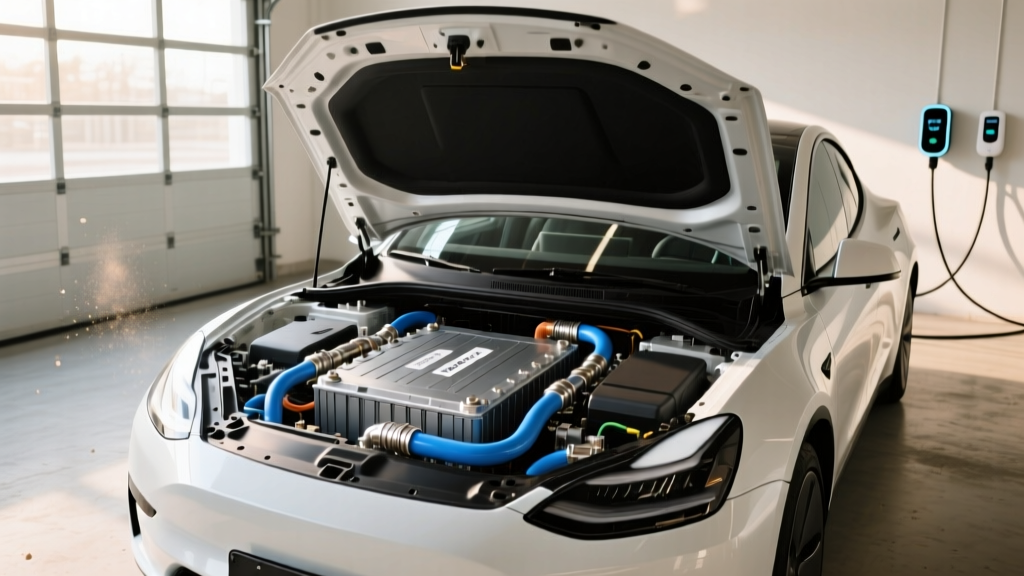
Tesla's 4680-format NCA cells, produced at Giga Texas, power the Cybertruck and some Model Y variants. These structural battery packs integrate cells into the vehicle chassis, reducing weight and improving rigidity but making individual module replacement more complex.
Real-World Degradation: What the Data Actually Shows
Tesla publishes fleet degradation data in its annual Impact Report, and independent sources like Recurrent Auto track thousands of vehicles. The picture is consistently reassuring — but not uniform.
| Mileage | Average Capacity Retained | Notes |
|---|---|---|
| 0–30,000 miles | ~95–97% | Initial drop is steepest, then plateaus |
| 50,000 miles | ~92–95% | Curve flattens significantly |
| 100,000 miles | ~88–92% | Most packs still well above warranty threshold |
| 150,000 miles | ~85–90% | LFP packs trending toward higher end |
| 200,000+ miles | ~80–88% | Data sparser; high-mileage fleet vehicles |
The degradation curve is non-linear. Most lithium-ion packs lose 2–5% capacity in the first year (the "break-in" loss from solid electrolyte interphase formation), then the rate slows dramatically. A 2024 Tesla Impact Report noted that Model 3/Y packs retain approximately 85% capacity at 200,000 miles — and Tesla's engineering target is less than 12% loss over that distance.
LFP vs NMC Degradation Patterns
LFP packs degrade more slowly in terms of cycle count, but they have a unique quirk: the battery management system (BMS) has difficulty estimating state of charge at intermediate levels because LFP's voltage curve is nearly flat between 20% and 80% SoC. This can cause the displayed range to appear to "jump" after a full charge to 100%. Tesla recommends charging LFP vehicles to 100% at least once a week to recalibrate the BMS — this is not harmful to the chemistry and is actually required for accuracy.
NMC and NCA packs show more gradual and predictable degradation but are more sensitive to sustained high-SoC storage. Leaving an NMC Tesla at 100% SoC for several days in hot weather accelerates capacity loss measurably.
Tesla's Battery Warranty: What's Covered and What's Not
Tesla's battery warranty is among the clearest in the industry, but the details matter — especially the capacity retention threshold.
| Model | Warranty Period | Mileage Limit | Minimum Capacity Retention |
|---|---|---|---|
| Model 3 RWD (LFP) | 8 years | 100,000 miles | 70% |
| Model 3 Long Range / Performance | 8 years | 120,000 miles | 70% |
| Model Y (all trims) | 8 years | 120,000 miles | 70% |
| Model S | 8 years | 150,000 miles | 70% |
| Model X | 8 years | 150,000 miles | 70% |
| Cybertruck | 8 years | 120,000 miles | 70% |
The warranty guarantees that your battery will retain at least 70% of its original capacity within the stated time and mileage limits (whichever comes first). If it falls below that threshold, Tesla will replace or refurbish the pack to bring it back to at least 70% — not 100%. This is standard across the industry; Tesla's official warranty page details the full terms.
What's Not Covered
- Normal degradation above 70%: A pack at 72% capacity at 110,000 miles is not a warranty claim, even though you've lost 28% of your range.
- Damage from accidents, flooding, or improper modifications: Aftermarket battery modifications or charging with non-compliant equipment can void coverage.
- The 12V auxiliary battery: This small lithium-ion battery (which replaced the legacy lead-acid unit) powers the vehicle's computers and accessories. It has a separate, shorter warranty and is not part of the high-voltage traction battery warranty.
Battery Replacement Cost: What to Budget For
This is the question that generates the most anxiety, but context is critical: the vast majority of Tesla owners never need a battery replacement. Tesla's fleet data shows failure rates well below 1% in the first 8 years. When replacements do occur, they're typically covered under warranty.
| Model | Pack Size | Estimated Parts Cost | Estimated Labor | Total Range |
|---|---|---|---|---|
| Model 3 RWD (LFP) | ~57.5 kWh | $7,000–$9,000 | $1,500–$2,500 | $8,500–$11,500 |
| Model 3/Y Long Range | ~75 kWh | $10,000–$13,000 | $1,500–$2,500 | $11,500–$15,500 |
| Model S | ~95 kWh | $13,000–$17,000 | $2,000–$3,000 | $15,000–$20,000 |
| Model X | ~95 kWh | $14,000–$18,000 | $2,000–$3,500 | $16,000–$21,500 |
| Cybertruck (4680) | ~123 kWh | $15,000–$20,000 | $2,500–$4,000 | $17,500–$24,000 |
These figures are estimates based on out-of-warranty service center quotes and third-party EV repair shops. Costs have been declining steadily — in 2015, a Model S replacement could exceed $25,000. By 2026, pack-level pricing has dropped significantly due to cell cost reductions and Tesla's vertical integration. For context, a comparable engine and transmission replacement on a luxury ICE vehicle can run $8,000–$15,000.
When replacements are needed, they're typically due to manufacturing defects (covered under warranty), physical damage (covered by insurance), or — rarely — excessive degradation in high-mileage vehicles well past the warranty period. Most packs simply keep functioning at reduced capacity indefinitely.
Factors That Accelerate Battery Degradation
Not all miles are equal. How you charge and drive has a measurable impact on long-term pack health. Here's what the data shows:
Battery Care Best Practices
- Minimize DC fast charging frequency: Occasional Supercharging (250 kW peak) is fine for road trips, but daily use of DC fast charging — especially at high kW rates — accelerates degradation. A 2023 study by Recurrent Auto found that vehicles fast-charging more than 3 times per week showed 2–3% additional degradation over 3 years versus those primarily using Level 2.
- Avoid sustained 100% SoC (NMC/NCA only): For nickel-based packs, charge to 80% for daily use and only set 100% when you're about to drive a long trip. LFP owners should charge to 100% regularly per Tesla's recommendation.
- Don't store at low SoC: Leaving any lithium battery below 10% SoC for extended periods (weeks) risks cell damage. If storing a Tesla for a month or more, set the charge limit to 50% and leave it plugged in.
- Precondition before Supercharging: Tesla's navigation-routed preconditioning warms the battery to optimal temperature before you arrive at a Supercharger. This improves charge speed and reduces stress on the cells. Always navigate to the Supercharger rather than driving there manually.
- Extreme heat is worse than extreme cold: Cold weather temporarily reduces range (expect 20–30% loss below 20°F), but it doesn't permanently damage the battery. Sustained exposure to temperatures above 95°F while at high SoC, however, accelerates chemical degradation. Garage parking in hot climates helps.
- Use scheduled charging: Set your Tesla to charge during off-peak hours and finish close to your departure time. This minimizes time spent sitting at high SoC.
The DC Fast Charging Reality
Tesla Superchargers peak at 250 kW (V3) or up to 325+ kW (V4), but that peak rate is sustained only between roughly 10–30% SoC. Above 50%, the charge curve tapers significantly; above 80%, it drops to under 50 kW. This taper exists partly to protect battery health. A typical 10–80% Supercharger session on a Model 3 Long Range takes approximately 25–30 minutes. Charging from 80–100% can add another 20+ minutes — which is why Tesla's navigation recommends charging only to the SoC needed to reach your next stop.
How to Monitor Your Tesla's Battery Health
Tesla doesn't expose a direct "State of Health" (SoH) percentage in the vehicle UI the way some competitors (like Hyundai or BMW) do. But you can assess pack condition through several methods:
Method 1: Range Comparison at 100% SoC
Charge your vehicle to 100% and note the displayed range. Compare it to the original EPA-rated range for your model. For example, if your 2024 Model 3 Long Range originally displayed 341 miles at 100% and now shows 310 miles, you're at approximately 91% capacity. (Note: Tesla's displayed range is calculated from a fixed efficiency factor, not real-time BMS data, so this is an approximation.)
Method 2: Third-Party Apps
Apps like Tessie, Stats, and TeslaFi pull data from Tesla's API and can track your 100%-charge range over time, building a degradation curve. Tessie also provides an estimated SoH percentage based on your charging history and range trends.
Method 3: Service Center Diagnostic
If you suspect abnormal degradation (e.g., a sudden range drop), a Tesla Service Center can run a full battery diagnostic that reads individual module voltages and provides a precise SoH reading. This is typically done during warranty claim evaluations.
Method 4: OBD-II Dongle + Scan My Tesla
For technically inclined owners, an OBD-II adapter paired with the Scan My Tesla app can read real-time BMS data including cell voltages, pack current/voltage, and estimated capacity — though interpreting these readings requires some knowledge of lithium-ion behavior.
What's Next: Solid-State and Silicon-Anode Batteries
Tesla's current lithium-ion technology is mature and proven, but the industry is actively developing next-generation chemistries. Here's the realistic timeline:
Silicon-anode cells: Tesla and suppliers like Sila Nanotechnologies are incrementally increasing the silicon content in anodes to boost energy density. The 4680 cell already uses some silicon. Expect gradual 5–10% energy density improvements through 2028, not a step-change revolution.
Solid-state batteries: Companies like QuantumScape and Toyota have announced prototype solid-state cells promising faster charging and higher energy density. However, no solid-state battery is currently in mass production for any consumer EV. Realistic timelines for commercial availability in Tesla vehicles are 2029–2032 at the earliest, with initial deployment likely in premium/high-performance models. Cost parity with current lithium-ion is unlikely before 2033.
Sodium-ion batteries: CATL and other suppliers are developing sodium-ion cells as a lower-cost alternative to LFP for entry-level EVs. These sacrifice energy density for cost and cold-weather performance. Tesla has not announced sodium-ion adoption, but industry analysts expect it could appear in a future compact Tesla model aimed at sub-$30,000 pricing.
For buyers in 2026, the practical takeaway is clear: today's lithium-ion batteries are the technology you'll actually own, and they're good enough that pack replacement is statistically unlikely during normal ownership.
Frequently Asked Questions
How long do Tesla lithium batteries actually last?
Based on fleet data, most Tesla battery packs retain 85–90% of their original capacity at 150,000 miles and can function well past 200,000 miles before approaching the 70% warranty threshold. In calendar years, that's typically 12–15+ years of normal use. LFP packs in Model 3/Y RWD variants are trending toward the higher end of these estimates due to their superior cycle life.
How much does it cost to replace a Tesla battery?
Out-of-warranty replacement costs range from approximately $8,500 for a Model 3 RWD (LFP, ~57.5 kWh) to $24,000 for a Cybertruck (4680 structural pack, ~123 kWh), including parts and labor. However, the vast majority of replacements are covered under Tesla's 8-year battery warranty. Catastrophic failure outside of warranty is extremely rare — well under 1% of vehicles.
What does Tesla's battery warranty actually cover?
Tesla warrants the high-voltage traction battery for 8 years and 100,000–150,000 miles (depending on model) with a minimum 70% capacity retention guarantee. If your pack drops below 70% within that window, Tesla will repair or replace it. The warranty does not cover normal degradation above 70%, the 12V auxiliary battery, or damage from accidents or misuse.
LFP or NMC — which Tesla battery is better?
It depends on your use case. LFP (in Model 3/Y RWD) offers longer cycle life, lower cost, superior thermal safety, and the convenience of daily 100% charging — making it ideal for commuting and daily drivers. NMC/NCA (in Long Range, Model S/X) provides higher energy density for maximum range (320–402 miles EPA) and better cold-weather charging performance — better for frequent road trippers and cold-climate drivers who need every mile of range.
Does frequent Supercharging damage Tesla batteries?
Occasional Supercharging for road trips has minimal impact. However, data from Recurrent Auto indicates that vehicles relying on DC fast charging as their primary charging method (3+ sessions per week) show 2–3% additional capacity loss over 3 years compared to vehicles primarily using Level 2 home charging. For optimal longevity, use Level 2 for daily charging and reserve Supercharging for trips.
How do I check my Tesla battery's State of Health?
Tesla doesn't display a direct SoH percentage in the vehicle. The most practical method is to charge to 100%, note the displayed range, and compare it to your vehicle's original EPA rating. Third-party apps like Tessie or TeslaFi can track this over time. For a precise diagnostic, a Tesla Service Center can read individual cell module data during a service appointment.