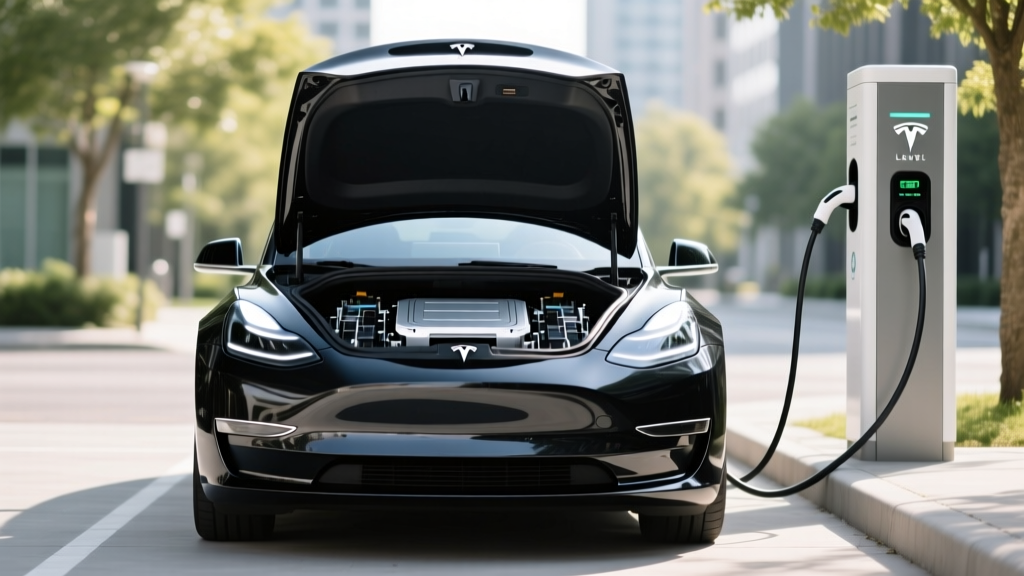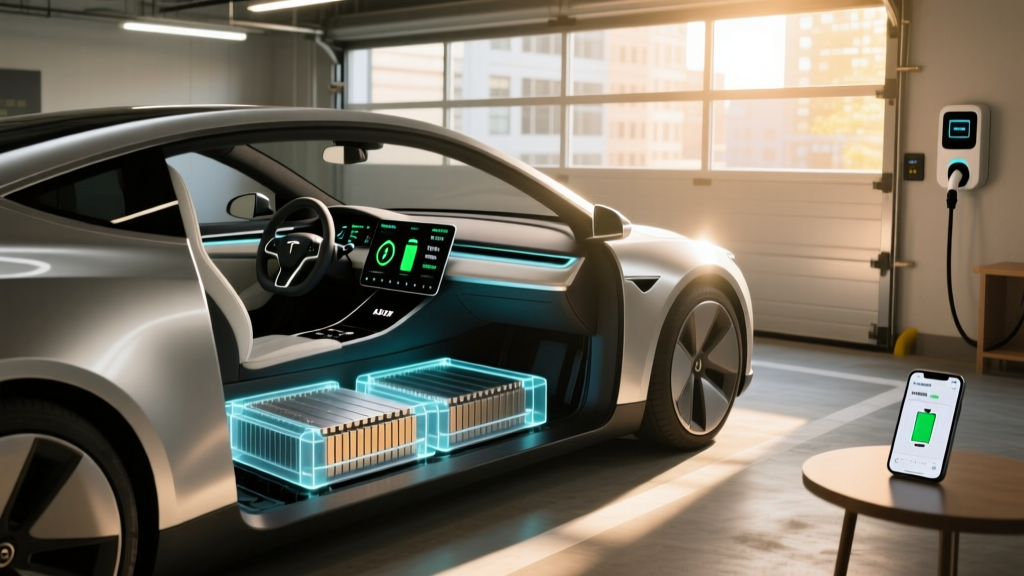
If you own a Tesla — or are about to buy one — the high-voltage traction battery is the single most expensive component in the vehicle. It's also the most misunderstood. Buyers routinely confuse kilowatts (kW, a measure of power) with kilowatt-hours (kWh, a measure of energy storage), worry about replacement costs that rarely materialize within the car's useful life, and overlook the fact that Tesla uses two fundamentally different battery chemistries across its lineup.
This guide breaks down exactly what's inside a Tesla battery pack, how long it lasts based on real-world degradation data, what the warranty actually covers, what a replacement costs in 2026, and how to monitor and maximize your battery's State of Health (SoH). Whether you're looking at a Model 3 Standard Range with LFP cells or a Model S Plaid with NMC, the details matter.
LFP vs NMC: Which Battery Chemistry Does Your Tesla Use?
Tesla currently sources two distinct lithium-ion chemistries for its vehicles. The chemistry in your car affects range, charging behavior, cold-weather performance, longevity, and even how you should charge it daily.
| Attribute | LFP (Lithium Iron Phosphate) | NMC/NCA (Nickel Manganese Cobalt / Nickel Cobalt Aluminum) |
|---|---|---|
| Vehicles (2026) | Model 3 RWD, Model Y RWD (Standard Range) | Model 3/Y Long Range & Performance, Model S, Model X, Cybertruck |
| Energy Density | Lower (~160 Wh/kg cell-level) | Higher (~250-270 Wh/kg cell-level) |
| Typical Pack Size | ~60 kWh usable | ~75-100 kWh usable |
| Cycle Life | 3,000-5,000+ cycles | 1,000-2,000 cycles |
| Daily Charge Recommendation | 100% (Tesla recommends regular full charges) | 80-90% daily; 100% only for trips |
| Cold-Weather Performance | More range loss in freezing temps (~30-40%) | Better cold performance (~20-30% loss) |
| Cost | Lower per kWh (no cobalt or nickel) | Higher per kWh (cobalt/nickel supply chain) |
| Thermal Stability | Excellent — higher thermal runaway threshold | Good — managed via active thermal system |
The practical takeaway: If you drive a Model 3 RWD or Model Y RWD, you likely have an LFP pack. Tesla explicitly recommends charging LFP batteries to 100% regularly because the chemistry's voltage curve is very flat — the Battery Management System (BMS) needs full-charge calibration to accurately estimate remaining range. NMC/NCA packs, found in Long Range and Performance trims, benefit from daily charging limits of 80-90% to reduce stress on the cathode and slow degradation.
LFP's lower energy density means less range per pound, which is why Tesla reserves it for Standard Range models. But LFP's dramatically longer cycle life — often exceeding 4,000 cycles before reaching 80% capacity — makes it arguably the more durable chemistry for high-mileage drivers and fleet use.
How Long Do Tesla Batteries Actually Last?
The short answer: almost certainly longer than you'll own the car. Tesla's own 2024 Impact Report (the most recent with comprehensive fleet data) showed that Model 3 and Model Y batteries retain approximately 85% of their original capacity after 200,000 miles. That's a 15% loss over what is, for most owners, a lifetime of driving.
Typical Tesla Battery Degradation Curve (Fleet Averages)
| Mileage | Average Capacity Retained | Range Loss (Example: 350-mi EPA pack) |
|---|---|---|
| 0 miles (new) | 100% | 0 miles |
| 30,000 miles | ~95% | ~17 miles |
| 50,000 miles | ~93% | ~25 miles |
| 100,000 miles | ~90% | ~35 miles |
| 150,000 miles | ~88% | ~42 miles |
| 200,000 miles | ~85% | ~53 miles |
Data synthesized from Tesla Impact Reports and independent fleet analyses. Individual results vary based on charging habits, climate, and usage patterns. Degradation is non-linear — most loss occurs in the first 20,000-30,000 miles, then the curve flattens significantly.
This non-linear pattern is critical to understand. You'll notice the most range drop in the first year — often 3-5% — as the battery undergoes initial formation losses. After that, degradation typically slows to roughly 1-1.5% per year for average drivers covering 12,000-15,000 miles annually. According to data aggregated by fueleconomy.gov and third-party telematics studies, a 2024 Model 3 Long Range with an EPA-rated 341 miles might realistically deliver 310-320 miles at 100% SoC after three years and 45,000 miles of mixed driving.
What Does the Tesla Battery Warranty Cover?
Tesla's battery and drive unit warranty is among the strongest in the industry, but the specific terms vary by model and trim. Understanding the capacity retention threshold is essential — the warranty doesn't guarantee zero degradation; it guarantees the battery won't fall below a specified percentage of its original capacity within the warranty period.
| Model / Trim | Warranty Period | Mileage Limit | Minimum Capacity Retention |
|---|---|---|---|
| Model 3 RWD (LFP) | 8 years | 100,000 miles | 70% |
| Model 3 Long Range / Performance | 8 years | 120,000 miles | 70% |
| Model Y RWD (LFP) | 8 years | 100,000 miles | 70% |
| Model Y Long Range / Performance | 8 years | 120,000 miles | 70% |
| Model S / Model X | 8 years | 150,000 miles | 70% |
| Cybertruck | 8 years | 120,000 miles | 70% |
The 70% threshold is the trigger point. If your Model 3 Long Range battery drops below 70% of its original usable capacity (roughly 52.5 kWh from a ~75 kWh pack) within 8 years or 120,000 miles — whichever comes first — Tesla will repair or replace the pack at no cost. In practice, very few Tesla batteries hit this threshold under normal use. The warranty also covers manufacturing defects and sudden failures unrelated to capacity loss.
Important caveat: the warranty does not cover damage from accidents, flooding, improper modifications, or use of non-Tesla-approved charging equipment that causes electrical damage. It also doesn't cover cosmetic corrosion or 12V auxiliary battery replacement — that's a separate, conventional maintenance item.
Tesla Battery Replacement Cost: What You'd Actually Pay
This is the question that generates the most anxiety — and the most misinformation. Let's anchor this in real 2026 service-center pricing and third-party repair-shop data.
| Model | Pack Size | Chemistry | OEM Replacement (Tesla Service) | Refurbished / Third-Party |
|---|---|---|---|---|
| Model 3 RWD | ~60 kWh | LFP | $12,000 - $15,000 | $8,000 - $11,000 |
| Model 3 Long Range | ~75 kWh | NMC | $14,000 - $18,000 | $10,000 - $14,000 |
| Model Y Long Range | ~75 kWh | NMC | $14,000 - $18,000 | $10,000 - $14,000 |
| Model S (current gen) | ~100 kWh | NMC | $18,000 - $24,000 | $13,000 - $18,000 |
| Model X (current gen) | ~100 kWh | NMC | $18,000 - $24,000 | $13,000 - $18,000 |
| Cybertruck | ~123 kWh | NMC (4680 cells) | $20,000 - $28,000 | Limited availability |
Context that matters: Full pack replacement is rare. The vast majority of Tesla batteries outlast the vehicle's useful economic life. When issues do arise, they're often isolated to individual modules or the BMS — not the entire pack. Tesla Service Centers can sometimes replace individual modules for $2,000-$5,000 rather than the full pack. Early Model S and Model X vehicles (2012-2017) saw higher failure rates due to earlier cell designs, but the 2170 and 4680 cell generations used in current vehicles show markedly better reliability.
If you're buying a used Tesla outside of warranty, a pre-purchase battery health inspection (available through Tesla Service or qualified independent EV shops) is strongly recommended. This typically costs $100-$200 and provides a SoH percentage reading directly from the BMS.
Factors That Accelerate (or Slow) Battery Degradation
Not all miles are equal when it comes to battery wear. The following factors have measurable, data-backed impacts on how quickly your Tesla's pack loses capacity:
Battery Care Best Practices for Tesla Owners
- Daily charge limit: Set to 80% for NMC/NCA packs (Long Range, Performance, Model S/X). Set to 100% for LFP packs (Model 3/Y RWD) — Tesla's own in-car software recommends this.
- Avoid prolonged 100% SoC: For NMC packs, charge to 100% only when you're leaving for a road trip within hours. Sitting at 100% accelerates calendar degradation.
- Don't let it sit at 0%: Storing a Tesla with a near-empty battery causes copper dissolution in the anode. Keep stored vehicles at 40-60% SoC.
- Minimize DC fast charging when possible: Frequent Supercharging (250 kW) generates more heat than Level 2 home charging. Tesla's thermal management mitigates this well, but daily Supercharging shows measurably higher degradation in fleet data — approximately 1-2% additional loss over 100,000 miles compared to primarily Level 2 charging.
- Precondition before fast charging: Navigate to a Supercharger using the Tesla app or in-car nav. The car will automatically warm the battery to optimal charging temperature (~40°C), which reduces stress and improves charge speed.
- Extreme cold: In sub-freezing climates, plug in when parked and use Scheduled Departure to precondition the battery while on grid power. This preserves range and reduces the need for the battery to self-heat during driving.
- Extreme heat: Park in shade or a garage when possible. Tesla's thermal management runs even when parked in extreme heat, which draws from the battery — keeping it plugged in offsets this.
The single biggest controllable factor is state-of-charge management. A study published in the Journal of Power Sources found that consistently cycling an NMC cell between 20-80% SoC roughly doubles its cycle life compared to 0-100% cycling. For a Tesla Model 3 Long Range owner who charges to 80% daily and uses home Level 2 charging predominantly, reaching 200,000 miles with 85%+ capacity retention is a realistic expectation.
How to Check Your Tesla's Battery Health (State of Health)
Tesla doesn't expose a direct State of Health (SoH) percentage in the standard vehicle interface the way some competitors do. But there are several reliable methods to assess your pack's condition:
Method 1: The Range Calculation Method
Charge your Tesla to 100% (for LFP) or your typical max (for NMC) and note the displayed range. Compare this to the EPA-rated range when new. For example, if your 2024 Model 3 Long Range showed 341 miles at 100% when new and now shows 310 miles at 100% after 40,000 miles, your approximate SoH is 310/341 = ~91%. This method has a margin of error because displayed range is affected by recent driving efficiency and temperature, but it's a useful trend indicator.
Method 2: Tesla Service Mode
Tesla's Service Mode (accessible via the software menu in newer firmware versions) includes a Battery Health test that provides a more precise SoH reading. Navigate to Software → tap and hold the model name for a few seconds to access Service Mode, then run the Battery Health test. This performs a controlled calculation using voltage and impedance data.
Method 3: Third-Party Apps and OBD-II Readers
Apps like Tessie, Stats (iOS), and Scan My Tesla paired with an OBD-II Bluetooth adapter can pull detailed battery telemetry, including individual cell voltages, pack impedance, and calculated SoH. These tools provide the most granular view of pack health and can flag imbalances between cell groups — an early indicator of module-level issues.
Method 4: Tesla Service Center Diagnostic
If you're considering a used Tesla purchase or want an official reading, a Tesla Service Center can run a full battery diagnostic for approximately $100-$200. This produces a report with SoH percentage, cell balance data, and any logged fault codes.
Emerging Battery Technology: What's Next After Lithium-Ion
Several next-generation battery technologies are in development, but it's important to separate laboratory progress from production reality.
Solid-state batteries: These replace the liquid electrolyte with a solid material, promising higher energy density (potentially 400+ Wh/kg at the cell level), faster charging, and improved safety. Toyota has announced solid-state production targets for 2027-2028, and QuantumScape is working with Volkswagen. However, manufacturing scalability and cost remain unsolved challenges. Realistic mass-market availability for Tesla-class vehicles is 2029 at the earliest, more likely the early 2030s.
Silicon-dominant anodes: Companies like Sila Nanotechnologies and Group14 are replacing graphite anodes with silicon composites, boosting energy density by 20-40%. Tesla's 4680 cells already incorporate some silicon in the anode. Incremental improvements here will continue through the rest of this decade.
Sodium-ion batteries: CATL has begun producing sodium-ion cells for lower-cost, shorter-range EVs. These are unlikely to appear in Tesla vehicles soon — Tesla's focus remains on LFP for cost-optimized models and NMC/4680 for range/performance — but sodium-ion could eventually offer a lower-cost alternative for urban-focused vehicles.
None of these technologies are available in any production Tesla as of 2026. Tesla's current 4680 cell architecture (used in Cybertruck and some Model Y vehicles from the Austin factory) represents the company's latest production advancement, with incremental energy density and manufacturing cost improvements over the earlier 2170 cells.
Frequently Asked Questions
How long do Tesla batteries last in years and miles?
Based on Tesla's fleet data, most Tesla batteries retain approximately 85% capacity after 200,000 miles. In years, that translates to 15-20 years for an average driver covering 10,000-15,000 miles annually. Full battery replacement within the vehicle's first decade is uncommon under normal use. The 8-year warranty provides a safety net, but most packs significantly outlast the warranty period.
How much does it cost to replace a Tesla battery?
A full OEM battery replacement at a Tesla Service Center ranges from approximately $12,000 for a Model 3 RWD (LFP, ~60 kWh) to $24,000+ for a Model S/X (~100 kWh). Refurbished packs from third-party EV repair shops can reduce costs by 25-40%. However, complete pack replacement is rare — many issues can be resolved with module-level repairs costing $2,000-$5,000.
Is LFP or NMC better for a Tesla battery?
Neither is universally "better" — they serve different priorities. LFP offers longer cycle life (3,000-5,000 cycles vs 1,000-2,000), lower cost, better thermal stability, and the convenience of 100% daily charging. NMC delivers higher energy density (more range in a lighter, smaller pack) and better cold-weather performance. If you prioritize longevity and value, LFP (Model 3/Y RWD) is compelling. If you need maximum range and all-weather capability, NMC (Long Range/Performance) is the right choice.
Does frequent Supercharging damage the Tesla battery?
DC fast charging generates more heat than Level 2 charging, which contributes to slightly accelerated degradation over time. Fleet data suggests vehicles that Supercharge daily show approximately 1-2% more capacity loss over 100,000 miles compared to those primarily using Level 2 home charging. Tesla's active thermal management system significantly mitigates this — preconditioning the battery before Supercharging further reduces stress. Occasional Supercharging on road trips has negligible impact; it's daily exclusive reliance on DC fast charging that shows measurable effects.
What voids the Tesla battery warranty?
The warranty is voided by: physical damage from accidents or flooding, unauthorized modifications to the battery or high-voltage system, use of non-approved charging equipment that causes damage, and failure to maintain the vehicle's cooling system. Normal degradation, even if it feels significant, is only covered if capacity drops below 70% within the warranty period. For detailed terms, consult the Tesla New Vehicle Limited Warranty documentation.
Can I upgrade my Tesla's battery to a larger capacity later?
No. Tesla does not offer battery capacity upgrades for existing vehicles. The pack size is determined at manufacture and is integrated with the vehicle's structural design (especially in Model Y and Cybertruck, which use structural battery packs). If you need more range, the path is selling your current vehicle and purchasing a Long Range or higher-capacity model.
For the latest official specifications and warranty details, refer to Tesla's owner documentation and the EPA's fueleconomy.gov database for verified range and efficiency figures.