The Tesla Cybertruck arrived with more than stainless-steel panels and steer-by-wire — it introduced a fundamentally different approach to power delivery among Tesla's consumer lineup. At the center of that approach is a high-voltage traction system that diverges from the 400V-class architectures found in the Model 3 and Model Y. Understanding the Tesla Cybertruck battery voltage architecture is essential for prospective buyers evaluating charging speed, long-term battery health, and total cost of ownership for this 6,800-pound electric pickup.
This guide breaks down the Cybertruck's pack chemistry, voltage class, degradation expectations, warranty coverage, replacement economics, and the daily habits that maximize battery lifespan — with exact numbers and real-world context.
Cybertruck Battery Specs: Voltage, Capacity, and Chemistry
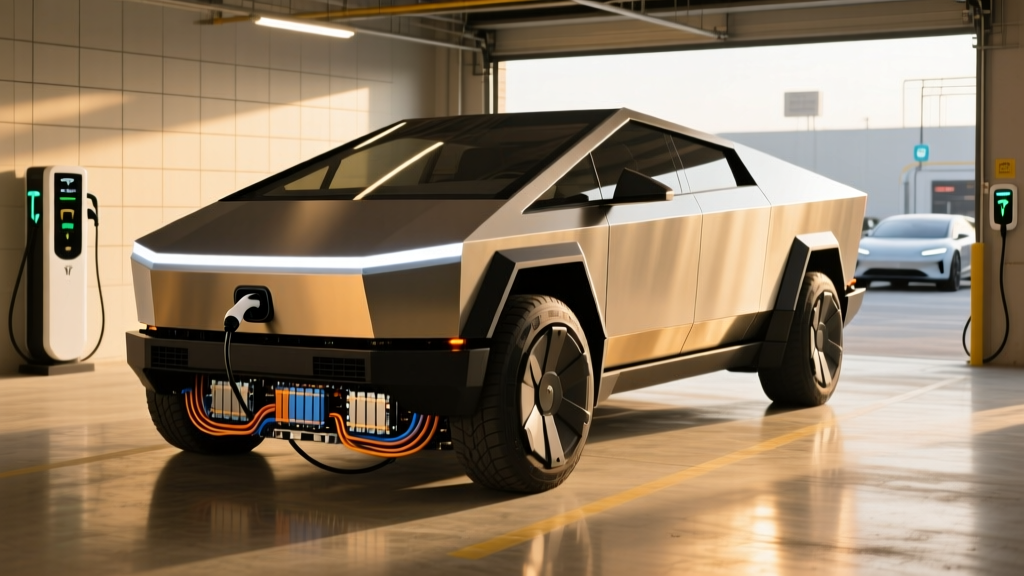
The Cybertruck uses a structural battery pack integrated into the vehicle's exoskeleton frame. Here are the confirmed and widely reported specifications across current trims:
| Specification | AWD (Dual Motor) | Cyberbeast (Tri Motor) |
|---|---|---|
| Usable Battery Capacity | ~123 kWh | ~123 kWh |
| Battery Chemistry | NMC (Nickel Manganese Cobalt) | NMC (Nickel Manganese Cobalt) |
| Voltage Architecture | ~800V-class (nominal ~740–816V) | ~800V-class (nominal ~740–816V) |
| EPA Range | 340 miles | 320 miles |
| Peak DC Fast Charge Rate | ~250 kW (est.) | ~250 kW (est.) |
| 10–80% DC Fast Charge Time | ~28 minutes (est.) | ~28 minutes (est.) |
| Horsepower | 600 hp | 845 hp |
| 0–60 mph | 3.9 seconds | 2.6 seconds |
| Base MSRP | $79,990 | $99,990 |
Sources: Tesla Cybertruck specs page, fueleconomy.gov
The ~800V-class architecture is the defining feature here. Most Tesla vehicles (Model 3, Model Y) operate on ~400V nominal systems. By roughly doubling the system voltage, the Cybertruck can deliver the same power (kW = Volts × Amps) at half the current. Lower current means thinner, lighter wiring harnesses, reduced resistive heat losses, and improved charging efficiency — critical advantages in a vehicle this heavy and power-dense.
Why Voltage Architecture Matters for Charging and Performance
Voltage architecture is one of the most consequential engineering decisions in any EV platform. Here is why the Cybertruck's ~800V system matters in practical terms:
- Charging speed headroom: Higher voltage allows faster DC charging without requiring proportionally thicker cables or generating excessive heat. Vehicles like the Hyundai Ioniq 5 and Porsche Taycan use 800V systems to achieve 10–80% charges in roughly 18 minutes. The Cybertruck's massive 123 kWh pack means even at ~250 kW peak, a 10–80% session takes roughly 28 minutes — the pack size is the limiting factor, not the architecture.
- Thermal efficiency: Lower current at the same power output means less I²R (resistive) heating in cables, busbars, and motor windings. This reduces cooling demands on the battery thermal management system, preserving more energy for propulsion.
- Power delivery: The Cyberbeast's 845 hp requires enormous instantaneous power. An 800V-class system delivers that power without drawing extreme amperage, protecting components and sustaining performance during repeated hard acceleration.
- Weight savings: High-voltage wiring can use smaller-gauge conductors, saving weight — a meaningful advantage when the vehicle already weighs nearly 7,000 pounds curb.
For context, the Hyundai Ioniq 5's 800V E-GMP platform charges from 10–80% in approximately 18 minutes on a 350 kW charger, but its battery is only 77.4 kWh. The Cybertruck's pack is roughly 60% larger, so even with comparable architecture voltage, total charge time is longer. This is physics, not a limitation of Tesla's engineering.
NMC Chemistry in the Cybertruck: Trade-Offs vs. LFP
Tesla uses NMC (Nickel Manganese Cobalt) cells in the Cybertruck, consistent with its performance-oriented and long-range vehicles. The Standard Range Model 3 and Model Y use LFP (Lithium Iron Phosphate) chemistry, which trades energy density for cost and longevity. Here is how the two chemistries compare:
| Attribute | LFP (LiFePO₄) | NMC (LiNiMnCoO₂) |
|---|---|---|
| Energy Density | Lower (~160 Wh/kg cell-level) | Higher (~220–260 Wh/kg cell-level) |
| Cycle Life | 3,000–5,000+ cycles | 1,500–3,000 cycles |
| Cold-Weather Performance | Moderate — greater range loss below freezing | Better low-temp discharge capability |
| Cost (per kWh) | Lower — no cobalt or nickel | Higher — commodity-linked materials |
| Thermal Stability | Excellent — lower thermal runaway risk | Good — requires robust BMS/cooling |
| State of Charge Estimation | Flat voltage curve makes SoC harder to gauge | Steeper voltage curve — easier SoC estimation |
| Recommended Daily Charge Limit | 100% (Tesla recommends periodic full charges) | 80% for daily use; 100% for trips only |
| Used In | Model 3/Y RWD, some Standard Range | Cybertruck, Model S/X, Long Range/Performance trims |
For the Cybertruck, NMC is the correct choice. The truck needs maximum energy density to achieve 320–340 miles of range in a package that already pushes weight and dimensional limits. LFP's lower energy density would require a heavier, larger pack to achieve the same range — counterproductive in a 6,800-lb vehicle. The trade-off is that NMC is more sensitive to prolonged high-state-of-charge storage and extreme heat, making daily charging habits more consequential for long-term health.
Battery Degradation: What the Data Actually Shows
Battery degradation — the gradual loss of usable capacity over time and charge cycles — is the single most common concern among EV buyers. Here is what real-world data tells us:
• Year 1 / 15,000 miles: ~2–5% capacity loss (initial formation loss)
• Year 3 / 45,000 miles: ~5–8% total loss
• Year 5 / 75,000 miles: ~8–12% total loss
• Year 8 / 120,000 miles: ~10–15% total loss
Source: Tesla Impact Reports, fleet telemetry aggregations (Teslanomics, Recurrent Auto)
Tesla's own fleet data, published in annual Impact Reports, has consistently shown that its NMC packs retain approximately 85–90% of original capacity after 150,000 miles. The Cybertruck's large 123 kWh pack provides a buffer: even at 15% degradation, the AWD model would still deliver roughly 289 miles of EPA-rated range — more than adequate for most use cases.
Key factors that accelerate degradation include:
- Frequent DC fast charging: Occasional Supercharging is fine; daily DC fast charging at high kW increases thermal stress. Tesla's thermal management system mitigates this, but heat is the primary degradation driver.
- Prolonged storage at 100% SoC: NMC cells degrade faster when held at full charge, especially in hot climates. Tesla's vehicle settings allow scheduling charge completion to minimize time at 100%.
- Extreme temperatures: Sustained operation or storage above 100°F or below 0°F accelerates chemical aging. The Cybertruck's liquid thermal management system actively conditions the pack, but garage parking in extreme climates helps.
- Deep discharge cycles: Regularly driving to near 0% SoC stresses NMC chemistry. Keeping daily driving within a 20–80% SoC window is optimal.
Tesla Battery Warranty: What Is Covered
Tesla provides a battery and drive unit warranty for the Cybertruck that aligns with its other premium vehicles:
| Coverage Item | Term |
|---|---|
| Battery Warranty Duration | 8 years |
| Battery Warranty Mileage | 150,000 miles (whichever comes first) |
| Minimum Capacity Retention | 70% of original capacity |
| Drive Unit Warranty | 8 years / 150,000 miles |
| What Triggers a Claim | Capacity drops below 70% within warranty period, or manufacturing defect |
| Remedy | Repair or replacement at Tesla's discretion to restore ≥70% capacity |
Source: Tesla New Vehicle Limited Warranty
The 70% retention threshold over 8 years / 150,000 miles is industry-standard — matching or exceeding warranties from Ford (F-150 Lightning: 8 yr/100,000 mi, 70%), Rivian (R1T: 8 yr/175,000 mi, 70%), and GM (Silverado EV: 8 yr/100,000 mi, 70%). The Cybertruck's 150,000-mile coverage is among the most generous for mileage in the electric pickup segment.
Important caveat: the warranty covers capacity degradation below the threshold and manufacturing defects. It does not cover damage from accidents, improper charging equipment, or modifications. Normal degradation above the 70% threshold is expected and not warrantable.
Battery Replacement Cost: When and How Much
This is the question that generates the most anxiety — and the most misinformation. Here is the reality:
| Vehicle / Pack Size | Estimated Replacement Cost | Typical Replacement Timeline |
|---|---|---|
| Tesla Model 3/Y (~75–82 kWh, NMC) | $12,000–$16,000 | Rarely needed within 15 years |
| Tesla Cybertruck (~123 kWh, NMC) | $20,000–$30,000 (est.) | Rarely needed within 15 years |
| Ford F-150 Lightning (~131 kWh ext. range) | $20,000–$28,000 (est.) | Rarely needed within 15 years |
| Rivian R1T (~128 kWh Max Pack) | $20,000–$30,000 (est.) | Rarely needed within 15 years |
| Chevrolet Bolt EV (~65 kWh) | $14,000–$16,000 | Rarely needed within 15 years |
The Cybertruck's large 123 kWh pack makes it one of the most expensive batteries to replace in the consumer EV market. However, context matters enormously:
- Most EV batteries outlive their vehicles. Tesla's fleet data shows fewer than 1% of packs replaced under warranty. The vast majority of EVs are scrapped or retired for non-battery reasons (body damage, electronics failures, owner upgrades) before the pack requires replacement.
- Battery costs continue to decline. Pack-level costs have fallen from over $1,000/kWh in 2010 to roughly $130–$150/kWh in 2025. By the time a Cybertruck pack might need replacement (2040+), costs will likely be substantially lower.
- Module-level repair is increasingly viable. Many battery issues involve individual modules or the BMS (Battery Management System), not the entire pack. Independent EV repair shops are developing module-level replacement capabilities at a fraction of full-pack cost.
Maximizing Cybertruck Battery Health: Owner Best Practices
- Set daily charge limit to 80% (use the Tesla app or vehicle settings)
- Charge to 100% only when needed for long trips; depart shortly after reaching full charge
- Use Scheduled Charging and Scheduled Departure to precondition the battery and minimize time at high SoC
- Avoid leaving the vehicle at 100% SoC in hot weather for extended periods
- Use DC fast charging (Superchargers) for road trips; rely on Level 2 home charging for daily needs
- Plug in when possible in extreme cold — the vehicle's thermal management will maintain pack temperature
- Avoid regularly discharging below 10% SoC
- Keep tires properly inflated — underinflation increases energy consumption and charging frequency
- Monitor battery health via the Tesla app and service menu
How to Check Battery State of Health (SoH)
Tesla does not expose a direct SoH percentage in the vehicle's main UI, but owners have several methods:
- Tesla App Energy Graph: Track your typical energy consumption and range over time. A gradual decrease in range at the same SoC percentage indicates normal degradation.
- Service Mode (if accessible): Some Tesla vehicles expose battery health data in Service Mode. Navigate to Controls → Software → tap the model name multiple times (availability varies by firmware version).
- Third-party tools: Apps like Tessie, TeslaFi, and Stats (for macOS) can log detailed battery telemetry including nominal full-pack capacity vs. current capacity, giving a calculated SoH percentage.
- Tesla Service Center: Request a battery health report during routine service. Tesla can pull detailed pack diagnostics including individual module voltage variance and internal resistance.
Emerging Battery Technologies: What Is on the Horizon
While the Cybertruck uses proven NMC lithium-ion technology, several next-generation battery technologies are in development. It is important to understand their realistic timelines:
- Solid-state batteries: Replace the liquid electrolyte with a solid conductor, promising higher energy density, faster charging, and improved safety. Toyota, Samsung SDI, and QuantumScape are leading development. Realistic timeline: limited production vehicles by 2028–2030; mass-market availability unlikely before 2032. The Cybertruck will not receive solid-state cells during its current generation.
- Silicon-dominant anodes: Companies like Sila Nanotechnologies and Group14 are replacing graphite anodes with silicon, boosting energy density by 20–40%. Some premium EVs may adopt this by 2027–2028. Timeline: early adoption in luxury/performance EVs by 2027; broader availability 2029+.
- Sodium-ion batteries: Lower cost and no critical minerals, but significantly lower energy density. CATL and BYD are producing these for budget EVs in China. Timeline: unlikely for US-market trucks due to range/weight constraints; possible for stationary storage integration.
- Dry electrode manufacturing: Tesla's own 4680 cell production uses dry electrode coating, reducing manufacturing cost and energy. This is already in production for some Tesla vehicles and improves economics without changing fundamental chemistry.
None of these technologies will retrofit into an existing Cybertruck. Buyers should evaluate the current NMC pack on its merits — which, with proper care, will deliver well over a decade of reliable service.
Tesla Cybertruck Battery Architecture: Key Takeaways
The Cybertruck's ~800V-class NMC battery architecture represents a deliberate engineering trade-off: maximum energy density and charging efficiency in exchange for the care requirements that come with nickel-rich chemistry. The 123 kWh pack delivers 320–340 miles of EPA range, charges at roughly 250 kW peak, and is backed by an 8-year/150,000-mile warranty with a 70% retention guarantee.
For buyers, the critical numbers are these: expect 260–290 real-world highway miles (AWD), plan for ~28-minute DC fast charges from 10–80%, set your daily charge limit to 80%, and know that the pack will almost certainly outlast the vehicle's useful life. The ~$20,000–$30,000 replacement cost figure, while eye-catching, applies to a scenario that fewer than 1% of Tesla owners ever face.
Frequently Asked Questions
How long do Tesla Cybertruck batteries last?
Based on Tesla's fleet-wide NMC degradation data, Cybertruck batteries should retain approximately 85–90% of original capacity after 150,000 miles (roughly 10 years of average driving). Full pack replacement is rarely needed within the vehicle's typical 15–20 year lifespan. The warranty guarantees at least 70% capacity retention for 8 years or 150,000 miles.
How much does a Cybertruck battery cost to replace?
Estimated at $20,000–$30,000 for a full pack replacement based on the 123 kWh capacity and current NMC cell pricing. However, Tesla's fleet data shows fewer than 1% of packs require replacement under warranty, and battery costs are projected to decline significantly by the 2035–2040 timeframe when a replacement might conceivably be needed.
Does the Cybertruck use an 800V battery system?
Yes. The Cybertruck uses an ~800V-class nominal architecture (approximately 740–816V depending on state of charge), roughly double the ~400V systems in the Model 3 and Model Y. This enables more efficient power delivery to the tri-motor Cyberbeast powertrain and reduces resistive losses in the high-current wiring harness.
What does the Cybertruck battery warranty cover?
Tesla's battery warranty covers the traction battery for 8 years or 150,000 miles, whichever comes first. If capacity drops below 70% of original within that period, Tesla will repair or replace the pack to restore at least 70% capacity. The warranty covers manufacturing defects and abnormal degradation but not accident damage, misuse, or unauthorized modifications.
Is LFP or NMC better for the Cybertruck?
NMC is the appropriate chemistry for the Cybertruck. LFP's lower energy density (~160 Wh/kg vs. ~220–260 Wh/kg for NMC) would require a significantly heavier and larger pack to achieve 320+ miles of range — impractical in an already 6,800-lb vehicle. NMC's higher energy density, better cold-weather performance, and steeper voltage curve (enabling more accurate state-of-charge estimation) make it the right choice for a heavy, performance-oriented truck. The trade-off is that NMC requires more careful charge-limit habits (80% daily) compared to LFP (100% daily is acceptable).
Can I Supercharge the Cybertruck every day?
Occasional Supercharging is fine and will not meaningfully accelerate degradation thanks to Tesla's active thermal management. However, daily DC fast charging at high power (250 kW) generates more cumulative thermal stress than Level 2 home charging (11.5 kW). For battery longevity, use Level 2 home charging for daily needs and reserve Supercharging for road trips or when fast turnaround is necessary.
How do I check my Cybertruck battery health?
Use the Tesla app's energy tracking to monitor range trends over time, or employ third-party logging tools like Tessie or TeslaFi that calculate State of Health (SoH) from charge/discharge telemetry. For an official assessment, request a battery health report from a Tesla Service Center, which includes module-level voltage variance and internal resistance diagnostics.