The Tesla Cybertruck's 123 kWh battery pack is one of the largest and most structurally integrated energy storage systems on any consumer vehicle. For buyers and owners, the question of long-term battery longevity, degradation behavior, and eventual replacement cost is central to the ownership calculus. This guide synthesizes Tesla's engineering disclosures, real-world fleet data, and industry-wide battery research to answer the core questions around the Cybertruck's high-voltage traction battery.
Cybertruck Battery Architecture: What Tesla Engineered
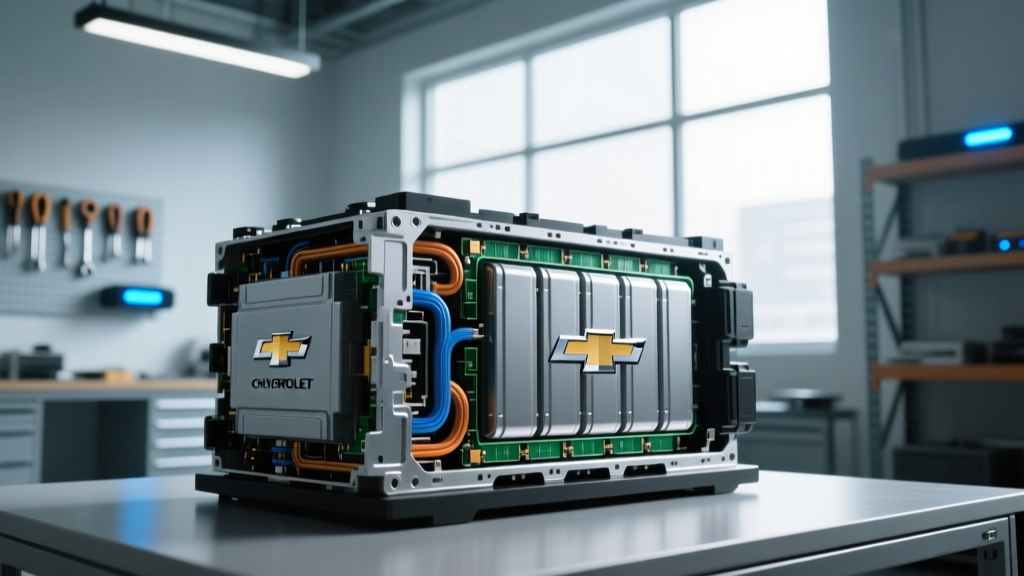
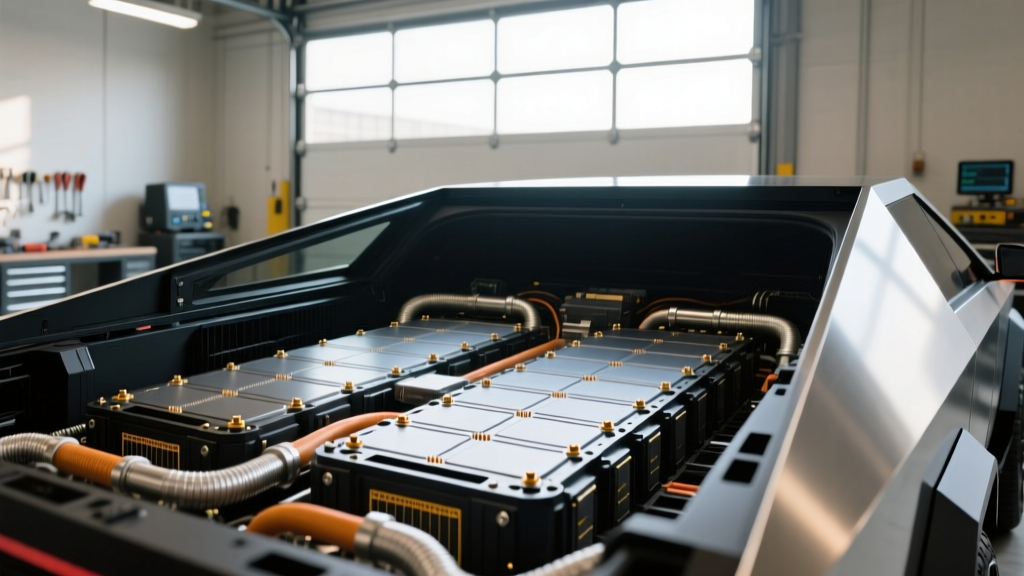
The Cybertruck uses a structural battery pack built around Tesla's 4680 cylindrical cells. Unlike traditional EV packs where cells sit inside a separate enclosure bolted to the chassis, the Cybertruck's pack serves as a stressed member of the vehicle's stainless-steel exoskeleton. The cells are bonded with a structural adhesive that transfers load between the upper and lower pack housings, reducing overall vehicle mass while increasing torsional rigidity.
The pack is rated at approximately 123 kWh of usable energy. The chemistry is NMC (nickel-manganese-cobalt), specifically a high-nickel formulation optimized for energy density — a necessary choice given the Cybertruck's 6,800+ lb curb weight and the range targets Tesla set for the platform. The 4680 cell format offers a larger electrode tabless design that reduces internal resistance, improving both thermal management during fast charging and sustained power delivery under heavy loads like towing.
| Specification | Value |
|---|---|
| Usable battery capacity | ~123 kWh |
| Cell format | 4680 cylindrical |
| Chemistry | NMC (high-nickel) |
| Pack architecture | Structural (load-bearing) |
| Thermal management | Active liquid cooling/heating |
| EPA range (AWD) | 340 mi |
| EPA range (Cyberbeast) | 320 mi |
| Max DC fast charge rate | ~250 kW (V3 Supercharger) |
| 10–80% DC charge time | ~35–40 minutes |
NMC vs LFP: Why Tesla Chose NMC for the Cybertruck
Tesla uses two primary cell chemistries across its lineup: NMC for performance and long-range models, and LFP (lithium iron phosphate) for Standard Range variants. The Cybertruck exclusively uses NMC. Understanding the trade-offs between these chemistries explains why — and what it means for long-term ownership.
| Attribute | NMC (Cybertruck) | LFP (Model 3/Y RWD) |
|---|---|---|
| Energy density | ~260–300 Wh/kg (higher) | ~160–200 Wh/kg (lower) |
| Typical cycle life | 1,000–2,000 full cycles | 3,000–5,000+ full cycles |
| Cold-weather performance | Better low-temp discharge | Reduced range in extreme cold |
| Cost per kWh | Higher (cobalt/nickel) | Lower (iron/phosphate) |
| Recommended daily SoC | 80% (charge to 100% for trips) | 100% daily is acceptable |
| Thermal stability | Good (requires active management) | Excellent (inherently stable) |
| Degradation profile | Gradual, ~10–15% over 200k mi | Very slow, ~5–10% over 200k mi |
The Cybertruck's weight and towing demands make energy density non-negotiable. An LFP pack of equivalent range would add several hundred pounds, further degrading efficiency and payload capacity. The trade-off is a chemistry that requires more careful state-of-charge management and shows slightly faster degradation over time — though real-world data suggests the difference is modest with proper care.
Degradation Data: What Fleet Research Shows
One of the most persistent concerns in EV ownership is battery degradation — the gradual loss of usable capacity over time and charge cycles. Tesla's own impact reports and independent fleet analyses provide concrete data points for NMC packs, which we can extrapolate to the Cybertruck's 4680 architecture.
According to Tesla's 2024 Impact Report, Model S and Model X vehicles (NMC chemistry, older 18650 and 2170 cells) retained approximately 88% of original capacity at 150,000 miles and roughly 85% at 200,000 miles. The newer 4680 cells in the Cybertruck benefit from improved electrode design and better thermal management, but they operate under higher stress due to the vehicle's mass and towing loads.
Projected Cybertruck NMC Degradation Curve (based on Tesla fleet data and 4680 cell research):
- Year 1 / 15,000 mi: ~3–5% capacity loss (initial formation loss, steepest part of curve)
- Year 3 / 45,000 mi: ~7–9% cumulative loss
- Year 5 / 75,000 mi: ~9–12% cumulative loss
- Year 8 / 120,000 mi: ~12–15% cumulative loss
- Year 10 / 150,000 mi: ~14–18% cumulative loss
- 200,000+ mi: ~15–22% cumulative loss (most packs still functional)
Source: Tesla Impact Report fleet data, tesla.com; Recurrent Auto battery degradation studies.
The degradation curve is non-linear: the steepest drop occurs in the first 10,000–20,000 miles as the solid electrolyte interphase (SEI) layer stabilizes. After that, capacity loss slows dramatically. A Cybertruck owner who drives 15,000 miles per year can reasonably expect to retain 85–88% of original capacity at the 8-year warranty mark — translating to roughly 285–300 miles of EPA-equivalent range from the original 340.
Warranty Coverage: What Tesla Guarantees
Tesla's battery warranty for the Cybertruck provides a critical safety net against premature or excessive degradation. Understanding the exact terms — and what triggers a warranty claim — is essential for ownership planning.
| Warranty Parameter | Cybertruck Coverage |
|---|---|
| Duration | 8 years |
| Mileage limit | 150,000 miles (whichever comes first) |
| Capacity retention threshold | 70% of original usable capacity |
| What's covered | Defects, failures, or capacity below 70% |
| What's NOT covered | Cosmetic issues, damage from accidents/modifications, normal wear above 70% |
| Remedy | Repair, replacement, or refurbished pack at Tesla's discretion |
| Drivetrain warranty | 8 years / 150,000 miles (motors, inverters) |
The 70% threshold is consistent across Tesla's truck and SUV lineup (Model S, Model X, and now Cybertruck). In practical terms, a Cybertruck would need to lose more than 37 kWh of usable capacity — dropping below ~86 kWh — for the warranty to apply. Based on current degradation data, very few vehicles reach this threshold within the warranty period under normal use. According to data from Recurrent Auto, fewer than 1.5% of Tesla vehicles have required warranty battery replacements.
Cybertruck Battery Replacement Cost: Engineering and Economics
This is the question that generates the most anxiety — and the most misinformation. The cost of replacing a 123 kWh structural NMC pack is substantial, but context matters enormously. Let's break down the actual numbers.
| Component / Scenario | Estimated Cost |
|---|---|
| Full pack replacement (out of warranty, 2026 pricing) | $22,000 – $30,000 |
| Refurbished/remanufactured pack (if available) | $15,000 – $20,000 |
| Individual module replacement (partial failure) | $3,000 – $8,000 |
| Labor (structural pack removal/install) | $2,500 – $5,000 |
| Typical replacement timing | 200,000+ miles or 12–15+ years (if ever) |
Several engineering factors push the Cybertruck's replacement cost toward the upper end of the EV spectrum:
- Structural integration: Because the pack is a load-bearing member, removal requires disassembly of chassis components, increasing labor time and complexity compared to a traditional bolt-in pack.
- Pack size: At 123 kWh, this is roughly 50% larger than a Model 3 Long Range pack. More cells, more nickel and cobalt, higher raw-material cost.
- 4680 cell supply: As of 2026, 4680 cells are still primarily manufactured at Tesla's own facilities, limiting aftermarket supply competition.
However, the critical context is this: most EV batteries never need full replacement. The vast majority of packs outlast the vehicle's economic life. By the time a Cybertruck reaches 200,000 miles, it will likely be 12–15 years old, and the replacement decision will be weighed against the vehicle's residual value — which, for a $80,000+ truck, may still justify a new pack. For most owners, the battery will simply degrade gradually to 80–85% capacity and remain functional for the vehicle's entire useful life.
Factors That Accelerate (or Preserve) Battery Life
Battery longevity is not purely a function of time and miles. How you charge, drive, and store the Cybertruck has a measurable impact on the degradation rate. Here is what the engineering research shows:
Practices That Preserve Battery Health
- Set daily charge limit to 80%: NMC cells experience the least stress between 20–80% SoC. Reserve 100% charges for road trips.
- Use Level 2 home charging as your primary method: Slow charging (7–11 kW) generates far less heat than DC fast charging, reducing electrolyte breakdown.
- Precondition before fast charging: The Cybertruck's navigation-based preconditioning warms the pack to optimal temperature before arriving at a Supercharger, improving charge speed and reducing thermal stress.
- Avoid prolonged storage above 90% or below 10% SoC: If storing for weeks, set to ~50% and leave plugged in so the BMS can maintain balance.
- Use scheduled charging in extreme cold: Plug in and schedule departure times so the pack is warm when you drive, reducing lithium plating risk.
Practices That Accelerate Degradation
- Exclusive DC fast charging: Daily Supercharging (250 kW) generates sustained high temperatures. Fleet data shows vehicles that rely primarily on DCFC degrade 2–4% faster over 100,000 miles than those that home-charge.
- Frequent 100% charges with extended sits: Leaving an NMC pack at 100% for days accelerates cathode oxidation.
- Regular deep discharges to 0%: Dropping below 5% stresses the anode and can cause copper dissolution in extreme cases.
- Heavy towing in extreme heat without cool-down: Sustained high-C-rate discharge in 100°F+ ambient temps pushes cell temperatures toward the upper thermal limit.
- Ignoring software updates: Tesla's BMS algorithms improve over time; skipping updates may mean missing optimization improvements.
Monitoring Battery Health: How to Check SoH
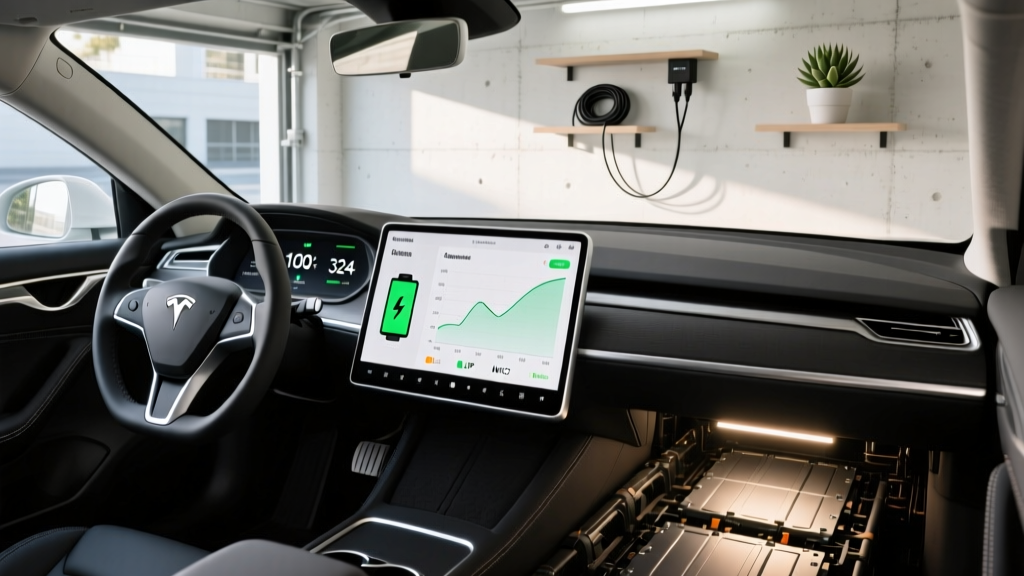
The Cybertruck's onboard Battery Management System (BMS) continuously monitors cell voltages, temperatures, and internal resistance across the entire pack. As an owner, you have several ways to assess State of Health (SoH):
- Tesla App & Vehicle Screen: Navigate to the battery settings to view estimated range at 100% charge. Compare this to the original EPA figure (340 mi for AWD). A drop from 340 to 306 miles suggests ~10% degradation.
- Energy App: The Cybertruck's Energy app tracks consumption and can display projected range based on recent driving patterns versus rated range — a growing gap indicates degradation.
- Third-party OBD-II tools: Devices like the OBDeleven or apps like TeslaFi and Tessie can pull detailed BMS data including nominal full-pack capacity (kWh), cell imbalance (mV spread), and cycle count.
- Service Center diagnostic: Tesla can run a full pack health report that provides a precise SoH percentage — useful before purchasing a used Cybertruck or filing a warranty claim.
A healthy pack should show cell voltage imbalance of less than 20–30 mV at rest. Packs with cells exceeding 50 mV spread may have a defective module that could be replaced individually rather than requiring a full pack swap.
Emerging Battery Technologies: What's on the Horizon
The battery industry is moving rapidly, but it is essential to separate laboratory breakthroughs from production-ready technology. Here is where next-generation chemistries stand as of 2026:
- Silicon-dominant anodes: Companies like Sila Nanotechnologies and Group14 are shipping silicon-carbon composite anode materials that boost energy density by 15–25% over graphite. Tesla's 4680 cells already incorporate a modest silicon percentage. Expect incremental increases in silicon content through 2027–2028, improving range without changing pack size.
- Solid-state batteries: Toyota, QuantumScape, and Samsung SDI have demonstrated solid-state cells with 500+ Wh/L energy density and 1,000+ cycle life in lab settings. However, manufacturing scalability remains the primary bottleneck. Toyota has announced limited solid-state EV production for 2027–2028, but widespread adoption in large vehicles like the Cybertruck is unlikely before 2030. These are not drop-in replacements for existing packs.
- Sodium-ion cells: CATL and BYD have begun producing sodium-ion batteries for lower-cost, shorter-range vehicles. Sodium-ion is not suitable for the Cybertruck's energy-density requirements but may appear in future Tesla Standard Range models.
- Dry electrode manufacturing: Tesla's acquisition of Maxwell Technologies' dry electrode process continues to scale at the Austin Gigafactory. This reduces manufacturing cost and energy consumption for 4680 cells, which should gradually lower replacement pack pricing over time.
For current Cybertruck owners, these technologies are informational rather than actionable. The NMC 4680 pack in your vehicle is a mature, well-understood system with predictable degradation characteristics and a robust warranty.
Frequently Asked Questions
How long do EV batteries last in real-world use?
Most modern NMC EV batteries, including the Cybertruck's 4680 pack, are engineered to retain 70–85% of original capacity at 200,000 miles. At an average of 15,000 miles per year, that translates to 13+ years of functional use before capacity drops below the warranty threshold. Full battery failure (the pack ceasing to function) is extremely rare — degradation is gradual, not sudden.
How much does a Cybertruck battery cost to replace?
A full out-of-warranty replacement pack is estimated at $22,000–$30,000 including labor, based on the 123 kWh pack size and structural integration complexity. Refurbished packs, when available, may cost $15,000–$20,000. However, the vast majority of Cybertruck batteries will never need replacement — they degrade gradually and remain usable for the vehicle's economic life.
What does the Cybertruck battery warranty cover?
Tesla covers the battery for 8 years or 150,000 miles (whichever comes first) against defects and capacity loss below 70% of the original 123 kWh. If your pack drops below approximately 86 kWh of usable capacity within that window, Tesla will repair or replace it. The warranty does not cover damage from accidents, modifications, or abuse.
How do I check my Cybertruck's battery health?
Monitor the estimated range at 100% charge via the vehicle's touchscreen or Tesla app. For detailed data, use third-party apps like TeslaFi or Tessie to track nominal full-pack kWh, cell imbalance, and cycle count. Tesla Service Centers can also run a comprehensive SoH diagnostic report on request.
Is LFP better than NMC for battery longevity?
LFP cells generally offer longer cycle life (3,000–5,000 cycles vs. 1,000–2,000 for NMC) and greater thermal stability. However, NMC provides significantly higher energy density, which is essential for a heavy vehicle like the Cybertruck. "Better" depends on the application: LFP excels in daily commuting vehicles where weight is less critical, while NMC is necessary for long-range, heavy-duty applications. The Cybertruck does not offer an LFP variant.
Does frequent Supercharging damage the Cybertruck battery?
Exclusive reliance on DC fast charging accelerates degradation by approximately 2–4% over 100,000 miles compared to primarily Level 2 home charging, based on fleet data from Recurrent Auto. Occasional Supercharging for road trips has negligible impact. The Cybertruck's active thermal management and preconditioning system mitigate much of the thermal stress, but daily DCFC use is not ideal for long-term SoH.
Can individual battery modules be replaced instead of the whole pack?
In principle, yes — Tesla's service procedures allow for module-level repair on some pack designs. However, the Cybertruck's structural pack with bonded cells makes module-level service more complex than on older Model S/X packs. Whether Tesla offers module-level repair for the 4680 structural pack depends on the specific failure mode and Tesla's service policies at the time. Expect full-pack replacement to be the standard remedy for significant capacity loss.