If you're researching the Tesla Cybertruck battery capacity before pulling the trigger on a reservation or a dealer lot, you're asking the right question. The high-voltage traction battery is the single most expensive component in any electric vehicle, and the Cybertruck's massive pack is no exception. In this guide, we unpack the Cybertruck's battery specs, the chemistry inside it, what real-world degradation looks like, what the warranty actually covers, and how to maximize pack life over 200,000+ miles.
Cybertruck Battery Capacity: The Exact Numbers
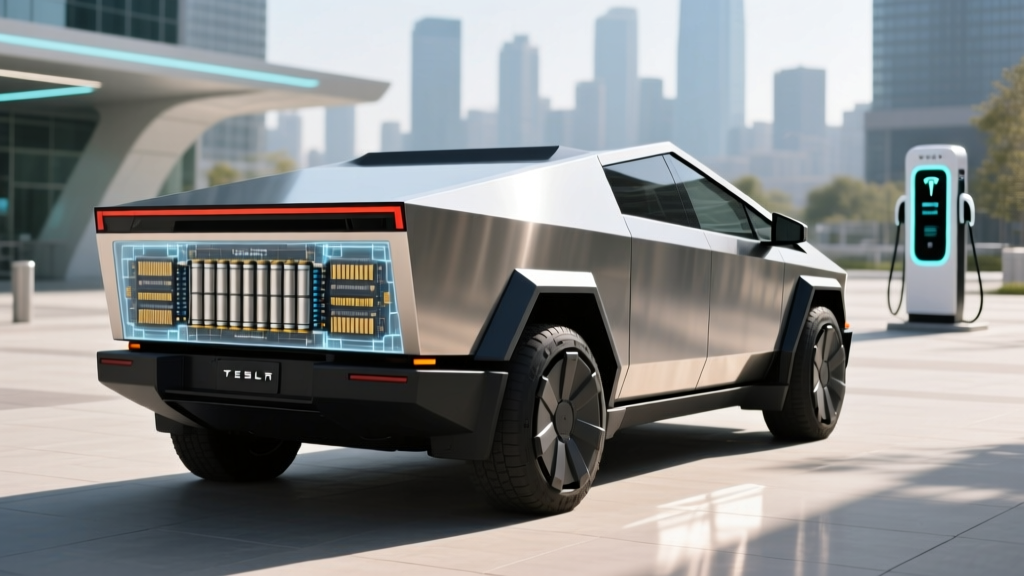
The Tesla Cybertruck (AWD and Cyberbeast trims) uses a large NMC (nickel-manganese-cobalt) lithium-ion battery pack with approximately 123 kWh of usable capacity. Tesla does not publish an official gross capacity figure, but teardown analysis and EPA filing data point to a gross capacity in the 125–130 kWh range, with a top and bottom buffer to protect cell longevity.
For context, here's how the Cybertruck's pack compares to other large-battery EVs on the market:
| Vehicle | Usable Battery (kWh) | Chemistry | EPA Range (mi) | Peak DC Charge (kW) |
|---|---|---|---|---|
| Tesla Cybertruck AWD | ~123 | NMC | 340 | ~250 (est.) |
| GMC Hummer EV Pickup | ~212 | NMC | 329 | 350 |
| Rivian R1T (Large Pack) | ~128 | NMC | 352 | ~220 |
| Ford F-150 Lightning (Ext. Range) | ~131 | NMC | 320 | ~150 |
Despite the Cybertruck's enormous battery, its EPA range sits at 340 miles for the AWD dual-motor trim. That's because the Cybertruck is heavy (curb weight over 6,600 lbs), boxy (high aerodynamic drag), and runs large all-terrain tires. Real-world highway range at 75 mph in moderate temperatures typically falls to 270–300 miles. In cold weather (below 30°F), expect a further 15–25% reduction, dropping effective range to 210–250 miles depending on cabin heating use and whether you precondition.
Inside the Pack: NMC Chemistry and Why Tesla Chose It
The Cybertruck uses NMC (nickel-manganese-cobalt) cells, likely a high-nickel variant (such as NMC 811 or a Tesla-custom 4680-format cell with NMC chemistry). This is a deliberate choice driven by the vehicle's requirements: massive energy storage in a finite physical space, high power output for up to 845 hp (Cyberbeast), and fast-charging capability.
Here's how NMC stacks up against the other dominant EV chemistry, LFP (lithium iron phosphate), which Tesla uses in the Model 3 and Model Y Standard Range (Rear-Wheel Drive) trims:
| Attribute | NMC (Cybertruck) | LFP (Model 3/Y RWD) |
|---|---|---|
| Energy Density | High (~250–300 Wh/kg cell-level) | Moderate (~160–200 Wh/kg) |
| Cycle Life | ~1,000–2,000 full cycles to 80% SoH | ~3,000–5,000+ full cycles to 80% SoH |
| Cold-Weather Performance | Better low-temp discharge & charge acceptance | Reduced regen & charge speed in cold; benefits heavily from preconditioning |
| Cost (per kWh) | Higher (nickel and cobalt are expensive) | Lower (iron and phosphate are abundant) |
| Thermal Stability | Good, but requires robust BMS and cooling | Excellent — inherently more stable chemistry |
| Recommended Daily Charge Limit | 80–90% (for longevity) | 100% OK for daily use (Tesla recommends periodic full charges for calibration) |
| Best For | Long-range, high-performance, heavy vehicles | Standard-range daily drivers, fleet/robotaxi use |
Why not LFP in the Cybertruck? The Cybertruck needs 123+ kWh of usable energy, and stuffing that much LFP into the vehicle's footprint would add hundreds of extra pounds and exceed packaging limits. NMC's superior energy density makes it the only practical choice for a vehicle this large and heavy that still needs to deliver 340 miles of range.
Battery Degradation: What the Data Actually Shows
EV battery degradation is a fact of chemistry, not a defect. Every lithium-ion cell loses capacity over time and use. The question is how fast — and the data is more reassuring than most buyers expect.
Tesla's own Impact Reports have historically shown that their NMC packs retain approximately 88–90% of original capacity after 200,000 miles across the Model S and Model X fleet. The Model 3/Y fleet (mix of NMC and LFP) shows similar or better retention. For the Cybertruck specifically, long-term fleet data is still maturing (the truck launched in late 2023), but the 4680-format cells and Tesla's advanced thermal management system give us strong reason to expect comparable or better results.
Typical NMC Degradation Curve (Tesla Fleet Data, Aggregated):
- Year 1 / 15,000 mi: ~2–4% loss (initial formation loss, most rapid period)
- Year 3 / 45,000 mi: ~5–7% total loss
- Year 5 / 75,000 mi: ~7–9% total loss
- Year 8 / 120,000 mi: ~9–12% total loss
- Year 10+ / 200,000 mi: ~10–15% total loss (fleet average; many packs retain 88%+)
Source: Tesla annual Impact Reports, aggregated fleet telemetry. Individual results vary based on charging habits, climate, and usage patterns.
For the Cybertruck specifically, a 12% loss over 200,000 miles would mean its 340-mile EPA range drops to roughly 300 miles — still very usable. And remember: most vehicles in the U.S. are scrapped before reaching 200,000 miles. The battery will very likely outlast the rest of the truck.
What the Cybertruck Battery Warranty Actually Covers
Tesla provides an 8-year / 120,000-mile battery and drive unit warranty on the Cybertruck (whichever comes first). This is consistent with Tesla's coverage for its non-Standard-Range vehicles. The key detail is the capacity retention threshold: 70%.
| Coverage Item | Term |
|---|---|
| Duration | 8 years or 120,000 miles (whichever comes first) |
| Minimum Capacity Retention | 70% of original usable capacity |
| What's Covered | Battery pack, drive unit(s), high-voltage components |
| What Triggers a Claim | Capacity drops below 70% (measured by Tesla diagnostics) OR a manufacturing defect causes failure |
| Remedy | Tesla will repair or replace the battery to bring it above the 70% threshold (replacement may be a refurbished pack of equivalent capacity) |
| Exclusions | Damage from accidents, flooding, fire, tampering, or unauthorized modifications; normal capacity loss above the 70% threshold is not covered |
The 70% threshold is important context: Tesla's warranty does not guarantee your battery will retain 90% or 95%. It guarantees it won't fall below 70% within the warranty period. In practice, based on fleet data, very few Tesla packs hit that threshold under normal use. You'd need severe, repeated abuse — consistent 100% charges in extreme heat, frequent DC fast-charging to full, or sustained operation at very low SoC in freezing conditions — to approach that level of degradation within 120,000 miles.
Battery Replacement Cost: The Number Nobody Wants to Hear
If your Cybertruck battery fails outside of warranty — or if you're buying a high-mileage used example and want to budget for a worst-case scenario — here's what replacement looks like in 2026:
| Vehicle / Pack Size | Estimated Replacement Cost (Parts + Labor) | Typical Need Timeline |
|---|---|---|
| Tesla Cybertruck (~123 kWh NMC) | $18,000 – $28,000 | Rarely needed before 200,000+ mi; most packs outlive the vehicle |
| Tesla Model 3 Long Range (~75 kWh NMC) | $12,000 – $18,000 | Rarely needed before 200,000+ mi |
| Tesla Model 3 RWD (~60 kWh LFP) | $8,000 – $13,000 | Very rarely needed; LFP cycle life is exceptionally long |
| Ford F-150 Lightning Ext. Range (~131 kWh NMC) | $20,000 – $30,000 | Rarely needed before 200,000+ mi |
| GMC Hummer EV (~212 kWh NMC) | $30,000 – $42,000 | Rarely needed before 200,000+ mi |
These are out-of-warranty estimates based on current parts pricing, Tesla service center labor rates, and independent EV shop quotes. Costs are expected to decline gradually as battery manufacturing scales and cell prices per kWh continue their long-term downward trend. According to BloombergNEF battery price surveys, pack-level pricing has fallen from over $1,000/kWh in 2010 to roughly $115–140/kWh in 2025, though large custom packs like the Cybertruck's carry a premium due to structural integration and low production volume relative to the Model 3/Y.
The honest take: A full battery replacement on a Cybertruck is a five-figure event. But it's also extraordinarily rare within the first 10–15 years of ownership. Think of it the way you'd think about an engine rebuild on a gas truck — possible, but not something that factors into most purchase decisions.
How to Maximize Cybertruck Battery Life
Your daily habits have a measurable impact on how quickly your NMC pack degrades. Here's an evidence-based checklist for getting 200,000+ miles out of the Cybertruck's battery with minimal capacity loss:
- Set your daily charge limit to 80%. NMC cells degrade fastest when held at high states of charge for extended periods. Use the Tesla app to set a daily limit of 80%, and only charge to 100% when you need the full range for a road trip.
- Avoid letting SoC drop below 10% for extended periods. Very low states of charge stress NMC chemistry. If you're parking for a week or more, aim for 40–60% SoC.
- Use Level 2 home charging as your primary method. Slow, steady AC charging generates far less heat than DC fast charging. A Tesla Wall Connector at 48 amps (11.5 kW) is ideal for overnight top-ups.
- Limit DC fast charging to road trips. Occasional Supercharging is fine — Tesla's thermal management is excellent — but daily DCFC accelerates degradation. If you must rely on DCFC, try to charge between 20–80% rather than 0–100%.
- Precondition before fast charging. The Cybertruck's navigation system will automatically precondition the battery when you route to a Supercharger. This brings the cells to optimal temperature for fast charging, reducing stress and improving charge speed. Never skip this.
- In extreme heat, avoid parking at 100% SoC. High SoC + high ambient temperature is the worst combination for NMC longevity. If it's 100°F outside, keep your charge limit at 70–80% even when parked.
- In extreme cold, plug in when possible. The Cybertruck's thermal management will use grid power (when plugged in) to keep the battery warm, rather than draining the pack. This preserves both range and battery health.
- Don't obsess about avoiding regen braking. Tesla's BMS manages regen current to stay within safe C-rates. One-pedal driving is fine for battery health.
Monitoring Battery Health: Checking Your SoH
Tesla doesn't expose a direct "State of Health" percentage in the Cybertruck's touchscreen or app the way some competitors do. However, you can estimate your pack's SoH using a few methods:
- Projected Range at Full Charge: Set your charge limit to 100%, charge fully, and note the displayed range. Compare it to the original EPA rating (340 mi for AWD). A new Cybertruck may display 325–340 mi at 100% depending on tire condition, temperature, and recent driving patterns. If you see this number consistently drop below 300 mi at 100% after the first year, that suggests roughly 10%+ degradation.
- Tesla Service Diagnostics: Request a battery health check through the Tesla app. Tesla service can run a diagnostic that provides a more precise SoH estimate based on actual capacity measurement.
- Third-Party Tools: Apps like Tessie or TeslaFi can log charge sessions and estimate SoH over time by comparing energy added during a known SoC range to the expected energy capacity.
- OBD-II Readers (Limited): Some advanced OBD-II tools can pull BMS data from Tesla vehicles, though Tesla's proprietary CAN bus limits what's accessible without specialized adapters.
For most owners, monitoring the projected range at full charge once a month is sufficient. Degradation is gradual and nonlinear — you'll see a faster drop in the first year (2–4%), then a long, slow plateau.
Looking Ahead: Solid-State and Next-Gen Battery Tech
The battery industry is investing heavily in next-generation chemistries that promise step-change improvements. Here's where things stand as of 2026 — with realistic timelines:
- Solid-State Batteries: Replace the liquid electrolyte with a solid material, potentially offering 30–50% higher energy density, faster charging, and improved safety. Companies like Toyota, QuantumScape, and Samsung SDI have demonstrated prototype cells, but mass production for consumer EVs is not expected before 2028–2030 at the earliest. Cost and manufacturing scalability remain major hurdles. The Cybertruck will not receive a solid-state pack in its current generation.
- Silicon-Dominant Anodes: Replacing graphite anodes with silicon can boost energy density by 20–40%. Tesla's 4680 cells already incorporate some silicon in the anode. Companies like Sila Nanotechnologies and Group14 are scaling production, with broader adoption expected in the 2027–2029 timeframe.
- Sodium-Ion Batteries: Lower cost and excellent cold-weather performance, but significantly lower energy density than NMC or LFP. Likely to appear in budget EVs and stationary storage before premium vehicles. CATL and BYD are leading development, with 2026–2028 consumer vehicle integration in China and possibly globally.
- LMFP (Lithium Manganese Iron Phosphate): A hybrid chemistry blending LFP's cost and safety advantages with higher voltage (and thus higher energy density). Tesla and other OEMs are evaluating LMFP for mid-range vehicles. Possible introduction in 2027–2028 model-year vehicles.
None of these technologies are available in production EVs sold today. If you're buying a Cybertruck now, you're getting proven NMC chemistry with a well-understood degradation profile — which, frankly, is a safer bet than waiting for technology that's still 3–5 years from showroom floors.
Frequently Asked Questions
How long do Tesla Cybertruck batteries last?
Based on Tesla's fleet-wide NMC degradation data, Cybertruck batteries should retain 85–90% of original capacity at 200,000 miles under normal use. That translates to 15–20+ years for the average driver covering 12,000–15,000 miles per year. Complete battery failure before 200,000 miles is statistically rare.
How much does a Cybertruck battery cost to replace?
An out-of-warranty replacement for the Cybertruck's ~123 kWh NMC pack is estimated at $18,000–$28,000 (parts and labor) as of 2026. Within the 8-year/120,000-mile warranty period, Tesla covers replacement if capacity drops below 70% due to normal degradation or manufacturing defects.
What does the Cybertruck battery warranty cover?
Tesla covers the battery pack and drive unit for 8 years or 120,000 miles, guaranteeing a minimum of 70% capacity retention. If the pack falls below that threshold, Tesla will repair or replace it. The warranty excludes damage from accidents, flooding, tampering, or unauthorized modifications.
How do I check my Cybertruck's battery health?
Monitor the projected range displayed at 100% charge and compare it to the original EPA rating. You can also request a diagnostic health check through the Tesla app, or use third-party logging apps like Tessie or TeslaFi to track SoH trends over time.
Is NMC better than LFP for the Cybertruck?
For the Cybertruck's requirements — 340+ miles of range in a heavy, high-performance vehicle — NMC is the better fit. Its higher energy density allows Tesla to pack 123 kWh into a manageable footprint and weight. LFP would require a significantly larger, heavier pack to achieve the same range. However, LFP offers superior cycle life and can be charged to 100% daily without concern, making it better suited for standard-range daily drivers.
Does frequent Supercharging damage the Cybertruck battery?
Occasional DC fast charging (like on road trips) has a minimal impact on battery health thanks to Tesla's active thermal management. However, daily DC fast charging does accelerate degradation compared to Level 2 home charging. If you rely on public charging daily, try to stay within the 20–80% SoC window and avoid charging to 100% on DCFC unless necessary.
Does cold weather permanently damage the battery?
No. Cold weather temporarily reduces range and charge speed, but it does not cause permanent degradation — as long as you don't charge at high rates when the battery is frozen. The Cybertruck's thermal management system and battery preconditioning protect against this. Plug in when parked in extreme cold to let the system maintain battery temperature using grid power.