Tesla's Battery Lineup: Not All Packs Are Created Equal
If you've shopped for a Tesla in the last few years, you may have noticed something confusing in the specs: some Model 3 and Model Y variants list "lithium iron phosphate" while Long Range and Performance trims reference nickel-based chemistry. The answer to what type of batteries are in a Tesla depends entirely on the model, trim level, and where the vehicle was assembled.
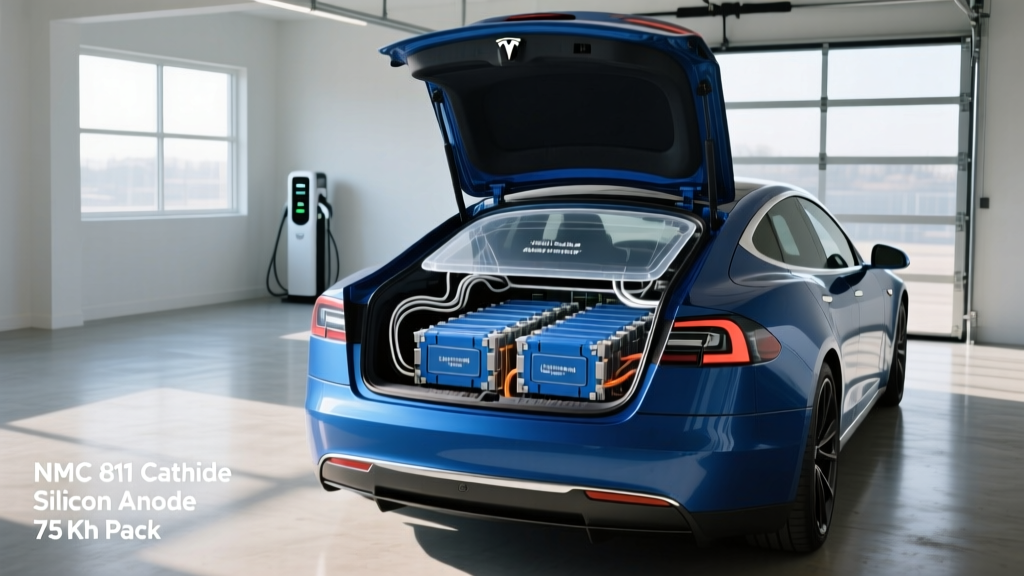
Tesla currently sources cells from CATL, Panasonic, LG Energy Solution, and its own 4680 cell lines, deploying two primary chemistries across its 2026 fleet: LFP (lithium iron phosphate) for Standard Range trims, and NMC/NCA (nickel manganese cobalt / nickel cobalt aluminum) for Long Range and Performance variants. Each chemistry delivers fundamentally different trade-offs in energy density, cycle life, cold-weather behavior, and cost.
Tesla Battery Chemistry Comparison (2026 Models)
| Attribute | LFP (LiFePO₄) | NMC / NCA (Nickel-based) |
|---|---|---|
| Models using it | Model 3 RWD, Model Y RWD | Model 3 LR/Perf, Model Y LR/Perf, Model S, Model X, Cybertruck |
| Energy density | Lower (~160 Wh/kg cell-level) | Higher (~250–300 Wh/kg cell-level) |
| Typical usable capacity | ~57–60 kWh | ~75–100 kWh |
| Cycle life | 3,000–5,000+ cycles | 1,500–2,500 cycles |
| Cold-weather range loss | Greater (~30–40% at 20°F) | Moderate (~20–30% at 20°F) |
| Recommended daily SoC | 100% (Tesla recommends weekly full charge) | 80% daily; 100% for trips only |
| Cobalt content | None | Low (NCA) to moderate (NMC) |
| Relative cost | Lower | Higher |
Which Tesla Models Use LFP vs. Nickel-Based Cells?
As of the 2026 model year, Tesla's chemistry assignments follow a predictable pattern tied to price positioning and range targets:
- Model 3 Rear-Wheel Drive: ~60 kWh LFP pack (CATL prismatic cells), EPA range 272 miles, 0–60 mph in 5.8 seconds.
- Model 3 Long Range AWD: ~79 kWh usable NMC pack (Panasonic/LG 2170 cells), EPA range 363 miles, 0–60 in 4.2 seconds.
- Model 3 Performance: ~79 kWh NMC, EPA range 315 miles, 0–60 in 2.9 seconds.
- Model Y Rear-Wheel Drive: ~60 kWh LFP, EPA range 260 miles.
- Model Y Long Range AWD: ~79 kWh NMC, EPA range 330 miles.
- Model S / Model X: ~100 kWh NMC/NCA pack (Panasonic 18650/2170), EPA range 402 / 348 miles respectively.
- Cybertruck AWD / Cyberbeast: ~123 kWh NMC (4680 structural pack), EPA range 340 / 320 miles.
The LFP-equipped Standard Range vehicles carry a lower MSRP and a smaller battery, but they compensate with superior cycle life and the ability to charge to 100% daily without accelerating degradation — a meaningful advantage for commuters who can install a Level 2 home charger.
How Long Do Tesla Batteries Actually Last?
Tesla publishes fleet data in its annual Impact Report, and independent analyses from sources like Recurrent Auto confirm that the vast majority of Tesla packs retain well above 80% of original capacity after 150,000 miles.
Typical Tesla Battery Degradation Curve
| Mileage | NMC (Long Range / Perf) | LFP (Standard Range) |
|---|---|---|
| New | 100% | 100% |
| 25,000 mi | ~94–96% | ~96–98% |
| 50,000 mi | ~90–93% | ~93–96% |
| 100,000 mi | ~86–90% | ~90–94% |
| 150,000 mi | ~82–88% | ~87–92% |
| 200,000 mi | ~78–85% | ~84–90% |
Source: Aggregated fleet data from Tesla Impact Reports and Recurrent Auto. Individual results vary based on charging habits, climate, and DC fast-charging frequency.
The pattern is clear: most degradation occurs in the first 20,000–30,000 miles (calendar aging and initial formation losses), after which the curve flattens significantly. LFP packs degrade more slowly due to their inherent chemical stability — the olivine crystal structure of iron phosphate resists lattice breakdown far better than nickel-rich cathodes under repeated cycling.
What Does the Tesla Battery Warranty Cover?
Tesla's battery and drive unit warranty is among the strongest in the industry, but the specifics matter — especially the capacity retention threshold.
Tesla Battery Warranty by Model (2026)
| Model | Warranty Period | Mileage Limit | Minimum Capacity Retention |
|---|---|---|---|
| Model 3 RWD (LFP) | 8 years | 100,000 miles | 70% |
| Model 3 LR / Perf | 8 years | 120,000 miles | 70% |
| Model Y RWD (LFP) | 8 years | 100,000 miles | 70% |
| Model Y LR / Perf | 8 years | 120,000 miles | 70% |
| Model S / Model X | 8 years | 150,000 miles | 70% |
| Cybertruck | 8 years | 120,000 miles | 70% |
Source: Tesla New Vehicle Limited Warranty. Warranty covers defects and capacity loss below the stated threshold under normal use. Damage from accidents, flooding, or unauthorized modifications is excluded.
The 70% threshold is the industry standard (matching Hyundai, Ford, and GM), but it's worth noting that very few Tesla owners actually hit this floor within the warranty period. Based on the degradation data above, even a 200,000-mile NMC pack typically retains 78–85% — well above the warranty trigger. The warranty is best understood as a backstop against manufacturing defects and anomalous cell failures, not as a prediction of normal end-of-life.
How Much Does a Tesla Battery Replacement Cost?
This is the question that dominates EV forums, and the honest answer requires context. Out-of-warranty battery replacements are rare — most packs outlast the vehicle's economic life — but when they are needed, costs are significant.
Estimated Tesla Battery Replacement Costs (2026)
| Model / Pack Size | Battery Cost (Parts) | Labor | Estimated Total |
|---|---|---|---|
| Model 3 RWD (~60 kWh LFP) | $8,000–$10,000 | $1,500–$2,500 | $9,500–$12,500 |
| Model 3/Y LR (~79 kWh NMC) | $12,000–$15,000 | $1,500–$2,500 | $13,500–$17,500 |
| Model S/X (~100 kWh NMC) | $15,000–$20,000 | $2,000–$3,000 | $17,000–$23,000 |
| Cybertruck (~123 kWh 4680) | $18,000–$25,000 | $2,500–$4,000 | $20,500–$29,000 |
Estimates based on service center invoices shared by owners and third-party EV repair shops. Costs are expected to decline as cell prices continue falling and refurbished packs become more available.
Two critical points: first, Tesla often replaces individual modules or the entire pack with a remanufactured unit rather than a brand-new battery, which can reduce cost. Second, the 4680 structural pack in the Cybertruck integrates cells into the vehicle's frame, making replacement more labor-intensive and expensive. For most Model 3 and Model Y owners, the likelihood of needing an out-of-warranty replacement is low — data from fueleconomy.gov and fleet operators shows that Tesla packs routinely exceed 200,000 miles before reaching 70% capacity.
Factors That Accelerate (or Preserve) Battery Life
Battery degradation is not purely a function of time or mileage — your habits play a measurable role. Here's what the electrochemistry actually responds to:
Battery Longevity Best Practices
- Limit DC fast charging to road trips. Frequent Supercharging (250 kW peak) generates heat that stresses nickel-rich cathodes. For daily use, Level 2 at 7–11 kW is ideal. If you must fast-charge daily, precondition the battery via navigation to a Supercharger to optimize thermal management.
- Follow the SoC guidance for your chemistry. LFP owners should charge to 100% at least weekly (Tesla's BMS needs full-charge calibration for accurate range estimation). NMC/NCA owners should set the daily limit to 80% and reserve 100% for trip days.
- Avoid prolonged storage at extremes. Leaving an NMC pack at 100% SoC in 100°F+ heat for days accelerates electrolyte decomposition. If storing, set SoC to ~50% and plug in so the thermal management system can maintain battery temperature.
- Use Scheduled Departure. Tesla's Scheduled Departure feature warms or cools the battery while plugged in, reducing the energy drawn from the pack for cabin conditioning and minimizing cold-weather regen limitations.
- Don't obsess about range loss. A 2–3% loss in the first year is normal formation degradation. The curve flattens. Check State of Health quarterly, not daily.
Cold weather deserves special mention. At 20°F, expect 20–30% range reduction on NMC packs and 30–40% on LFP packs due to increased internal resistance and cabin heating demands. Tesla's heat pump (standard on all current models) mitigates this compared to resistive heating, but physics is physics — Tesla's thermal management system can only optimize, not eliminate, cold-weather losses.
How to Check Your Tesla's Battery Health (SoH)
Tesla doesn't expose a direct "State of Health" percentage in the vehicle UI the way some competitors do, but there are reliable methods to estimate it:
- Projected Range Method: Charge to 100% (LFP) or your typical max (NMC) and note the displayed range. Compare to the EPA sticker when new. A Model 3 LR that showed 363 miles new and now shows 330 miles at 100% has roughly 91% SoH.
- Tesla Service Mode: On newer software versions, entering Service Mode (tap the vehicle model name on the About screen, type "service" in the prompt) reveals a "Battery Health" screen with a percentage readout. Availability varies by software version.
- Third-Party Apps: Tools like Tessie, TeslaFi, or Stats (iOS) log charge sessions and calculate SoH over time using kWh-delivered vs. range-added ratios.
- OBD-II Dongles: Devices like the OBDLink SX paired with apps such as Scan My Tesla can read BMS data including nominal full-pack energy (kWh), which you compare to the original spec.
For warranty claims, Tesla Service will run a diagnostic that reads the BMS-reported capacity. If it falls below 70% within the warranty window, replacement is covered.
What's Next: Solid-State and Silicon Anode Batteries
The battery industry is actively developing next-generation chemistries, but it's essential to separate laboratory milestones from production timelines.
Solid-state batteries — which replace the liquid electrolyte with a solid conductor — promise higher energy density (~400+ Wh/kg cell-level), faster charging, and improved safety. Companies like QuantumScape, Toyota, and Samsung SDI have demonstrated prototype cells, but manufacturing yield, cost, and scale remain unsolved. Realistic production timeline for automotive volumes: 2028–2032, likely debuting in premium models first.
Silicon anode technology replaces graphite anodes with silicon-dominant composites, boosting energy density by 20–40%. Tesla's 4680 cells already incorporate incremental silicon content, and companies like Sila Nanotechnologies and Group14 are scaling supply. Expect gradual adoption through 2026–2028 model years rather than a sudden generational leap.
Sodium-ion batteries are emerging as a low-cost alternative for entry-level EVs, with CATL beginning volume production. Tesla has not announced sodium-ion adoption, but the chemistry is viable for urban-commuter vehicles where energy density is less critical than cost.
None of these technologies are available in any Tesla you can order today. If you're buying in 2026, LFP and NMC are mature, well-understood chemistries with proven longevity data — there is no compelling reason to wait for solid-state.
Frequently Asked Questions
How long do Tesla batteries last in years and miles?
Based on fleet data, Tesla batteries typically retain 80–90% capacity at 150,000 miles. Most packs will exceed 200,000 miles before reaching the 70% warranty threshold. In years, expect 15–20+ years of usable service under normal driving patterns (12,000–15,000 miles/year).
Is LFP better than NMC for a Tesla?
Neither is universally "better" — they serve different use cases. LFP offers longer cycle life, lower cost, and 100% daily charging capability, making it ideal for commuters with home charging. NMC delivers higher energy density and better cold-weather performance, making it the right choice for road-trippers and those who need maximum range.
Does frequent Supercharging damage the battery?
Occasional Supercharging on road trips has negligible impact. Daily DC fast charging does accelerate degradation slightly — studies show an additional 1–3% capacity loss over 100,000 miles compared to exclusive Level 2 charging. Tesla's battery preconditioning and thermal management mitigate much of this, but Level 2 remains the longevity-optimal choice for daily use.
Can I replace individual battery modules instead of the whole pack?
Yes, Tesla Service Centers and some independent EV shops can replace individual modules within a pack. This is common for isolated cell failures and costs significantly less than a full pack replacement ($1,500–$4,000 per module depending on the model). However, if overall capacity has degraded uniformly, a full pack swap may be recommended.
Does the Tesla battery warranty transfer to a second owner?
Yes. Tesla's battery and drive unit warranty is tied to the vehicle VIN, not the original owner. If you buy a used Tesla with 60,000 miles, you still have the remainder of the 8-year/120,000-mile (or 100,000/150,000-mile) coverage. This is a significant advantage in the used EV market.
What happens when an EV battery reaches end of life?
"End of life" for an EV battery means it has degraded below ~70% capacity — it still functions, just with reduced range. Many packs are repurposed for stationary energy storage (Tesla's own Megapack program uses recycled cells). Tesla states that 100% of its returned batteries are recycled through partners like Redwood Materials, recovering 92%+ of critical minerals.