Why the Size of a Tesla Battery Matters More Than You Think
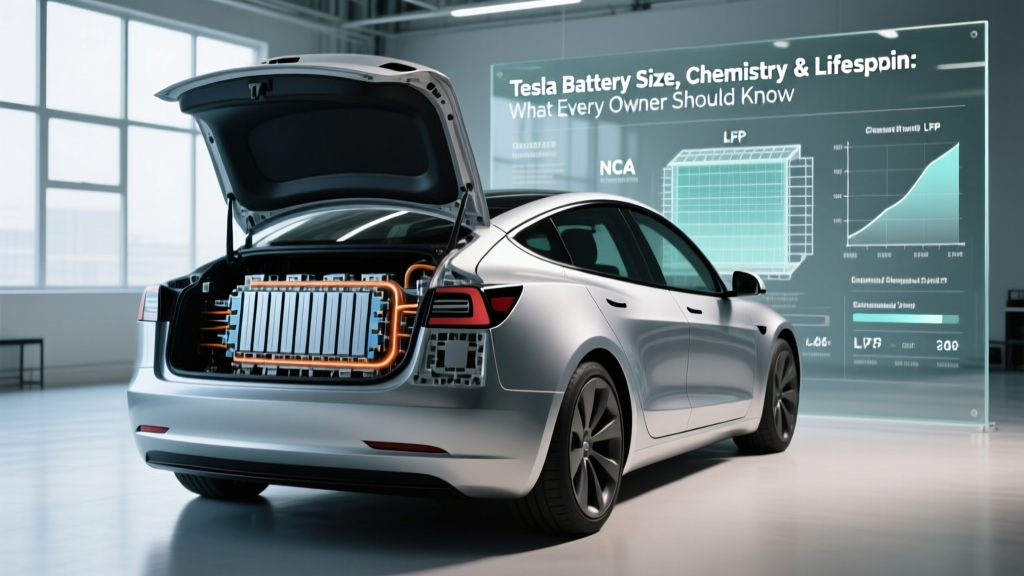
When buyers search for the size of a Tesla battery, they're usually asking two different questions: how much energy does it store (measured in kilowatt-hours, or kWh), and how large is the physical pack under the floor. Both answers shape everything from EPA range and charging speed to vehicle weight, handling, and long-term ownership cost. Tesla currently offers several battery configurations across the Model 3, Model Y, Model S, Model X, and the Cybertruck, and the chemistry inside those packs — not just the capacity — determines how they age, charge, and perform in extreme weather.
This guide breaks down every major Tesla battery pack available in the 2025–2026 model years, explains the real-world trade-offs between LFP and NMC/NCA chemistries, and gives you the data to project degradation, warranty coverage, and eventual replacement costs. We'll also cover how to monitor State of Health (SoH) and what emerging solid-state technology might mean for future packs.
Tesla Battery Sizes by Model: kWh, Chemistry, and EPA Range
Tesla does not publish official usable kWh figures on its consumer spec sheets, but teardown data, EPA filings on fueleconomy.gov, and service documentation give us reliable numbers. Below is the current lineup as of the 2026 model year.
| Model / Trim | Usable Capacity (kWh) | Chemistry | EPA Range (mi) | Real-World Highway Estimate |
|---|---|---|---|---|
| Model 3 RWD | ~57.5 kWh | LFP (CATL) | 272 | ~230–245 mi |
| Model 3 Long Range AWD | ~75 kWh | NMC/NCA | 363 | ~300–320 mi |
| Model 3 Performance | ~75 kWh | NMC/NCA | 315 | ~260–280 mi |
| Model Y RWD | ~57.5 kWh | LFP (CATL) | 260 | ~220–235 mi |
| Model Y Long Range AWD | ~75 kWh | NMC/NCA | 320 | ~270–290 mi |
| Model S Dual Motor | ~95 kWh | NMC (Panasonic) | 402 | ~330–360 mi |
| Model X Dual Motor | ~95 kWh | NMC (Panasonic) | 348 | ~290–310 mi |
| Cybertruck AWD | ~123 kWh | NMC (4680 cells) | 340 | ~280–300 mi |
LFP vs NMC/NCA: The Chemistry Trade-Off Explained
The single biggest decision Tesla makes for each trim is which cell chemistry goes inside the pack. Since 2021, Tesla has used two primary chemistries in its consumer vehicles: Lithium Iron Phosphate (LFP) and Nickel Manganese Cobalt / Nickel Cobalt Aluminum (NMC/NCA). Each has distinct strengths, and understanding them is essential for choosing the right trim — and for caring for the battery over its lifespan.
| Attribute | LFP (LiFePO₄) | NMC / NCA |
|---|---|---|
| Energy Density | Lower (~160 Wh/kg cell-level) | Higher (~250–300 Wh/kg cell-level) |
| Typical Use in Tesla | Model 3/Y RWD (Standard Range) | Long Range, Performance, S/X, Cybertruck |
| Cycle Life | 3,000–5,000+ cycles to 80% SoH | 1,000–2,000 cycles to 80% SoH |
| Cold-Weather Performance | Moderate — slightly less range loss at low SoC | Better low-temp conductivity, but more stress at high SoC + cold |
| Charging Recommendation | Can charge to 100% daily (Tesla recommends weekly 100%) | Best kept at 80% daily; 100% only for trips |
| Cost | Lower — no cobalt or nickel | Higher — commodity-priced nickel/cobalt |
| Thermal Stability | Excellent — less prone to thermal runaway | Good — requires more active thermal management |
| SoC Estimation Accuracy | Flat voltage curve makes BMS estimation harder | Steeper voltage curve allows more precise BMS tracking |
Which is better? Neither is universally superior. LFP wins on longevity, cost, and daily charging convenience — ideal for commuters who drive 30–60 miles daily and can charge at home. NMC/NCA wins on range per kilogram and cold-weather capability — better for road-trippers and those in northern climates who need maximum range. Tesla's decision to put LFP in base trims and NMC in premium trims reflects this positioning.
How Long Do Tesla Batteries Last? Degradation Data
Tesla batteries are engineered to outlast the vehicle itself in most cases. According to Tesla's 2023 Impact Report (the most recent with large-scale fleet data), Model 3 and Model Y batteries retain approximately 85% of their original capacity after 150,000 miles. Model S and Model X data shows similar retention at equivalent mileage, though older packs (pre-2020) showed slightly steeper curves.
• Year 1 / 15,000 mi: ~3–5% loss (initial formation loss)
• Year 3 / 45,000 mi: ~6–8% total loss
• Year 5 / 75,000 mi: ~8–10% total loss
• Year 8 / 120,000 mi: ~10–15% total loss
• Year 10+ / 150,000+ mi: ~12–18% total loss
Note: LFP packs tend to show slower degradation in the 20–80% SoC range but may show slightly faster initial calendar aging. Individual results vary significantly based on charging habits, climate, and Supercharger frequency.
The degradation curve is not linear. Most lithium-ion batteries experience a relatively rapid initial capacity drop (formation loss) in the first year or two, then settle into a slow, nearly linear decline for the remainder of their life. This means a Tesla battery that has lost 8% after three years has not necessarily lost 16% by year six — the rate typically slows.
Tesla Battery Warranty: What's Covered and for How Long
Tesla's battery and drive unit warranty is among the strongest in the industry. Coverage applies to the high-voltage traction battery (not the 12V auxiliary battery) and guarantees that the battery will retain a minimum percentage of its original capacity over the warranty period.
| Model | Warranty Period | Mileage Limit | Minimum Capacity Retention |
|---|---|---|---|
| Model 3 RWD (LFP) | 8 years | 100,000 miles | 70% |
| Model 3 Long Range / Performance | 8 years | 120,000 miles | 70% |
| Model Y (all trims) | 8 years | 120,000 miles | 70% |
| Model S / Model X | 8 years | 150,000 miles | 70% |
| Cybertruck | 8 years | 120,000 miles | 70% |
What triggers a warranty claim? If your battery's usable capacity drops below 70% of its original spec within the warranty period (verified by Tesla's diagnostic tools), Tesla will repair or replace the pack at no cost. In practice, very few owners hit this threshold. Fleet data suggests that fewer than 1% of Tesla battery packs have required warranty replacement, and most of those were due to manufacturing defects rather than normal degradation.
The warranty also covers defects in materials and workmanship, including individual module failures and BMS (Battery Management System) malfunctions. It does not cover damage from accidents, flooding, or unauthorized modifications.
How Much Does a Tesla Battery Replacement Cost?
Out-of-warranty battery replacement is the concern that keeps many prospective EV buyers awake at night. Here's what the data actually shows for 2025–2026 pricing:
| Model | Battery Size | Estimated Replacement Cost | When Typically Needed |
|---|---|---|---|
| Model 3 RWD (LFP) | ~57.5 kWh | $12,000–$16,000 | Rarely — most packs outlast the vehicle |
| Model 3/Y Long Range | ~75 kWh | $15,000–$20,000 | 200,000+ mi or 15+ years |
| Model S / Model X | ~95 kWh | $20,000–$28,000 | 200,000+ mi or 15+ years |
| Cybertruck | ~123 kWh | $25,000–$35,000 | Too new for fleet data |
These figures include parts and labor at Tesla Service Centers. Third-party EV repair shops may offer refurbished packs at 30–50% lower cost, though availability is limited and warranty terms vary. Importantly, Tesla often replaces only failed modules rather than the entire pack when possible, reducing costs significantly for partial failures.
Context that matters: The average age of a scrapped passenger vehicle in the US is approximately 15 years, and the average mileage at scrappage is around 180,000 miles. Given Tesla's degradation data, most batteries will retain 80%+ capacity at that point — meaning the battery is very likely to outlive the car's economic life. Replacement is a real cost, but it is not the inevitability that some fear.
Factors That Accelerate (or Slow) Battery Degradation
Battery longevity is not purely a function of time and mileage. How you charge, where you park, and how you drive all measurably affect the rate of capacity loss. Here are the factors ranked by impact:
- State of Charge Habits (High Impact): Storing an NMC/NCA battery at 100% SoC for extended periods accelerates electrolyte decomposition. Tesla recommends setting daily charge limits to 80% for NMC packs and only charging to 100% when departing on a trip. LFP packs are an exception — Tesla recommends charging to 100% at least once per week for accurate BMS calibration.
- DC Fast Charging Frequency (Moderate Impact): Frequent Supercharging (3+ times per week consistently over years) adds thermal stress. Tesla's thermal management system mitigates this significantly, but fleet data shows a small but measurable increase in degradation for vehicles that rely heavily on DC fast charging versus Level 2 home charging.
- Extreme Temperature Exposure (Moderate Impact): Repeated exposure to ambient temperatures above 95°F or below 15°F — especially at high SoC — accelerates calendar aging. Parking in a garage and using Tesla's scheduled departure preconditioning reduces this stress.
- Deep Discharges (Low-Moderate Impact): Routinely driving the battery below 10% SoC and letting it sit in that state stresses the cells. Occasional low-SoC driving is fine; leaving the car unplugged at 5% for days is not.
- Aggressive Acceleration (Low Impact): High C-rate discharges (Ludicrous/Plaid mode launches) generate heat, but Tesla's thermal management handles this well. Impact on long-term degradation is minimal for normal use.
How to Monitor and Maximize Tesla Battery Health
Tesla does not expose a direct State of Health (SoH) percentage in the vehicle's native interface the way some competitors do. However, owners have several reliable methods to track battery health:
1. Tesla App — Energy & Range Estimates: The Tesla app shows projected range at your current SoC. By comparing your range at 100% charge (for LFP) or at a known SoC against the original EPA figure, you can estimate capacity loss. For example, if your Model 3 Long Range originally showed 363 miles at 100% and now shows 330 miles at 100%, that's roughly 9% degradation.
2. Third-Party Apps: Tools like Tessie, TeslaFi, and Stats (iOS) log detailed battery data over time, including estimated SoH, charge curves, and energy consumption trends. These are widely used by the Tesla owner community and provide more granular tracking than the native app.
3. Service Mode (Advanced): Tesla's Service Mode (accessible via the software menu on most 2021+ vehicles) displays the battery's nominal full-pack capacity in kWh. Comparing this to the original spec gives a direct SoH calculation. Use with caution — changing settings in Service Mode can affect vehicle configuration.
4. Annual Service Check: If you notice a sudden drop in range or irregular charging behavior, a Tesla Service Center can run a full battery health diagnostic. This is the most authoritative measurement and is required for any warranty claim.
Emerging Battery Tech: Solid-State and Silicon Anodes
Tesla's current battery roadmap centers on scaling its 4680 cell format (used in Cybertruck and some Model Y vehicles built at Giga Texas). These cells use a dry-electrode manufacturing process that reduces cost and energy consumption during production, but they still use conventional NMC chemistry.
Solid-State Batteries: Multiple companies — including Toyota, QuantumScape, and Samsung SDI — have announced solid-state battery prototypes promising 50–80% more energy density, faster charging, and improved safety. However, as of early 2026, no solid-state pack is in mass production for any consumer vehicle. Realistic timelines for commercial availability in Tesla or competitor vehicles point to 2028–2030 at the earliest, with initial deployment likely in premium models due to high manufacturing costs.
Silicon Anode Technology: Companies like Sila Nanotechnologies and Group14 are developing silicon-dominant anodes that can boost energy density by 20–40% over graphite anodes. Tesla has shown interest in silicon anode research, and incremental silicon content in anodes is already present in some current cells. Wider adoption is expected throughout the late 2020s, but this is an evolution of existing lithium-ion technology, not a replacement for it.
What this means for buyers today: Waiting for solid-state batteries is not a practical purchase strategy. Current Tesla batteries already offer 250,000+ mile projected lifespans, 8-year warranties, and degradation rates that keep the vehicle functional well beyond its economic life. The next generation of batteries will improve cost and energy density, but the fundamentals of EV ownership are already established with today's technology.
Frequently Asked Questions
How long do Tesla batteries last in years and miles?
Based on Tesla's fleet data, most Model 3 and Model Y batteries retain approximately 85% capacity at 150,000 miles. At typical US driving rates of 12,000–15,000 miles per year, that equates to 10–12 years before reaching 85% State of Health. Many packs will function well beyond 200,000 miles before dropping to the 70% warranty threshold.
How much does it cost to replace a Tesla battery out of warranty?
Full pack replacement costs range from approximately $12,000 for a Model 3 RWD (LFP) to $28,000+ for a Model S/X. However, Tesla often replaces individual modules rather than the full pack for partial failures, reducing costs. Full replacement is rarely needed — most packs outlast the vehicle's economic life.
What does the Tesla battery warranty actually cover?
Tesla's battery warranty covers capacity loss below 70% of original capacity within 8 years (100,000–150,000 miles depending on model), plus defects in materials and workmanship. It does not cover damage from accidents, flooding, or unauthorized modifications. The 12V auxiliary battery is covered separately under a shorter warranty period.
Should I charge my Tesla to 100% every day?
It depends on chemistry. If your Tesla has an LFP battery (Model 3 RWD, Model Y RWD), Tesla recommends charging to 100% at least once per week for BMS calibration, and daily 100% charging is acceptable. If you have an NMC/NCA battery (Long Range, Performance, Model S/X), set your daily charge limit to 80% and only charge to 100% when departing on a longer trip.
Does frequent Supercharging damage the battery?
Tesla's thermal management system actively cools and heats the battery during Supercharging to minimize stress. Fleet data shows that vehicles relying primarily on Supercharging experience slightly higher degradation than those using Level 2 home charging, but the difference is modest — typically a few percentage points over 100,000 miles. Occasional Supercharging is not harmful; daily exclusive Supercharging over many years adds measurable wear.
LFP vs NMC: which Tesla battery chemistry should I choose?
Choose LFP (Model 3/Y RWD) if you commute shorter distances, charge primarily at home, want maximum cycle life, and prefer the simplicity of charging to 100% daily. Choose NMC/NCA (Long Range, Performance, S/X) if you need maximum EPA range for road trips, live in a cold climate where energy density matters, or want the highest performance. Both chemistries are proven and reliable — the right choice depends on your driving pattern.