If you're researching a Tesla purchase — new or used — one question inevitably dominates: how many miles do Tesla batteries last before degradation makes the car impractical or triggers a costly replacement? The short answer, backed by Tesla's own fleet data and independent analysis, is that most Tesla high-voltage traction batteries retain 80% or more of their original capacity after 200,000 miles, and many outlast the vehicle's chassis and interior. But the nuance matters. Chemistry, charging habits, climate, and model year all shape the degradation curve you'll actually experience.
This guide dissects the data behind Tesla battery longevity across the Model 3, Model Y, Model S, and Model X lineups as of the 2026 model year. We'll cover the two battery chemistries Tesla uses, what the warranty actually protects, what a replacement costs if you need one outside warranty, and how to monitor and maximize your pack's State of Health (SoH).
Tesla Battery Lifespan: What the Data Shows
Tesla's 2024 Impact Report (the most recent comprehensive fleet data published) states that Model 3 and Model Y vehicles retain approximately 85% of their original battery capacity at 200,000 miles. Model S and Model X packs show roughly 88% retention at the same mileage — a reflection of their larger battery buffers and more conservative depth-of-discharge usage patterns. These figures are fleet averages across millions of vehicles and varied climates, so individual results will differ.
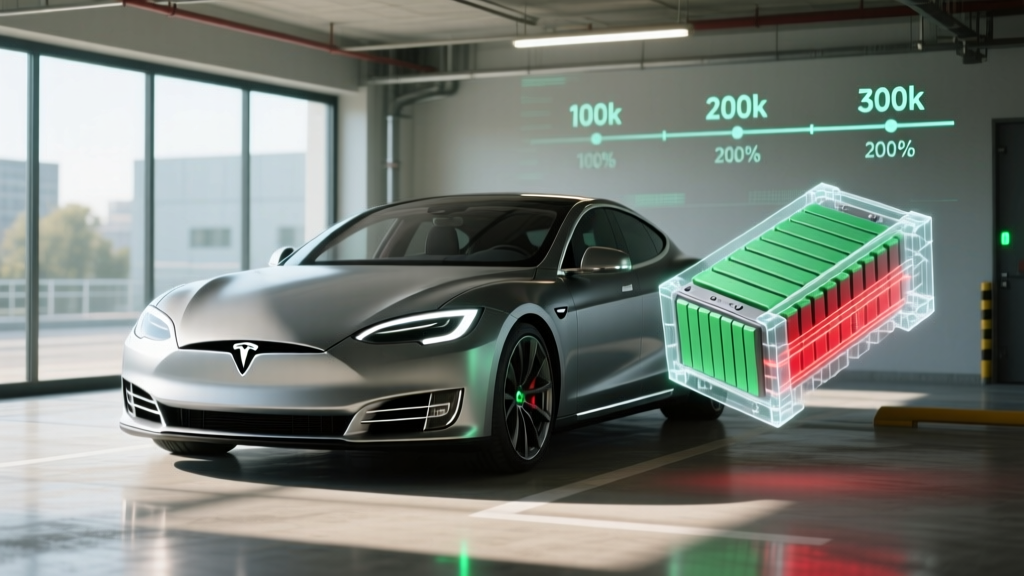
Typical Tesla Battery Degradation Curve (Fleet Average):
- 0–30,000 miles: ~2–5% capacity loss (initial steeper drop as the battery's solid electrolyte interphase layer stabilizes)
- 30,000–100,000 miles: ~0.5–1% loss per 15,000 miles (gradual, nearly linear)
- 100,000–200,000 miles: ~0.3–0.7% loss per 15,000 miles (plateau phase)
- 200,000+ miles: Pack typically retains 80–88% of original capacity depending on model and chemistry
Source: Tesla Impact Reports, tesla.com; corroborated by independent fleet data from Recurrent Auto and Teslanomics.
The critical insight here is that degradation is not linear. You lose the most capacity in the first year or two, then the curve flattens considerably. A Model 3 Long Range with an EPA-rated 341 miles when new might realistically offer 310–320 miles of range at 50,000 miles and 275–295 miles at 200,000 miles — still very usable for daily driving and road trips.
LFP vs. NMC/NCA: Which Tesla Battery Chemistry Is Better?
Tesla uses two distinct lithium-ion chemistries across its 2026 lineup, and understanding the trade-offs is essential for predicting longevity and choosing the right model.
NMC/NCA (Nickel Manganese Cobalt / Nickel Cobalt Aluminum) powers the Long Range and Performance variants of the Model 3, Model Y, Model S, and Model X. These cells — supplied primarily by Panasonic (at Gigafactory Nevada) and LG Energy Solution — offer high energy density, which translates to longer EPA range in a given pack size. They perform better in cold weather but degrade slightly faster under high state-of-charge stress.
LFP (Lithium Iron Phosphate) is used in the standard-range (Rear-Wheel Drive) Model 3 and Model Y. Sourced primarily from CATL, LFP cells have lower energy density (meaning slightly less range for a given weight) and reduced cold-weather performance. However, they tolerate 100% state-of-charge storage far better, support more charge cycles before significant degradation, and contain no cobalt or nickel — reducing supply-chain cost and ethical concerns.
| Attribute | NMC/NCA (Long Range / Performance) | LFP (Standard Range / RWD) |
|---|---|---|
| Energy Density | Higher — enables 320–402 mi EPA range | Lower — 272–300 mi EPA range |
| Cycle Life | ~1,000–1,500 full cycles to 80% SoH | ~2,000–3,000+ full cycles to 80% SoH |
| Cold-Weather Performance | Better — ~20–25% range loss at 20°F | Worse — ~25–35% range loss at 20°F |
| Recommended Daily Charge Limit | 80% (per Tesla guidance) | 100% (Tesla recommends weekly full charges) |
| Cost (Cell Level) | Higher (nickel/cobalt commodity exposure) | Lower (abundant iron/phosphate) |
| Models Using This Chemistry | Model 3 LR/Perf, Model Y LR/Perf, Model S, Model X | Model 3 RWD, Model Y RWD |
| Typical 200k-mi Retention | ~83–88% | ~85–90% |
Which is better? If your priority is maximum range and cold-climate usability, NMC/NCA wins. If you want the longest possible cycle life and don't mind a slightly lower EPA range — and you can charge to 100% regularly without guilt — LFP is the longevity champion. For most urban and suburban drivers covering under 15,000 miles annually, the LFP Model 3 or Model Y RWD offers the most durable battery over a 10–15 year ownership window.
Tesla Battery Warranty: What's Actually Covered
Tesla's high-voltage battery warranty is one of the more straightforward in the EV industry, but the details matter if you ever need to make a claim.
| Model | Warranty Duration | Mileage Limit | Minimum Capacity Retention |
|---|---|---|---|
| Model 3 RWD (LFP) | 8 years | 100,000 miles | 70% |
| Model 3 Long Range / Performance | 8 years | 120,000 miles | 70% |
| Model Y (all trims) | 8 years | 120,000 miles | 70% |
| Model S / Model X | 8 years | 150,000 miles | 70% |
The warranty guarantees that your battery will retain at least 70% of its original usable capacity for the stated period or mileage, whichever comes first. If your pack drops below that threshold within the warranty window, Tesla will repair or replace it to bring capacity back above 70%. Critically, this covers defects and abnormal degradation — not damage from accidents, flooding, or improper modification.
The 70% threshold is important context: it means a Model 3 Long Range (EPA 341 mi) would need to fall below roughly 239 miles of range at full charge to qualify for a warranty claim. Given that fleet data shows most packs retain 80%+ at 200,000 miles, very few owners ever approach this threshold within the warranty period.
Tesla Battery Replacement Cost: What to Budget
Most Tesla batteries will never need replacement during typical ownership. But if you plan to keep your vehicle past the warranty window, or you're buying a high-mileage used Tesla, here's what out-of-warranty replacement costs look like in 2026.
| Model | Battery Size (Usable kWh) | Remanufactured Pack | New Pack (if available) |
|---|---|---|---|
| Model 3 RWD (LFP) | ~57.5 kWh | $8,000–$10,000 | $12,000–$14,000 |
| Model 3 Long Range | ~75 kWh | $10,000–$13,000 | $14,000–$16,000 |
| Model Y Long Range | ~75 kWh | $10,000–$13,000 | $14,000–$17,000 |
| Model S | ~95 kWh | $13,000–$16,000 | $18,000–$22,000 |
| Model X | ~95 kWh | $13,000–$16,000 | $18,000–$22,000 |
These ranges include the battery pack and labor at a Tesla Service Center. Third-party EV shops may offer lower pricing, particularly with remanufactured packs. Tesla increasingly uses remanufactured battery packs for out-of-warranty replacements — these are packs that have been disassembled, had weak modules replaced, and been recertified. They carry their own limited warranty (typically 1–2 years).
To put this in perspective: a $13,000 battery replacement at 250,000 miles on a Model 3 Long Range still represents roughly $0.052 per mile driven over the vehicle's life — far less than the cumulative fuel and maintenance costs of a comparable gasoline sedan over the same distance. The fear of catastrophic battery replacement costs is largely overblown for owners who plan to drive the car into high mileage.
What Affects Tesla Battery Life? Six Key Factors
Not all Tesla batteries age identically. Your charging patterns, climate, and driving style materially influence the degradation curve. Here are the six factors with the largest impact:
1. State of Charge (SoC) Habits
Lithium-ion cells degrade fastest when held at extremes — either 100% or near 0% SoC — for extended periods. For NMC/NCA packs, Tesla recommends setting your daily charge limit to 80% and only charging to 100% when preparing for a road trip. LFP packs are an exception: Tesla explicitly recommends charging to 100% at least once per week to keep the battery management system (BMS) calibrated, as LFP's flatter voltage curve makes SoC estimation harder.
2. DC Fast Charging Frequency
Supercharging at 150–250 kW generates significant heat within the cells. Tesla's thermal management system (liquid cooling) mitigates this effectively, but frequent exclusive use of DC fast charging — say, daily Supercharging without home Level 2 — has been correlated with slightly higher degradation rates. Studies from Recurrent Auto suggest that vehicles fast-charging more than 90% of the time show approximately 2–3% additional degradation at 100,000 miles compared to predominantly Level 2-charged vehicles. The effect is real but modest.
3. Temperature Extremes
Hot climates (consistently above 95°F) accelerate electrolyte decomposition. Cold climates (below 20°F) don't permanently damage the battery but reduce available capacity temporarily and increase charging stress if you fast-charge without preconditioning. Tesla's heat pump (standard on all 2026 models) and battery preconditioning feature help significantly — always enable "Navigate to Supercharger" routing to trigger automatic preconditioning before a fast-charge session.
4. Depth of Discharge
Cycling from 90% down to 10% and back stresses cells more than shallow cycles between 70% and 30%. If your daily commute uses only 20% of your battery, you're in the ideal zone. Owners who regularly drain below 10% and then immediately fast-charge to 100% are imposing the most stressful cycle pattern possible.
5. Storage Conditions
Leaving a Tesla parked at 100% SoC in a hot garage for weeks is one of the fastest ways to accelerate calendar degradation. If storing for more than a week, set the charge limit to 50% and plug in (the car will maintain that level). Tesla's "Sentry Mode" and cabin overheat protection also draw power and can push SoC lower if unplugged.
6. Software and BMS Updates
Tesla periodically releases over-the-air updates that adjust the BMS charging profile, thermal thresholds, and usable buffer. Occasionally, an update may slightly reduce displayed range at full charge while actually protecting long-term health. This is normal and reflects refined management algorithms, not degradation.
Tesla Battery Care Best Practices:
- ✅ Set daily charge limit to 80% (NMC/NCA) or 100% (LFP, weekly minimum)
- ✅ Plug in whenever parked at home — the BMS works best when connected
- ✅ Use Level 2 (7–11.5 kW) for the majority of your charging
- ✅ Enable preconditioning before Supercharging (use in-car navigation to route to a Supercharger)
- ✅ Avoid leaving the car below 10% SoC for more than a few hours
- ✅ If storing for 2+ weeks, set SoC to ~50% and leave plugged in
- ❌ Don't daily-drive to 5% and then immediately Supercharge to 100%
- ❌ Don't leave the car at 100% SoC in hot weather for extended periods
How to Check Your Tesla's Battery Health (State of Health)
Tesla does not display a dedicated "State of Health" percentage in the vehicle's UI the way some competitors do. But there are several reliable methods to estimate your pack's SoH:
Method 1: Displayed Range at 100% Charge
Charge your Tesla to 100% (do this for NMC/NCA cars only when needed for a trip; for LFP, it's routine). Note the displayed rated range. Compare this to the original EPA-rated range for your specific model and year. Example: a 2024 Model 3 Long Range had an EPA rating of 341 miles. If your car displays 310 miles at 100% after 60,000 miles, your estimated SoH is roughly 310/341 = ~91%.
Caveat: The displayed range is influenced by the BMS calibration, which can drift. For NMC/NCA packs that are never charged to 100%, the BMS may underestimate capacity. A full charge-to-100% session followed by a drive down to 10% and back to 100% recalibrates the system.
Method 2: Tesla Service Mode (DIY)
Some Tesla owners access Service Mode (hold the model name on the Software screen for ~5 seconds, enter "service" as the access code) to view more detailed battery metrics, including nominal full-pack energy (kWh). Comparing this figure to the original pack capacity gives a direct SoH percentage. Note: Tesla may restrict Service Mode access in future updates.
Method 3: Third-Party Diagnostics
Services like Recurrent Auto (free enrollment) connect to your Tesla's telematics and provide ongoing SoH tracking, degradation projections, and battery health reports — useful for peace of mind or for documenting health when selling a used Tesla.
What's Next: Solid-State and Silicon Anode Batteries
The battery landscape is evolving, and Tesla — along with the broader industry — is investing in next-generation chemistries. Here's what's realistic as of 2026:
Silicon-dominant anodes: Companies like Sila Nanotechnologies and Group14 are supplying silicon-carbon anode materials that increase energy density by 10–20% over current graphite anodes. Tesla has begun incorporating incremental silicon content into newer 4680 cells. This is happening now, in production, but the gains are evolutionary rather than revolutionary.
Solid-state batteries: These promise higher energy density, faster charging, and improved safety by replacing the liquid electrolyte with a solid ceramic or polymer. Toyota, QuantumScape, and Samsung SDI have demonstrated prototypes, but commercial-scale production for passenger vehicles remains in the 2028–2032 window by most credible estimates. Solid-state cells are not available in any production Tesla as of 2026.
4680 cell evolution: Tesla's in-house 4680 cells (used in the Model Y from Giga Texas and the refreshed Model 3) continue to improve in yield, energy density, and manufacturing cost. The structural battery pack design — where cells form part of the vehicle's chassis — reduces weight and cost. Expect incremental improvements each model year rather than a single breakthrough moment.
For current buyers: don't delay a purchase waiting for solid-state. The NMC and LFP packs in today's Teslas are mature, well-understood, and demonstrably long-lasting. The next generation will be better, but today's batteries are already sufficient for 200,000+ miles of service.
Frequently Asked Questions
How many miles do Tesla batteries last before needing replacement?
Based on Tesla's fleet data and independent tracking, most Tesla batteries retain 80–88% of their original capacity at 200,000 miles. Very few require replacement before 300,000 miles under normal use. The battery is one of the most durable components in the vehicle — most owners will sell or total the car for unrelated reasons before the battery becomes unusable.
How much does it cost to replace a Tesla battery out of warranty?
Out-of-warranty replacement costs range from approximately $8,000 for a remanufactured Model 3 RWD pack to $22,000 for a new Model S/X pack. Remanufactured packs are the most common option and typically cost $8,000–$16,000 depending on model and capacity. Labor is included in these estimates at a Tesla Service Center.
What does the Tesla battery warranty cover?
Tesla's battery warranty covers capacity loss below 70% of original capacity for 8 years / 100,000–150,000 miles (depending on model). It also covers manufacturing defects and abnormal degradation. It does not cover damage from accidents, environmental events, or unauthorized modifications. See Tesla's warranty page for full terms.
Is it bad to Supercharge my Tesla every day?
It's not catastrophic, but it's not optimal. Data suggests exclusive DC fast charging adds roughly 2–3% more degradation at 100,000 miles compared to Level 2 charging. If you have access to home or workplace Level 2 charging, use it for daily needs and reserve Supercharging for road trips. Tesla's preconditioning system helps reduce fast-charging stress when you navigate to a Supercharger via the car's built-in routing.
LFP vs. NMC — which Tesla battery lasts longer?
LFP batteries generally offer longer cycle life (2,000–3,000+ cycles to 80% SoH vs. 1,000–1,500 for NMC/NCA). In real-world mileage terms, an LFP Model 3 RWD is likely to show slightly less degradation at 200,000 miles than an NMC Model 3 Long Range, all else being equal. However, NMC packs offer more range and better cold-weather performance. The "better" chemistry depends on your priorities — LFP for longevity and cost, NMC for range and cold-climate usability.
Should I buy a used Tesla with high mileage?
High-mileage Teslas (100,000–200,000 miles) can be excellent value if the battery SoH checks out. Use the 100% charge test or a third-party service like Recurrent to verify capacity. A 150,000-mile Model 3 Long Range with 88% SoH still delivers over 300 miles of range and may have 100,000+ miles of useful life remaining. The bigger concerns with high-mileage used Teslas are suspension components, drive unit bearings, and cosmetic wear — not the battery.
Does cold weather permanently damage Tesla batteries?
No. Cold weather temporarily reduces available range (20–35% depending on chemistry and temperature) and slows charging speeds, but it does not cause permanent damage. Tesla's battery preconditioning — activated when you navigate to a Supercharger — warms the pack to an optimal temperature before you arrive, minimizing stress. The bigger longevity risk is heat, not cold.