The Short Answer: Most Tesla Batteries Outlast the Car
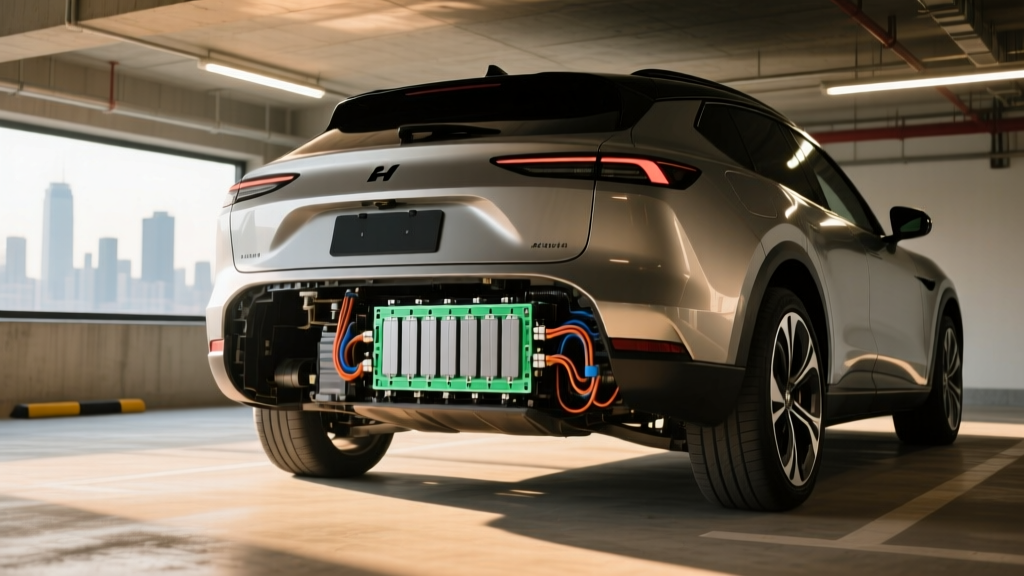
If you're researching how long a Tesla battery lasts, the data is reassuring: Tesla's high-voltage traction batteries are engineered to retain roughly 80–90% of their original capacity after 150,000–200,000 miles. Internal fleet data Tesla publishes in its annual Impact Report shows that Model S and Model X vehicles lose approximately 12% of range after 200,000 miles, while the more recent Model 3 and Model Y fleet shows roughly 15% degradation at the same milestone. For the average American driver logging 13,500 miles per year, that translates to well over 15 years of usable battery life before capacity drops to levels most owners would consider problematic.
But "how long does a Tesla battery last" isn't a single-number question. It depends on which battery chemistry your Tesla uses, how you charge it, where you live, and what you consider "end of life." A battery at 70% capacity still drives — it just has less range. Let's unpack every variable with hard numbers.
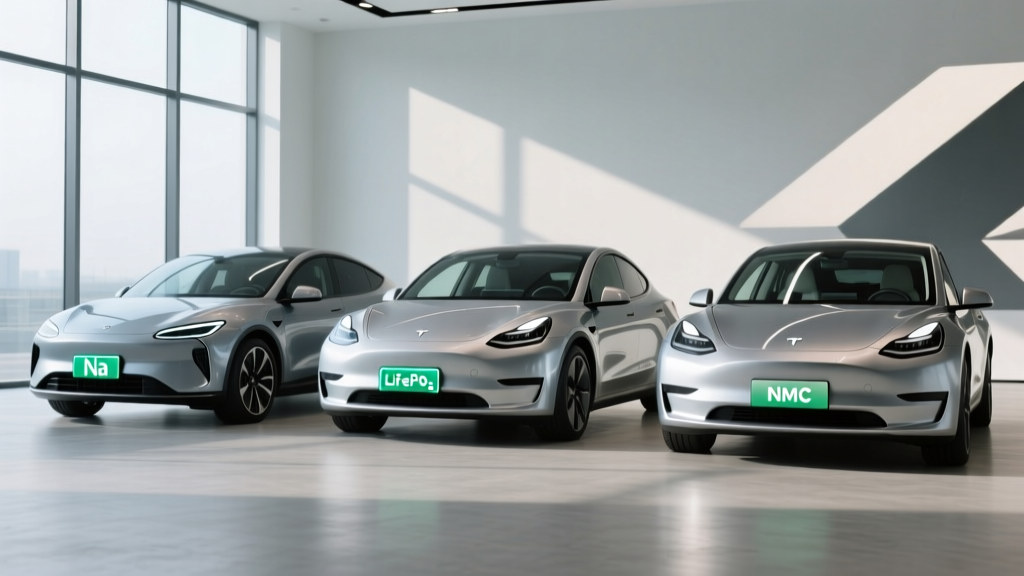
LFP vs. NMC/NCA: Which Tesla Battery Chemistry Do You Have?
Tesla currently uses two distinct lithium-ion chemistries across its lineup, and the chemistry inside your pack has a significant impact on longevity, range, and daily charging habits.
Nickel Manganese Cobalt (NMC) and Nickel Cobalt Aluminum (NCA) cells power the Long Range and Performance variants of the Model 3, Model Y, Model S, and Model X. These chemistries prioritize energy density — more kWh packed into a smaller, lighter battery — which translates to longer EPA range per charge. However, NMC/NCA cells are more sensitive to sustained high states of charge and extreme heat, which can accelerate degradation over time.
Lithium Iron Phosphate (LFP) cells are used in the rear-wheel-drive (Standard Range) Model 3 and Model Y. LFP chemistry sacrifices some energy density — meaning slightly less range in the same physical pack size — in exchange for dramatically longer cycle life, superior thermal stability, and lower raw-material cost. Tesla recommends LFP owners charge to 100% regularly, something NMC owners are told to avoid for daily use.
| Attribute | LFP (RWD Model 3 / Y) | NMC / NCA (Long Range / Performance) |
|---|---|---|
| Energy Density | ~160 Wh/kg (cell-level) | ~250–270 Wh/kg (cell-level) |
| Typical Usable Capacity | 57–60 kWh | 75–100 kWh depending on model |
| Cycle Life (to 80% SoH) | 3,000–5,000+ cycles | 1,000–2,000 cycles |
| Daily Charge Recommendation | 100% OK — Tesla recommends weekly 100% | 80% daily; 100% for trips only |
| Cold-Weather Performance | Moderate — slightly more range loss below freezing | Better low-temp conductivity |
| Cost | Lower — no cobalt or nickel | Higher — commodity-priced metals |
| Thermal Stability | Excellent — higher runaway threshold | Good — requires active thermal management |
Which is better for longevity? If your priority is maximum calendar life and cycle count, LFP wins. Its flatter degradation curve and tolerance for 100% SoC mean an LFP pack can realistically exceed 300,000 miles before hitting 80% State of Health. NMC/NCA packs deliver more range per charge and better cold-weather efficiency, making them the better choice for road-trippers and cold-climate drivers — but they require more deliberate charging habits to maximize lifespan.
Real-World Tesla Battery Degradation: What the Data Shows
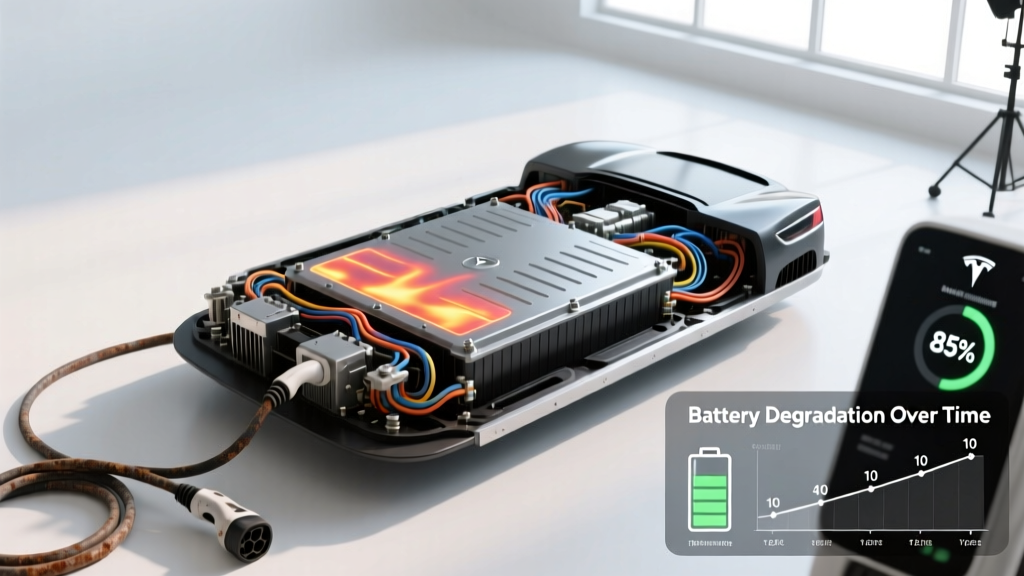
Degradation is not linear. Most Tesla batteries experience a steeper capacity loss in the first 15,000–25,000 miles (roughly 2–5%), then settle into a very gradual, nearly linear decline for the remainder of their life. This pattern is consistent across LFP and NMC chemistries, though the initial drop is often smaller with LFP.
Here's what aggregated fleet data and independent tracking (from sources like TeslaFi user submissions and Tesla's own Impact Report) indicate for NMC/NCA packs:
- 25,000 miles: ~95–97% remaining capacity (3–5% loss)
- 50,000 miles: ~93–95% remaining
- 100,000 miles: ~90–93% remaining
- 150,000 miles: ~87–90% remaining
- 200,000 miles: ~85–88% remaining
LFP packs in the Model 3 RWD show even slower degradation in early data, with many owners reporting 95%+ State of Health at 50,000 miles. Part of this is chemistry; part is the fact that LFP owners charge to 100% more often, which keeps the Battery Management System (BMS) calibrated and avoids the "apparent degradation" that NMC owners sometimes see when the BMS loses calibration from repeated partial charges.
Tesla's Battery Warranty: What's Covered and for How Long
Tesla's battery and drive unit warranty is one of the strongest in the EV industry, and it sets a clear baseline for what the company considers acceptable battery life.
| Model / Trim | Warranty Period | Mileage Limit | Minimum Capacity Retention |
|---|---|---|---|
| Model 3 RWD (LFP) | 8 years | 100,000 miles | 70% |
| Model 3 Long Range / Performance | 8 years | 120,000 miles | 70% |
| Model Y (all trims) | 8 years | 120,000 miles | 70% |
| Model S / Model X | 8 years | 150,000 miles | 70% |
The threshold is straightforward: if your battery drops below 70% of its original capacity within the warranty period (whichever limit — time or miles — comes first), Tesla will replace or refurbish the pack at no cost. According to Tesla's official warranty documentation, this covers defects and excessive capacity loss but does not cover damage from accidents, flooding, or unauthorized modifications.
It's worth noting that fewer than 1% of Tesla vehicles have required a warranty battery replacement, based on the company's published fleet data. The vast majority of packs simply don't degrade fast enough to trigger the 70% threshold within 8 years or 120,000 miles.
Tesla Battery Replacement Cost: What to Expect If You're Out of Warranty
This is the question that generates the most anxiety, so let's ground it in actual service-center figures and third-party replacement data. Battery replacement is rare — most Tesla batteries outlive the vehicle's useful economic life — but if you do need one outside of warranty, here's the current landscape:
| Model | Battery Size (Usable) | Chemistry | Estimated Replacement Cost |
|---|---|---|---|
| Model 3 RWD | ~57 kWh | LFP | $8,000–$12,000 |
| Model 3 Long Range | ~75 kWh | NMC | $12,000–$16,000 |
| Model Y Long Range | ~75 kWh | NMC | $12,000–$16,000 |
| Model S / X | ~95–100 kWh | NMC/NCA | $15,000–$22,000 |
These figures include the battery pack and labor but can vary by service center, region, and whether Tesla installs a new or remanufactured pack. Remanufactured packs — which use tested, healthy modules from returned batteries — are common and typically cost 20–30% less than a brand-new pack while still carrying a warranty.
When is replacement actually needed? In practice, very few owners face this. A Tesla battery at 70% capacity after 200,000 miles still functions as a daily driver — it simply has less range. Most "replacements" occur due to manufacturing defects early in the vehicle's life (covered by warranty) or physical damage from collisions, not gradual wear-out. For context, the average age of a scrapped passenger vehicle in the US is roughly 15 years, and most Tesla packs will still have 75–85% capacity at that age.
Factors That Affect Tesla Battery Longevity
Battery degradation is influenced by a combination of charging habits, environmental conditions, and usage patterns. Here are the variables with the most measurable impact:
State of Charge (SoC) habits. For NMC/NCA batteries, consistently charging to 100% and letting the car sit at full charge accelerates electrolyte decomposition and cathode stress. Tesla's recommendation to set daily charge limits to 80% for NMC vehicles is based on well-established lithium-ion chemistry research. Conversely, LFP batteries are structurally more stable at high SoC, which is why Tesla encourages 100% charging for those packs.
DC fast-charging frequency. Occasional Supercharging (Tesla's DC fast-charging network, peaking at up to 250 kW on V3 stalls and 325 kW on newer V4 stalls) has a minimal impact on battery health. However, exclusive reliance on DC fast charging — especially in hot climates without preconditioning — can add roughly 1–3% additional degradation over 100,000 miles compared to predominantly Level 2 home charging. Tesla's BMS actively manages charge rates and temperatures during Supercharging to mitigate this, but the physics of high-current charging still generate more electrode wear than slower charging.
Extreme temperatures. Lithium-ion batteries degrade faster when exposed to sustained heat above 95°F (35°C). Cold weather doesn't permanently damage the battery, but charging a cold battery without preconditioning can cause lithium plating on the anode — a form of irreversible capacity loss. Tesla's navigation-to-charger preconditioning feature warms the battery before you arrive at a Supercharger, significantly reducing this risk. Always use it.
Depth of discharge. Frequently draining the battery to very low SoC (below 10%) and then charging to 100% creates wider charge cycles, which accumulate wear faster than shallow cycles (e.g., charging between 30% and 70%). You don't need to obsess over this, but avoiding habitual deep discharges extends pack life.
- Set daily charge limit to 80% (NMC/NCA) or 100% (LFP) per Tesla's guidance
- Plug in when possible — batteries prefer partial SoC to sitting at 0% or 100%
- Use navigation-to-charger preconditioning before every Supercharger stop
- Charge to 100% for road trips; it's fine occasionally on NMC, just don't let it sit at 100% for days
- In extreme heat, park in shade or a garage when possible
- In cold weather, use scheduled departure to precondition the battery before driving
- Avoid leaving the car unplugged at very low SoC (below 10%) for extended periods — the 12V auxiliary system still draws from the traction battery via the DC-DC converter
How to Check Your Tesla's Battery Health (State of Health)
Tesla does not display a direct State of Health (SoH) percentage in the vehicle's UI, unlike some competitors (e.g., the Nissan Leaf's battery health bars). However, there are reliable methods to assess your pack's condition:
Method 1: Range comparison. Charge your Tesla to 100% (or your normal limit) and note the projected range displayed. Compare this to the EPA-rated range when new. For example, if your Model Y Long Range showed 320 miles at 100% when new and now shows 295 miles at 100% after 60,000 miles, your approximate SoH is 295 ÷ 320 = 92%. This method isn't perfectly precise — the displayed range is influenced by recent driving efficiency and temperature — but it gives a solid estimate.
Method 2: TeslaFi or third-party logging. Apps like TeslaFi pull data directly from Tesla's API and track estimated battery capacity over time. By logging every charge session and calculating the energy added versus the SoC change, these tools estimate your pack's actual usable kWh. Many owners find this more accurate than the car's range display, especially for tracking gradual degradation trends over months.
Method 3: Service center diagnostic. If you suspect abnormal degradation or are approaching the warranty threshold, Tesla Service can run a full battery health diagnostic remotely or in person. This reads individual module voltages, internal resistance, and total capacity — providing a definitive SoH figure.
Looking Ahead: Solid-State and Silicon-Anode Batteries
Next-generation battery technologies are in active development across the industry, and Tesla is investing heavily in its own cell manufacturing (the 4680 cell format with a dry-electrode process). However, it's important to separate announcements from availability:
Silicon-anode cells — which replace graphite anodes with silicon to increase energy density by 20–40% — are beginning to appear in limited production from suppliers like Sila Nanotechnologies and Group14. Tesla's 4680 cells already incorporate some silicon in the anode, but full silicon-anode cells with long cycle life remain in the pilot-to-early-production stage. Expect broader automotive deployment around 2028–2030.
Solid-state batteries — which replace the liquid electrolyte with a solid conductor for improved safety and energy density — are the most discussed future technology. Companies like Toyota, QuantumScape, and Samsung SDI have demonstrated prototype cells, but manufacturing at automotive scale with acceptable cost and cycle life has not been achieved. According to U.S. Department of Energy assessments, solid-state batteries are unlikely to reach mass-market EV production before 2030 at the earliest.
For current Tesla buyers: today's lithium-ion batteries — both LFP and NMC — are mature, well-characterized, and demonstrably long-lasting. Waiting for solid-state is a choice, but it means waiting at least 4–5 years for vehicles that may carry a significant price premium at launch.
Frequently Asked Questions
How long do EV batteries last in years and miles?
Based on Tesla's fleet data, the average Tesla battery retains 85–88% of its original capacity after 200,000 miles — roughly 15 years of average US driving. LFP batteries are projected to last even longer, potentially exceeding 300,000 miles before reaching 80% State of Health. Most EV batteries will outlast the vehicle's body, interior, and suspension components.
How much does a Tesla battery cost to replace?
Out-of-warranty Tesla battery replacement costs range from approximately $8,000 for a Model 3 RWD (LFP, ~57 kWh) to $22,000 for a Model S/X (~100 kWh). Most replacements use remanufactured packs at the lower end of these ranges. Under warranty (8 years / 100,000–150,000 miles depending on model), replacement is free if capacity drops below 70%.
What does the Tesla battery warranty cover?
Tesla's battery warranty covers defects in materials and workmanship and guarantees a minimum of 70% capacity retention over 8 years or 100,000–150,000 miles (varies by model). It does not cover damage from accidents, flooding, fire, or unauthorized modifications. Full terms are available on Tesla's warranty page.
How do I maximize my Tesla battery's lifespan?
For NMC/NCA batteries: set the daily charge limit to 80%, avoid leaving the car at 100% SoC for extended periods, use preconditioning before DC fast charging, and minimize deep discharges below 10%. For LFP batteries: charge to 100% at least weekly to keep the BMS calibrated. For all chemistries: plug in when parked for long periods, avoid extreme heat exposure, and use scheduled departure preconditioning in cold weather.
LFP vs NMC — which Tesla battery is better and why?
Neither is universally better; they serve different priorities. LFP offers longer cycle life (3,000–5,000+ cycles vs. 1,000–2,000), lower cost, superior thermal safety, and the convenience of 100% daily charging — making it ideal for commuters and high-mileage drivers who don't need maximum range. NMC/NCA provides higher energy density (more range per kWh of battery weight) and better cold-weather performance, making it the better choice for long-distance travelers and cold-climate owners who prioritize range over cycle count.