Tesla's high-voltage traction battery is the single most expensive component in the vehicle — and the one that generates the most ownership anxiety. The good news, backed by millions of real-world miles and Tesla's own annual impact reports, is that most Tesla battery packs outlast the cars they're installed in. But "last" doesn't mean "stay at 100%." Every lithium-ion pack degrades over time, and how you charge, store, and drive your Tesla determines whether you lose 8% or 18% of capacity over a decade.
This guide breaks down Tesla battery life with hard numbers: chemistry trade-offs between LFP and NMC/NCA packs, degradation curves by model and mileage, warranty terms, replacement costs if the worst happens, and actionable care habits that measurably extend pack longevity.
How Long Do Tesla Batteries Actually Last?
Based on fleet data Tesla publishes in its annual impact reports and independent analysis from owners tracking their vehicles via apps like Tessie and TeslaFi, most Tesla battery packs retain between 85% and 92% of original capacity after 150,000 miles. Tesla's own 2023 Impact Report (the most recent with granular fleet data) showed that Model 3 and Model Y packs retained approximately 85% capacity at 200,000 miles. Model S and Model X packs showed roughly 88% retention at 150,000 miles, though these figures reflect older NCA chemistry that has since been updated.
In years, that translates to a practical lifespan of 15 to 20 years for most owners driving 10,000–15,000 miles annually. The battery won't "die" at a specific mileage — it gradually loses range. A Model 3 Long Range with an EPA-rated 341 miles that degrades 12% over a decade still delivers roughly 300 miles, which remains functional for nearly all daily driving.
- Year 1 / 15,000 mi: ~2–4% loss (initial calibration drop)
- Year 3 / 45,000 mi: ~5–8% total loss
- Year 5 / 75,000 mi: ~7–10% total loss
- Year 8 / 120,000 mi: ~10–14% total loss
- Year 10 / 150,000 mi: ~12–16% total loss (NMC/NCA); ~8–11% (LFP)
Source: Tesla Impact Reports, Tessie fleet aggregation. Individual results vary based on charging habits, climate, and chemistry.
The critical insight: degradation is non-linear. The steepest loss occurs in the first 10,000–20,000 miles (roughly 2–3%), then the curve flattens considerably. This is why a three-year-old Tesla with 40,000 miles often shows only marginally more degradation than a one-year-old with 15,000 miles.
LFP vs NMC/NCA: Which Tesla Battery Chemistry Is Better?
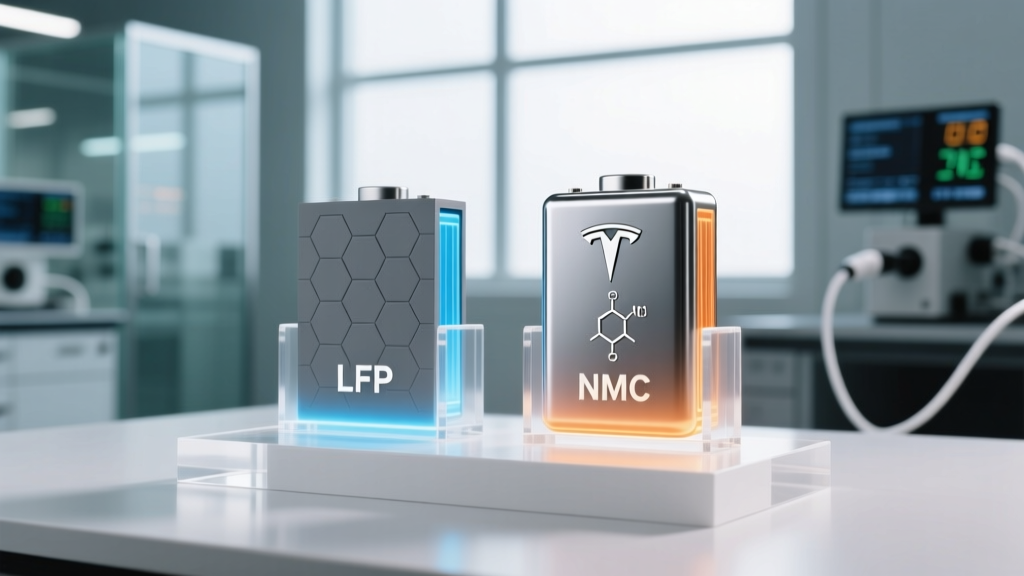
Tesla currently uses two battery chemistries across its lineup, and the choice between them affects range, longevity, charging behavior, and cold-weather performance. Understanding which pack is in your Tesla — or the one you're considering — is essential.
| Attribute | LFP (Lithium Iron Phosphate) | NMC/NCA (Nickel Manganese Cobalt / Nickel Cobalt Aluminum) |
|---|---|---|
| Energy Density | Lower (~160 Wh/kg cell-level) | Higher (~250–270 Wh/kg cell-level) |
| Cycle Life | 3,000–5,000+ cycles to 80% SoH | 1,500–2,500 cycles to 80% SoH |
| Recommended SoC | 100% daily (Tesla recommends) | 80% daily; 100% for trips only |
| Cold Performance | Weaker — more range loss below 32°F | Better low-temp discharge capability |
| Cost | Lower (no cobalt/nickel) | Higher (commodity-sensitive) |
| Used In (2026) | Model 3 RWD, Model Y RWD (Standard Range) | Model 3 Long Range/Performance, Model Y LR/Perf, Model S, Model X |
| Typical Usable kWh | ~57–60 kWh (Model 3 RWD) | ~75–82 kWh (Long Range); ~100 kWh (Model S/X) |
The practical takeaway: LFP packs degrade slower and tolerate daily 100% charging, making them ideal for commuters who charge at home and don't need maximum range. NMC/NCA packs deliver more range per kilogram and perform better in cold climates, but they demand more careful state-of-charge management to maximize longevity. Neither chemistry is universally "better" — it depends on your driving pattern.
If you live in a cold northern climate and regularly drive in sub-freezing temperatures, NMC/NCA's superior low-temperature performance is a genuine advantage. If you're in a moderate climate and prioritize pack longevity over maximum single-charge range, LFP's cycle-life advantage is substantial.
What Does the Tesla Battery Warranty Cover?
Tesla's battery warranty is among the strongest in the EV industry, but understanding its specifics prevents unpleasant surprises. The warranty covers defects and excessive capacity loss — not damage from accidents, flooding, or modifications.
| Model | Warranty Duration | Mileage Limit | Minimum Capacity Retention |
|---|---|---|---|
| Model 3 RWD (LFP) | 8 years | 100,000 miles | 70% |
| Model 3 Long Range / Performance | 8 years | 120,000 miles | 70% |
| Model Y (all trims) | 8 years | 120,000 miles | 70% |
| Model S / Model X | 8 years | 150,000 miles | 70% |
The 70% retention threshold is the trigger: if your battery drops below 70% of original usable capacity within the warranty period, Tesla will repair or replace it to bring it above that threshold. In practice, hitting 70% within 8 years requires severe abuse or a manufacturing defect — fleet data shows the vast majority of Teslas retain 85%+ within the warranty window.
Important nuance: Tesla's warranty covers the battery and drive unit together under the same terms. If an inverter or drive motor fails within the warranty period, it's covered. The warranty is also transferable to subsequent owners, which supports Tesla resale values.
How Much Does a Tesla Battery Replacement Cost?
Out-of-warranty battery replacement is the nightmare scenario most prospective EV buyers worry about. Here's what it actually costs in 2026, based on service center quotes and third-party EV repair shops:
| Model / Pack Size | Battery Replacement Cost | Labor | Total Estimated |
|---|---|---|---|
| Model 3 RWD (~60 kWh LFP) | $8,000–$12,000 | $1,500–$2,500 | $10,000–$14,500 |
| Model 3/Y Long Range (~78 kWh NMC) | $12,000–$16,000 | $1,500–$2,500 | $13,500–$18,500 |
| Model S/X (~100 kWh NCA) | $15,000–$22,000 | $2,000–$3,000 | $17,000–$25,000 |
Context that matters: Full battery replacements are rare. Far more common is a module-level repair, where Tesla or a qualified third-party shop replaces individual degraded modules within the pack for $2,000–$5,000. The structural battery pack design in newer Model 3 and Model Y vehicles (where cells are bonded into the chassis) makes module-level repair more difficult, potentially pushing toward full-pack replacement if issues arise out of warranty.
For perspective, a Model 3 owner driving 12,000 miles annually for 10 years would accumulate 120,000 miles — well within the period where fleet data shows 85%+ retention. The probability of needing a full replacement is low, but the cost if it happens is real. Budgeting for it as you would a transmission replacement on a gas car — unlikely but not impossible — is the rational approach.
Factors That Accelerate (or Preserve) Tesla Battery Life
Battery degradation is driven by electrochemistry, not just mileage. The following factors have measurable, data-backed impacts on how quickly your pack loses capacity:
- Daily charge limit: Set to 80% for NMC/NCA packs; 100% is fine for LFP. Sustained high SoC stresses NMC/NCA cathodes.
- Avoid prolonged storage above 90% or below 10%: If leaving your Tesla for a week+, set the charge limit to 50–60%.
- Minimize DC fast charging when possible: Frequent Supercharging (150–250 kW) generates heat that accelerates electrolyte decomposition. Use Level 2 home charging for daily needs.
- Precondition before fast charging: Tesla's navigation-routed preconditioning warms the battery to optimal temperature (~95°F), reducing stress during high-power charging.
- Use Scheduled Departure: This feature warms or cools the battery while plugged in, avoiding energy draw from the pack and reducing thermal cycling.
- Don't obsess about 100% avoidance: Occasional 100% charges for road trips are fine. It's sustained high SoC (sitting at 100% for days) that causes damage.
- Regenerative braking setting: Standard regen is fine for battery health — the current flows are well within safe C-rates.
Cold weather reality: In sub-freezing temperatures, expect 20–30% range reduction due to increased internal resistance and cabin heating demands. This is temporary range loss, not permanent degradation. However, repeatedly charging a cold battery without preconditioning can cause lithium plating on the anode — a form of permanent damage. Always precondition before charging in cold weather.
Supercharging frequency: Data from Tessie's fleet aggregation suggests that owners who Supercharge more than 3 times per week show approximately 1–2% more degradation at 100,000 miles compared to those who primarily use Level 2 home charging. The difference is real but modest — Tesla's battery management system (BMS) actively manages charge rates and temperatures to limit damage.
How to Check Your Tesla's Battery Health (State of Health)
Tesla doesn't display a State of Health (SoH) percentage in the vehicle's native UI, which frustrates many owners. Here are the reliable methods to assess your pack's condition:
Method 1: Manual calculation from the touchscreen. Charge your Tesla to 100% (or use the projected range at your current SoC and extrapolate). Compare the displayed rated range at 100% to the original EPA-rated range for your model. A Model 3 Long Range that originally rated 341 miles EPA but now shows 305 miles at 100% has approximately 89% SoH. Note: Tesla's displayed range estimate uses a fixed efficiency calculation and may not perfectly reflect usable capacity — it's a close approximation, not a lab measurement.
Method 2: Third-party apps. Services like Tessie and TeslaFi log detailed charge data and calculate SoH over time by comparing energy added during charges to the expected capacity. These are more accurate than the touchscreen method because they track trends across hundreds of charge cycles.
Method 3: Tesla Service diagnostic. If you suspect abnormal degradation (e.g., a sudden range drop), Tesla Service can run a full battery health diagnostic remotely or at a service center. This provides a precise SoH reading and can identify individual module imbalances.
Emerging Battery Tech: What's Next After Lithium-Ion?
Tesla's current 4680 cells (used in Model Y Austin-built vehicles and the Cybertruck) represent an incremental improvement in energy density and manufacturing cost, but the industry is pursuing several next-generation technologies:
Solid-state batteries: These replace the liquid electrolyte with a solid material, promising higher energy density (potentially 400+ Wh/kg at the cell level), faster charging, and improved safety. Companies like QuantumScape and Toyota have demonstrated prototypes, but commercial-scale production for passenger vehicles is not expected before 2028–2030. Tesla has not announced a solid-state timeline. Treat any claims of imminent solid-state availability with skepticism.
Silicon anode batteries: Replacing graphite anodes with silicon can increase energy density by 20–40%. Sila Nanotechnologies and Group14 are supplying early silicon-anode materials, and Tesla's 4680 cells already incorporate some silicon content. Expect incremental adoption through 2026–2028 rather than a sudden breakthrough.
Sodium-ion batteries: CATL and BYD have begun producing sodium-ion cells for lower-cost, lower-range applications. These offer excellent cycle life and cold performance but significantly lower energy density (~120–150 Wh/kg). They may appear in future Tesla base-model vehicles or energy storage products, but no Tesla vehicle currently uses sodium-ion chemistry.
For today's buyers: current lithium-ion technology (both LFP and NMC/NCA) is mature, well-understood, and sufficient for 15+ years of service. Waiting for solid-state is not a rational purchase strategy unless your timeline extends to 2030 or beyond.
Tesla Battery Life FAQ
Do Tesla batteries need to be replaced?
Most Tesla batteries never need replacement during the vehicle's typical ownership life. Fleet data shows 85%+ capacity retention at 200,000 miles. Replacement is typically needed only if the pack suffers a manufacturing defect, physical damage, or extreme degradation — all uncommon within the first 15 years.
Is it bad to Supercharge my Tesla every day?
Daily Supercharging is not catastrophic, but it does accelerate degradation slightly. Fleet data suggests 1–2% more capacity loss at 100,000 miles for frequent Superchargers versus Level 2 home chargers. For daily charging, Level 2 at home (7–11 kW) is gentler on the pack. Use Supercharging for road trips and when you need quick top-ups.
Does Tesla's battery warranty transfer to a second owner?
Yes. Tesla's 8-year battery and drive unit warranty transfers automatically to subsequent owners with no paperwork required. The warranty follows the vehicle's VIN, not the original purchaser. This is one reason used Teslas hold value better than many competing EVs.
How much range does a Tesla lose in winter?
Expect 20–30% range reduction in sustained sub-freezing temperatures, primarily from cabin heating and increased battery internal resistance. A Model 3 Long Range rated at 341 miles EPA may deliver 240–270 miles in 20°F weather. This is temporary — range returns when temperatures rise. Using seat heaters and preconditioning while plugged in minimizes the impact.
Should I buy a Tesla with an LFP or NMC battery?
Choose LFP (Model 3 RWD, Model Y RWD) if you want maximum cycle life, can charge to 100% daily without worry, and don't need the longest single-charge range. Choose NMC/NCA (Long Range, Performance) if you need maximum range, live in a cold climate, or regularly take long road trips. Both chemistries are reliable — the choice is about your use case, not quality.
Can I check my Tesla battery health before buying used?
Yes. Charge the vehicle to 100% and note the displayed rated range. Compare it to the original EPA rating for that model year and trim. You can also request a battery health report from Tesla Service. Third-party apps like Tessie provide SoH estimates if the previous owner used them. Always verify the remaining warranty period via the Tesla app or your Tesla account.
Sources: Tesla 2023 Impact Report, U.S. Department of Energy / fueleconomy.gov, Tesla Vehicle Warranty.