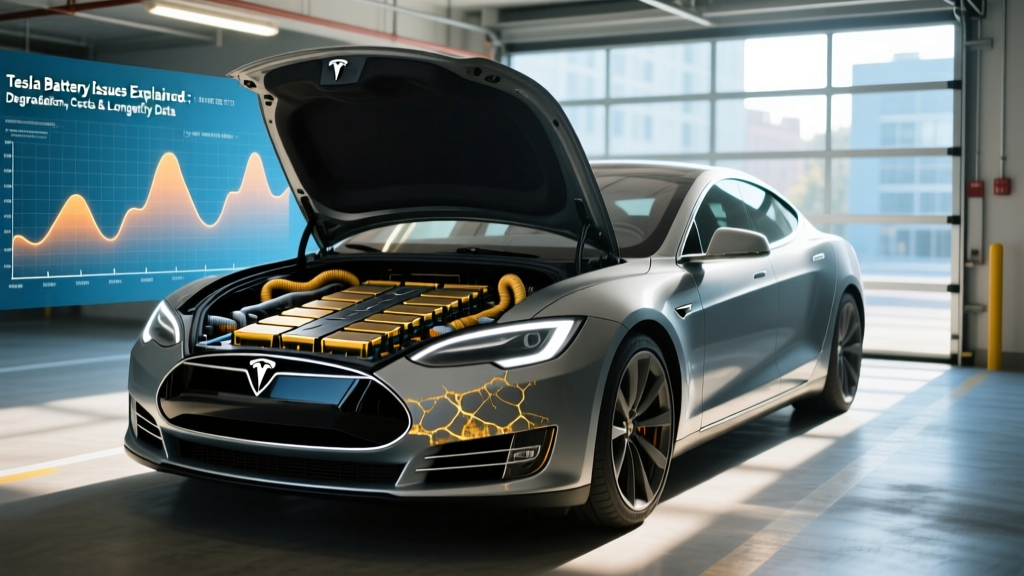
The Truth About Tesla Battery Issues: Data Over Drama
Search "tesla battery issues" and you'll find a polarized landscape: forums filled with catastrophic failure stories on one side, and owners reporting 200,000+ miles with minimal degradation on the other. The reality, backed by fleet data and manufacturer warranty claims, sits firmly in the middle. Tesla's high-voltage traction batteries (not the 12V auxiliary battery — a common source of confusion) are among the most durable in the EV industry, but they aren't immune to chemistry-specific quirks, early-production defects, or the natural capacity loss every lithium-ion cell experiences over time.
This guide breaks down exactly what Tesla battery issues look like in 2026, using real degradation curves, warranty claim data, and chemistry trade-offs. Whether you own a Model 3 with an LFP pack or a Model S Plaid with NMC cells, understanding these dynamics is essential for maximizing longevity and setting accurate expectations.
LFP vs NMC/NCA: Which Tesla Battery Chemistry Do You Have?
The single biggest factor in your Tesla's battery behavior is its chemistry. Tesla uses two primary cell types across its 2026 lineup, and the differences extend far beyond range.
| Attribute | LFP (Lithium Iron Phosphate) | NMC/NCA (Nickel Manganese Cobalt / Nickel Cobalt Aluminum) |
|---|---|---|
| Models (2026) | Model 3 RWD, Model Y RWD | Model 3 Long Range/Performance, Model Y LR/Perf, Model S, Model X, Cybertruck |
| Energy Density | Lower (~160 Wh/kg cell-level) | Higher (~250-300 Wh/kg cell-level) |
| Typical Pack Size | ~57-60 kWh usable | ~75-100 kWh usable depending on model |
| Cycle Life | 3,000-5,000+ cycles to 80% SoH | 1,000-2,000 cycles to 80% SoH |
| Recommended Daily Charge | 100% (Tesla recommends regular full charges) | 80% daily; 100% only for trips |
| Cold-Weather Performance | More range loss in cold (~30-40% reduction at 20°F) | Better cold performance (~20-30% reduction at 20°F) |
| Cost | Lower ($/kWh) — no cobalt or nickel | Higher — relies on critical minerals |
| Thermal Stability | Superior — less prone to thermal runaway | Good but requires more active thermal management |
Why This Matters for Battery Issues
If you're researching Tesla battery issues, the first question is: which chemistry does your vehicle use? LFP packs (found in standard-range Model 3 and Model Y vehicles built from 2021 onward, primarily using CATL prismatic cells) are extraordinarily durable but can show state-of-charge calibration drift if never charged to 100%. NMC/NCA packs (the 4680 cells in newer Long Range models, and the 2170 Panasonic cells in Model S/X) offer superior range and cold-weather performance but degrade faster if habitually held at high states of charge.
A common "issue" reported by LFP owners is the battery management system (BMS) displaying inaccurate range estimates. This isn't actual degradation — it's a calibration problem resolved by charging to 100% and letting the car sit for a few hours. Tesla explicitly recommends 100% charging at least weekly for LFP vehicles.
Tesla Battery Degradation: What the Data Actually Shows
Battery degradation is not a defect — it's an electrochemical certainty. Every lithium-ion cell loses capacity over time and use. The question is how much, how fast, and whether it matters in practical terms.
Tesla Fleet Degradation Curve (Composite Data from Tesla Impact Reports & Independent Fleet Studies):
- Year 1 / ~15,000 miles: 2-4% capacity loss (initial formation period — steepest part of the curve)
- Year 3 / ~45,000 miles: 5-8% total loss
- Year 5 / ~75,000 miles: 8-12% total loss
- Year 8 / ~120,000 miles: 12-15% total loss (still above warranty threshold)
- 200,000 miles: 12-17% total loss (Model 3/Y average ~15%; Model S/X average ~12%)
Sources: Tesla Impact Report, fueleconomy.gov, Recurrent Auto fleet data.
The Degradation Curve Is Not Linear
The most important insight for Tesla owners is that degradation follows a logarithmic pattern, not a straight line. You'll see the most noticeable capacity drop in the first 20,000-30,000 miles (typically 3-5%), after which the curve flattens considerably. A Model 3 Long Range that showed 310 miles of EPA range when new might display 298 miles after 25,000 miles, then hold relatively steady at 290-295 miles through 100,000 miles.
This pattern is consistent across chemistries, though LFP packs show a flatter curve overall due to their superior cycle life. The 4680 cells introduced in 2022-2023 structural packs are still accumulating long-term fleet data, but early indicators suggest degradation profiles similar to or slightly better than the 2170 cells they replaced.
Real-World Range Impact
A 2026 Model Y Long Range AWD with its 75 kWh (usable) NMC pack and EPA rating of 310 miles will realistically deliver:
- New: ~280-295 miles in mixed real-world driving (highway speeds, moderate climate use)
- At 50,000 miles (~10% degradation): ~255-270 miles real-world
- At 100,000 miles (~13% degradation): ~245-260 miles real-world
- In cold weather (30°F) at any age: Subtract an additional 20-30% from the above figures
For most daily commutes under 60 miles round-trip, even a 100,000-mile Tesla battery provides ample range. The degradation becomes most noticeable on road trips, where charging stops may need to be planned slightly more frequently.
Tesla Battery Warranty: What's Actually Covered
Tesla's battery and drive unit warranty is one of the more straightforward in the industry, but the specifics matter when you're evaluating whether a perceived "issue" qualifies for a claim.
| Model | Warranty Period | Mileage Limit | Minimum Capacity Retention |
|---|---|---|---|
| Model 3 RWD (LFP) | 8 years | 100,000 miles | 70% |
| Model 3 Long Range / Performance | 8 years | 120,000 miles | 70% |
| Model Y (all trims) | 8 years | 120,000 miles | 70% |
| Model S / Model X | 8 years | 150,000 miles | 70% |
| Cybertruck | 8 years | 120,000 miles | 70% |
What the 70% Threshold Means
If your Tesla's battery falls below 70% of its original usable capacity within the warranty period (whichever limit — years or miles — comes first), Tesla will repair or replace it at no cost. In practice, this means a Model 3 Long Range originally rated at 330 miles EPA would need to drop below approximately 231 miles of displayed range at 100% state of charge to qualify.
Based on the degradation data above, virtually no Tesla reaches this threshold under normal use within the warranty period. A battery would need to lose 30% of its capacity in under 120,000 miles — roughly double the average degradation rate observed in fleet data. Warranty claims typically involve manufacturing defects (bad cell groups, BMS failures, coolant leaks into the pack) rather than normal wear.
What's NOT Covered
Tesla's warranty explicitly excludes:
- Capacity loss from normal degradation above the 70% threshold
- Damage from accidents, flooding, or improper modifications
- Issues caused by using non-Tesla-approved charging equipment that damages the pack
- Cosmetic issues that don't affect function
For comprehensive warranty details, always reference the official Tesla New Vehicle Limited Warranty documentation for your specific model year.
Tesla Battery Replacement Cost: What to Expect
This is the topic that generates the most fear — and the most misinformation. Let's ground this in actual numbers.
| Model | Battery Size (Usable) | Estimated Replacement Cost (Out of Warranty) | Typical When Needed |
|---|---|---|---|
| Model 3 RWD (LFP) | ~57 kWh | $12,000 - $16,000 | Rarely before 300,000+ miles |
| Model 3 LR / Model Y LR | ~75 kWh | $15,000 - $20,000 | Rarely before 250,000+ miles |
| Model S / Model X | ~95-100 kWh | $18,000 - $25,000 | Rarely before 200,000+ miles |
| Cybertruck | ~123 kWh | $22,000 - $30,000 | Insufficient long-term data |
These figures include the battery pack, labor, and associated diagnostics. They represent out-of-warranty pricing at Tesla Service Centers as of 2025-2026. Third-party EV repair shops are beginning to offer module-level repairs (replacing individual cell modules rather than the entire pack) for $5,000-$10,000, though this is still an emerging service category.
The Replacement Cost Reality Check
Context matters enormously here. A $16,000 battery replacement sounds alarming until you consider:
- Most Tesla batteries outlast the vehicle's economic life. A 10-year-old Model 3 might be worth $12,000-$18,000 total — making a full pack replacement uneconomical, but also largely unnecessary because the battery still functions.
- Compare to ICE powertrain replacements. A new engine or transmission for a gas vehicle runs $5,000-$10,000 and is far more commonly needed at high mileage.
- Battery prices continue declining. Pack-level costs have fallen from over $200/kWh in 2018 to approximately $100-$120/kWh in 2026, meaning replacement costs will be lower if and when you actually need one.
- Refurbished packs are increasingly available. Tesla and third parties offer remanufactured packs at 30-50% below new pricing.
Factors That Accelerate Tesla Battery Degradation
Not all Tesla batteries age equally. The gap between a well-maintained pack and an abused one can be 10-15 percentage points of capacity retention over the same mileage. Here's what actually moves the needle:
✅ Practices That Maximize Battery Life
- NMC/NCA owners: Set daily charge limit to 80%. Charge to 100% only when departing for a road trip, and don't let the car sit at 100% for extended periods.
- LFP owners: Charge to 100% at least once per week to maintain BMS calibration. Daily 100% charging is fine for LFP chemistry.
- Minimize DC fast charging when possible. Occasional Supercharging is fine, but daily DCFC sessions accelerate degradation by an estimated 2-5% over the battery's life compared to primarily Level 2 home charging.
- Use scheduled departure and preconditioning. Warming or cooling the battery while plugged in (using grid power) reduces stress from extreme-temperature driving.
- Avoid prolonged storage at low SoC. If leaving your Tesla for weeks, set the charge limit to 50% and leave it plugged in. Storage below 20% for extended periods can cause irreversible cell damage.
- Drive moderately in extreme heat. Battery temperatures above 110°F (achievable during hard driving in 100°F+ ambient conditions) accelerate chemical aging. Tesla's thermal management system is excellent, but physics is physics.
The Supercharging Question
One of the most debated "Tesla battery issues" is whether frequent Supercharging causes meaningful harm. The data suggests: yes, but modestly. Tesla's thermal management system actively cools the pack during DC fast charging, which mitigates the worst effects of high-C-rate charging. However, the electrochemistry of lithium-ion cells means that pushing ions faster through the electrolyte causes incremental structural damage to the anode.
Studies from Recurrent Auto, which tracks over 15,000 Tesla vehicles, show that vehicles Supercharging more than 90% of the time exhibit approximately 3-5% more degradation at 100,000 miles compared to vehicles primarily charged on Level 2. This is measurable but not catastrophic — the difference between 87% and 92% capacity retention, for example.
How to Check and Monitor Your Tesla's Battery Health
Tesla doesn't provide a direct "State of Health" percentage in the vehicle UI the way some competitors do. Here's how to assess your pack's condition:
Method 1: The Range Calculation
Charge your Tesla to 100% and note the displayed range. Compare it to the original EPA rating for your model. A 2024 Model 3 Long Range that originally displayed 330 miles at 100% but now shows 297 miles has experienced approximately 10% degradation. Note: displayed range is influenced by recent driving efficiency, so this method has a margin of error of ±2-3%.
Method 2: Energy Screen (Built-In)
Navigate to Controls > Software > Additional Vehicle Information on newer Tesla software versions. Some model years display battery health metrics. The "Battery Health" test, introduced in software updates during 2024-2025, runs a diagnostic that estimates remaining capacity.
Method 3: Third-Party Apps
Apps like Tessie, TeslaFi, and Stats (for Tesla) log charging sessions and energy consumption over time, allowing you to calculate a more precise SoH by comparing energy added during a known charge session to the battery's original capacity. These tools track degradation trends across months and years, giving you far more insight than a single data point.
Method 4: Tesla Service Diagnostic
If you suspect a genuine issue (sudden range drop, charging anomalies, warning lights), schedule a service appointment. Tesla can run a full pack diagnostic that reads individual module voltages, internal resistance, and precise capacity measurements. This is the most accurate method and is typically free if a warranty concern is suspected.
Emerging Battery Technologies: What's on the Horizon
While current Tesla batteries use proven lithium-ion chemistries, several next-generation technologies are in development. It's important to note that none of these are currently available in production Tesla vehicles as of 2026:
Solid-State Batteries
Solid-state cells replace the liquid electrolyte with a solid material, promising higher energy density (potentially 400+ Wh/kg at the cell level), faster charging, and improved safety. Companies like QuantumScape, Toyota, and Samsung SDI have demonstrated prototypes, but manufacturing challenges remain significant. Realistic timeline for commercial EV deployment: 2028-2032 for initial limited-production vehicles, with mainstream availability likely post-2032.
Silicon Anode Technology
Replacing graphite anodes with silicon can increase energy density by 20-40%. Companies like Sila Nanotechnologies and Group14 are scaling production. Tesla's 4680 cells already incorporate incremental silicon content. Expect gradual adoption rather than a dramatic switchover, with meaningful capacity improvements appearing in the 2027-2029 timeframe.
Sodium-Ion Batteries
CATL (which supplies LFP cells to Tesla) has begun producing sodium-ion cells that eliminate lithium entirely. These offer lower energy density but dramatically lower cost and excellent cold-weather performance. They may appear in entry-level Tesla models in markets where cost is paramount, potentially by 2027-2028.
None of these technologies should factor into a current purchase decision. Today's Tesla batteries, properly maintained, will outlast the useful life of the vehicle for the vast majority of owners.
Frequently Asked Questions
How long do Tesla batteries last in years and miles?
Based on fleet data, Tesla batteries typically retain 80-88% of original capacity at 200,000 miles. In terms of calendar years, most packs show 2-3% annual degradation regardless of mileage due to chemical aging. A reasonable expectation is 15-20 years of functional service before capacity drops to a level that significantly impacts usability (below 70%). Many Tesla batteries will outlive the vehicle they're installed in.
How much does a Tesla battery replacement cost?
Out-of-warranty replacement costs range from approximately $12,000 for a Model 3 RWD LFP pack to $25,000+ for a Model S/X pack. However, full replacement is rarely needed — most packs remain functional well beyond 200,000 miles. Module-level repairs at third-party shops cost $5,000-$10,000. Refurbished packs offer a lower-cost alternative.
What does the Tesla battery warranty cover?
Tesla covers the battery pack and drive unit for 8 years with mileage limits varying by model (100,000 miles for RWD Model 3, 120,000 for Model Y and LR/Performance trims, 150,000 for Model S/X). If capacity drops below 70% within these limits, Tesla will repair or replace the pack. Manufacturing defects (cell failures, BMS issues, coolant leaks) are also covered.
How do I check my Tesla battery health?
Charge to 100% and compare displayed range to the original EPA rating. Use third-party apps like TeslaFi or Tessie for long-term trend tracking. Newer Tesla software versions include a Battery Health diagnostic test. For the most precise measurement, request a pack diagnostic at a Tesla Service Center.
LFP vs NMC — which Tesla battery is better?
Neither is universally "better" — they serve different needs. LFP offers superior longevity (3,000-5,000+ cycles), lower cost, and better thermal safety, but has lower energy density and worse cold-weather performance. NMC/NCA provides more range per kWh, better cold-weather usability, and faster charging, but has shorter cycle life and requires more careful state-of-charge management. If you prioritize maximum range and don't mind charging to 80% daily, NMC is the better fit. If you want maximum durability and don't need 300+ miles, LFP is excellent.
Is frequent Supercharging bad for my Tesla battery?
Exclusively relying on DC fast charging (Supercharging) causes approximately 3-5% more degradation over 100,000 miles compared to primarily using Level 2 home charging. Occasional Supercharging for road trips has negligible impact. If you have home Level 2 access, use it for daily charging and reserve Supercharging for longer trips.
Do Tesla batteries degrade in cold weather permanently?
No. Cold-weather range loss (20-40% in sub-freezing temperatures) is temporary and reverses when temperatures rise. However, charging a frozen battery without preconditioning can cause lithium plating, which is permanent damage. Always enable preconditioning before charging in cold weather — Tesla's navigation system does this automatically when routing to a Supercharger.