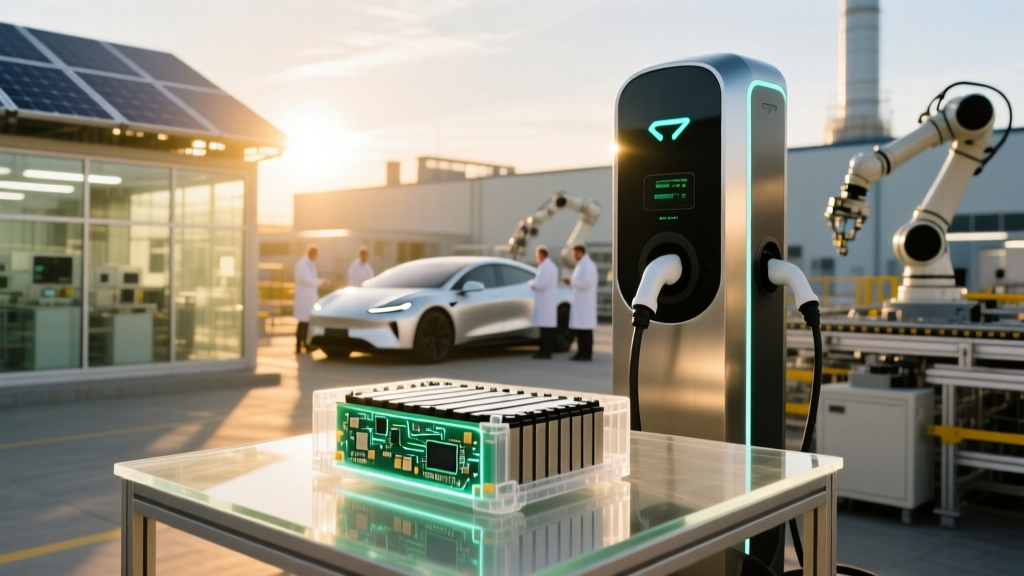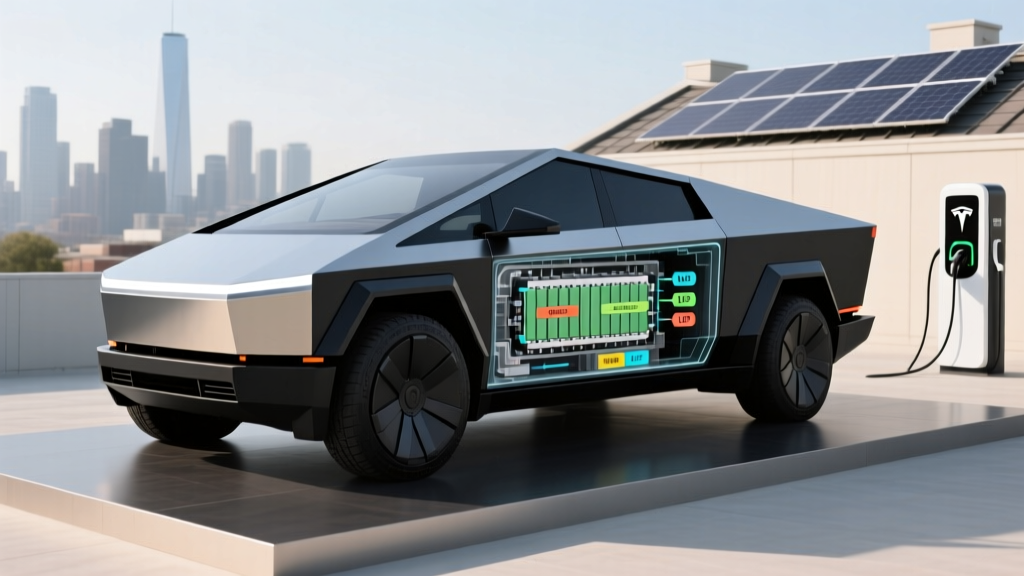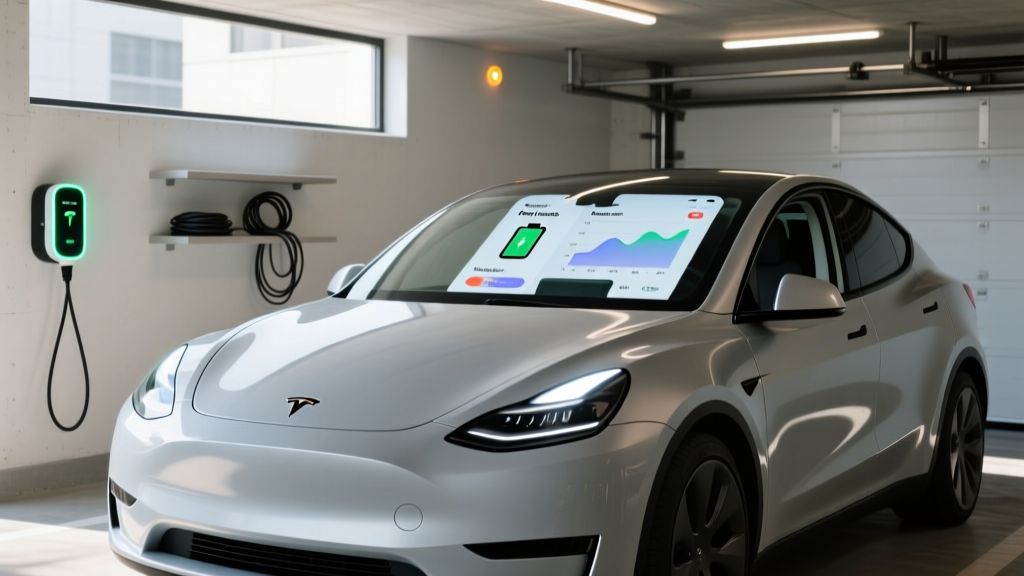
Every EV owner eventually asks the same question: how is my battery actually doing? For Tesla drivers, the answer lives partly in the vehicle's native diagnostics and partly in third-party tools that read the car's Battery Management System (BMS) data. But understanding what the Tesla battery health app numbers mean — and how they compare to the broader EV landscape — requires a working knowledge of battery chemistry, degradation physics, and warranty coverage. This guide breaks down all of it with real data.
How the Tesla Battery Health App Works (and What It Doesn't Show)
Tesla does not expose a dedicated "battery health" percentage in its official mobile app or in-car UI the way Apple shows iPhone battery health. What you can access is the car's estimated range at 100% State of Charge (SoC), which indirectly reflects degradation. If your 2024 Model 3 Long Range originally displayed 341 miles at 100% (its EPA rating) and now shows 320 miles, that ~6% loss is your working degradation estimate.
For a more granular State of Health (SoH) reading, owners turn to third-party solutions:
- TeslaFi / Tessie / Stats for Tesla — these apps connect to your Tesla's API and log detailed charge data, including energy added vs. SoC gained, which allows them to estimate usable kWh and SoH over time.
- OBD-II dongles + Scan My Tesla — plugging into the diagnostic port (available on pre-2022 Model S/X and via adapter on newer models) unlocks BMS-level data: cell voltage imbalance, pack resistance, and nominal full-pack kWh.
- Service Mode (in-car) — Tesla's hidden Service Mode (accessible via the Software screen) shows "Nominal Full Pack" and "Buffer" kWh figures. The difference between your current nominal full pack and the original spec gives the most accurate SoH calculation without third-party tools.
- Charge to 100% (do this occasionally for LFP packs; NMC owners can calculate from a 90% charge extrapolation).
- Note the displayed range.
- Divide current displayed range by original EPA range × 100 = approximate SoH%.
- Example: 310 mi displayed ÷ 341 mi EPA = 90.9% SoH.
This method has a margin of error (±2-3%) because the BMS recalibrates periodically and displayed range is temperature-dependent, but it's directionally reliable for tracking long-term trends.
LFP vs NMC/NCA: Which Tesla Battery Chemistry Do You Have?
Tesla uses two distinct lithium-ion chemistries across its 2026 lineup, and knowing which one is in your car changes how you should charge, store, and interpret health data.
| Attribute | LFP (Lithium Iron Phosphate) | NMC/NCA (Nickel Manganese Cobalt / Nickel Cobalt Aluminum) |
|---|---|---|
| Found in (2026 Tesla) | Model 3 RWD, Model Y RWD | Model 3 Long Range/Performance, Model Y LR/Perf, Model S, Model X, Cybertruck |
| Energy density | Lower (~160 Wh/kg cell-level) | Higher (~250-270 Wh/kg cell-level) |
| Typical usable capacity | ~57-60 kWh (Model 3 RWD) | ~75-100 kWh depending on model |
| Cycle life | 3,000-5,000+ cycles to 80% SoH | 1,000-2,000 cycles to 80% SoH |
| Cold-weather performance | More range loss below 32°F (~30-35% loss at 20°F) | Better cold performance (~20-25% loss at 20°F) |
| Charging to 100% daily | Recommended (helps BMS calibration) | Not recommended (accelerates degradation; 80-90% daily) |
| Cost per kWh (pack-level) | ~$100-115 | ~$130-150 |
| Cobalt content | None | Contains cobalt (sourcing concerns) |
The practical takeaway: LFP packs sacrifice range-per-kWh but gain massively in cycle life and cost. If you're a high-mileage driver or plan to keep the car 10+ years, LFP's 3,000+ cycle durability is a significant advantage. NMC/NCA packs deliver more range in a lighter package — critical for Long Range and Performance trims — but demand more careful SoC management.
EV Battery Degradation: What the Real Data Shows
Contrary to early-EV-era fears, modern lithium-ion packs degrade slowly and predictably. The largest real-world dataset comes from Tesla's own annual Impact Reports and independent aggregations by Teslanomics and Recurrent Auto, which tracks over 15,000 EVs.
- Year 1 / 15,000 mi: ~3-5% capacity loss (initial formation loss, steepest part of the curve)
- Year 3 / 45,000 mi: ~7-9% total loss
- Year 5 / 75,000 mi: ~9-12% total loss
- Year 8 / 120,000 mi: ~12-16% total loss
- Year 10+ / 150,000+ mi: ~15-20% total loss (most packs still above warranty threshold)
The curve flattens significantly after year 2. Tesla's 2025 Impact Report states the average Model 3/Y pack retains ~88% capacity at 150,000 miles. Catastrophic pack failure (sudden cell group death) is rare — well under 1% of packs in the fleet.
For context, the average American drives ~14,000 miles per year (FHWA data). That means most EV owners will trade or sell the car before the battery reaches even 15% degradation.
Factors That Accelerate (or Slow) Battery Degradation
Not all miles are equal. Battery wear is driven by electrochemical stress, and specific habits meaningfully shift the degradation curve:
Habits That Accelerate Wear
- Frequent DC fast charging above 150 kW — High C-rates generate heat and lithium plating risk. Occasional Supercharging is fine; daily 250 kW sessions add ~1-3% extra degradation over 5 years vs. Level 2 charging.
- Storing at 100% SoC for extended periods — Especially damaging for NMC/NCA. A pack held at 100% in 95°F heat degrades 3-4× faster than one stored at 50% SoC in moderate temps.
- Deep discharges below 10% SoC — Regularly running the pack near empty stresses the anode. The BMS maintains a ~3-5 kWh bottom buffer, but repeatedly hitting 0% displayed still accelerates wear.
- Extreme heat exposure — Sustained pack temps above 104°F (40°C) accelerate electrolyte decomposition. This is why Tesla's thermal management system is critical — and why cars parked unshaded in Phoenix summers see slightly higher degradation.
Habits That Maximize Longevity
- Daily charging to 80% (NMC) or 100% (LFP) — Follow Tesla's in-app recommendation based on your chemistry.
- Primarily Level 2 home charging (7-11 kW) — Gentle charge rates produce minimal thermal stress.
- Preconditioning before Supercharging — The car heats or cools the pack to the optimal ~35-45°C window, enabling faster charging with less degradation.
- Storing at 50% SoC — If the car will sit for weeks, set the charge limit to 50%.
- Using Scheduled Departure — Charging completes just before you leave, minimizing time spent at high SoC.
Tesla Battery Warranty: What's Actually Covered
Tesla's battery and drive unit warranty is one of the industry's longer coverage periods, but the details matter — especially the capacity retention threshold.
| Model | Warranty Period | Mileage Cap | Minimum Capacity Retention |
|---|---|---|---|
| Model 3 RWD (LFP) | 8 years | 100,000 miles | 70% |
| Model 3 Long Range / Performance | 8 years | 120,000 miles | 70% |
| Model Y (all trims) | 8 years | 120,000 miles | 70% |
| Model S / Model X | 8 years | 150,000 miles | 70% |
| Cybertruck | 8 years | 120,000 miles | 70% |
What "70% retention" means: If your Model 3 Long Range (originally 75 kWh usable) drops below 52.5 kWh usable capacity within 8 years or 120,000 miles — whichever comes first — Tesla will repair or replace the pack to bring it above the 70% threshold. This is a defect and excessive-degradation warranty, not a guarantee of specific range.
What voids coverage: Salvage title, unauthorized modifications to the high-voltage system, using the vehicle as a stationary power source beyond V2H/V2L specifications, or physical damage to the pack from collisions or flooding.
For comparison, Hyundai and Kia offer 10-year/100,000-mile battery warranties on the Ioniq 5 and EV6, while GM provides 8 years/100,000 miles on Ultium-based vehicles. Tesla's 120,000-150,000 mile caps on Long Range and S/X models are among the highest mileage thresholds in the industry.
EV Battery Replacement Cost: 2026 Pricing and Reality
This is the topic that generates the most anxiety — and the most misinformation. Here are the actual numbers as of 2026:
| Model / Pack Size | Chemistry | Estimated Replacement Cost (Out of Warranty) | Typical Need Timeline |
|---|---|---|---|
| Model 3 RWD (~60 kWh) | LFP | $8,000 – $12,000 | Rarely needed; 300,000+ mi cycle life |
| Model 3/Y Long Range (~75-82 kWh) | NMC/NCA | $12,000 – $16,000 | Typically 200,000+ mi before critical loss |
| Model S/X (~100 kWh) | NCA | $15,000 – $22,000 | 150,000-200,000+ mi depending on usage |
| Cybertruck (~123 kWh) | NMC (4680 cells) | $18,000 – $25,000 (estimated) | Too new for fleet data; projected 200,000+ mi |
Important context: Pack-level replacement is the exception, not the rule. Tesla service centers increasingly perform module-level repairs — replacing individual cell modules within the pack for $2,000-$5,000 rather than swapping the entire unit. The 4680 structural pack in the Cybertruck and newer Model Y is more complex to service at the module level, which may push replacement costs toward the higher end.
For perspective, a conventional automatic transmission replacement on a gas car runs $4,000-$8,000, and an engine rebuild can exceed $7,000. The difference is that most EV batteries never need replacement during typical ownership — they outlast the vehicle's economic life.
How Long Do EV Batteries Actually Last?
"Last" has two meanings: when does the battery become unusable, and when does it fall below a practical threshold?
Cycle life to 80% SoH:
- NMC/NCA packs: ~1,500-2,000 full charge cycles. At an average of 250 miles per cycle (Model 3 LR), that's 375,000-500,000 miles before hitting 80% capacity.
- LFP packs: ~3,000-5,000 full cycles. At ~220 miles per cycle (Model 3 RWD), that's 660,000-1,100,000 miles.
Calendar aging: Even with zero miles driven, lithium-ion packs lose ~1-2% capacity per year from electrolyte decomposition and solid-electrolyte interphase (SEI) layer growth. Over 15 years, expect ~15-20% calendar loss regardless of mileage.
Realistic lifespan answer: A modern Tesla battery pack should provide 15-20 years of service before dropping to 70-75% capacity — at which point the car still functions, just with reduced range. Most packs will outlive the vehicle's body, interior, and suspension components. The first-generation Tesla Model S (2012-2015) is now over a decade old, and fleet data shows the majority of original packs are still operational with 15-25% degradation at 100,000-180,000 miles.
Emerging Battery Tech: Solid-State and Silicon Anodes
Next-generation battery technologies are in active development, but realistic timelines matter — this is forward-looking context, not currently available product.
Solid-state batteries: Companies like QuantumScape and Toyota are targeting commercial production in the 2028-2030 timeframe. Solid-state cells promise ~40% higher energy density, faster charging (potentially 10-80% in under 10 minutes), and improved safety (no liquid electrolyte to ignite). However, manufacturing scale-up remains the bottleneck, and initial deployment will likely be limited to premium models. Do not delay a 2026 purchase waiting for solid-state — it is years from mass-market availability.
Silicon-dominant anodes: Companies like Sila Nanotechnologies and Group14 are already shipping silicon-blend anode materials that boost energy density 10-20% over graphite. Tesla's 4680 cells incorporate some silicon content, and expect incremental increases through 2027-2028. This is an evolution, not a revolution — meaningful but not disruptive to current buying decisions.
Sodium-ion batteries: CATL has begun mass production of sodium-ion cells for lower-cost, lower-range EVs (primarily in China). These offer ~100 Wh/kg energy density — suitable for city cars but not long-range models. Not expected in US-market Teslas in the near term.
Frequently Asked Questions
Is there an official Tesla battery health app?
No. Tesla does not provide a standalone battery health percentage in its official app. You can estimate SoH by comparing your 100%-charge displayed range to the original EPA figure, or use third-party apps like Tessie, TeslaFi, or Scan My Tesla (via OBD-II) for more precise BMS data including nominal full-pack kWh.
How often should I charge my Tesla to 100%?
It depends on chemistry. LFP packs (Model 3 RWD, Model Y RWD) should be charged to 100% at least once per week for proper BMS cell balancing. NMC/NCA packs (Long Range, Performance) should stay at 80-90% for daily use; charge to 100% only when you need the full range for a trip, and depart soon after reaching 100%.
Does frequent Supercharging damage my battery?
Occasional DC fast charging has a minor impact. Studies from Recurrent Auto show that Tesla owners who Supercharge frequently (3+ times per week) see roughly 1-3% additional degradation over 5 years compared to primarily Level 2 chargers. The car's preconditioning and thermal management significantly mitigate heat-related stress, but the physics of high C-rate charging still produce incremental wear.
What happens if my battery degrades below 70%?
If this occurs within the warranty period (8 years / 100,000-150,000 miles depending on model), Tesla will repair or replace the pack to restore capacity above 70%. Out of warranty, you'd face the replacement costs outlined above. In practice, fleet data shows fewer than 5% of Tesla packs fall below 70% within the warranty window — most retain 82-88% at the 8-year mark.
Can I upgrade my Tesla's battery to a larger capacity later?
No. Tesla does not offer retrofit battery upgrades. The pack you purchase is the pack the car keeps. Some early Model S owners received upgraded packs during warranty replacements when original 60/85 kWh packs were discontinued, but this is not a customer-initiated option.
LFP vs NMC — which is better for me?
Choose LFP if: you drive a Model 3/Y RWD, want maximum cycle life, don't mind slightly less range, live in a moderate climate, and prefer the simplicity of daily 100% charging. Choose NMC/NCA if: you need the longest possible range (Long Range trims), frequently drive in cold weather, want maximum performance, or regularly road-trip and value faster charging speeds. Neither is universally "better" — they optimize for different priorities.