Search for "Tesla battery disposal" and you'll find a lot of alarmism about toxic landfills and environmental catastrophe. The reality is far more nuanced — and far more reassuring. Tesla's high-voltage traction batteries are among the most recyclable components on the vehicle, with current industrial processes recovering upwards of 92% of raw materials by weight. But before you get to the end-of-life question, you need to understand what's inside the pack, how it degrades, what it costs to replace, and how to maximize its usable life.
This guide covers the full lifecycle of a Tesla battery — from chemistry and degradation curves to replacement economics and responsible disposal — using real data, not marketing copy.
What's Inside a Tesla Battery Pack: LFP vs NMC/NCA Chemistry
Tesla uses two primary cathode chemistries across its 2025–2026 lineup, and the choice affects everything from range to charging habits to eventual recycling value.
Nickel Manganese Cobalt (NMC) and Nickel Cobalt Aluminum (NCA) cells power the Long Range and Performance variants of the Model 3, Model Y, Model S, and Model X. These chemistries prioritize energy density — more kWh packed into less weight — which translates to the 320–402 mile EPA range figures you see on Long Range trims. The trade-off: NMC/NCA cells degrade slightly faster under high-heat and high-state-of-charge conditions, and they contain cobalt, which carries supply-chain and ethical sourcing concerns.
Lithium Iron Phosphate (LFP) cells are used in the Standard Range (Rear-Wheel Drive) Model 3 and Model Y. LFP chemistry sacrifices some energy density (hence the ~272 mile EPA range on the RWD Model 3) but offers dramatically longer cycle life — often 3,000+ full cycles before significant degradation — and contains no cobalt or nickel. Tesla explicitly recommends LFP owners charge to 100% at least once per week, something you'd avoid with NMC.
| Attribute | LFP (Standard Range / RWD) | NMC / NCA (Long Range / Performance) |
|---|---|---|
| Models using it | Model 3 RWD, Model Y RWD | Model 3 LR, Model Y LR/Perf, Model S, Model X |
| Usable capacity | ~57–60 kWh | ~75–100 kWh |
| EPA range (typical) | 272 mi (Model 3 RWD) | 341–402 mi (Model 3 LR / Model S) |
| Energy density | Lower (~160 Wh/kg cell-level) | Higher (~260 Wh/kg cell-level) |
| Cycle life | 3,000+ full cycles | 1,500–2,000 full cycles |
| Cold-weather range loss | Greater (~30–35% at 20°F) | Moderate (~20–25% at 20°F) |
| Recommended daily SoC | 100% (charge fully weekly minimum) | 80% daily, 100% only for trips |
| Cobalt content | None | Yes (reduced in newer formulations) |
| Approximate cell cost | ~$90–100/kWh | ~$110–130/kWh |
Which is better? For high-mileage commuters who charge at home nightly and don't need 340+ miles of range, LFP is the superior longevity play. For road-trippers and cold-climate drivers who need maximum range per charge, NMC/NCA remains the practical choice. Neither is "better" universally — it depends on your driving pattern.
Tesla Battery Degradation: Real Data Over Time and Miles
Every lithium-ion battery loses capacity with use and age. The question isn't whether your Tesla battery will degrade — it's how much, and whether it matters in practice.
Tesla's own 2024 Impact Report (the latest with multi-year fleet data) showed that Model 3 and Model Y packs retain approximately 85% of original capacity after 200,000 miles. That's a 15% loss over roughly 13–15 years of average American driving (14,263 miles/year per FHWA data). Model S and Model X packs, which historically used older cell formats, show slightly higher degradation — roughly 10–12% loss at 150,000 miles.
Typical Tesla Degradation Curve (NMC/NCA Long Range Packs):
- Year 1 / 15,000 mi: ~3–5% loss (initial formation drop, steepest part of the curve)
- Year 3 / 45,000 mi: ~7–9% total loss
- Year 5 / 75,000 mi: ~9–11% total loss
- Year 8 / 120,000 mi: ~12–15% total loss
- Year 12 / 180,000 mi: ~15–18% total loss
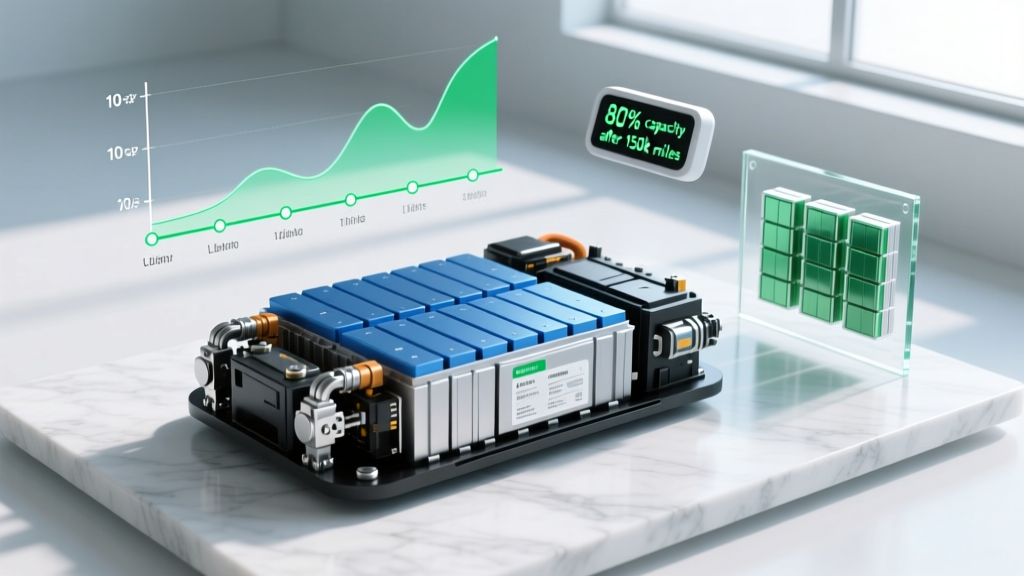
LFP packs show a flatter curve: typically 5–8% loss at 100,000 miles, with the curve flattening further after the initial break-in period. Data compiled from Tesla Impact Reports and third-party fleet analysis by Recurrent Auto.
The critical insight: degradation is non-linear. The largest drop happens in the first 10,000–20,000 miles as the solid electrolyte interphase (SEI) layer forms on the anode. After that, the curve flattens considerably. Most Tesla owners will never see their pack drop below 80% capacity during typical ownership — and many will sell or trade the car before reaching 150,000 miles.
Tesla Battery Warranty: What's Covered and for How Long
Tesla's high-voltage battery warranty is one of the strongest in the industry, but the fine print matters. Here's exactly what you're covered for:
| Model / Trim | Warranty Period | Mileage Limit | Minimum Capacity Retention |
|---|---|---|---|
| Model 3 RWD (LFP) | 8 years | 100,000 miles | 70% |
| Model 3 Long Range / Performance | 8 years | 120,000 miles | 70% |
| Model Y RWD (LFP) | 8 years | 100,000 miles | 70% |
| Model Y Long Range / Performance | 8 years | 120,000 miles | 70% |
| Model S | 8 years | 150,000 miles | 70% |
| Model X | 8 years | 150,000 miles | 70% |
What triggers a warranty claim? If your battery's usable capacity drops below 70% of its original kWh rating within the warranty period, Tesla will repair or replace the pack at no cost. In practice, Tesla typically replaces individual modules (not the entire pack) when possible, which is faster and less resource-intensive.
What's NOT covered: Damage from accidents, flooding, fire, or improper modification. Also, cosmetic range loss from normal degradation above the 70% threshold is considered expected wear — not a defect. If your 82 kWh pack holds 58 kWh (70.7%) at year 7, you're within spec, even if you've lost 90 miles of displayed range.
Tesla Battery Replacement Cost: When and How Much
Let's address the concern directly: yes, an out-of-warranty Tesla battery replacement is expensive. But context is critical — the vast majority of Tesla batteries outlast the vehicle's economic life, and many packs from 2018–2020 Model 3s are still running strong at 150,000+ miles with 85%+ retention.
| Model | Battery Size | Estimated Parts Cost | Labor | Total Range |
|---|---|---|---|---|
| Model 3 RWD (LFP) | ~57 kWh | $10,000–$13,000 | $1,500–$2,500 | $12,000–$15,000 |
| Model 3 Long Range | ~75 kWh | $13,000–$16,000 | $1,500–$2,500 | $14,000–$18,000 |
| Model Y Long Range | ~75 kWh | $14,000–$17,000 | $1,500–$2,500 | $15,000–$19,000 |
| Model S (2023+) | ~100 kWh | $18,000–$22,000 | $2,000–$3,000 | $20,000–$25,000 |
| Model X (2023+) | ~100 kWh | $18,000–$22,000 | $2,000–$3,000 | $20,000–$25,000 |
When is replacement typically needed? Based on current degradation data, very few Tesla packs require full replacement before 200,000 miles. Most owners who experience sub-70% capacity are at 250,000+ miles or have experienced a manufacturing defect covered under warranty. For context, the average age of a vehicle scrapped in the U.S. is 15.7 years (S&P Global Mobility) — at 14,000 miles/year, that's ~220,000 miles, right at the point where a Tesla pack might approach 80% retention.
If you're buying a used Tesla out of warranty, request a battery health reading from the service center. A pack at 88% State of Health (SoH) with 60,000 miles has a lot of life left; one at 78% with 90,000 miles may warrant negotiation on price.
How to Check and Maximize Your Tesla Battery Health
Tesla doesn't expose a direct State of Health (SoH) percentage in the vehicle UI the way some competitors do. But there are reliable methods to assess your pack's condition:
Checking Battery Health
- Tesla Service Mode: On 2023+ software, you can access Service Mode (tap the "Software" tile, hold for 3 seconds, type "service") to view estimated battery capacity in kWh compared to original. This gives a rough SoH percentage.
- Third-party apps: Tools like Tessie, TeslaFi, or Stats (iOS) log charge sessions and can calculate SoH by comparing energy added during a known SoC window (e.g., 20% to 80%) against the pack's rated capacity.
- Range comparison method: Charge to 100% (or a consistent SoC) and compare displayed rated range to the original EPA figure. A Model 3 LR that originally displayed 341 miles at 100% but now shows 300 miles is at roughly 88% SoH. Note: displayed range varies with temperature, so compare in similar conditions.
- Service center diagnostic: Tesla can run a full capacity test — useful for pre-purchase inspections on used vehicles.
Battery Care Checklist: Maximizing Longevity
- NMC/NCA daily limit: Set charge limit to 80% for daily driving. Only charge to 100% when you'll use the range within 24 hours.
- LFP daily limit: Charge to 100% at least once per week (Tesla's official recommendation) to keep the Battery Management System (BMS) calibrated.
- Avoid prolonged storage at extremes: Don't leave the car sitting at 100% or below 10% SoC for more than a few days. For long-term storage (vacation), set to 50% SoC and leave plugged in.
- Minimize DC fast charging when possible: Supercharging at 250 kW is convenient but generates significant heat. For daily use, Level 2 home charging at 7–11 kW is gentler on cells. Occasional Supercharging on road trips is fine — it's the daily habit that accelerates wear.
- Precondition before charging: Use the Tesla app or scheduled departure to warm the battery before fast charging in cold weather. A cold battery charged at high power suffers lithium plating, an irreversible degradation mechanism.
- Park in shade or a garage: Sustained high battery temperatures (above 95°F ambient, especially in Southwest climates) accelerate calendar aging. A garage makes a measurable difference over years.
- Use regenerative braking: Tesla's regen reduces mechanical brake wear and, more importantly, means less energy needs to be re-added via charging — fewer total charge cycles over the vehicle's life.
Tesla Battery Disposal and Recycling: The End-of-Life Reality
This is where the keyword "Tesla battery disposal" gets its due — and where the narrative shifts from concern to one of the EV industry's stronger environmental stories.
Tesla does not send battery packs to landfills. End-of-life Tesla packs follow one of three paths:
- Second-life applications (~10–20% of retired packs): Packs that have degraded below automotive usefulness (typically below 70% SoH) still hold substantial energy. These are repurposed for stationary energy storage — think home Powerwall-style applications or commercial grid-buffering. A 75 kWh pack at 70% health still stores 52.5 kWh, enough to power an average U.S. home for nearly two days.
- Hydrometallurgical recycling (~70–80% of retired packs): Tesla partners with Redwood Materials (founded by former Tesla CTO JB Straubel) and other recyclers to recover raw materials. Current hydrometallurgical processes recover 92–98% of nickel, cobalt, copper, and lithium from spent cells. These materials re-enter the supply chain as cathode precursor, directly reducing the need for virgin mining.
- Component-level refurbishment: When a single module fails within a pack, Tesla service centers replace that module rather than the entire pack. The failed module is then recycled. This is the most common "repair" scenario and dramatically reduces waste.
What about the environmental impact of lithium mining? It's real — lithium extraction carries water-use and land-disturbance concerns, particularly in South American brine operations. But the recycling loop is tightening: Redwood Materials alone is scaling to produce enough recycled cathode material for 1 million EVs annually by 2028. Every retired pack that enters the recycling stream reduces the marginal need for new extraction.
Owner responsibility: If you're retiring a Tesla or replacing a pack out of warranty, the old pack is handled by Tesla's service network or an authorized recycler. You don't need to arrange disposal yourself. In fact, a degraded Tesla pack still has significant residual value — some third-party buyers pay $2,000–$5,000 for packs with 65–75% SoH for second-life projects.
What's Next: Solid-State and Silicon-Anode Batteries
If you're wondering whether to wait for "next-gen" battery tech before buying, here's a grounded timeline:
Silicon-anode cells (higher energy density than current graphite anodes) are already in limited production. Tesla's 4680 cell design incorporates incremental silicon content, and companies like Sila Nanotechnologies and Group14 are supplying silicon-carbon anode materials to multiple automakers. Expect 10–20% energy density gains in production vehicles by 2027–2028 — meaningful but evolutionary, not revolutionary.
Solid-state batteries (replacing the liquid electrolyte with a solid conductor) promise higher energy density, faster charging, and improved safety. Toyota has announced a 2027–2028 production timeline for solid-state EVs; QuantumScape is shipping prototype cells to Volkswagen. However, manufacturing scalability remains the unsolved challenge. Realistically, solid-state batteries won't appear in mainstream, affordably priced EVs until 2030 or later. If you need a car now, don't wait for solid-state.
Current NMC and LFP chemistries are mature, well-understood, and backed by robust recycling infrastructure. The environmental case for driving an EV today with today's batteries is strong — the EPA confirms that even accounting for battery manufacturing, a typical EV produces fewer lifecycle greenhouse gas emissions than a comparable gasoline car in every U.S. grid region.
Frequently Asked Questions
How long do Tesla batteries last in real-world use?
Based on Tesla's fleet data, NMC/NCA packs retain approximately 85% capacity at 200,000 miles. LFP packs show even slower degradation. In years, most Tesla batteries will function well beyond 15 years of average driving. Full replacement before 200,000 miles is rare and usually covered under the 8-year warranty.
How much does it cost to replace a Tesla battery?
Out-of-warranty replacement ranges from approximately $12,000 (Model 3 RWD LFP pack) to $25,000 (Model S/X 100 kWh pack), including parts and labor. However, most Tesla batteries never need full replacement during typical ownership. Module-level repairs, when needed, cost significantly less.
What does Tesla's battery warranty actually cover?
Tesla warrants the high-voltage battery against capacity loss below 70% for 8 years, with mileage limits of 100,000 (RWD), 120,000 (Model 3/Y LR), or 150,000 (Model S/X). Manufacturing defects and abnormal degradation are covered. Damage from accidents, flooding, or unauthorized modifications is not.
Is LFP better than NMC for Tesla batteries?
It depends on your priorities. LFP offers longer cycle life (3,000+ cycles vs ~1,500–2,000), no cobalt, and lower cost — but less range per charge and worse cold-weather performance. If you commute under 60 miles daily and charge at home, LFP is the longevity winner. If you road-trip frequently or live in a cold climate, NMC/NCA's higher energy density is worth the trade-off.
Does frequent Supercharging damage the battery?
DC fast charging at 250 kW generates heat, which accelerates degradation over time. Occasional Supercharging (road trips, a few times per month) has minimal impact. Daily Supercharging as your primary charging method will measurably increase degradation compared to Level 2 home charging. Tesla's thermal management system actively cools the pack during Supercharging to mitigate this, but physics still applies.
How do I responsibly dispose of a Tesla battery?
You don't handle it yourself. Tesla's service network manages end-of-life packs through certified recycling partners like Redwood Materials. If you're replacing a pack out of warranty, the old pack is taken by the service center. Degraded packs still have residual value ($2,000–$5,000) for second-life energy storage applications.
Can I check my Tesla's battery health myself?
Yes. Use Service Mode (on newer software versions) to view estimated capacity, compare your displayed rated range at full charge to the original EPA figure, or use third-party logging apps like Tessie or TeslaFi to calculate SoH from charge-session data. For the most accurate reading, request a diagnostic at a Tesla service center.