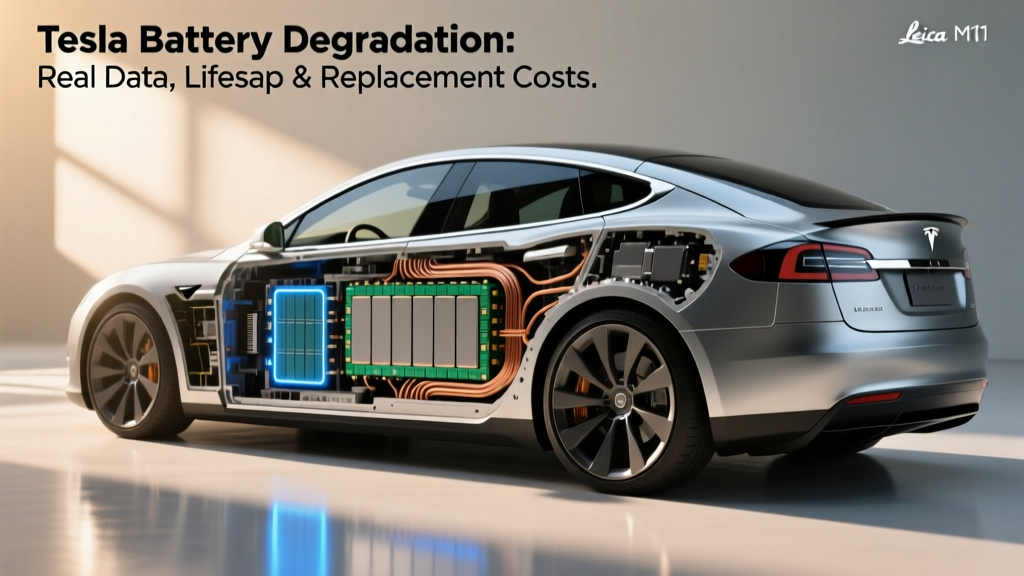
The Real Story Behind Tesla Battery Degradation
If you own a Tesla — or are considering one — battery longevity is likely your biggest long-term concern. The traction battery is the single most expensive component in any electric vehicle, and headlines about replacement costs north of $15,000 don't help. But the data tells a more nuanced story: most Tesla batteries lose capacity slowly and predictably, and the vast majority will outlast the vehicle's useful life without needing replacement.
This guide breaks down what Tesla battery degradation actually looks like in practice, the chemistry differences between Model 3/Y Standard Range (LFP) and Long Range/Performance (NMC/NCA) variants, what the warranty covers, and how to monitor and maximize your battery's State of Health (SoH) over hundreds of thousands of miles.
LFP vs NMC/NCA: Which Chemistry Does Your Tesla Use?
Tesla uses two primary battery chemistries across its lineup, and understanding which one is in your vehicle fundamentally changes how you should charge, store, and think about long-term health.
| Attribute | LFP (Lithium Iron Phosphate) | NMC/NCA (Nickel Manganese Cobalt / Nickel Cobalt Aluminum) |
|---|---|---|
| Found in | Model 3/Y Standard Range (RWD) | Model 3/Y Long Range & Performance; Model S/X |
| Energy density | Lower (~160 Wh/kg cell-level) | Higher (~250-270 Wh/kg cell-level) |
| Cycle life | 3,000-5,000+ cycles | 1,000-2,000 cycles |
| Cold-weather performance | Reduced range & slower charging in freezing temps | Better low-temp conductivity, less range loss |
| Recommended daily SoC | 100% (Tesla recommends weekly full charge for calibration) | 80% daily; 100% only for trips |
| Cost | Lower — no cobalt or nickel | Higher — commodity-sensitive materials |
| Typical usable capacity (2025-2026) | ~57-60 kWh (Model 3 RWD) | ~75-82 kWh (Long Range); ~100 kWh (Model S) |
The trade-off in plain terms: LFP batteries sacrifice some energy density (meaning slightly less range for the same physical pack size) in exchange for dramatically longer cycle life and the ability to sit at 100% State of Charge without accelerated degradation. NMC/NCA packs deliver more range per kilogram but are more sensitive to high SoC storage and benefit from being kept between 20-80% for daily use.
If you're a high-mileage driver who charges daily to 100% out of convenience, LFP is the more forgiving chemistry. If you need maximum range and can manage charge limits, NMC/NCA offers the performance edge.
Tesla Battery Degradation: What the Data Actually Shows
Tesla's own Impact Report has historically stated that Model S/X batteries retain approximately 88% capacity after 200,000 miles, and Model 3/Y packs retain roughly 85% at the same mileage. Independent fleet data and owner surveys largely corroborate these figures, though with important nuances.
Typical Degradation Curve by Mileage
| Mileage | Avg. Capacity Retained (Model 3/Y NMC) | Avg. Capacity Retained (Model 3/Y LFP) | Notes |
|---|---|---|---|
| 0-30,000 mi | ~95-97% | ~97-99% | Initial "break-in" loss; steepest part of the curve |
| 50,000 mi | ~92-94% | ~95-97% | Curve flattens significantly |
| 100,000 mi | ~88-92% | ~92-95% | Linear, slow decline phase |
| 150,000 mi | ~85-90% | ~90-93% | Still well above warranty threshold |
| 200,000 mi | ~82-88% | ~88-92% | Approaching warranty boundary for some packs |
Sources: Tesla Impact Reports, Recurrent Auto fleet data, owner-reported datasets aggregated by TeslaFi and Teslamate communities. Individual results vary based on charging habits, climate, and Supercharging frequency.
Key takeaway: Degradation is not linear. Most capacity loss occurs in the first 20,000-30,000 miles (roughly 3-5%), after which the curve flattens considerably. A Model 3 Long Range with an EPA-rated 341 miles that drops to ~325 miles after two years isn't defective — it's following the expected curve. The real-world highway range at 75 mph will be closer to 280-300 miles even at 100% SoC when new, so a degraded pack at 90% SoH still delivers 250+ usable highway miles in moderate conditions.
What Tesla's Battery Warranty Actually Covers
Tesla's battery and drive unit warranty is among the more straightforward in the industry, but the details matter — especially the capacity retention threshold that triggers a claim.
| Model / Variant | Warranty Period | Mileage Limit | Minimum Capacity Retention |
|---|---|---|---|
| Model 3 RWD (LFP) | 8 years | 100,000 miles | 70% |
| Model 3 Long Range / Performance | 8 years | 120,000 miles | 70% |
| Model Y (all variants) | 8 years | 120,000 miles | 70% |
| Model S / Model X | 8 years | 150,000 miles | 70% |
Source: Tesla New Vehicle Limited Warranties. Warranty covers defects and capacity loss below the stated threshold. It does not cover cosmetic issues, damage from accidents, or modifications.
What "70% retention" means in practice: If your Model 3 Long Range started with 75 kWh usable and drops below 52.5 kWh usable within the warranty window, Tesla will repair or replace the pack to bring it above 70%. In reality, very few Teslas fall below this threshold under normal use — the degradation data above shows most packs retain 82-92% even at 200,000 miles.
The warranty is also transferable to subsequent owners, which supports resale value. However, if you exceed the mileage cap before the 8-year mark, coverage ends. High-mileage drivers (30,000+ miles/year) should factor this into their ownership calculus.
Factors That Accelerate (or Slow) Battery Degradation
Not all miles are created equal when it comes to battery wear. Research from battery analytics firm Recurrent Auto and academic studies point to several controllable factors:
Charging Habits That Maximize Battery Life
- For NMC/NCA packs: Set daily charge limit to 80%. Reserve 100% charges for road trips. Avoid letting SoC sit below 10% for extended periods.
- For LFP packs: Charge to 100% at least once per week for BMS calibration. Daily 100% is acceptable per Tesla's guidance.
- Minimize DC fast charging frequency: Occasional Supercharging is fine, but packs that DC fast charge daily show ~1-2% additional degradation over 100,000 miles compared to predominantly Level 2 charging. The high C-rates and heat generated during 150-250 kW sessions stress cells more than gentle 7-11 kW Level 2 charging.
- Use preconditioning: Enable "Scheduled Departure" or navigate to a Supercharger to precondition the battery. Charging a cold pack forces the BMS to restrict charge rate, and cold charging causes lithium plating — a permanent degradation mechanism.
- Avoid extreme SoC storage: Don't leave an NMC pack at 100% or below 5% for weeks. If storing the vehicle, set SoC to ~50%.
Environmental Factors
- Extreme heat is worse than extreme cold for long-term degradation. Parking in shade or a garage in hot climates (Arizona, Texas, SoCal) measurably extends pack life.
- Cold weather reduces range temporarily (10-30% loss depending on temperature) but does not cause permanent degradation if the pack is preconditioned before charging.
- Tesla's active thermal management system (liquid cooling/heating) significantly mitigates temperature-related stress compared to passively cooled packs in older EVs.
How Much Does a Tesla Battery Replacement Cost?
This is the question that generates the most anxiety — and the most misinformation. Here's what replacement actually costs in 2025-2026, and more importantly, how often it's needed.
| Model | Battery Size | Chemistry | Out-of-Warranty Replacement Cost (parts + labor) | Typical Replacement Trigger |
|---|---|---|---|---|
| Model 3 RWD | ~57-60 kWh | LFP | $12,000 - $15,000 | Rare before 300,000+ mi; physical damage or cell failure |
| Model 3/Y Long Range | ~75-82 kWh | NMC/NCA | $14,000 - $18,000 | Rare before 250,000+ mi under normal use |
| Model S (current gen) | ~100 kWh | NCA | $18,000 - $24,000 | Older high-mileage units; newer packs rarely need replacement |
| Model X (current gen) | ~100 kWh | NCA | $18,000 - $25,000 | Similar to Model S; structural pack adds labor complexity |
Costs based on 2025-2026 service center quotes and third-party EV repair data. Refurbished/remanufactured packs may reduce cost by 30-40%. Prices subject to change as battery commodity costs fluctuate.
Context that matters: The average age of a vehicle on US roads is over 12 years, and the average car is driven ~14,000 miles per year. That's roughly 168,000 miles over a typical ownership lifecycle. Based on the degradation data, most Tesla packs will retain 85-90%+ capacity at that mileage — far above the 70% warranty threshold. Full battery replacement due to degradation alone is exceedingly rare in modern Teslas. When replacements do occur, they're more often due to manufacturing defects (covered under warranty), physical damage from road debris, or coolant system failures rather than natural end-of-life wear.
For comparison, a transmission replacement on a conventional vehicle runs $4,000-$8,000, and an engine rebuild can exceed $7,000 — components that fail far more frequently than EV traction batteries.
How to Monitor Your Tesla's Battery Health (SoH)
Tesla doesn't expose a direct "State of Health" percentage in the vehicle UI the way some competitors do, but there are several reliable methods to track your pack's condition:
Method 1: Range Comparison at 100% SoC
Charge your NMC/NCA Tesla to 100% (or your LFP Tesla, which should regularly hit 100%) and note the displayed range. Compare this to the EPA-rated range when new. For example, a Model 3 Long Range that displayed 341 miles at 100% when new and now shows 318 miles at 100% has roughly 93% SoH. Note: Tesla's displayed range is based on a fixed energy-per-mile factor, not a dynamic calculation, so this method is reasonably consistent.
Method 2: Third-Party Apps
Apps like TeslaFi, Teslamate (self-hosted), and Stats log detailed charging data including energy added vs. SoC change, which allows them to estimate actual usable kWh and calculate SoH more precisely than the dashboard range display. These tools track degradation over time with graphs, making trends visible.
Method 3: Service Mode (Limited)
Tesla's Service Mode (accessible via the software menu) shows nominal full-pack capacity in kWh on some firmware versions. This is the most direct reading but isn't available on all software builds and Tesla has occasionally restricted access.
Method 4: Energy Screen Trip Tracker
Reset the trip energy tracker, drive from 100% to ~10% on a long trip, and note total kWh consumed. Compare this to the pack's original usable capacity. This is the most accurate real-world test but requires a long drive.
What's Next: Solid-State and Silicon Anode Batteries
The battery technology landscape is evolving, but it's critical to separate announced research from production reality.
Solid-state batteries promise higher energy density, faster charging, and improved safety by replacing the liquid electrolyte with a solid conductor. Companies like Toyota, QuantumScape, and Samsung SDI have demonstrated prototypes, but mass production for consumer vehicles remains estimated for 2028-2030 at the earliest. Tesla has not announced a solid-state production timeline. These batteries will likely debut in premium/limited applications before reaching mainstream pricing.
Silicon anode technology is closer to production. By incorporating silicon into the graphite anode, manufacturers can increase energy density by 10-20%. Tesla's existing 4680 cells already use some silicon in the anode, and incremental improvements are expected in successive model years. This is evolution, not revolution — expect gradual range and cost improvements rather than a step-change breakthrough.
Sodium-ion batteries are emerging as a low-cost alternative for entry-level EVs, with CATL and BYD leading production. Tesla has not announced sodium-ion adoption, but the chemistry could theoretically appear in future base-model vehicles where cost matters more than range. Timeline: 2027+ for any potential Tesla application.
For buyers today: don't delay a purchase waiting for next-generation battery tech. Current LFP and NMC chemistries are mature, well-understood, and backed by real-world degradation data spanning hundreds of millions of fleet miles.
Tesla Battery Degradation FAQ
How long do Tesla batteries last in years and miles?
Based on fleet data, most Tesla batteries retain 82-92% capacity at 200,000 miles. At an average driving rate of 14,000 miles/year, that's 14+ years before reaching even moderate degradation. The battery will typically outlast the vehicle's other components. Full replacement due to degradation alone is rare before 250,000-300,000 miles.
How much does it cost to replace a Tesla battery?
Out-of-warranty replacement costs range from approximately $12,000 for a Model 3 RWD (LFP) to $25,000 for a Model X (NCA), including parts and labor. Refurbished packs can reduce this by 30-40%. However, the vast majority of Tesla owners will never need a replacement — degradation data shows packs retaining well above the 70% warranty threshold through 200,000+ miles.
What does Tesla's battery warranty cover?
Tesla covers the battery and drive unit for 8 years / 100,000-150,000 miles (depending on model) with a minimum 70% capacity retention guarantee. If your pack drops below 70% of original usable capacity within the warranty window, Tesla will repair or replace it. The warranty covers defects and abnormal degradation but not damage from accidents, misuse, or modifications.
How do I check my Tesla battery health?
The simplest method: charge to 100% and compare displayed range to the original EPA rating. A 100% charge showing 318 miles on a car rated at 341 miles suggests ~93% State of Health. For more precise tracking, use third-party apps like TeslaFi or Teslamate that calculate usable kWh from charging data. Tesla's Service Mode may also display nominal pack capacity on some firmware versions.
Is LFP or NMC better for long-term battery health?
For pure cycle life and tolerance of 100% daily charging, LFP is superior — it offers 3,000-5,000+ cycles vs. 1,000-2,000 for NMC. However, LFP has lower energy density (less range), worse cold-weather performance, and slower cold-temperature charging. NMC delivers more range and better cold performance but requires disciplined 80% daily charge limits. Neither chemistry is universally "better" — the right choice depends on your driving patterns, climate, and charging access.
Does frequent Supercharging damage the battery?
Occasional Supercharging has minimal impact. However, fleet data shows packs that DC fast charge daily exhibit approximately 1-2% additional capacity loss over 100,000 miles compared to those primarily using Level 2 (7-11 kW) home charging. The heat and high C-rates during 150-250 kW charging sessions accelerate cell wear. For daily charging, a home Level 2 setup at 32-48 amps is gentler on the pack. Use Superchargers for road trips and occasional top-ups without concern.
Does cold weather permanently damage the battery?
No. Cold weather causes temporary range loss (10-30% depending on severity) due to increased internal resistance and energy used for cabin/pack heating, but this is fully reversible. The risk is charging a cold pack without preconditioning — this can cause lithium plating, a permanent degradation mechanism. Always use Scheduled Departure or navigate to a Supercharger to precondition before charging in freezing temperatures.