When shoppers search for "Tesla how many batteries," they are usually asking one of two questions: how many individual lithium-ion cells make up a Tesla's high-voltage traction battery pack, or how often will that pack need replacing over the vehicle's life. The answer to the first is a matter of engineering architecture; the answer to the second is reassuring for nearly every buyer. This guide dissects Tesla's battery design, chemistry choices, real-world degradation data, warranty coverage, and replacement economics — with exact numbers and no fear-mongering.
How Many Cells Are Inside a Tesla Battery Pack?
A Tesla vehicle contains one high-voltage traction battery pack (plus a separate, conventional 12V or 16V lithium auxiliary battery for accessories — not to be confused with the main pack). Inside that single traction pack, however, are thousands of individual cylindrical or prismatic lithium-ion cells wired in series and parallel to achieve the pack's total voltage and kWh (kilowatt-hours, a measure of energy capacity).
The cell count varies by model, model year, and battery size:
- Model 3 Standard Range (LFP, ~57.5 kWh usable): Uses prismatic LFP cells from CATL. Exact cell count is proprietary, but these packs use fewer, larger prismatic cells rather than thousands of cylinders.
- Model 3/Model Y Long Range (NMC/NCA, ~75-82 kWh usable): Approximately 4,416 individual 2170-type cylindrical cells (or equivalent in newer 4680-cell configurations).
- Model S/Model X (100 kWh-class pack): The current dual-motor models use packs derived from the 18650-cell architecture (roughly 7,104 cells in older packs) or newer structural packs depending on production date.
- Cybertruck (~123 kWh usable): Uses Tesla's 4680 structural battery pack with dry-cathode NMC chemistry. Fewer, larger cells — approximately 1,300+ 4680 cells.
The trend across Tesla's lineup is toward fewer, larger cells (the 4680 form factor is 5× the volume of the older 18650), which simplifies manufacturing and can improve pack-level energy density. For the owner, cell count matters less than total pack kWh, chemistry, and thermal management — all of which determine range, charging speed, and longevity.
LFP vs NMC/NCA: Which Chemistry Does Tesla Use?
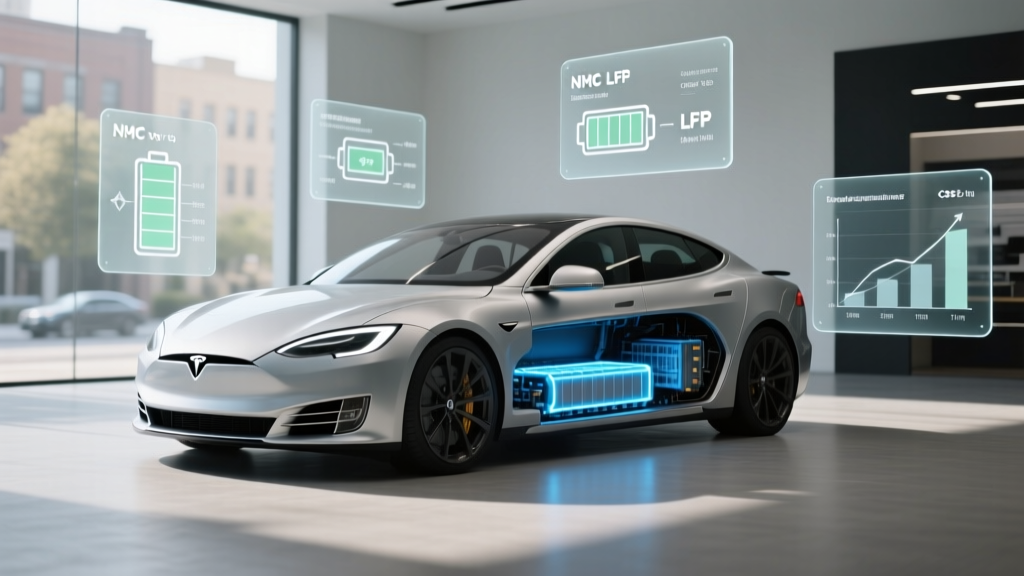
Tesla is one of the few automakers that deploys two distinct battery chemistries across its lineup, and the choice has real ownership implications. Here is how they compare:
| Attribute | LFP (Lithium Iron Phosphate) | NMC/NCA (Nickel Manganese Cobalt / Nickel Cobalt Aluminum) |
|---|---|---|
| Models using it | Model 3 RWD, Model Y RWD (Standard Range) | Model 3/Y Long Range & Performance, Model S, Model X, Cybertruck |
| Energy density | Lower (~160 Wh/kg cell-level) | Higher (~250-300 Wh/kg cell-level) |
| Typical pack size | ~57.5 kWh usable | ~75-123 kWh usable |
| Cycle life | 3,000-5,000+ cycles to 80% capacity | 1,000-2,000 cycles to 80% capacity |
| Cold-weather performance | Greater range loss below freezing (~30-35% reduction at 20°F) | Better cold performance (~20-25% reduction at 20°F) |
| Charging recommendation | Tesla recommends charging to 100% regularly | Tesla recommends daily limit of 80-90%, 100% for trips only |
| Cost per kWh | Lower (no cobalt or nickel) | Higher (nickel and cobalt content) |
| Thermal stability | Higher — less prone to thermal runaway | Lower — requires robust thermal management |
Which is better? Neither is universally superior. LFP wins on longevity, cost, and safety — ideal for daily commuting and high-mileage drivers who charge to 100% nightly. NMC/NCA wins on energy density and cold-weather range — better for Long Range buyers who need 320+ EPA miles and frequently drive in winter conditions. Tesla's vehicle software manages each chemistry differently (different charge limits, preconditioning profiles, and BMS calibration), so the owner experience is already optimized.
How Long Do Tesla Batteries Actually Last?
Based on fleet data published in Tesla's Impact Reports and independent analysis by researchers like those at Tesla's annual impact reporting, the average Tesla battery retains approximately 85-90% of its original capacity after 150,000 miles. This is not a lab projection — it is measured across hundreds of thousands of vehicles in real-world use.
Tesla Fleet Degradation Data Points (NMC/NCA packs, aggregated):
- 25,000 miles: ~3-5% capacity loss (initial calibration drop)
- 50,000 miles: ~5-7% capacity loss
- 100,000 miles: ~8-10% capacity loss
- 150,000 miles: ~10-15% capacity loss
- 200,000 miles: ~12-17% capacity loss (data set smaller)
Source: Tesla Impact Reports (2023-2025 editions). LFP packs show a flatter degradation curve, often retaining 92-95% at 100,000 miles due to the chemistry's inherently longer cycle life.
Translation: a Model Y Long Range with an EPA-rated 320 miles and 82 kWh pack will still deliver roughly 275-290 miles of range at 100,000 miles. For most owners, the battery will outlast the vehicle's useful economic life. The fear of needing a replacement at 80,000 miles — a persistent myth from early Nissan Leaf days with passively-cooled packs — does not apply to Tesla's actively liquid-cooled systems.
What Does Tesla's Battery Warranty Cover?
Tesla's battery and drive unit warranty is one of the stronger offerings in the EV market, and it is specific by model:
| Model | Warranty Period | Mileage Limit | Minimum Capacity Retention |
|---|---|---|---|
| Model 3 RWD (LFP) | 8 years | 100,000 miles | 70% |
| Model 3 Long Range / Performance | 8 years | 120,000 miles | 70% |
| Model Y (all trims) | 8 years | 120,000 miles | 70% |
| Model S / Model X | 8 years | 150,000 miles | 70% |
| Cybertruck | 8 years | 120,000 miles | 70% |
What this means in practice: If your battery drops below 70% of its original capacity within the warranty window (whichever limit comes first — years or miles), Tesla will replace or refurbish the pack at no cost. The warranty also covers manufacturing defects and drive unit failures. It does not cover damage from accidents, flooding, or modifications. Per Tesla's official warranty documentation, refurbished replacement packs may be used, but they will meet or exceed the 70% retention threshold.
How Much Does a Tesla Battery Replacement Cost?
Out-of-warranty battery replacement is the single largest potential expense in EV ownership. For Tesla vehicles, costs vary significantly by model and pack size:
| Model / Pack | Pack Size (usable kWh) | Estimated Replacement Cost | Typical Replacement Trigger |
|---|---|---|---|
| Model 3 RWD (LFP) | ~57.5 kWh | $5,000 - $8,000 | Physical damage; rare degradation failure post-warranty |
| Model 3/Y Long Range | ~75-82 kWh | $8,000 - $13,000 | Physical damage; extreme mileage degradation (200k+ mi) |
| Model S / Model X | ~95-100 kWh | $12,000 - $16,000 | Older 85/90 kWh packs more prone; newer 100 kWh packs rarely fail |
| Cybertruck | ~123 kWh | $13,000 - $18,000 (est.) | Physical damage; too new for long-term degradation data |
These figures include the pack and labor at a Tesla Service Center. Independent EV shops may offer refurbished packs at 20-30% less. However, the critical context is this: the vast majority of Tesla owners never pay for a battery replacement. Packs are lasting well beyond warranty limits, and out-of-warranty replacements are overwhelmingly due to collision damage (covered by insurance), not degradation. According to fleet data, fewer than 1-2% of Tesla battery packs have required replacement due to degradation failure within the first 150,000 miles.
What Affects Tesla Battery Life — and How to Maximize It
Battery degradation is not random. It follows predictable electrochemical patterns driven by temperature, charge state, and charging speed. Here are the factors that matter most, ranked by impact:
Battery Care Checklist for Tesla Owners
- Avoid prolonged storage at 100% SoC (NMC/NCA packs): Sitting at full charge accelerates electrolyte decomposition. Set your daily charge limit to 80% and only charge to 100% when departing on a trip within a few hours. LFP packs are the exception — Tesla recommends regular 100% charges to keep the BMS calibrated.
- Minimize DC fast charging when Level 2 is available: Supercharging at 150-250 kW generates significant heat. Tesla's thermal management handles this well, but frequent daily Supercharging (vs. home Level 2) correlates with slightly higher long-term degradation — roughly 1-3% additional loss over 100,000 miles based on fleet comparisons.
- Precondition before fast charging: Tesla's navigation system automatically preconditions the battery when you route to a Supercharger. This warms the cells to optimal temperature (~95-105°F), enabling faster charging and reducing stress. Never override this by manually setting charge limits mid-route.
- Park in shade or a garage during extreme heat: Sustained pack temperatures above 110°F (parking in direct sun in Arizona summers, for example) accelerate degradation. The car's thermal management runs even when parked, but it cannot eliminate all heat soak.
- Do not let the pack sit at very low SoC for extended periods: Below 5%, the battery management system draws power for monitoring and cell balancing. A car left at 2% for weeks can brick the 12V system and stress the traction pack. Keep storage SoC around 50% for long-term parking.
- Use Scheduled Departure and Scheduled Charging: These Tesla features let you charge during off-peak hours and precondition the battery right before you leave, minimizing time spent at high SoC.
How to Check Your Tesla's Battery Health (State of Health)
Tesla does not display a simple "battery health percentage" on the main touchscreen the way some competitors do. However, owners have several methods to estimate State of Health (SoH):
- Range comparison method: Charge to 100% (or your normal limit) and note the displayed estimated range. Compare this to the EPA-rated range for your model when new. A Model Y Long Range that displayed 320 miles at 100% when new but now shows 285 miles at 100% has roughly 89% SoH. Note: displayed range is affected by recent driving efficiency and temperature, so take multiple readings over time.
- Tesla Service Mode (DIY): On newer software versions, you can access Service Mode by holding the "Model" text on the About screen for several seconds. Within Service Mode, the Battery Health test runs a controlled discharge/analysis and reports a percentage. This is the most accurate built-in method.
- Third-party apps: Apps like Tessie, Stats for Tesla, or Scan My Tesla (via an OBD-II Bluetooth adapter) can read the BMS-reported nominal full-pack energy (in kWh) and compare it to the original factory capacity. This gives a precise SoH figure.
- Tesla Service Center diagnostic: Requesting a battery health check at a service appointment yields an official report. This is useful for pre-purchase inspections on used Teslas.
What Comes After Lithium-Ion? Emerging Battery Tech
Several next-generation battery technologies are in development that could eventually reach Tesla vehicles. None are currently available in any production car as of 2026, and realistic timelines are measured in years, not months:
- Silicon-dominant anodes: Replacing graphite anodes with silicon can increase energy density by 20-40%. Tesla has been incrementally increasing silicon content in its 4680 cells. Full silicon anodes face expansion and cracking challenges; companies like Sila Nanotechnologies and Group14 are working on composite solutions. Realistic production timeline: 2027-2029 for meaningful integration.
- Solid-state batteries: Replacing liquid electrolyte with a solid conductor promises higher energy density, faster charging, and improved safety. Toyota has announced a 2027-2028 target for limited production; QuantumScape is in pilot phases. Tesla has not announced a solid-state program. Realistic timeline for broad EV adoption: 2030+.
- Sodium-ion batteries: Lower cost and no lithium dependency, but significantly lower energy density. CATL has begun production for Chinese-market vehicles. Possible future use in Tesla's lowest-cost models or energy storage, but unlikely in US-market vehicles before 2028-2029.
- Dry electrode manufacturing (Tesla-specific): Tesla's 4680 cells are moving toward dry-cathode production, which reduces factory footprint, energy use, and cost. This is a manufacturing innovation, not a chemistry change, but it directly lowers the per-kWh cost of future packs. Already in limited production; scaling through 2026-2027.
For buyers today, these technologies are context, not a reason to wait. Current NMC and LFP packs are mature, well-understood, and lasting 200,000+ miles. The next chemistry leap will benefit future buyers, but waiting for solid-state is like waiting for a perfect engine — the technology horizon always advances.
Frequently Asked Questions
How many batteries does a Tesla have?
One high-voltage traction battery pack (containing thousands of individual lithium-ion cells) plus one small 12V or 16V auxiliary battery for accessories and electronics. When people ask "Tesla how many batteries," they are usually referring to the cell count inside the main pack, which ranges from ~1,300 (4680 cells in Cybertruck) to ~7,100+ (18650 cells in older Model S/X).
How long do Tesla batteries last in years and miles?
Based on fleet data, Tesla's liquid-cooled NMC/NCA packs retain 85-90% capacity at 150,000 miles. LFP packs retain 90-95% at the same mileage. In years, most packs are lasting 12-15+ years before reaching 70% capacity. Degradation is front-loaded (the first 20,000-30,000 miles see the steepest drop) and then flattens significantly.
How much does it cost to replace a Tesla battery?
Between $5,000 and $18,000 depending on the model and pack size, including labor at a Tesla Service Center. However, most owners never pay this — packs are outlasting the vehicles, and failures within the 8-year warranty are covered at no cost. Out-of-warranty replacements are rare and usually due to collision damage, which insurance covers.
Does Supercharging damage Tesla batteries?
Not significantly. Tesla's liquid thermal management keeps cells within safe temperature ranges during DC fast charging. Fleet data shows that owners who Supercharge frequently experience only 1-3% additional degradation over 100,000 miles compared to those who primarily charge at home on Level 2. The convenience of Supercharging far outweighs this marginal difference.
Should I charge my Tesla to 100% every day?
It depends on your chemistry. If you have an LFP pack (Model 3 RWD, Model Y RWD), Tesla recommends charging to 100% at least weekly for BMS calibration. If you have an NMC/NCA pack (Long Range, Performance, Model S/X), set your daily limit to 80% and reserve 100% for road trips. This single habit is the most impactful thing you can do for long-term battery health.
What voids the Tesla battery warranty?
According to Tesla's warranty terms, the battery warranty does not cover damage from collisions, flooding, fire (external), aftermarket modifications to the battery or high-voltage system, or use of the vehicle as a stationary power source beyond V2H/V2L features officially supported by Tesla. Normal degradation is covered if it falls below 70% within the warranty window.