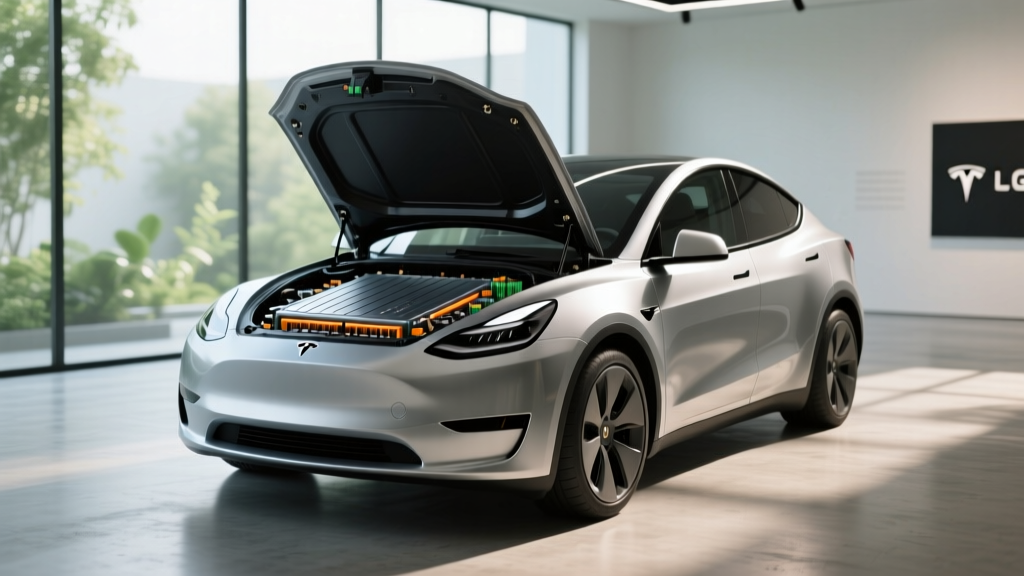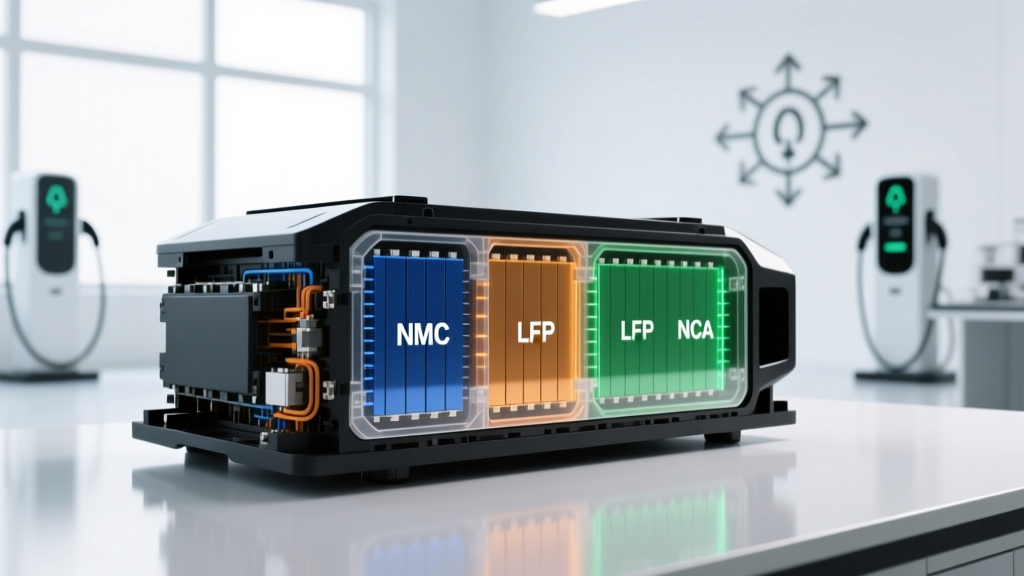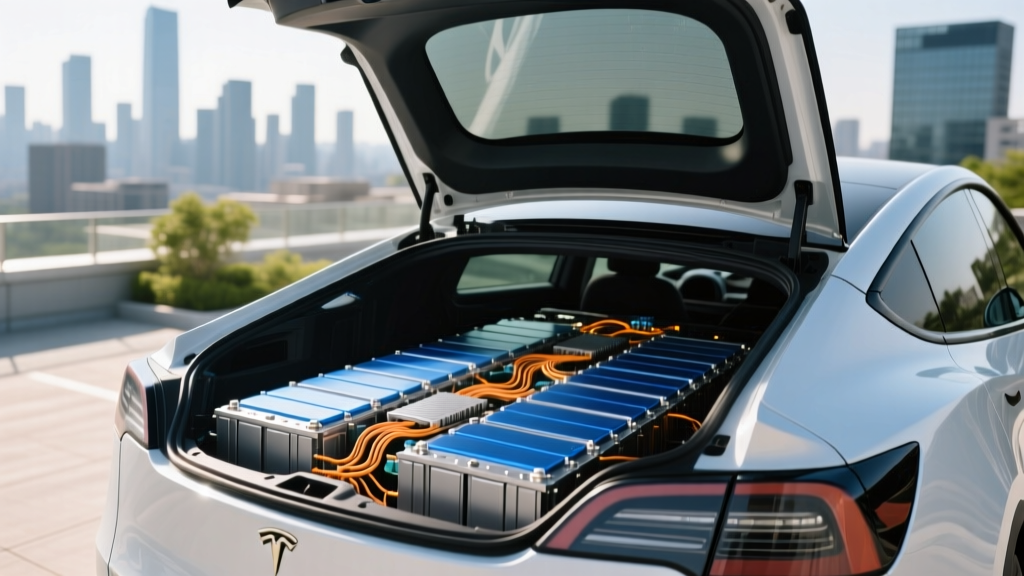
If you've ever wondered what are Tesla batteries made of, the answer has evolved considerably over the past decade. Tesla doesn't use a single battery type across its lineup — it deploys distinct lithium-ion chemistries depending on the model, trim level, and market. In 2026, Tesla's fleet relies primarily on two cathode chemistries: lithium iron phosphate (LFP) for Standard Range (now simply "Model 3" and "Model Y" base trims) and nickel manganese cobalt (NMC) / nickel cobalt aluminum (NCA) for Long Range and Performance variants. The anode across both is predominantly graphite, with incremental silicon-blend additions in newer cells.
Understanding which chemistry sits under your Tesla's floor matters because it dictates real-world range behavior, charging habits, longevity expectations, and ultimately replacement economics. This guide breaks down the exact cell compositions, what the degradation data actually shows, and what ownership looks like beyond the warranty period.
LFP vs NMC/NCA: The Two Chemistries Powering Teslas
Tesla sources cells from multiple suppliers — primarily CATL (LFP prismatic cells), Panasonic (NCA/NMC cylindrical 2170 and 4680 cells), and LG Energy Solution (NMC pouch and cylindrical cells). The chemistry chosen for each trim isn't arbitrary; it reflects a deliberate engineering trade-off.
| Attribute | LFP (LiFePO₄) | NMC / NCA |
|---|---|---|
| Energy Density | ~160–180 Wh/kg (cell level) | ~250–300 Wh/kg (cell level) |
| Typical Tesla Use | Model 3 / Model Y base (RWD) | Model 3/Y Long Range, Model S/X, Cybertruck |
| Cycle Life | 3,000–5,000+ cycles to 80% SoH | 1,000–2,000 cycles to 80% SoH |
| Cold-Weather Performance | More range loss in freezing temps (~30–40% reduction) | Better low-temp performance (~20–30% reduction) |
| Charging to 100% | Recommended weekly for calibration | Daily limit to 80%; 100% only for trips |
| Cost | Lower — no cobalt or nickel | Higher — commodity-linked metals |
| Thermal Stability | Superior — higher thermal runaway threshold | Good, but requires robust BMS management |
| Cell Form Factor (Tesla) | Prismatic (CATL) | Cylindrical 2170 / 4680 (Panasonic, LG) |
Which is better? Neither is universally superior — it depends on your driving pattern. LFP is the better choice for daily commuters who can charge at home every night and want maximum cycle longevity. NMC/NCA is better for road-trippers and cold-climate drivers who need the energy density for longer range and better winter performance. Tesla's own recommendation reflects this: LFP owners should charge to 100% at least once a week, while NMC/NCA owners should set daily limits to 80%.
How Long Do Tesla Batteries Actually Last?
Tesla's 2025 Impact Report (the most recent published data) stated that Model 3/Y battery packs retain approximately 85% of original capacity after 150,000 miles, which roughly corresponds to 8–10 years of average US driving. Model S/X packs show similar retention figures at the same mileage. This aligns with independent fleet data from sources like Tessie and Recurrent Auto, which track thousands of vehicles.
Here's what the degradation curve actually looks like in practice:
| Mileage | Avg. Capacity Retained (LFP) | Avg. Capacity Retained (NMC/NCA) |
|---|---|---|
| 10,000 mi | ~97% | ~95–96% |
| 30,000 mi | ~95% | ~93% |
| 60,000 mi | ~93% | ~90% |
| 100,000 mi | ~90% | ~87% |
| 150,000 mi | ~87–88% | ~84–85% |
| 200,000 mi | ~84–85% | ~80–82% |
Source: Aggregated fleet data from Tesla Impact Reports and third-party telematics trackers. Individual results vary based on charging habits, climate, and Supercharger frequency.
The key takeaway: degradation is non-linear. Most capacity loss occurs in the first 20,000–30,000 miles (the so-called "break-in" period where the solid electrolyte interphase stabilizes), then the curve flattens considerably. A Model 3 Long Range with an EPA-rated 341 miles that drops to ~320 miles after two years isn't defective — it's following a normal degradation trajectory.
For context, the average American drives roughly 14,000 miles per year according to the Federal Highway Administration. At that rate, a Tesla battery reaching 200,000 miles represents 14+ years of service — well beyond the point where most owners have moved on to a new vehicle.
Tesla Battery Warranty: What's Covered and What Isn't
Tesla's battery and drive unit warranty is one of the more straightforward in the industry, but the details matter — especially the capacity retention threshold.
| Model / Trim | Warranty Period | Mileage Limit | Minimum Capacity Retention |
|---|---|---|---|
| Model 3 RWD (LFP) | 8 years | 100,000 miles | 70% |
| Model 3 Long Range / Performance | 8 years | 120,000 miles | 70% |
| Model Y (all trims) | 8 years | 120,000 miles | 70% |
| Model S / Model X | 8 years | 150,000 miles | 70% |
| Cybertruck (AWD / Cyberbeast) | 8 years | 120,000 miles | 70% |
If your battery falls below 70% of its original usable capacity within the warranty window, Tesla will repair or replace it at no cost. The replacement may be a new or remanufactured pack that meets the same functional standard. Critically, the warranty covers manufacturing defects and abnormal degradation — it does not cover damage from accidents, flooding, improper modifications, or using non-approved charging equipment.
The 70% threshold is significant. Given that real-world data shows most Tesla packs retaining 84–88% at 150,000 miles, actually triggering a warranty replacement is uncommon for typical owners. The warranty is a safety net, not a prediction of expected failure.
EV Battery Replacement Cost: What Tesla Owners Actually Pay
Out-of-warranty battery replacement is the single biggest fear among prospective EV buyers. Here's what it actually costs in 2026 based on service invoices shared across Tesla owner communities and third-party repair shops:
| Model | Battery Size (Usable) | Chemistry | Estimated Replacement Cost |
|---|---|---|---|
| Model 3 RWD | ~57.5 kWh | LFP (CATL) | $8,000 – $12,000 |
| Model 3/Y Long Range | ~75–82 kWh | NMC/NCA | $12,000 – $16,000 |
| Model S / X | ~95–100 kWh | NMC/NCA | $14,000 – $22,000 |
| Cybertruck | ~123 kWh | NMC (4680) | $18,000 – $28,000 |
Costs include the pack, labor, and ancillary components. Prices have declined roughly 8–12% since 2023 as cell costs fell and remanufactured packs became more available.
Important context: full battery replacement is rare. Tesla's structural pack design (especially in 2022+ vehicles using the 4680 cells as a stressed chassis member) makes module-level repair more complex, but most degradation-related issues are addressed under warranty. Independent EV repair shops report that the majority of out-of-warranty replacements involve vehicles with 200,000+ miles, salvage titles, or physical damage — not simple end-of-life degradation.
For comparison, a conventional car's transmission replacement can cost $4,000–$8,000, and an engine rebuild can exceed $7,000. The EV battery is a more expensive single component, but it replaces the entire powertrain complexity of an internal-combustion vehicle.
Factors That Accelerate (or Preserve) Battery Health
Not all miles age a battery equally. The rate of degradation depends on how you charge, where you park, and how hard you drive. Here's what the data shows:
Habits That Preserve Battery Life
- Keep daily SoC between 20–80% (NMC/NCA): The battery management system (BMS) buffers the extremes, but staying in the mid-range reduces cathode stress.
- Charge LFP to 100% weekly: LFP cells have a very flat voltage curve, and the BMS needs full-charge events to recalibrate cell balancing. Tesla explicitly recommends this in the owner's manual.
- Use Level 2 home charging as your primary method: Slow, steady AC charging at 7–11.5 kW generates far less heat than DC fast charging.
- Precondition before Supercharging: Navigate to a Supercharger using the Tesla app or in-car nav, and the car will warm or cool the pack to optimal temperature, reducing charge time and cell stress.
- Park in shade or a garage during summer: Sustained high pack temperatures (above 104°F / 40°C) accelerate calendar degradation even when the car isn't driven.
Habits That Accelerate Degradation
- Exclusive Supercharger use: Fleet data from Recurrent Auto shows that vehicles DC fast-charging more than 90% of the time exhibit 2–3% additional capacity loss at 100,000 miles compared to primarily L2-charged vehicles.
- Regularly storing at 100% SoC (NMC/NCA): Sitting at full charge for days stresses the cathode. If you charge to 100% for a road trip, try to depart within a few hours.
- Frequent deep discharges below 10%: Low SoC combined with high current draw (hard acceleration on a near-empty pack) increases internal resistance growth.
- Letting the car sit unplugged in extreme cold: Below 14°F (-10°C), a parked Tesla without shore power will use battery energy to keep critical systems warm, and cold-soaked cells are more susceptible to lithium plating if you fast-charge without preconditioning.
The good news: Tesla's BMS is among the most sophisticated in the industry. It actively manages cell temperature, balances voltage across the pack, and maintains a hidden buffer (typically 2–5 kWh) below the displayed 0% to prevent true deep discharge. Most of the "damage" from poor habits is already being mitigated — you're just deciding how much additional margin to provide.
How to Check Your Tesla's Battery State of Health
Tesla doesn't display a direct State of Health (SoH) percentage in the vehicle UI the way some competitors do. Here are the practical methods owners use in 2026:
1. The Charge-to-100% Method (Easiest)
Charge your Tesla to 100% (for LFP, this is routine; for NMC, do it occasionally for this test). Note the displayed range at full charge. Compare it to the original EPA-rated range for your specific model and wheel configuration. For example, a 2025 Model 3 Long Range AWD with 19" wheels originally rated at 341 miles EPA that now shows 310 miles at 100% has approximately 91% SoH. Note: displayed range is also affected by tire wear, alignment, and software updates that adjust the range algorithm.
2. Tesla Service Mode (Built-In)
Navigate to Software → press and hold the model name for ~3 seconds → enter "service" to access Service Mode. Under the "High Voltage Battery" section, you'll find a "Health Test" that runs a brief diagnostic and reports a nominal full-pack capacity in kWh. Compare this to your pack's original usable capacity (e.g., ~75 kWh for a Model 3 LR) to calculate SoH.
3. Third-Party Telematics Apps
Apps like Tessie and Stats for Tesla pull data from Tesla's API and track estimated capacity over time, giving you a longitudinal SoH graph. This is the most reliable method for monitoring trends rather than relying on a single snapshot.
4. OBD-II Dongles with CAN Bus Readers
Tools like the OBDeleven or dedicated Tesla CAN readers can extract the BMS-reported "nominal full pack" and "ideal range" values directly. This is the most technical method but provides the rawest data.
What's Inside a Tesla Battery Cell: Materials and Construction
At the cell level, here's what physically constitutes a Tesla battery:
Cathode (positive electrode): This is where the chemistry name comes from. LFP cells use lithium iron phosphate (LiFePO₄) — an abundant, cobalt-free compound. NMC cells use varying ratios of nickel, manganese, and cobalt (Tesla's latest Panasonic-sourced cells trend toward high-nickel formulations like NMC 811 or NCA, reducing cobalt content to under 5%). NCA cells use nickel, cobalt, and aluminum.
Anode (negative electrode): Predominantly synthetic graphite. Tesla's 4680 cells incorporate a small percentage of silicon oxide blended into the anode to increase energy density — silicon can theoretically store roughly 10x more lithium ions than graphite, but it swells during cycling, so current blends limit silicon content to manage expansion.
Electrolyte: A lithium salt (typically LiPF₆) dissolved in an organic solvent. This is the medium through which lithium ions shuttle between cathode and anode during charge and discharge.
Separator: A microporous polyethylene/polypropylene membrane that prevents direct contact between electrodes while allowing ion flow. In LFP cells, the separator's thermal shutdown properties are a key safety advantage.
Cell housing: Cylindrical cells (2170 and 4680) use nickel-plated steel cans. CATL's prismatic LFP cells use aluminum housings. The 4680 cells also serve a structural role in the vehicle chassis, bonded directly into the pack tray to increase torsional rigidity.
Looking Ahead: Solid-State and Next-Gen Cell Technology
The battery industry is actively pursuing solid-state batteries — replacing the liquid electrolyte with a solid ceramic, glass, or polymer conductor. The theoretical advantages are substantial: higher energy density (potentially 400+ Wh/kg at the cell level), faster charging, and near-zero fire risk. Companies like QuantumScape, Toyota, and Samsung SDI have demonstrated prototype cells with promising results.
However, as of 2026, no solid-state battery has entered mass production in a consumer vehicle at scale. Manufacturing challenges — particularly achieving consistent solid-solid interface contact at high production volumes — remain unsolved for automotive applications. Realistic timelines from industry analysts place solid-state EVs in limited production no earlier than 2028–2030, with cost parity likely not arriving until the early 2030s.
Closer to market are silicon-dominant anodes (moving from 5% silicon blend to 50%+ with engineered nanostructures to manage swelling) and sodium-ion batteries from CATL, which could serve as an even lower-cost alternative to LFP for shorter-range applications. Tesla has not announced sodium-ion adoption, but the supply chain is developing rapidly.
For current buyers: today's LFP and NMC chemistries are mature, well-understood, and backed by real-world data spanning millions of vehicle-miles. Waiting for solid-state means waiting years and paying a premium when it first arrives.
Frequently Asked Questions
Do Tesla batteries contain cobalt?
LFP Tesla batteries (Model 3 RWD, Model Y base) contain zero cobalt. NMC/NCA batteries in Long Range and Performance models do contain cobalt, but Tesla's high-nickel formulations have reduced cobalt content to roughly 5% or less of the cathode by weight — down from ~15% in earlier NMC 111 chemistries. This matters for both cost and ethical sourcing, as detailed in IRS §30D critical mineral sourcing requirements for federal tax credit eligibility.
How long do Tesla batteries last before needing replacement?
Based on fleet data, most Tesla battery packs retain 80%+ of original capacity at 200,000 miles — roughly 14–15 years of average US driving. Full replacement is rarely needed during typical ownership. The battery warranty guarantees at least 70% retention over 8 years / 100,000–150,000 miles depending on the model.
Is it okay to Supercharge my Tesla every day?
It's not catastrophic, but fleet data shows a measurable difference. Vehicles that rely on DC fast charging for more than 90% of their charging show approximately 2–3% additional capacity loss at 100,000 miles compared to those primarily using Level 2 home charging. For maximum longevity, use Level 2 as your daily routine and Supercharge for road trips. Tesla's preconditioning system helps mitigate fast-charging stress when you navigate to a Supercharger.
Does cold weather permanently damage a Tesla battery?
No. Cold weather causes temporary range reduction (20–40% depending on chemistry and temperature) due to increased internal resistance and reduced regenerative braking. The range returns when the pack warms up. The only cold-related risk is lithium plating if you fast-charge a cold-soaked pack without preconditioning — Tesla's BMS limits charge speed in this scenario to protect the cells, which is why preconditioning matters.
Can I replace individual battery modules instead of the whole pack?
On older Tesla models (pre-2021 Model S/X with module-based packs), yes — individual modules could be swapped. On current vehicles with the structural pack design (4680 cells bonded into the chassis), module-level repair is significantly more complex and often not practical. Tesla service centers typically replace the entire pack assembly, while some independent EV shops are developing module-level capabilities for newer architectures.
LFP vs NMC — which Tesla battery should I choose?
Choose LFP (Model 3/Y base) if: you charge at home daily, drive under 270 miles between charges, live in a moderate climate, and want maximum cycle life with the simplicity of 100% charging. Choose NMC/NCA (Long Range/Performance) if: you regularly take road trips exceeding 300 miles, live in a cold climate where energy density matters for winter range, or want the fastest acceleration. Both chemistries will outlast the typical ownership period with proper care.