If you've ever searched "what is the Tesla battery made of" and found only vague answers about lithium-ion cells, you're not alone. Tesla doesn't use a single battery chemistry across its lineup — the answer depends on the exact model, trim, and model year you're looking at. As of 2026, Tesla sources cells from multiple suppliers (Panasonic, CATL, LG Energy Solution) and deploys two primary chemistries: lithium iron phosphate (LFP) and nickel-based chemistries (NMC and NCA). Each has distinct trade-offs in energy density, longevity, cold-weather performance, and cost.
This guide breaks down exactly what's inside a Tesla battery pack, how long those cells actually last based on real-world fleet data, what the warranty covers, and what a replacement would cost if you ever need one.
Tesla Battery Chemistry: LFP vs. NMC vs. NCA
At the cell level, a Tesla battery is a lithium-ion pack composed of thousands of individual cylindrical or prismatic cells wired in series and parallel. But the cathode chemistry — the material that stores and releases lithium ions — is what defines the pack's behavior.
NCA (Nickel Cobalt Aluminum) and NMC (Nickel Manganese Cobalt) are Tesla's high-energy chemistries. They appear in Long Range and Performance variants of the Model 3, Model Y, Model S, and Model X. Panasonic's 4680 cells (used in the Model Y built at Giga Texas) are NCA-based. LG Energy Solution supplies NMC cells for certain Model Y and Model 3 builds.
LFP (Lithium Iron Phosphate) powers the Standard Range (now called "Model 3 Rear-Wheel Drive" and "Model Y Rear-Wheel Drive") variants. These cells, supplied primarily by CATL, use iron and phosphate in the cathode instead of nickel and cobalt.
| Attribute | LFP (CATL Prismatic) | NMC (LG / Panasonic 2170) | NCA (Panasonic 4680) |
|---|---|---|---|
| Energy Density | ~160 Wh/kg (cell-level) | ~250-270 Wh/kg | ~260-290 Wh/kg |
| Cycle Life | 3,000-5,000+ cycles | 1,500-2,500 cycles | 1,500-2,000 cycles |
| Cold Performance | Moderate — 15-25% range loss below freezing | Better low-temp discharge | Better low-temp discharge |
| Charging Recommendation | Can charge to 100% daily | Recommended daily limit: 80% | Recommended daily limit: 80% |
| Cost per kWh | Lower (~$90-110/kWh cell cost) | Higher (~$120-140/kWh) | Higher (~$110-130/kWh) |
| Typical Tesla Application | Model 3 RWD, Model Y RWD | Model 3/Y Long Range (LG cells) | Model Y AWD (4680), Model S/X |
| Cobalt Content | None | Low (~5-10%) | Very low (~1-3%) |
The practical upshot: LFP batteries trade energy density (meaning heavier packs for the same range) for dramatically longer cycle life and lower cost. NMC and NCA deliver more range per kilogram but degrade faster and carry a higher replacement cost. If you primarily drive in warm climates and want maximum pack lifespan, LFP is arguably the more durable chemistry. If you need maximum range and live in a cold climate, nickel-based packs hold an edge.
What Is Inside a Tesla Battery Pack — Beyond the Cells
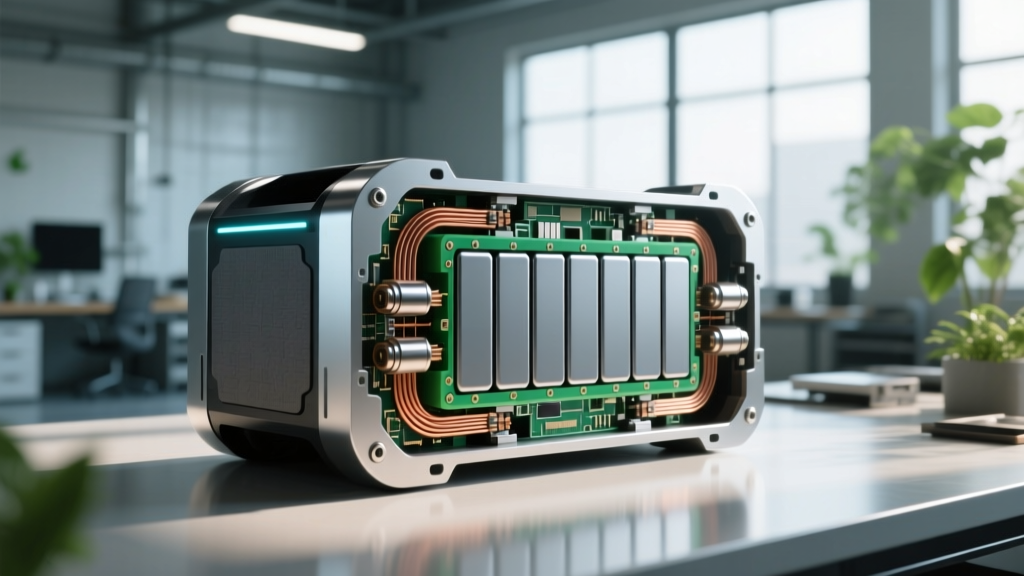
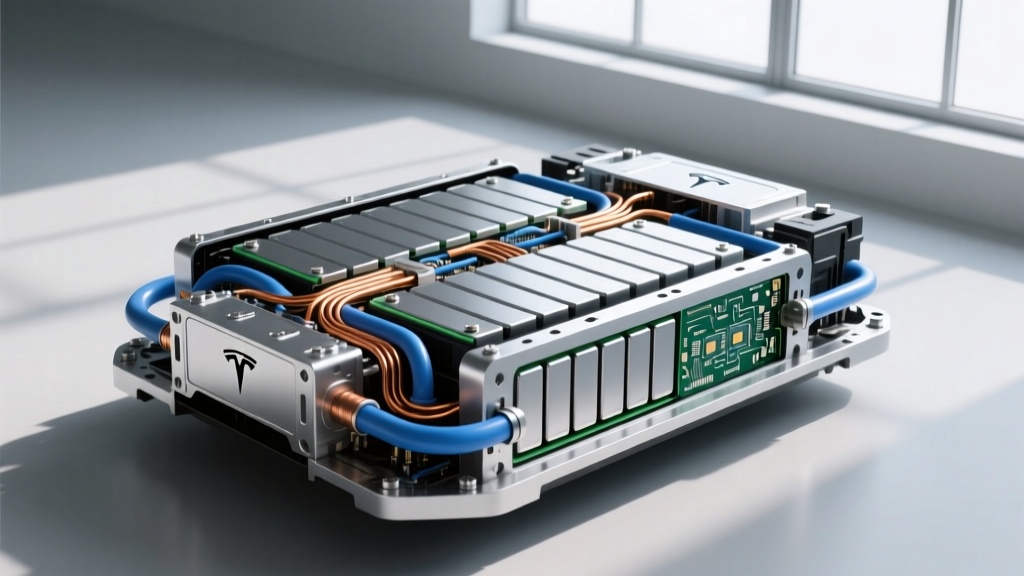
The cells are only part of the story. A Tesla battery pack is an engineered system that includes:
- Cells: Thousands of individual lithium-ion cells (2170 cylindrical cells in most Model 3/Y packs; 4680 cells in structural packs; prismatic LFP cells in Standard Range models)
- Modules and structural pack: Cells are grouped into modules or, in the 4680 structural pack, bonded directly into a load-bearing unit that contributes to chassis rigidity
- Battery Management System (BMS): Monitors voltage, temperature, and current at the cell level; balances cells; manages charge/discharge limits
- Thermal management: A liquid glycol cooling/heating loop runs through cooling tubes bonded to the cells, maintaining optimal operating temperature (roughly 20-40°C)
- Contactors and fuses: High-voltage safety disconnects that isolate the pack in a fault condition
- Structural enclosure: A sealed aluminum/steel housing that protects cells from impact and moisture
The raw materials in a typical NMC Tesla pack include lithium, nickel, manganese, cobalt, graphite (anode), aluminum (current collector and casing), copper (wiring and current collector), and electrolyte solvents. An LFP pack replaces nickel, manganese, and cobalt with iron and phosphate — a meaningful difference both for cost and supply-chain ethics.
How Long Do Tesla Batteries Actually Last?
Tesla's 2024 Impact Report (the most recent comprehensive fleet data published) showed that Model 3 and Model Y battery packs retain approximately 85% of their original capacity after 200,000 miles. That translates to roughly 15% degradation over what is, for most owners, 13-15 years of driving at the U.S. average of ~13,500 miles per year.
Real-world degradation data from Tesla owners tracked on platforms like Teslanorth and TeslaFi shows a consistent pattern:
- Year 1 (0-15,000 mi): 2-4% capacity loss — the initial "break-in" degradation as the solid electrolyte interface (SEI) layer stabilizes
- Years 2-4 (15,000-60,000 mi): Roughly 1-2% loss per year — a slow, linear decline
- Years 5-8 (60,000-120,000 mi): Continued linear loss; most packs sit at 88-92% State of Health (SoH)
- Beyond 150,000 miles: Data is sparser, but fleet averages suggest 82-88% SoH for nickel-based packs and 90%+ for LFP
LFP packs consistently show slower degradation curves. CATL's LFP cells are rated for 3,000-5,000 full charge cycles before reaching 80% capacity. At a 250-mile range per cycle, 3,000 cycles equals 750,000 miles — far beyond the practical life of any vehicle.
For context, the average U.S. driver keeps a car for about 8.4 years and drives roughly 13,500 miles annually. Most Tesla batteries will outlast the vehicle they're installed in.
Tesla Battery Warranty: What's Covered and for How Long
Tesla's battery and drive unit warranty is one of the stronger guarantees in the EV industry, but the details matter.
| Model / Trim | Warranty Period | Mileage Limit | Minimum Capacity Retention |
|---|---|---|---|
| Model 3 Rear-Wheel Drive (LFP) | 8 years | 100,000 miles | 70% |
| Model 3 Long Range / Performance | 8 years | 120,000 miles | 70% |
| Model Y Rear-Wheel Drive (LFP) | 8 years | 100,000 miles | 70% |
| Model Y Long Range / Performance | 8 years | 120,000 miles | 70% |
| Model S / Model X | 8 years | 150,000 miles | 70% |
The warranty covers defects in materials or workmanship and guarantees that the battery will retain at least 70% of its original usable capacity during the warranty period. If your pack drops below that threshold (verified by Tesla's diagnostic tools), Tesla will replace or refurbish the pack at no cost. The warranty also covers the drive unit (motor and inverter).
What the warranty does not cover:
- Normal capacity degradation above the 70% threshold
- Damage from accidents, flooding, or modifications
- Range loss due to software updates that adjust charge limits for safety
The 70% retention threshold is significant: it means a Model 3 Long Range with an EPA-estimated 341 miles of range would need to drop below roughly 239 miles of real range to qualify for a warranty replacement. Based on fleet data, very few packs hit that mark within the warranty period.
EV Battery Replacement Cost: What Tesla Owners Actually Pay
Out-of-warranty battery replacement is the scenario that generates the most anxiety. Here's what the numbers look like in 2026:
| Model | Pack Size (Usable kWh) | Chemistry | Estimated Replacement Cost |
|---|---|---|---|
| Model 3 RWD | ~57 kWh | LFP | $8,000 - $12,000 |
| Model 3 Long Range | ~75 kWh | NMC | $12,000 - $16,000 |
| Model Y Long Range | ~75 kWh | NMC/NCA | $12,000 - $18,000 |
| Model S / X | ~95-100 kWh | NCA | $18,000 - $25,000 |
These figures include the pack and labor but can vary by service center and whether Tesla uses a new, remanufactured, or refurbished pack. In practice, Tesla often replaces failed modules within a pack rather than swapping the entire unit — a significantly cheaper repair that can run $3,000-$7,000 depending on the fault.
The critical context: based on Tesla's own fleet data and third-party tracking, fewer than 1-2% of Tesla battery packs have required full replacement, and the vast majority of those were under warranty. For a pack to fail out of warranty, it would typically need to reach 250,000+ miles or 15+ years of service — at which point the vehicle's residual value is minimal regardless.
What Affects Tesla Battery Life — and How to Maximize It
Battery degradation is driven by electrochemical stress. The factors you can control:
Battery Care Checklist for Tesla Owners
- Daily charge limit: Set to 80% for NMC/NCA packs; 100% is fine for LFP (Tesla recommends periodic 100% charges for LFP to allow cell balancing)
- Avoid prolonged storage at extremes: Don't leave the car at 100% or below 10% SoC for days; aim for 50% if storing for weeks
- DC fast charging: Occasional Supercharging is fine; daily DCFC accelerates degradation by an estimated 1-3% over the pack's life compared to Level 2 home charging
- Temperature management: Enable "preconditioning" before Supercharging in cold weather — the battery heater brings cells to optimal temperature, reducing lithium plating risk
- Avoid deep discharges: Try not to regularly drop below 10% SoC; the BMS buffer protects against true 0%, but repeated deep cycling adds stress
- Regenerative braking: Standard regen is fine; in cold weather, the car may limit regen until the battery warms — this is protective, not a fault
The single most impactful habit: don't charge nickel-based packs to 100% unless you're about to drive. High SoC combined with high temperature accelerates cathode degradation. LFP owners have an easier time here — the chemistry tolerates 100% SoC without meaningful penalty, which is one reason Tesla recommends it.
On DC fast charging: Tesla's battery management system actively limits charge rate as SoC increases (the "charge curve taper"), and the thermal management system cools cells during Supercharging sessions. While daily Supercharging isn't ideal, Tesla's own data shows that vehicles that Supercharge frequently show only marginally higher degradation than those that primarily use Level 2 charging — a difference measured in single-digit percentage points over 200,000 miles.
How to Check Your Tesla's Battery Health (State of Health)
Tesla does not display a direct State of Health (SoH) percentage in the vehicle's UI, unlike some competitors. Here's how to assess your pack's condition:
- Range estimate method: Charge to 100% and note the displayed range. Compare it to the original EPA-rated range for your model. A Model 3 Long Range that originally displayed 341 miles at 100% but now shows 310 miles has roughly 91% SoH. Note: displayed range is affected by temperature and driving style, so check in moderate weather.
- TeslaFi or Tessie app: Third-party tools like TeslaFi log charge data and can estimate SoH by comparing energy added during a full charge cycle to the pack's original capacity.
- Tesla Service diagnostic: You can request a battery health check through the Tesla app. Service will pull detailed BMS data including individual cell voltage variance, internal resistance, and capacity measurements.
- OBD-II tools: Devices like the OBDLink SX paired with apps like Scan My Tesla can read real-time pack voltage, current, and estimated capacity.
For most owners, the 100% charge range comparison is sufficient. If your range has dropped more than 10-15% from original and you're within the warranty period, it's worth scheduling a service check.
Emerging Battery Tech: Solid-State and Silicon Anodes
The next generation of battery technology promises higher energy density and faster charging, but timelines remain extended:
Solid-state batteries replace the liquid electrolyte with a solid ceramic, polymer, or sulfide material, potentially enabling 400+ Wh/kg energy density and faster charging. Toyota has announced solid-state cells for limited production in 2027-2028, but these are expected to debut in low volumes at premium price points. Tesla has not publicly committed to solid-state adoption as of 2026. Realistic mass-market availability: 2029-2032.
Silicon anode technology replaces or supplements the graphite anode with silicon, which can store roughly 10x more lithium ions per gram. Companies like Sila Nanotechnologies and Group14 are shipping silicon-dominant anode materials to battery manufacturers now, with incremental energy density gains (10-20%) expected in production cells by 2027-2028. This is a nearer-term improvement than solid-state but still represents an evolution rather than a revolution.
Sodium-ion batteries are entering production in China (CATL is shipping them in lower-cost vehicles) and offer a cobalt-free, lithium-free alternative with lower energy density but excellent cycle life and cold performance. They're unlikely to appear in Tesla vehicles sold in the U.S. before 2028-2029, if at all.
None of these technologies are available in Tesla vehicles today. If you're buying now, LFP and NMC/NCA are mature, proven chemistries with extensive real-world track records.
Frequently Asked Questions
How long do Tesla batteries last in years and miles?
Based on Tesla's fleet data, the average Model 3/Y battery retains about 85% capacity at 200,000 miles. At the U.S. average of 13,500 miles per year, that's roughly 15 years of service before reaching 85% SoH. LFP packs may last longer. Most Tesla batteries will outlast the vehicle's practical economic life.
How much does it cost to replace a Tesla battery?
Out-of-warranty replacement costs range from roughly $8,000 for a Model 3 RWD LFP pack to $25,000 for a Model S/X NCA pack, including labor. However, fewer than 1-2% of Tesla packs have ever required full replacement, and the vast majority of failures occur within the 8-year warranty period where replacement is free.
What does the Tesla battery warranty actually cover?
Tesla's battery warranty covers defects and guarantees a minimum of 70% capacity retention over 8 years (100,000-150,000 miles depending on model). If your pack drops below 70% SoH within that period, Tesla replaces or refurbishes it at no cost. Normal degradation above 70% is not covered.
Is LFP better than NMC for Tesla batteries?
It depends on your priorities. LFP offers longer cycle life (3,000-5,000+ cycles vs. 1,500-2,500), lower cost, no cobalt, and tolerance for daily 100% charging. NMC delivers higher energy density (more range in a lighter pack) and better cold-weather performance. For a daily commuter in a warm climate, LFP is arguably the more durable choice. For maximum range and cold-climate driving, NMC/NCA has the edge.
Does frequent Supercharging damage the Tesla battery?
Tesla's fleet data shows only a marginal difference in degradation between frequent Superchargers and exclusive Level 2 chargers — typically a few percentage points over 200,000 miles. The battery's thermal management system and charge curve tapering actively protect cells during DC fast charging. Occasional Supercharging is not a meaningful concern; daily Supercharging may slightly accelerate long-term wear but is not catastrophic.
How do I check my Tesla battery's State of Health?
Charge to 100% and compare the displayed range to the original EPA rating. You can also use third-party tools like TeslaFi to log charge cycles and estimate SoH, or request a battery health diagnostic through the Tesla app. Tesla does not display a SoH percentage natively in the vehicle interface.
Sources: Tesla Impact Report 2024, fueleconomy.gov (EPA range data), Tesla Battery Warranty. Tax credit eligibility under IRS §30D varies by model year, MSRP, buyer income, and battery sourcing requirements — consult irs.gov or a tax professional for your specific situation.