Which Tesla Battery Cells Are Actually in Your Car?
Not all Tesla battery cells are created equal. Depending on the model, trim, and model year you buy in 2026, your Tesla could be powered by radically different cell chemistries, form factors, and suppliers. The Model 3 Rear-Wheel Drive uses lithium iron phosphate (LFP) prismatic cells from CATL, while the Model 3 Long Range and Performance variants rely on nickel-manganese-cobalt (NMC) cylindrical cells — Tesla's proprietary 4680 design manufactured in-house, supplemented by 2170 cells from Panasonic. The Model Y follows a similar split, and the Cybertruck exclusively uses 4680 NMC cells.
This isn't just trivia. The chemistry inside your battery pack dictates your real-world range in cold weather, how many full charge cycles you can expect before meaningful degradation, how fast you can charge at a Supercharger, and even how you should manage your daily state of charge. Understanding Tesla battery cells is the single most important technical literacy gap between an informed EV buyer and one who ends up frustrated by range loss or charging confusion three years in.
This guide breaks down exactly what's inside current Tesla packs, what the degradation data actually shows, what the warranty covers, and what replacement looks like if you ever need it.
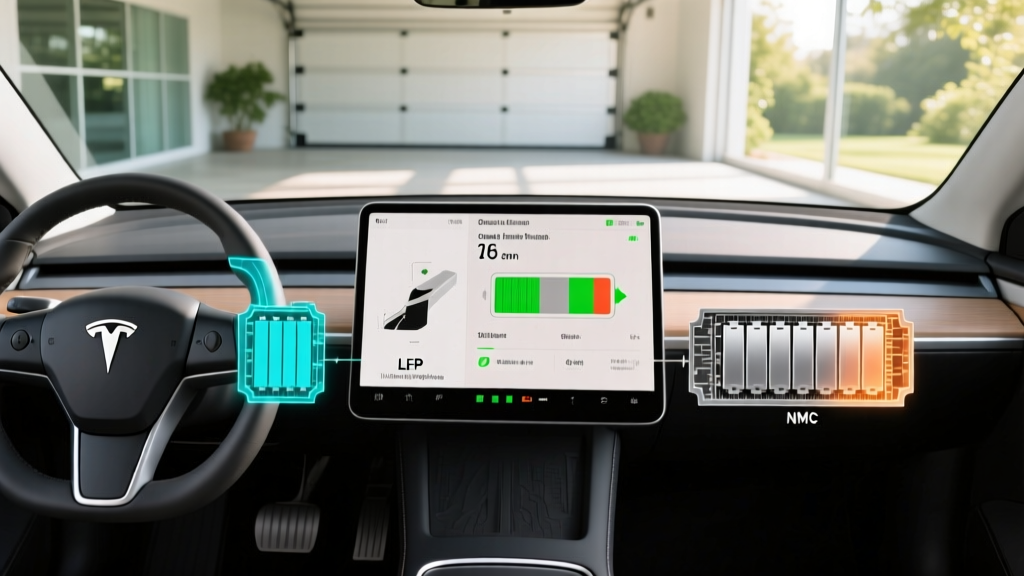
LFP vs NMC/NCA: The Chemistry Trade-Off That Matters Most
Tesla currently uses two primary cathode chemistries across its lineup. Each has distinct physics-level advantages and compromises that no amount of software optimization can fully erase.
| Attribute | LFP (Lithium Iron Phosphate) | NMC/NCA (Nickel Manganese Cobalt / Nickel Cobalt Aluminum) |
|---|---|---|
| Models Using | Model 3 RWD, Model Y RWD (Standard Range) | Model 3 Long Range/Performance, Model Y LR/Perf, Model S, Model X, Cybertruck |
| Cell Form Factor | Prismatic (CATL) | Cylindrical 2170 (Panasonic) and 4680 (Tesla in-house) |
| Energy Density | ~160 Wh/kg (cell-level) | ~250–300 Wh/kg (cell-level, 4680 NMC) |
| Typical Pack Size | ~57–60 kWh usable | ~75–100 kWh usable depending on model |
| Cycle Life | 3,000–5,000+ cycles to 80% capacity | 1,000–2,000 cycles to 80% capacity |
| Cold-Weather Performance | Greater range loss below 32°F (~30–40% reduction) | Better cold retention (~20–30% reduction) |
| Daily Charge Recommendation | 100% SoC daily (Tesla recommends) | 80% SoC daily, 100% for trips only |
| Thermal Stability | Excellent — higher thermal runaway threshold | Good — requires more active thermal management |
| Cost per kWh | Lower (~$90–110/kWh at pack level) | Higher (~$130–160/kWh at pack level) |
| Cobalt Content | None | Contains cobalt and nickel (supply chain and ethical considerations) |
The core trade-off is straightforward: LFP sacrifices energy density for longevity and cost, while NMC sacrifices cycle life for range and cold-weather performance. If you're a high-mileage commuter who charges daily and rarely drives in freezing weather, LFP's 3,000+ cycle life and 100% daily charging recommendation make it arguably the better long-term ownership proposition — even with a lower EPA range sticker. If you need maximum range per charge, regularly road-trip in winter, or tow with a Cybertruck, NMC is the chemistry you want.
How Long Do Tesla Battery Cells Actually Last?
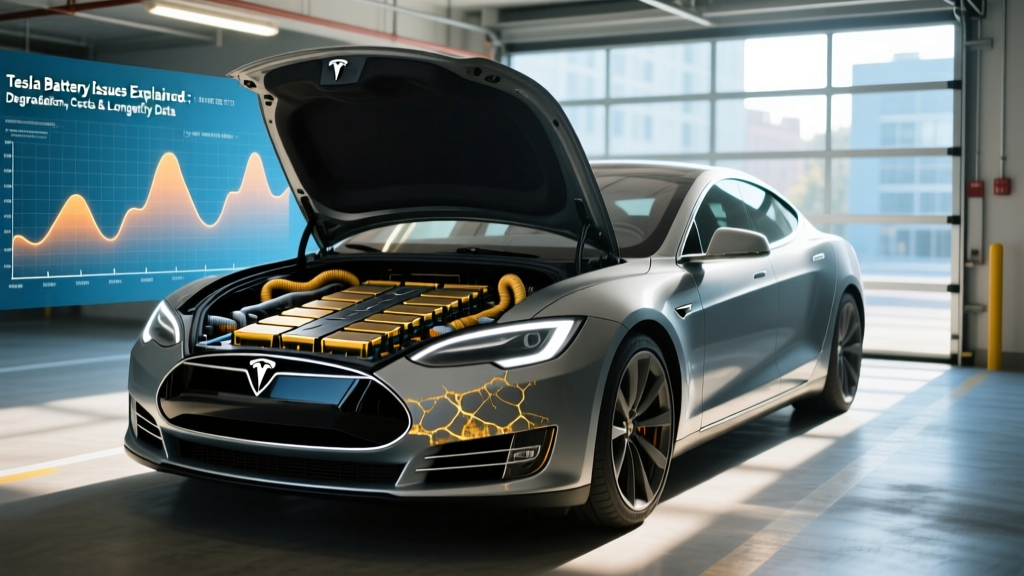
The question "how long do EV batteries last" is best answered with data, not anecdotes. Tesla's own Impact Report has historically shown that their battery packs retain approximately 88% of original capacity after 200,000 miles. Independent fleet data from TeslaFi and community tracking platforms corroborate a similar curve: a steeper initial drop of roughly 3–5% in the first 20,000–30,000 miles, followed by a very gradual linear decline.
Typical Tesla Battery Degradation Curve (Fleet Averages)
| Mileage | NMC (Model 3 LR / Model Y LR) | LFP (Model 3 RWD) |
|---|---|---|
| 0 miles (new) | 100% | 100% |
| 30,000 miles | ~95–96% SoH | ~96–98% SoH |
| 60,000 miles | ~92–94% SoH | ~94–97% SoH |
| 100,000 miles | ~89–92% SoH | ~92–95% SoH |
| 150,000 miles | ~86–90% SoH | ~89–93% SoH |
| 200,000 miles | ~83–88% SoH | ~87–92% SoH |
Sources: Tesla Impact Reports, TeslaFi fleet data aggregations, Recurrent Auto battery studies. Individual results vary based on charging habits, climate, and Supercharger frequency.
The LFP advantage in cycle life is visible at higher mileages. Because LFP chemistry is less stressed by repeated cycling — and because Tesla recommends charging LFP packs to 100% regularly, which helps the battery management system (BMS) calibrate accurately — LFP packs tend to flatten out at a higher state of health (SoH) plateau. NMC packs, particularly those frequently DC fast-charged or routinely held at 100% SoC, degrade somewhat faster.
Realistic lifespan expectation: Most Tesla battery packs will outlast the vehicle itself. A 200,000-mile Tesla with 85–90% SoH still has a functional vehicle with 220–280 miles of range depending on the model. Battery replacement before 300,000 miles is uncommon outside of manufacturing defects covered under warranty.
What Does the Tesla Battery Warranty Actually Cover?
Tesla's battery and drive unit warranty is one of the stronger guarantees in the EV market, but the specific terms vary by model and battery type. Understanding the exact coverage — and its limitations — is essential before purchase.
| Model | Warranty Period | Mileage Limit | Minimum Capacity Retention |
|---|---|---|---|
| Model 3 RWD (LFP) | 8 years | 100,000 miles | 70% |
| Model 3 Long Range / Performance (NMC) | 8 years | 120,000 miles | 70% |
| Model Y RWD (LFP) | 8 years | 100,000 miles | 70% |
| Model Y Long Range / Performance (NMC) | 8 years | 120,000 miles | 70% |
| Model S / Model X | 8 years | 150,000 miles | 70% |
| Cybertruck (AWD / Cyberbeast) | 8 years | 120,000 miles | 70% |
Key details: The warranty guarantees that your battery will retain at least 70% of its original capacity for the stated period or mileage, whichever comes first. If it falls below that threshold, Tesla will replace or repair the battery pack to bring it back above 70%. The warranty covers manufacturing defects and abnormal degradation but does not cover damage from accidents, flooding, or aftermarket modifications. It's also worth noting that Tesla may replace a degraded pack with a refurbished unit of equivalent capacity — not necessarily a brand-new pack.
For context, the 70% threshold is an industry-standard floor also used by Hyundai, Kia, and Ford. BMW and Mercedes-Benz offer similar 8-year terms. The differentiator for Tesla is the higher mileage cap on Long Range models (120,000) and on Model S/X (150,000), which reflects the expected usage patterns of those higher-range, higher-priced vehicles.
Tesla Battery Replacement Cost: What You'd Actually Pay
This is the question that generates the most anxiety — and the most misinformation. Let's ground it in real figures.
| Model / Pack | Battery Capacity | Chemistry | Estimated Replacement Cost |
|---|---|---|---|
| Model 3 RWD | ~57–60 kWh | LFP | $10,000–$14,000 |
| Model 3 Long Range | ~75–82 kWh | NMC (2170/4680) | $14,000–$18,000 |
| Model Y Long Range | ~75–82 kWh | NMC (2170/4680) | $14,000–$18,000 |
| Model S | ~100 kWh | NMC | $18,000–$24,000 |
| Model X | ~100 kWh | NMC | $18,000–$25,000 |
| Cybertruck | ~123 kWh | NMC (4680) | $20,000–$28,000 |
Costs include parts and labor at Tesla Service Centers. Third-party EV repair shops may offer lower pricing. Prices reflect 2026 estimates and are subject to change as cell costs decline.
When is replacement actually needed? In practice, very few Tesla owners pay for an out-of-warranty battery replacement. The degradation data above shows that even at 200,000 miles, most packs retain 83–92% of capacity. A replacement typically becomes relevant only if a pack suffers a manufacturing defect (covered by warranty), physical damage from an accident, or if an owner drives 300,000+ miles and the range reduction becomes functionally limiting. For the vast majority of owners who sell or trade their Tesla within 8–12 years and 100,000–150,000 miles, battery replacement is a non-issue.
It's also worth tracking the macro trend: battery cell prices have fallen from over $1,000/kWh in 2010 to roughly $100–130/kWh at the pack level in 2026, according to BloombergNEF. By the time a current Tesla owner might actually need a replacement in the 2030s, costs will likely be substantially lower.
Factors That Accelerate (or Slow) Battery Degradation
Battery chemistry sets the baseline, but your habits determine where on the degradation curve your pack lands. Here's what actually moves the needle:
Battery Care Checklist for Tesla Owners
- Daily state of charge: Set NMC packs to 80% daily and 100% only for road trips. LFP packs should be charged to 100% at least once per week for BMS calibration (Tesla's official recommendation).
- DC fast charging frequency: Occasional Supercharging is fine. Daily Supercharging accelerates degradation by approximately 1–2% additional over 100,000 miles compared to Level 2 home charging, per Recurrent Auto data. Use Level 2 (7–11 kW AC) as your primary charging method.
- Extreme heat exposure: Sustained ambient temperatures above 95°F stress NMC cells. Park in shade or a garage when possible. Tesla's thermal management system actively cools the pack, but it draws energy and adds wear.
- Extreme cold charging: Never DC fast charge a cold-soaked battery without preconditioning. Tesla's navigation-to-Supercharger feature automatically preconditions the pack — use it. Cold charging without preconditioning can cause lithium plating, a form of permanent degradation.
- Avoid prolonged storage at extremes: Don't leave your Tesla sitting at 100% or below 10% SoC for weeks. For extended storage, set the charge limit to 50% and plug in.
- Minimize phantom drain: Sentry Mode, frequent app-checking (which wakes the car), and third-party data loggers increase cycle count unnecessarily. Each wake cycle draws from the pack.
The single most impactful habit is your average state of charge. NMC cells held at 100% SoC experience accelerated calendar aging — the electrolyte oxidizes faster at high voltage. This is why Tesla's charge limit slider defaults to 80% on NMC vehicles. LFP cells, by contrast, are far more tolerant of high SoC, which is why Tesla explicitly tells LFP owners to charge to 100% regularly.
How to Check and Monitor Your Tesla's Battery Health
Tesla does not display a direct State of Health (SoH) percentage in the vehicle's native interface the way some competitors do. However, there are several reliable methods to assess your pack's condition:
Method 1: Manual Range Calculation
Charge your Tesla to 100% and note the displayed rated range. Compare this to the original EPA-rated range for your specific model and trim. For example, if your 2024 Model 3 Long Range originally displayed 341 miles at 100% and now shows 310 miles, your approximate SoH is 310 ÷ 341 = ~91%. Note that the displayed range at 100% can fluctuate based on recent driving efficiency and BMS calibration — perform this test after a full charge with preconditioning for accuracy.
Method 2: Third-Party Apps
Apps like TeslaFi, Tessie, and Stats for Tesla use the Tesla API to log detailed battery data over time, including estimated SoH, degradation trends, and charge/discharge cycle counts. These tools provide a much more granular picture than a single 100% charge snapshot. Many Tesla owners use TeslaFi ($5/month) to build a long-term degradation curve specific to their vehicle.
Method 3: Tesla Service Diagnostic
If you suspect abnormal degradation or are approaching the 70% warranty threshold, you can request a battery health diagnostic at a Tesla Service Center. This reads the BMS's internal capacity measurements, which are more accurate than the displayed range estimate. If the diagnostic confirms capacity below 70% within the warranty period, Tesla will initiate a warranty claim.
What's Next: Solid-State, Silicon Anodes, and Future Tesla Cells
Tesla's 4680 cell — introduced in limited production in 2022 and now used in Model Y and Cybertruck — represents the company's current state of the art in cylindrical cell design. The larger form factor reduces the number of cells per pack (reducing weight and manufacturing complexity) and enables a tabless electrode design that improves thermal management and charge rate. However, the 4680 is still NMC chemistry with incremental improvements, not a fundamental breakthrough.
Silicon anode technology is the nearer-term evolution. Companies like Sila Nanotechnologies and Group14 Technologies are supplying silicon-dominant anode materials that can increase energy density by 20–40% over conventional graphite anodes. Tesla has expressed interest in silicon anodes, and low-percentage silicon blends are already present in some current cells. Expect higher-silicon-content anodes to appear in production cells between 2027–2030.
Solid-state batteries — which replace the liquid electrolyte with a solid conductor, promising higher energy density, faster charging, and improved safety — remain in development across the industry. Toyota has announced a commercial solid-state EV target for 2027–2028, and QuantumScape is working with Volkswagen. Tesla has not announced a solid-state timeline. Realistic mass-production availability for solid-state cells in Tesla vehicles is 2030 at the earliest, with broad deployment likely later. Any claims of solid-state Teslas being imminent should be treated as speculative.
For buyers in 2026, the practical takeaway is this: current Tesla battery cells — both LFP and NMC — are mature, well-characterized technologies with extensive real-world data backing their longevity claims. Waiting for a hypothetical next-generation chemistry is not a rational purchase strategy when current packs demonstrably last 200,000+ miles with minimal degradation.
Frequently Asked Questions
How long do Tesla battery cells last in years and miles?
Based on fleet data and Tesla's own reporting, most Tesla battery packs retain 85–92% of their original capacity at 200,000 miles. In terms of years, a Tesla driven 12,000–15,000 miles annually should see its battery last 15–20+ years before reaching the 70% capacity threshold. LFP packs in Model 3 RWD and Model Y RWD tend to degrade more slowly due to superior cycle life.
How much does it cost to replace a Tesla battery?
Out-of-warranty replacement costs range from approximately $10,000–$14,000 for a Model 3 RWD (LFP) pack to $20,000–$28,000 for a Cybertruck (123 kWh NMC). However, battery replacement is rarely needed within a typical ownership period. Most packs outlast the vehicle. Cell costs continue to decline year over year.
What does the Tesla battery warranty cover?
Tesla warrants its battery packs for 8 years and 100,000–150,000 miles (depending on model) against falling below 70% capacity. The warranty covers manufacturing defects and abnormal degradation but excludes physical damage, accident damage, and aftermarket modifications. Tesla may use refurbished packs for warranty replacements.
LFP vs NMC — which Tesla battery cell chemistry is better?
Neither is universally better — it depends on your use case. LFP offers longer cycle life (3,000–5,000 cycles), lower cost, no cobalt, and tolerance for 100% daily charging, but sacrifices energy density (shorter range) and cold-weather performance. NMC delivers higher range per charge, better cold-weather retention, and faster peak charging, but has a shorter cycle life and requires more careful SoC management (80% daily limit). High-mileage, warm-climate drivers benefit from LFP. Long-distance and cold-climate drivers benefit from NMC.
Does frequent Supercharging damage Tesla battery cells?
Exclusive DC fast charging does accelerate degradation compared to Level 2 home charging, but the effect is modest — roughly 1–2% additional capacity loss over 100,000 miles according to Recurrent Auto fleet studies. Occasional Supercharging on road trips is not a concern. The bigger risk is DC fast charging a cold-soaked battery without preconditioning, which can cause lithium plating. Always use Tesla's built-in navigation to Superchargers to enable automatic pack preconditioning.
Can I check my Tesla's battery health myself?
Yes. Charge to 100% and compare the displayed rated range to your model's original EPA range to estimate SoH. For more detailed tracking, third-party apps like TeslaFi or Tessie log battery data via the Tesla API and generate degradation curves over time. For a definitive reading, request a BMS diagnostic at a Tesla Service Center.
Sources: Tesla Battery Warranty, fueleconomy.gov (EPA range data), Recurrent Auto battery degradation research, Tesla Impact Reports.