Every Tesla on the road in 2026 runs on one of two fundamentally different battery chemistries, and which Tesla battery cell sits beneath your floor dictates how you should charge it, what range to expect in winter, and how much capacity you'll retain after 100,000 miles. Yet most buyers never check the window sticker for the chemistry code. This guide breaks down the real-world data on Tesla's lithium iron phosphate (LFP) and nickel manganese cobalt (NMC) / nickel cobalt aluminum (NCA) cells, backed by fleet degradation numbers, warranty fine print, and the replacement costs owners actually face.
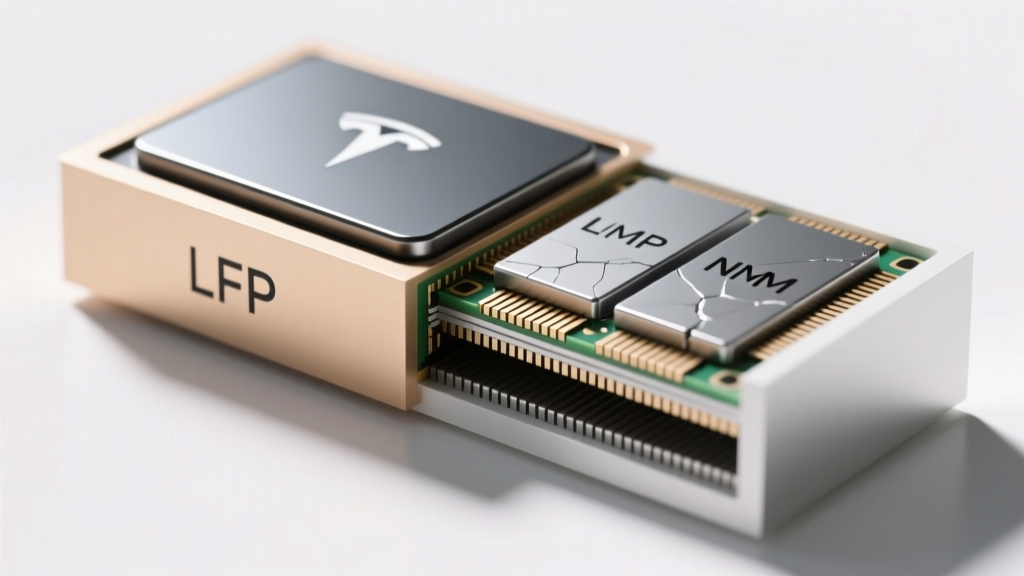
The Two Tesla Battery Cell Chemistries: LFP vs NMC/NCA
Tesla sources cells from CATL (LFP), Panasonic (NCA/NMC), LG Energy Solution (NMC), and BYD (LFP for certain markets). The chemistry determines energy density, cycle life, thermal behavior, and cost. Here is how the two families compare in the 2026 Tesla lineup:
| Attribute | LFP (Lithium Iron Phosphate) | NMC / NCA (Nickel-based) |
|---|---|---|
| Models using it | Model 3 RWD, Model Y RWD (Standard Range) | Model 3 Long Range/Performance, Model Y LR/Perf, Model S, Model X, Cybertruck |
| Energy density | ~160–180 Wh/kg (cell-level) | ~250–280 Wh/kg (cell-level) |
| Typical pack size | 57–60 kWh usable | 75–100 kWh usable |
| Cycle life (to 80% SoH) | 3,000–5,000+ cycles | 1,000–2,000 cycles |
| Cold-weather range loss | Higher (~30–35% at 20°F) | Moderate (~20–25% at 20°F) |
| Recommended daily SoC | 100% (charge to full regularly) | 80–90% daily; 100% for trips only |
| Cost per kWh (pack-level) | ~$100–115 | ~$130–150 |
| Thermal runaway risk | Very low (more stable chemistry) | Low but higher than LFP |
| Cobalt content | None | Contains cobalt (NMC) or none (NCA) |
The trade-off is straightforward: LFP cells are cheaper, last more charge cycles, and tolerate daily 100% charges — but they store less energy per kilogram and suffer more in freezing temperatures. NMC/NCA cells pack more range into the same space and perform better in cold weather, but they degrade faster if held at high state of charge (SoC) for extended periods.
How Long Do Tesla Battery Cells Last? Real Degradation Data
Tesla's 2025 Impact Report (the most recent full-year data available) states that Model 3 and Model Y fleets retain approximately 85% of original capacity after 200,000 miles — roughly 15% degradation over the typical life of the vehicle. Model S and Model X fleets show similar retention at the same mileage threshold.
Independent fleet data from Recurrent Auto and Tessietrack align with those numbers but reveal a non-linear curve:
Typical Tesla Battery Degradation Curve
- Year 1 / 15,000 miles: 3–5% loss (initial formation period — steepest drop)
- Year 2–4 / 15,000–60,000 miles: ~1–1.5% per year (slow, linear decline)
- Year 5–8 / 60,000–120,000 miles: ~0.8–1.2% per year
- Year 8+ / 120,000+ miles: Gradual taper; most packs still above 80% SoH
LFP packs tend to show slightly less total degradation at high mileage but a sharper initial drop in the first 10,000 miles. NMC/NCA packs degrade more steadily but are more sensitive to sustained high-SoC storage and frequent DC fast charging above 150 kW.
To put this in perspective: a 2024 Model 3 Long Range with an EPA-estimated 341 miles of range that has been driven 80,000 miles by 2026 will likely show 305–315 miles at 100% SoC — noticeable but hardly debilitating. Real-world highway range (at 70–75 mph, moderate climate) already sits around 275–290 miles when new, so a degraded pack may deliver 250–265 miles in the same conditions.
Tesla Battery Warranty: What's Actually Covered
Tesla's high-voltage battery warranty is one of the longest in the industry, but the details matter. Here is the current coverage by model:
| Model | Warranty Period | Mileage Limit | Minimum Capacity Retention |
|---|---|---|---|
| Model 3 RWD (LFP) | 8 years | 100,000 miles | 70% |
| Model 3 Long Range / Performance | 8 years | 120,000 miles | 70% |
| Model Y (all trims) | 8 years | 120,000 miles | 70% |
| Model S / Model X | 8 years | 150,000 miles | 70% |
| Cybertruck | 8 years | 120,000 miles | 70% |
The warranty guarantees the battery will retain at least 70% of its original capacity within the stated period or mileage, whichever comes first. If capacity drops below that threshold — verified via Tesla's onboard diagnostics — Tesla will repair or replace the pack at no cost. The warranty also covers manufacturing defects, including individual module failures and BMS (battery management system) faults.
What it does not cover: damage from accidents, flooding, fire, or unauthorized modifications; cosmetic corrosion; or capacity loss from consistently ignoring Tesla's charging recommendations (though this is rarely enforced in practice). Per Tesla's official warranty page, the battery warranty transfers to subsequent owners, which supports resale value.
EV Battery Replacement Cost: What Tesla Owners Actually Pay
Most Tesla battery packs outlast the vehicle itself. But when replacement is necessary — typically due to physical damage, coolant intrusion, or rare cell-group failures — the costs are significant:
| Model / Pack | Battery Size (usable kWh) | Chemistry | Replacement Cost Range |
|---|---|---|---|
| Model 3 RWD | ~57–60 kWh | LFP (CATL) | $10,000–$13,000 |
| Model 3 Long Range | ~75–79 kWh | NMC (LG/Panasonic) | $13,000–$16,000 |
| Model Y Long Range / Performance | ~75–81 kWh | NMC (LG/Panasonic) | $14,000–$17,000 |
| Model S / Model X (Plaid) | ~95–100 kWh | NMC/NCA (Panasonic) | $18,000–$24,000 |
| Cybertruck (AWD/Cyberbeast) | ~100+ kWh (est.) | NMC (Panasonic 4680) | $20,000–$28,000 |
These figures include the pack, labor, and calibration but not ancillary repairs (e.g., coolant system, contactors). Third-party EV repair shops are increasingly offering refurbished pack replacements at 30–40% below Tesla Service Center pricing, though this may void remaining warranty coverage.
The critical context: according to data from Recurrent Auto, fewer than 2% of Tesla battery packs have required full replacement outside of warranty claims, and most of those were due to manufacturing defects caught within the first two years. Catastrophic degradation below 70% SoH before 150,000 miles remains rare.
Factors That Accelerate (or Preserve) Tesla Battery Cell Health
Battery degradation is governed by electrochemistry, not marketing. The following factors have the largest measurable impact on your Tesla's long-term State of Health:
Battery Care Checklist for Tesla Owners
- Avoid sustained 100% SoC (NMC/NCA only): If you drive a Long Range or Performance model, set your daily charge limit to 80%. Reserve 100% for road trips and charge to full only when you'll be driving immediately. LFP owners: Tesla recommends charging to 100% at least once a week for accurate BMS calibration.
- Minimize DC fast charging above 150 kW when possible: Occasional Supercharging is fine — Tesla's thermal management is excellent — but daily reliance on 250 kW V3/V4 Superchargers accelerates electrolyte decomposition. Use Level 2 home charging (7–11.5 kW) as your baseline.
- Precondition before fast charging: Navigate to a Supercharger via the Tesla app or in-car nav so the battery preheats to optimal temperature (~95°F). Charging a cold pack at high kW causes lithium plating on the anode, permanently reducing capacity.
- Avoid prolonged storage at low or high SoC: If leaving your Tesla for more than two weeks, set the charge limit to 50% and leave it plugged in. The vehicle's vampire drain (sentry mode, connectivity, thermal management) can deplete a low-SoC pack to dangerous levels.
- Extreme heat is worse than extreme cold: Sustained ambient temperatures above 100°F with the pack at high SoC accelerate calendar aging. Park in shade or a garage when possible in summer. Cold weather reduces range temporarily but causes less permanent damage.
- Use Scheduled Charging and Scheduled Departure: These features let you time charging to finish just before you leave, minimizing time spent at high SoC and keeping the pack at optimal temperature.
How to Check Your Tesla Battery's State of Health (SoH)
Tesla does not expose a direct SoH percentage in the vehicle UI the way some competitors do. But owners have several reliable methods:
Method 1: Manual calculation from the Energy screen. Charge to 100% and note the rated range displayed. Divide this by the original EPA-rated range and multiply by 100. For example, if your 2024 Model 3 Long Range (EPA 341 miles) now shows 310 rated miles at 100%, your approximate SoH is 310 ÷ 341 = 90.9%. This method has a ±2% margin due to BMS estimation drift.
Method 2: Tesla Service Mode. Hold the "Model" text on the About screen for 3 seconds, enter "service" as the access code, and navigate to the High Voltage Battery section. This displays pack voltage, individual module balance, and estimated capacity in kWh — from which you can derive SoH more precisely.
Method 3: Third-party apps. Services like Tessie, Teslalogger, and Recurrent connect to your Tesla's API and track SoH over time using charge/discharge data. These provide trend lines that are more useful than a single snapshot.
Method 4: Tesla Service diagnostic. If you suspect abnormal degradation (e.g., range dropping more than 5% in a single year), request a battery health test via the Tesla app. A service technician can run a full capacity test and confirm whether you qualify for a warranty claim.
Emerging Battery Tech: What's Next After the Tesla Battery Cell of Today
Several next-generation technologies are in development or early production, but none are yet available in Tesla vehicles as of early 2026:
Panasonic 4680 dry-electrode cells: Tesla has been producing 4680-format cells at its Texas pilot line since 2022, and the Cybertruck uses them. The dry-electrode manufacturing process reduces energy and solvent use, but yield and energy-density improvements have been incremental. Full-scale production across the lineup remains a 2027–2028 prospect at earliest.
Silicon-dominant anodes: Replacing graphite anodes with silicon can increase energy density by 20–40%. Companies like Sila Nanotechnologies and Group14 are shipping early silicon-anode materials, but swelling and cycle-life issues limit adoption to small-format cells so far. Automotive-scale deployment is expected no earlier than 2028.
Solid-state batteries: Toyota, Samsung SDI, and QuantumScape continue to announce breakthroughs, but solid-state cells remain in pre-production validation. Realistic timelines for solid-state packs in consumer vehicles point to 2029–2032, with initial availability limited to premium models. As of 2026, no automaker sells a solid-state EV in the U.S. market.
For current Tesla buyers, the practical takeaway is that today's LFP and NMC cells are mature, well-understood technologies with proven longevity. Waiting for solid-state means waiting at least 4–6 years for limited availability at high prices.
Frequently Asked Questions
How long do Tesla battery cells last in years and miles?
Based on fleet data from Tesla's Impact Report and independent analysts like Recurrent Auto, the average Tesla battery retains approximately 85% of its original capacity at 200,000 miles. In years, most Tesla packs will outlast 12–15 years of average driving (13,500 miles/year) before reaching the 70% capacity threshold. Full replacement before 150,000 miles is statistically rare.
How much does it cost to replace a Tesla battery?
Replacement costs range from approximately $10,000 for a Model 3 RWD (LFP, ~60 kWh) to $24,000–$28,000 for a Model S/X or Cybertruck pack (~100 kWh). These are out-of-warranty figures. Under warranty, replacement is free if capacity drops below 70% within 8 years or the applicable mileage limit. Most owners never pay for a battery replacement.
What does Tesla's battery warranty cover?
Tesla's battery warranty covers capacity loss below 70% of original, manufacturing defects, module failures, and BMS faults for 8 years and 100,000–150,000 miles depending on model. It does not cover damage from accidents, flooding, unauthorized modifications, or cosmetic issues. The warranty is transferable to second owners.
How do I maximize Tesla battery health?
For NMC/NCA models: keep daily charge at 80%, minimize frequent 250 kW DC fast charging, precondition before Supercharging, and avoid storing the vehicle at high or low SoC. For LFP models: charge to 100% at least weekly for BMS calibration. All owners should use Scheduled Departure to minimize time at full charge and keep the pack at moderate temperatures.
LFP vs NMC — which Tesla battery cell is better?
Neither is universally better. LFP wins on longevity (3,000+ cycles), lower cost, and tolerance for daily 100% charging — making it ideal for commuters who can charge at home and don't need maximum range. NMC/NCA wins on energy density (more range per pound) and cold-weather performance — making it the right choice for road-trip-heavy drivers and cold-climate owners. If your daily driving is under 100 miles and you live in a temperate zone, LFP offers less long-term degradation worry. If you regularly drive 250+ miles or face sub-freezing winters, NMC/NCA's range buffer and thermal behavior are worth the trade-off.
Does frequent Supercharging damage Tesla battery cells?
Occasional Supercharging has minimal impact thanks to Tesla's active liquid thermal management, which keeps cells near optimal temperature during DC fast charging. However, daily use of 250 kW V3/V4 Superchargers does accelerate electrolyte degradation compared to Level 2 (7–11.5 kW) charging. Tesla's own data suggests owners who primarily home-charge see 1–2% less degradation at 100,000 miles than those who rely heavily on Supercharging. The recommendation: Supercharge on road trips, Level 2 at home.
Understanding which Tesla battery cell chemistry powers your vehicle — and treating it accordingly — is the single most impactful thing you can do for long-term range retention and resale value. The data is clear: these packs are built to outlast the cars they live in, provided owners respect the chemistry.