When you're spending $40,000 to $90,000+ on a Tesla, the single most expensive component inside that car is the high-voltage traction battery. It's also the one buyers worry about most. Will Tesla battery capacity degrade to the point of needing a costly replacement? How much range will you actually lose after five years? And does it matter whether your Model 3 has an LFP or NMC pack?
This guide breaks down Tesla battery capacity from a data-driven ownership perspective — chemistry trade-offs, real-world degradation curves, warranty coverage, replacement costs, and the daily habits that meaningfully extend pack life. No hype, no fear-mongering, just the numbers.
What Chemistry Is Inside Your Tesla? LFP vs. NMC/NCA
Tesla uses two primary cathode chemistries across its 2026 lineup, and the one in your car dictates how you should charge, store, and think about long-term degradation.
Lithium Iron Phosphate (LFP) powers the Standard Range (now called "Model 3" and "Model Y" base trims). LFP cells are cobalt-free, cheaper to produce, and inherently more thermally stable. The trade-off is lower energy density — meaning a heavier, physically larger pack for the same kWh — and noticeably reduced performance in sub-freezing temperatures.
Nickel Manganese Cobalt (NMC) and Nickel Cobalt Aluminum (NCA) chemistry is found in Long Range and Performance variants. These packs deliver higher energy density (more kWh in a lighter package), better cold-weather performance, and faster peak charge rates. The trade-offs include higher cost, reliance on cobalt and nickel supply chains, and a slightly less forgiving cycle-life profile if routinely charged to 100%.
| Attribute | LFP (Standard Range) | NMC/NCA (Long Range / Performance) |
|---|---|---|
| Energy Density | Lower (~160 Wh/kg cell-level) | Higher (~250-270 Wh/kg cell-level) |
| Usable Capacity (typical) | 57-60 kWh (Model 3) | 75-82 kWh (Model 3/Y LR) |
| Cycle Life | 3,000-5,000+ cycles | 1,500-2,500 cycles |
| Recommended Daily Charge | 100% (Tesla recommends weekly 100%) | 80% daily, 100% for trips only |
| Cold-Weather Range Loss | Greater (~30-40% at 20°F) | Less (~25-35% at 20°F) |
| Peak DC Fast Charge | ~170 kW | ~250 kW (V3/V4 Supercharger) |
| Cost to Manufacturer | Lower | Higher |
| Thermal Stability | Excellent (inherently safer) | Good (requires active management) |
The practical takeaway: If your daily commute is under 60 miles round-trip and you live in a moderate climate, LFP is arguably the superior long-term ownership choice — the cycle life advantage is massive. If you regularly road-trip, tow, or live where winters are brutal, NMC/NCA's energy density and cold performance justify the more careful charging discipline.
Tesla Battery Capacity Degradation: What the Data Actually Shows
Tesla's own Impact Report has historically shown that its battery packs lose roughly 12-15% of original capacity after 150,000 miles. Independent data from fleet operators and owner surveys largely corroborates this, though with important nuances.
Here's what the degradation curve typically looks like in practice:
| Mileage | Avg. Capacity Retained | Range Impact (358-mi EPA LR example) |
|---|---|---|
| New | 100% | 358 mi |
| 25,000 mi | ~95-97% | ~340-347 mi |
| 50,000 mi | ~92-95% | ~329-340 mi |
| 100,000 mi | ~88-92% | ~315-329 mi |
| 150,000 mi | ~85-88% | ~304-315 mi |
| 200,000 mi | ~80-85% | ~286-304 mi |
Several patterns emerge from this data. First, the steepest drop occurs in the first 10,000-20,000 miles — a "break-in" loss of 2-4% that then stabilizes. Second, degradation is largely linear after that initial drop, not a cliff. Third, LFP packs tend to show slightly less variance between best-case and worst-case units, likely due to the chemistry's inherent cycle-life advantage.
Real-world caveat: Degradation is not uniform across all cells. Tesla's battery management system (BMS) actively balances cells, but packs with consistently poor thermal management (frequent Supercharging without preconditioning, regular exposure to 110°F+ ambient heat) can degrade 2-5% faster than fleet averages.
What Does the Tesla Battery Warranty Actually Cover?
Tesla's high-voltage battery warranty is one of the stronger guarantees in the EV industry, but the details matter — especially the capacity retention threshold.
| Model / Trim | Warranty Duration | Mileage Limit | Min. Capacity Retention |
|---|---|---|---|
| Model 3 Standard Range (LFP) | 8 years | 100,000 miles | 70% |
| Model 3 Long Range / Performance | 8 years | 120,000 miles | 70% |
| Model Y (all trims) | 8 years | 120,000 miles | 70% |
| Model S / Model X | 8 years | 150,000 miles | 70% |
| Cybertruck (AWD / Cyberbeast) | 8 years | 120,000 miles | 70% |
What's covered: Any battery that drops below 70% of its original usable capacity within the warranty period, plus any manufacturing defect in the battery or drive unit. Tesla will repair or replace the pack to bring it above the 70% threshold — note this does not mean you get a brand-new battery. A replacement may be a remanufactured unit with capacity above 70%.
What's NOT covered: Normal degradation above the 70% threshold, damage from accidents, flooding, or unauthorized modifications, and range loss due to software updates that modify usable buffer. The warranty is also voided if the vehicle's salvage title was issued before your ownership.
Tesla Battery Replacement Cost: What You'd Actually Pay
Here's the question that generates the most anxiety — and the most misinformation. Let's ground it in real numbers.
| Model | Battery Size | Chemistry | Estimated Part + Labor |
|---|---|---|---|
| Model 3 Standard Range | ~57-60 kWh | LFP | $8,000 - $12,000 |
| Model 3 / Y Long Range | ~75-82 kWh | NMC | $12,000 - $16,000 |
| Model S / X | ~95-100 kWh | NMC/NCA | $14,000 - $22,000 |
| Cybertruck | ~123 kWh | NMC (4680 cells) | $15,000 - $25,000 |
Those numbers look steep — and they are. But context matters enormously. According to data from fueleconomy.gov and Tesla's own fleet data, the vast majority of Tesla battery packs retain 80%+ capacity at 200,000 miles. The median American driver covers roughly 14,000 miles per year, meaning a Tesla battery would need to last roughly 14+ years before hitting that mileage. Most packs will outlive the car's economic life.
Out-of-warranty replacements are rare. When they do occur, it's typically due to a manufacturing defect that manifests outside the warranty window, physical damage, or a pack that experienced unusual thermal stress. Tesla also offers remanufactured battery replacements at a lower cost than new packs, and the aftermarket for Tesla battery repair (module-level replacement rather than full pack swap) is growing, with independent shops offering repairs in the $3,000-$7,000 range for localized cell-group failures.
Factors That Accelerate (or Preserve) Tesla Battery Capacity
Battery degradation is not purely a function of time or mileage. How you use and charge your Tesla has a measurable impact on long-term capacity retention.
Habits That Preserve Battery Health
- Charge to 80% daily (NMC/NCA): Keeping your Long Range or Performance Tesla between 20-80% State of Charge (SoC) dramatically reduces calendar degradation. LFP owners should charge to 100% at least weekly for accurate BMS calibration.
- Precondition before DC fast charging: Tesla's navigation-routed preconditioning warms the battery to the optimal temperature for fast charging, reducing lithium plating risk. Always navigate to a Supercharger rather than driving there without preconditioning.
- Minimize Supercharging frequency: Daily Level 2 home charging at 7-11 kW is gentler on the pack than daily 150-250 kW DC fast charging. Reserve Supercharging for road trips or when Level 2 isn't available.
- Avoid prolonged storage at 100% or below 10%: If leaving your Tesla for more than a week, store it at 50-60% SoC. Extended time at extreme SoC states accelerates calendar aging.
- Use scheduled charging in hot climates: If your garage hits 100°F+ in summer, schedule charging for early morning when ambient temps are lower, reducing thermal stress during the charge cycle.
Habits That Accelerate Degradation
- Routine 100% charges on NMC packs: Charging a Long Range to 100% every night is the single most impactful habit for accelerating NMC degradation. Reserve 100% for road-trip departures.
- Frequent Supercharging without preconditioning: Cold batteries forced to accept high-current DC charging suffer lithium plating on the anode — a permanent, irreversible capacity loss mechanism.
- Regular deep discharges to 0%: Dropping below 5% SoC regularly stresses the cell chemistry. Tesla's buffer protects against true zero, but habitually running the pack very low still accelerates wear.
- Prolonged exposure to extreme heat: Parking in direct sun in Phoenix or Death Valley for extended periods with a high SoC accelerates calendar degradation. A shaded or climate-controlled garage is the single best environmental investment for battery longevity.
How to Check Your Tesla's Battery Health (State of Health)
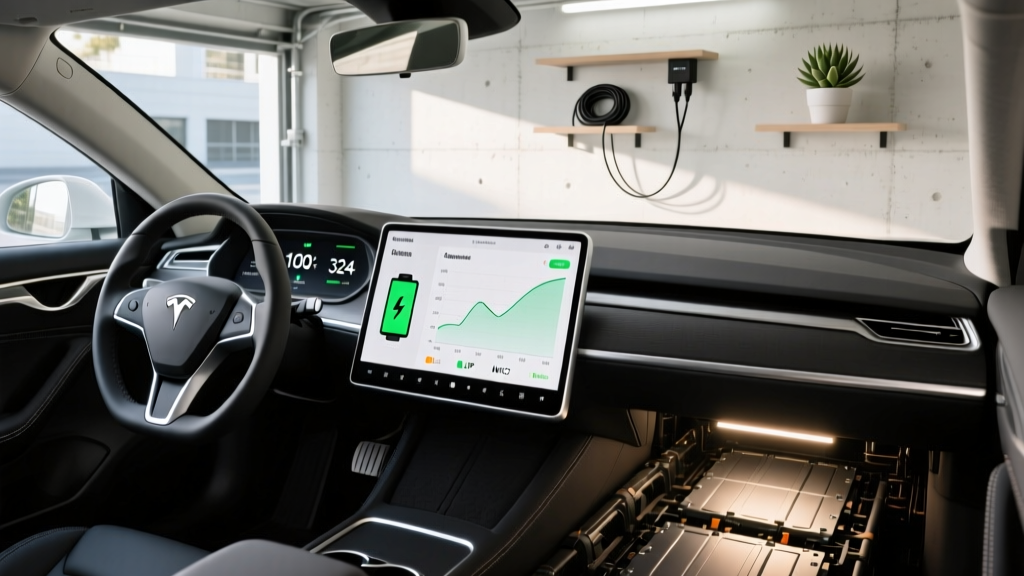
Tesla does not expose a native State of Health (SoH) percentage in the vehicle's UI the way some competitors do. But there are reliable methods to assess your pack's condition:
Method 1: The 100% Range Test. Charge your Tesla to 100% (for LFP, this is routine; for NMC, do this once for testing purposes). Note the projected range displayed. Compare it to the original EPA-rated range for your model and trim. A Model 3 Long Range that originally displayed 358 miles at 100% but now shows 322 miles has approximately 90% SoH. This isn't perfectly precise — the displayed range is an estimate influenced by recent driving efficiency — but it's a solid baseline.
Method 2: Third-party apps. Services like Tessie, TeslaFi, and Stats (iOS) log detailed charge data, including energy added vs. SoC change, which can be used to calculate actual usable kWh and derive a more accurate SoH figure. Tessie, for instance, provides a battery health estimate based on aggregated charge-session data over time.
Method 3: Service center diagnostic. Tesla Service can run a full battery health diagnostic that reads individual cell-group voltages, internal resistance, and total usable capacity. This is the most accurate method and is worth requesting if you're approaching the warranty threshold or considering a high-mileage used Tesla purchase.
Emerging Battery Technology: What's Next for Tesla
Tesla's 4680 cell — a larger-format, tabless cylindrical cell currently used in the Cybertruck and some Model Y variants — represents the company's current push toward lower manufacturing cost and higher energy density. But the broader industry is looking further ahead.
Silicon-dominant anodes: Replacing graphite anodes with silicon can theoretically boost energy density by 20-40%. Companies like Sila Nanotechnologies and Group14 are supplying early silicon-anode materials, but scaling to automotive volumes with acceptable cycle life remains a challenge. Expect limited commercial deployment in premium EVs by 2028-2029.
Solid-state batteries: The long-promised replacement of liquid electrolyte with a solid conductor would enable faster charging, higher energy density, and improved safety. Toyota, Samsung SDI, and QuantumScape have all announced prototype cells, but mass production at automotive scale is not expected before 2029-2031 at the earliest. Tesla has not publicly committed to a solid-state timeline.
Sodium-ion batteries: CATL has begun mass-producing sodium-ion cells for lower-cost, lower-range EVs in China. While sodium-ion is unlikely to appear in a Tesla sold in the US market in the near term, it represents a viable chemistry for future base-trim models globally where cost matters more than range.
Realistic timeline context: None of these technologies are available in a Tesla you can buy today. If you're making a purchase decision now, the LFP and NMC chemistries described above are what you'll own for the next 8-15 years — and both are proven, well-understood, and backed by extensive fleet data.
Tesla Battery Capacity FAQ
How long do Tesla batteries last in years and miles?
Based on fleet data, the average Tesla battery pack retains 80-85% of its original capacity at 200,000 miles. At the US average of ~14,000 miles per year, that's roughly 14+ years of service. Most packs will outlast the vehicle's useful economic life. Outright battery failure requiring replacement before 150,000 miles is statistically uncommon.
How much does a Tesla battery cost to replace?
Out-of-warranty Tesla battery replacements range from approximately $8,000 for a Model 3 Standard Range LFP pack to $22,000-$25,000 for a Model S/X or Cybertruck. Independent repair shops increasingly offer module-level repairs for $3,000-$7,000 when only a subset of cell groups has failed. Under warranty (8 years / 100,000-150,000 miles depending on model), replacement is free if capacity drops below 70%.
What does the Tesla battery warranty cover?
Tesla warrants its high-voltage battery for 8 years and 100,000-150,000 miles (varies by model) against defects and capacity loss below 70% of original capacity. The warranty covers the battery pack and drive unit. It does not cover damage from accidents, flooding, unauthorized modifications, or normal degradation above the 70% threshold. A replacement under warranty may be a new or remanufactured pack.
How do I check and maximize my Tesla battery health?
Check health by charging to 100% and comparing displayed range to the original EPA figure, or use third-party apps like Tessie or TeslaFi for data-driven SoH estimates. Maximize health by keeping NMC packs between 20-80% SoC for daily use, preconditioning before Supercharging, minimizing DC fast-charge frequency, avoiding prolonged storage at extreme SoC, and parking in shade or a garage in hot climates.
LFP vs. NMC — which Tesla battery is better?
Neither is universally better; it depends on your use case. LFP (Standard Range) offers superior cycle life (3,000-5,000+ cycles), lower cost, and the ability to charge to 100% daily — ideal for commuters and city drivers. NMC/NCA (Long Range/Performance) delivers higher energy density, better cold-weather performance, and faster DC charging — better for road-trippers, towers, and cold-climate drivers. For pure long-term longevity measured in total kWh cycled, LFP has a clear advantage.
Does frequent Supercharging damage my Tesla battery?
Exclusive reliance on DC fast charging accelerates degradation compared to primarily using Level 2 home charging. The high currents (150-250 kW) generate more heat and increase the risk of lithium plating, especially on cold packs. However, Tesla's BMS and preconditioning mitigate much of this risk. Owners who Supercharge 2-3 times per week on road trips while using Level 2 at home typically see only marginally higher degradation than those who never Supercharge. The real risk is daily Supercharging without preconditioning.
Will a software update reduce my Tesla's battery capacity?
Tesla occasionally adjusts the usable buffer (the hidden reserve above 0% and below 100%) via over-the-air updates. This can slightly change the displayed range at full charge. These adjustments are typically made to protect long-term battery health and are usually within 1-3% of total capacity. They do not represent physical degradation.
Sources: Tesla Impact Report, fueleconomy.gov, Tesla Battery Warranty. Degradation figures reflect fleet-averaged data and individual results will vary based on charging habits, climate, and usage patterns.