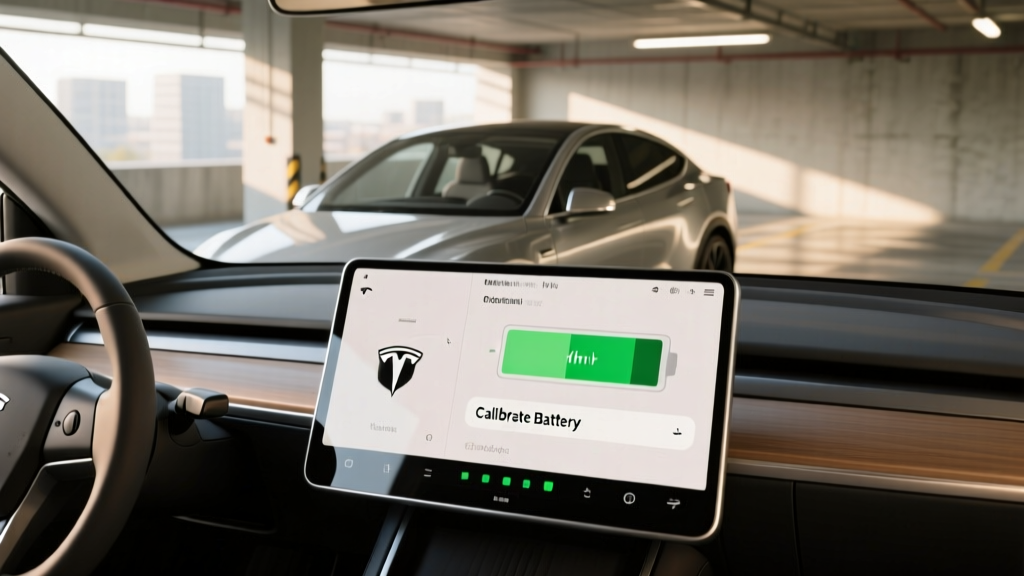
If your Tesla's displayed range seems to drop suddenly, fluctuates between charges, or shows less range than you expect after a software update, you may not have a degraded battery—you may have a calibration drift. Tesla battery calibration is the process of letting the Battery Management System (BMS) relearn the true state of charge (SoC) across the full capacity of your high-voltage traction pack. It's one of the most misunderstood topics in EV ownership, and getting it wrong can cost you usable range without any actual cell degradation.
This guide covers exactly when and how to recalibrate a Tesla battery, how calibration differs between LFP and NMC/NCA chemistries, and what real-world degradation data, warranty terms, and replacement costs look like in 2026.
What Tesla Battery Calibration Actually Does
The BMS in every Tesla estimates remaining energy by tracking voltage, current flow, and temperature across thousands of individual cells. Over time—especially if you rarely charge to 100% or discharge below 20%—the BMS loses precision at the top and bottom of the pack. The result: the range estimate on your screen drifts away from the actual energy stored.
Calibration doesn't change the physical health of your cells. It resets the software's understanding of the pack's upper and lower voltage limits so the displayed SoC and estimated range reflect reality. Think of it like resetting a fuel gauge that has slowly become inaccurate, not like repairing a fuel tank.
LFP vs NMC/NCA: Why Chemistry Dictates Your Calibration Routine
Tesla uses two primary cell chemistries across its 2025–2026 lineup, and each requires a different approach to calibration and daily charging.
| Attribute | LFP (Lithium Iron Phosphate) | NMC / NCA (Nickel-based) |
|---|---|---|
| Models (2026) | Model 3 RWD, Model Y RWD (Standard Range) | Model 3/Y Long Range & Performance, Model S, Model X, Cybertruck |
| Energy density | Lower (~160 Wh/kg cell-level) | Higher (~250–270 Wh/kg cell-level) |
| Cycle life | 3,000–5,000+ cycles to 80% SoH | 1,000–2,000 cycles to 80% SoH |
| Cold performance | Greater range loss below 32°F; slower charge acceptance | Better low-temp performance; heat pump standard |
| Daily charge recommendation | 100% regularly (Tesla recommends at least weekly) | 80% daily; 100% only for trips |
| Calibration ease | Flat voltage curve makes BMS estimation harder—regular 100% charges help | Steeper voltage curve; BMS tracks SoC more naturally |
| Cost (cell-level) | Lower; no cobalt or nickel | Higher; commodity-sensitive |
The flat discharge curve of LFP cells is the core reason calibration drift is more common on Standard Range Teslas. Because cell voltage barely changes between 80% and 20% SoC, the BMS has fewer voltage landmarks to estimate capacity. If you never charge to 100%, the BMS has no reliable reference point, and the displayed range gradually under-reports.
Step-by-Step Tesla Battery Calibration Procedure
There is no official "calibrate" button in Tesla's software. Instead, calibration is a manual process that gives the BMS the data it needs to re-map the pack. Here is the proven method used by Tesla service centers and experienced owners:
For LFP Packs (Model 3/Y Standard Range)
- Drive the vehicle down to 10% SoC or below. Use normal driving—no need to hypermile.
- Let the car sit powered off (not in Sentry Mode) for at least 3 hours. This allows cell voltages to stabilize and the BMS to record a true low-voltage reading.
- Charge continuously to 100% without interruption. Use a Level 2 charger (11.5 kW on a 48-amp circuit is ideal) rather than DC fast charging, which can terminate early due to cell-balancing routines.
- After reaching 100%, leave the car plugged in for an additional 2–3 hours. The BMS uses this time for cell balancing—equalizing voltage across all cell groups.
- Drive normally. You should see the displayed range correct upward, often by 5–15 miles depending on how far the calibration had drifted.
For NMC/NCA Packs (Long Range, Performance, Model S/X)
- Drive down to approximately 10–15% SoC.
- Let the car sit for 2–3 hours powered off.
- Charge to 100% in a single session on Level 2.
- Leave plugged in for 1–2 hours post-full for balancing.
- Immediately after, return your daily charge limit to 80% to minimize high-SoC calendar aging.
For both chemistries, perform this calibration routine every 3–6 months, or whenever you notice the displayed range dropping more than expected relative to your odometer reading. LFP owners who follow Tesla's recommendation to charge to 100% weekly are effectively performing a light calibration every week, which is why severe drift is less common among disciplined LFP owners.
Real-World Tesla Battery Degradation Data
Tesla's 2025 Impact Report and aggregated fleet data from sources like Tesla's official reports and independent trackers show the following degradation patterns:
- Model 3/Y NMC/NCA (Long Range): Average ~5% capacity loss at 50,000 miles, ~8–10% at 100,000 miles, and ~12–15% at 150,000 miles. Early degradation is steeper (the "break-in" curve), then flattens significantly.
- Model 3/Y LFP (Standard Range): Average ~3–4% at 50,000 miles, ~6–8% at 100,000 miles. LFP's longer cycle life means slower measurable degradation in typical ownership windows.
- Model S/X (NCA, 100 kWh pack): ~8–12% at 100,000 miles based on older pack architecture; newer 2023+ Plaid packs show improved retention.
These figures represent State of Health (SoH)—the percentage of original usable capacity remaining. A 10% degradation on a 75 kWh usable pack means you now have ~67.5 kWh available. On a Model 3 Long Range with an EPA range of 363 miles, that translates to roughly 327 miles at 100% SoC when new-range was 363.
The critical insight: degradation is not linear. Most loss occurs in the first 20,000–30,000 miles (typically 3–5%), after which the curve flattens dramatically. Many Tesla packs are projected to retain 85–90% SoH at 200,000 miles based on current fleet data.
Tesla Battery Warranty: What's Covered and for How Long
| Model / Variant | Warranty Period | Mileage Limit | Minimum Capacity Retention |
|---|---|---|---|
| Model 3 RWD (LFP) | 8 years | 100,000 miles | 70% |
| Model Y RWD (LFP) | 8 years | 100,000 miles | 70% |
| Model 3 Long Range / Performance | 8 years | 120,000 miles | 70% |
| Model Y Long Range / Performance | 8 years | 120,000 miles | 70% |
| Model S / Model X | 8 years | 150,000 miles | 70% |
| Cybertruck (AWD / Cyberbeast) | 8 years | 120,000 miles | 70% |
The warranty covers replacement or repair if your battery drops below 70% SoH within the stated period or mileage—whichever comes first. It also covers manufacturing defects and failures of the BMS, contactors, and pack internals. Importantly, it does not cover gradual capacity loss above the 70% threshold, damage from accidents, or modifications to the high-voltage system.
In practice, very few Tesla owners have needed a warranty replacement. The fleet data above shows that even at 150,000 miles, most packs remain well above the 70% floor. The warranty exists as a safety net, not a prediction.
EV Battery Replacement Cost: When and How Much
Out-of-warranty battery replacement is the single biggest fear among prospective EV buyers. Here's what it actually costs in 2026:
| Model / Pack | Battery Size (Usable kWh) | Estimated Replacement Cost | Typical Replacement Trigger |
|---|---|---|---|
| Model 3 RWD (LFP, ~57 kWh) | 57 kWh | $10,000–$13,000 | Rare before 250,000+ mi |
| Model 3/Y LR (NMC, ~75 kWh) | 75 kWh | $13,000–$16,000 | Rare before 200,000+ mi |
| Model S/X (~100 kWh) | 100 kWh | $18,000–$22,000 | Older packs at 150,000–200,000 mi |
| Cybertruck (~123 kWh) | 123 kWh | $20,000–$25,000 | Insufficient long-term data |
These figures include the pack and labor at a Tesla Service Center. Independent EV shops may offer refurbished packs for 20–35% less. The critical context: the vast majority of Tesla packs outlast the vehicle's useful economic life. According to data referenced by fueleconomy.gov, modern lithium-ion EV batteries are designed to last the lifetime of the vehicle under normal use. Replacement is typically needed only after extreme mileage, manufacturing defects (covered by warranty), or physical damage.
Factors That Accelerate (or Preserve) Battery Life
Battery Care Checklist
- Avoid sustained 100% SoC (NMC/NCA): Calendar aging accelerates sharply above 80% SoC. Charge to 100% only when you'll drive within a few hours.
- LFP owners: charge to 100% at least weekly. This is not optional—it's required for accurate BMS calibration and cell balancing.
- Minimize DC fast charging when Level 2 is available. Frequent 250 kW Supercharging sessions generate sustained heat. Occasional road-trip Supercharging has negligible impact; daily fast-charging adds up over years.
- Precondition before Supercharging. Navigate to a Supercharger in the Tesla app or nav so the pack preheats or precools—this reduces charge time and thermal stress.
- Avoid deep discharge storage. If storing the car for weeks, leave it plugged in at 50% SoC. Storing at 5% SoC risks bricking the 12V system and stressing the HV pack.
- Extreme heat is worse than extreme cold for longevity. Sustained ambient temperatures above 95°F with high SoC accelerate chemical aging. Park in shade or a garage when possible in hot climates.
- Don't obsess over regen braking settings. Regen current is well within the pack's C-rate tolerance and does not meaningfully affect degradation.
How to Check Your Tesla's Battery Health (SoH)
Tesla does not display a State of Health percentage in the vehicle UI. Here are the methods available to owners:
- Manual calculation: Charge to 100% and note the displayed range. Compare it to the original EPA range for your model year. A Model 3 Long Range that originally displayed 363 miles at 100% and now shows 330 miles has roughly 91% SoH (adjusting for calibration accuracy).
- Tesla Service Mode: Accessible via the software menu (tap your vehicle model name 3 times, enter "service" as the access code). The "High Voltage Battery" section shows pack voltage, energy remaining, and nominal full-pack kWh—a direct SoH indicator.
- Third-party apps: TeslaMate (self-hosted) and Tessie (subscription) log detailed charge data and can estimate SoH trends over time by tracking kWh added versus SoC change.
- Tesla Service Center diagnostic: Request a battery health report during a service visit. Tesla can pull a detailed cell-level analysis showing module imbalance and true capacity.
Check SoH every 6–12 months, or before purchasing a used Tesla. A pre-purchase Service Mode check is the most reliable assessment available without opening the pack.
Looking Ahead: Solid-State and Silicon-Anode Batteries
Next-generation battery chemistries are in active development across the industry, though none are currently available in production Tesla vehicles:
- Solid-state batteries replace the liquid electrolyte with a solid material, promising higher energy density (~400+ Wh/kg cell-level), faster charging, and improved safety. Toyota, Samsung SDI, and QuantumScape are targeting limited production in 2027–2029, but mass-market availability in affordable vehicles is realistically a 2030+ proposition.
- Silicon-anode cells (used in small quantities in current NMC cells) increase energy density by replacing graphite anodes with silicon. Companies like Sila Nanotechnologies and Group14 are scaling production, and incremental silicon-anode improvements are already appearing in 2025–2026 model-year packs. Expect 5–10% energy density gains per generation rather than step-change breakthroughs.
- Sodium-ion batteries are emerging as a low-cost alternative to LFP for standard-range vehicles, with CATL and BYD already producing cells. Tesla has not announced sodium-ion adoption as of 2026.
These technologies are promising but preliminary. No announced battery should factor into a current purchase decision. Today's LFP and NMC packs, properly maintained, will outlast most ownership periods.
Frequently Asked Questions
How often should I calibrate my Tesla battery?
Every 3–6 months for NMC/NCA packs, and effectively every week for LFP packs if you follow Tesla's guidance to charge to 100% regularly. If you notice range display inconsistency outside of seasonal temperature effects, run a full calibration cycle.
Does calibration restore lost range from degradation?
No. Calibration corrects the BMS's software estimate of your battery's capacity. It cannot restore physically degraded cells. However, if your BMS has drifted, calibration can "recover" range that was always there but not being displayed.
How long do Tesla batteries last in years and miles?
Based on fleet data, Tesla NMC/NCA packs retain approximately 85–90% capacity at 200,000 miles. LFP packs may retain 90%+ at the same mileage due to superior cycle life. In years, most packs show minimal calendar aging if stored at moderate SoC and temperatures—15–20 years of functional use is realistic for most owners.
Is it bad to Supercharge my Tesla frequently?
Occasional Supercharging (road trips, a few times per month) has a negligible effect on battery health. Daily DC fast charging, especially at 250 kW without preconditioning, generates sustained thermal load that accelerates degradation over years. If you have Level 2 home charging, use it as your primary method and reserve Supercharging for trips.
Does cold weather permanently damage my Tesla battery?
No. Cold weather reduces available range temporarily (expect 15–30% range loss at 20°F) because lithium-ion cells have higher internal resistance at low temperatures and energy is diverted to cabin and pack heating. Once the pack warms, full capacity returns. Permanent damage occurs only from charging at high rates while the pack is below freezing without preconditioning—the BMS prevents this by limiting charge speed.
Should I be worried about a $15,000+ battery replacement?
Context matters. The average age of a scrapped vehicle in the US is roughly 20 years. At 12,000 miles/year, that's 240,000 miles. Current Tesla fleet data suggests most packs will retain 80%+ capacity at that mileage. Combined with the 8-year warranty, the probability of needing an out-of-pocket replacement during typical ownership is low. For further details on EV battery longevity standards, refer to NHTSA guidance on battery safety and durability requirements.