If you've ever searched for what Tesla batteries are made of, you've likely hit a wall of vague answers. The reality is that Tesla doesn't use a single battery type — the chemistry inside a Model 3 Standard Range is fundamentally different from what powers a Model S Plaid. Understanding these differences matters because chemistry dictates your real-world range, charging behavior, long-term degradation, and even how you should care for the pack day to day.
This guide breaks down the exact cell chemistries Tesla uses in its 2025–2026 lineup, what degradation data actually shows, what the warranty covers, and what a replacement would cost if you ever need one. We'll also cover the emerging tech that could reshape Tesla packs in the coming years.
Tesla's Two Battery Chemistries: LFP vs NMC/NCA
Tesla currently sources cells from multiple suppliers — primarily CATL, Panasonic, LG Energy Solution, and BYD — and uses two distinct cathode chemistries across its fleet:
- LFP (Lithium Iron Phosphate): Used in the Model 3 Rear-Wheel Drive and Model Y Rear-Wheel Drive (Standard Range). These cells are prismatic and supplied primarily by CATL and BYD.
- NMC (Nickel Manganese Cobalt) and NCA (Nickel Cobalt Aluminum): Used in Long Range and Performance variants of the Model 3, Model Y, Model S, and Model X. Panasonic's 4680 cells (NMC-based) are also used in select Model Y builds from Tesla's Austin and Berlin factories.
Here's how the two chemistries stack up across the metrics that matter to owners:
| Attribute | LFP (LiFePO₄) | NMC / NCA |
|---|---|---|
| Energy density | ~160–180 Wh/kg (lower) | ~220–260 Wh/kg (higher) |
| Cycle life | 3,000–5,000+ cycles | 1,000–2,000 cycles |
| Cold-weather performance | Moderate range loss (~15–25% below freezing) | Better cold performance (~10–20% loss) |
| Cost per kWh | Lower (~$80–100/kWh at cell level) | Higher (~$110–140/kWh at cell level) |
| Recommended charge habit | Can charge to 100% daily | Best kept at 80% daily, 100% for trips |
| Thermal stability / safety | Excellent — less prone to thermal runaway | Good but requires more active thermal management |
| Typical Tesla models | Model 3 RWD, Model Y RWD | Model 3/Y LR & Perf, Model S, Model X |
Which Tesla Battery Chemistry Is Better for You?
Neither chemistry is universally "better" — the right choice depends on how you drive and charge.
Choose LFP (Model 3/Y RWD) if:
- You charge primarily at home and can plug in nightly
- You want the longest possible cycle life with minimal degradation
- You don't need 330+ miles of EPA range
- You prefer simpler charging habits (100% daily is fine)
- You live in a mild climate where cold-weather range loss is less impactful
Choose NMC/NCA (Long Range / Performance) if:
- You need maximum range for road trips (EPA 330–402 mi depending on model)
- You frequently drive in cold climates where NMC's cold-weather edge matters
- You want faster DC charging speeds (Long Range models peak at ~250 kW vs ~175 kW on LFP)
- You prioritize acceleration and performance (Performance trims are NMC/NCA only)
Tesla Battery Degradation: What the Data Actually Shows
Tesla's own 2024 Impact Report (the most recent with comprehensive fleet data) stated that Model 3 and Model Y packs retain approximately 85% of original capacity after 200,000 miles. That's 15% degradation over a distance that exceeds the mileage most owners will accumulate in a decade of driving.
Independent data from fleet operators and Tesla owner communities paints a more granular picture:
Typical Tesla Battery Degradation Curve (Fleet Averages):
- Year 1 / 15,000 mi: ~3–5% capacity loss (initial formation loss — steepest part of the curve)
- Year 2–3 / 30,000–50,000 mi: Additional ~2–3% loss (degradation slows significantly)
- Year 4–5 / 60,000–100,000 mi: ~1–2% per 25,000 miles
- Year 6–8 / 120,000–200,000 mi: Gradual linear decline, totaling ~12–18% from new
Sources: Tesla 2024 Impact Report, Recurrent Auto battery health data (2025 fleet study of 15,000+ Teslas).
An important nuance: LFP packs tend to show a slightly steeper initial drop in the first few thousand miles, then flatten out more completely than NMC packs. NMC packs may degrade slightly faster after the 100,000-mile mark, particularly if frequently charged to 100% or exposed to sustained high temperatures.
Factors That Accelerate (or Preserve) Tesla Battery Life
Battery degradation isn't purely a function of time or mileage — how you use the pack matters significantly. Here's what the electrochemistry tells us:
Habits that preserve battery health:
- For NMC/NCA packs: Set daily charge limit to 80% (Tesla's in-app recommendation). Charge to 100% only before long trips.
- For LFP packs: Tesla recommends charging to 100% at least once per week for accurate BMS calibration.
- Use preconditioning — enable "Scheduled Departure" or navigate to a Supercharger so the pack warms to optimal temperature before fast charging.
- Minimize prolonged exposure to extreme heat (avoid leaving the car at 100% SoC in 100°F+ ambient for days).
- Use Level 2 home charging as your primary method — slower charging generates less heat and stress on cells.
Habits that accelerate degradation:
- Frequent DC fast charging without preconditioning (cold packs forced to accept high kW rates causes lithium plating)
- Storing an NMC pack at 100% SoC for extended periods (days to weeks)
- Letting the pack sit at 0% SoC for prolonged periods (deep discharge damages cell chemistry)
- Repeatedly driving in extreme heat with aggressive acceleration and fast-charging cycles
Tesla Battery Warranty: What's Covered and for How Long
Tesla's battery and drive unit warranty is one of the more straightforward in the EV industry. Here's the current coverage for 2025–2026 model-year vehicles:
| Model / Trim | Warranty Period | Mileage Limit | Minimum Capacity Retention |
|---|---|---|---|
| Model 3 RWD (LFP) | 8 years | 100,000 miles | 70% |
| Model 3 Long Range / Performance (NMC) | 8 years | 120,000 miles | 70% |
| Model Y RWD (LFP) | 8 years | 100,000 miles | 70% |
| Model Y Long Range / Performance | 8 years | 120,000 miles | 70% |
| Model S / Model X | 8 years | 150,000 miles | 70% |
What this means in practice: If your battery drops below 70% of its original usable capacity within the warranty period, Tesla will repair or replace it at no cost. The replacement pack may be new or remanufactured, but it will meet the 70% threshold. This warranty covers defects and abnormal degradation — it does not cover damage from accidents, flooding, or unauthorized modifications.
For context on how this compares, see the Tesla New Vehicle Limited Warranty page. You can also cross-reference federal requirements at fueleconomy.gov, which lists warranty standards for EV tax credit eligibility.
Tesla Battery Replacement Cost: What to Expect
Out-of-warranty battery replacement is the cost that worries prospective EV buyers most. Here's the reality based on current service data and third-party repair shops:
| Model | Battery Size (Usable) | Chemistry | Estimated Replacement Cost |
|---|---|---|---|
| Model 3 RWD | ~57 kWh | LFP | $10,000–$13,000 |
| Model 3 Long Range | ~75 kWh | NMC | $13,000–$16,000 |
| Model Y Long Range | ~75 kWh | NMC | $14,000–$17,000 |
| Model S (current gen) | ~95 kWh | NMC | $18,000–$22,000 |
| Model X (current gen) | ~95 kWh | NMC | $18,000–$24,000 |
When is replacement typically needed? In practice, very few Tesla owners have needed a full pack replacement due to degradation alone. The fleet data shows that most packs retain 80–85% capacity at 200,000 miles. The replacements that do occur are more often due to manufacturing defects, physical damage, or coolant leaks — and those are typically covered under warranty.
It's also worth noting that Tesla service centers increasingly perform module-level repairs rather than full pack replacements. A single degraded or failed module can sometimes be swapped for $2,000–$5,000, depending on the pack architecture. This is more common on older Model S/X packs with removable modules; the structural battery packs in newer Model 3/Y vehicles are less modular and may require full-pack service.
How to Check Your Tesla's Battery Health (State of Health)
Tesla doesn't expose a direct "State of Health" (SoH) percentage in the vehicle's UI the way some competitors do. But there are several ways to estimate it:
Method 1: Range Comparison at 100% SoC
Charge your NMC Tesla to 100% (do this once for testing purposes — not as a daily habit). Compare the displayed range to the original EPA-rated range. For example, if your Model 3 Long Range originally showed 358 miles at 100% and now shows 320 miles, that's roughly an 11% capacity loss. LFP owners can do this routinely since 100% charging is recommended.
Method 2: Tesla Service Mode (DIY)
Tesla's hidden Service Mode (accessible via the software screen by holding the model name for a few seconds) includes a "Health Test" that runs a more detailed analysis of pack capacity. This test requires the car to sit idle for several hours and provides a closer approximation of true SoH.
Method 3: Third-Party Apps
Apps like Tessie and TeslaFi track your charging data over time and estimate SoH by comparing energy added during charges to the battery's original capacity. These estimates become more accurate with consistent data over weeks and months.
Method 4: Tesla Service Center Diagnostic
If you suspect abnormal degradation (especially near the warranty threshold), you can request a battery health diagnostic at a Tesla Service Center. This is the most authoritative measurement and is the one used for warranty claims.
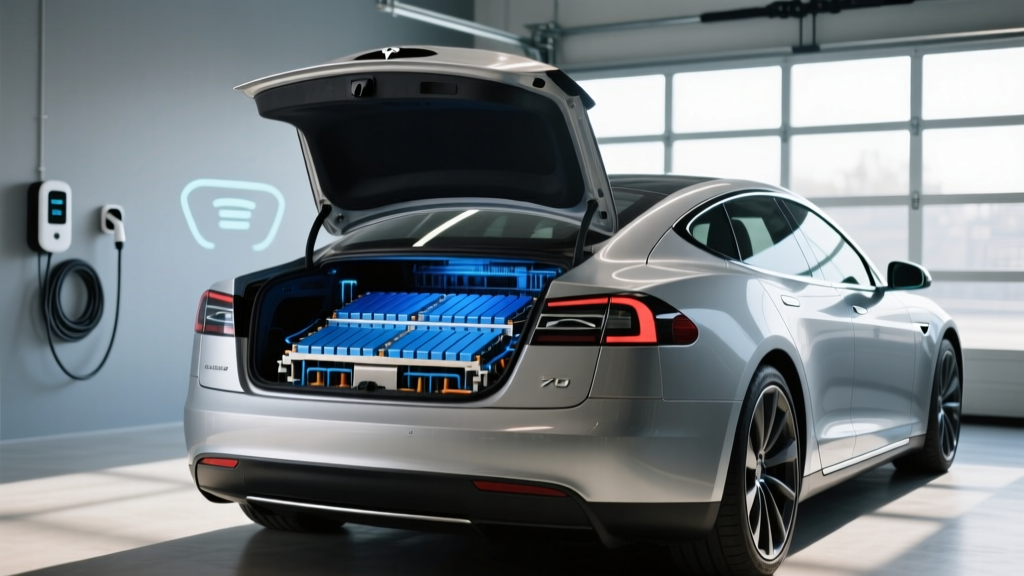
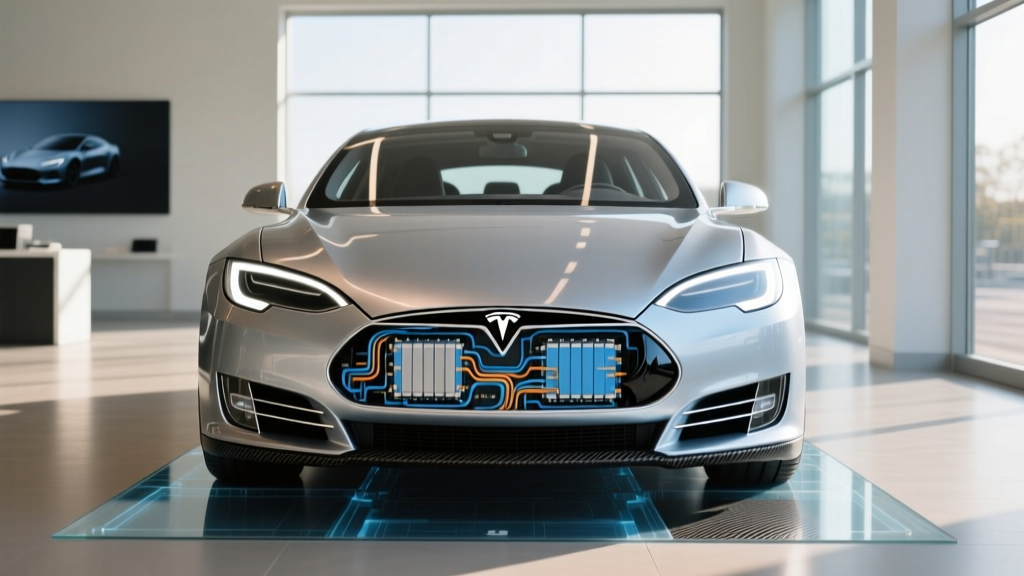
What's Inside a Tesla Battery: Cell Form Factors and Pack Architecture
Beyond chemistry, the physical design of Tesla's cells and packs has evolved significantly:
- 18650 cells: Used in older Model S and Model X (pre-2023). Cylindrical, ~18mm × 65mm. Thousands per pack.
- 2170 cells: Used in Model 3 and Model Y (Panasonic and LG). Cylindrical, ~21mm × 70mm. Higher energy density than 18650.
- 4680 cells: Tesla's in-house design, used in select Austin- and Berlin-built Model Y vehicles. Larger cylindrical cells (~46mm × 80mm) with a tabless electrode design for improved thermal management and manufacturing cost. These use NMC chemistry and a dry electrode process that Tesla has been scaling through 2025.
- Prismatic LFP cells: Supplied by CATL and BYD for Standard Range models. Rectangular format, simpler manufacturing, and inherently safer chemistry.
The newer structural battery pack (introduced with the 4680 cell in the Model Y) integrates the pack as a load-bearing part of the vehicle chassis. This reduces weight and part count but makes individual cell replacement impractical — the pack is serviced as a single unit.
Looking Ahead: Solid-State, Silicon Anodes, and What's Realistic
The battery industry is actively developing next-generation technologies, but it's critical to separate lab announcements from production reality:
Solid-state batteries promise higher energy density (potentially 400+ Wh/kg at the cell level) and improved safety by replacing the liquid electrolyte with a solid material. Companies like Toyota, QuantumScape, and Samsung SDI have announced prototypes, but no automaker — Tesla included — has a solid-state pack in mass production as of 2026. Realistic timeline for meaningful EV deployment: 2028–2030 at the earliest, likely starting in premium/low-volume applications.
Silicon-dominant anodes (replacing graphite) offer higher theoretical capacity and faster charging. Tesla's 4680 cells already incorporate some silicon in the anode, and suppliers like Sila Nanotechnologies and Group14 are scaling production. Expect incremental silicon-anode adoption across Tesla's lineup through 2027–2028, improving energy density by 10–20% rather than delivering a step-change revolution.
Sodium-ion batteries are entering the market in China (CATL has begun production) for lower-cost, lower-range applications. Tesla has not announced sodium-ion plans for US-market vehicles, but the chemistry could appear in future entry-level models aimed at the sub-$25,000 price point.
For current buyers, the takeaway is straightforward: LFP and NMC are mature, well-understood chemistries with extensive real-world track records. The packs in today's Teslas are designed to outlast the typical ownership period, and the next generation of breakthrough chemistries is still years from showroom floors.
How long do Tesla batteries last in years and miles?
Based on fleet data, Tesla batteries typically retain 80–85% of original capacity at 200,000 miles. In terms of calendar years, most owners report 10–15% degradation over 8–10 years of typical use (12,000–15,000 miles/year). The battery is designed to outlast the vehicle itself for the vast majority of owners.
How much does it cost to replace a Tesla battery?
Out-of-warranty replacement costs range from approximately $10,000 for a Model 3 RWD (LFP, ~57 kWh) to $24,000 for a Model X (~95 kWh NMC). However, full pack replacements due to degradation alone are rare — most replacements are due to defects covered under the 8-year warranty, or physical damage.
What does Tesla's battery warranty cover?
Tesla's Battery and Drive Unit Limited Warranty covers the battery pack and drive motor(s) for 8 years / 100,000–150,000 miles (depending on model), guaranteeing a minimum of 70% capacity retention. It covers defects and abnormal degradation but not damage from accidents, misuse, or unauthorized modifications.
How do I check my Tesla battery's State of Health?
You can estimate SoH by comparing your displayed range at 100% charge to the original EPA rating, use Tesla's Service Mode health test, track data through third-party apps like Tessie or TeslaFi, or request a formal diagnostic at a Tesla Service Center.
Is LFP better than NMC for Tesla batteries?
LFP offers longer cycle life (3,000–5,000+ cycles), lower cost, better thermal safety, and simpler daily charging habits (100% is fine). NMC offers higher energy density (more range in the same pack volume), better cold-weather performance, and faster peak DC charging. Neither is universally better — the right choice depends on your driving patterns, climate, and range needs.
Does frequent Supercharging damage a Tesla battery?
DC fast charging generates more heat than Level 2 charging, which accelerates degradation slightly over time. However, Tesla's thermal management system actively cools the pack during Supercharging, and preconditioning (which happens automatically when you navigate to a Supercharger) further mitigates stress. Occasional Supercharging has a negligible impact; daily Supercharging without preconditioning on a cold pack will measurably increase degradation over years. For the best longevity, use Level 2 home charging as your primary method and Supercharge for road trips.