Why Tesla's 4680 Battery Matters in 2026
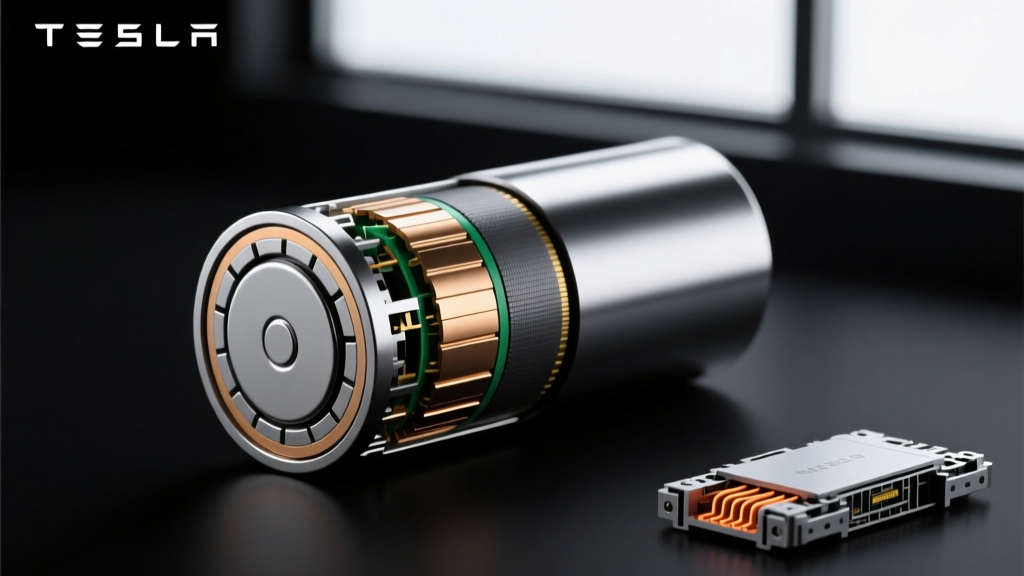
When Tesla introduced the 4680 cell at Battery Day in 2020, the promise was straightforward: a larger cylindrical cell (46 mm diameter, 80 mm height) that would deliver roughly 5x the energy of the older 2170 cell, enable 16% more vehicle range per pack, and cut per-kWh manufacturing costs through a tabless electrode design. By 2026, the 4680 has moved from pilot-line curiosity to volume production in select vehicles — most notably the Cybertruck and certain Model Y builds from Giga Texas — but the real-world picture is more nuanced than the keynote slides suggested.
This guide breaks down what the 4680 actually delivers today, how its NMC chemistry compares to the LFP cells Tesla also uses, what degradation data shows after years of real-world use, and what ownership costs look like if you ever need a replacement. We'll also cover how to monitor State of Health (SoH) and what's coming next in battery tech.
4680 Cell Architecture: What's Different
The 4680 is not just a bigger cylinder. The engineering changes are structural and electrical:
- Tabless (laser-patterned) electrode: Eliminates the traditional tab, reducing electron travel distance inside the cell. This lowers internal resistance, improves thermal management, and allows higher sustained charge/discharge rates.
- Dry electrode coating: Tesla's acquired Maxwell Technologies process eliminates solvent use in electrode manufacturing, cutting factory footprint and energy consumption. Yield on dry cathode has improved but remains a production bottleneck as of early 2026.
- Structural pack integration: In the Cybertruck and newer Model Y variants, 4680 cells are bonded into a structural battery pack that serves as a stressed member of the chassis — reducing part count, weight, and assembly complexity.
- Energy density: Tesla reports cell-level energy density improvements of roughly 10–15% over comparable 2170 NMC packs in production vehicles, translating to the ~16% vehicle-level range gain when combined with pack-level integration efficiencies.
The chemistry inside most 4680 cells deployed to date is nickel-based (NMC/NCA variant), not LFP. This matters for both range and longevity, as we'll explore next.
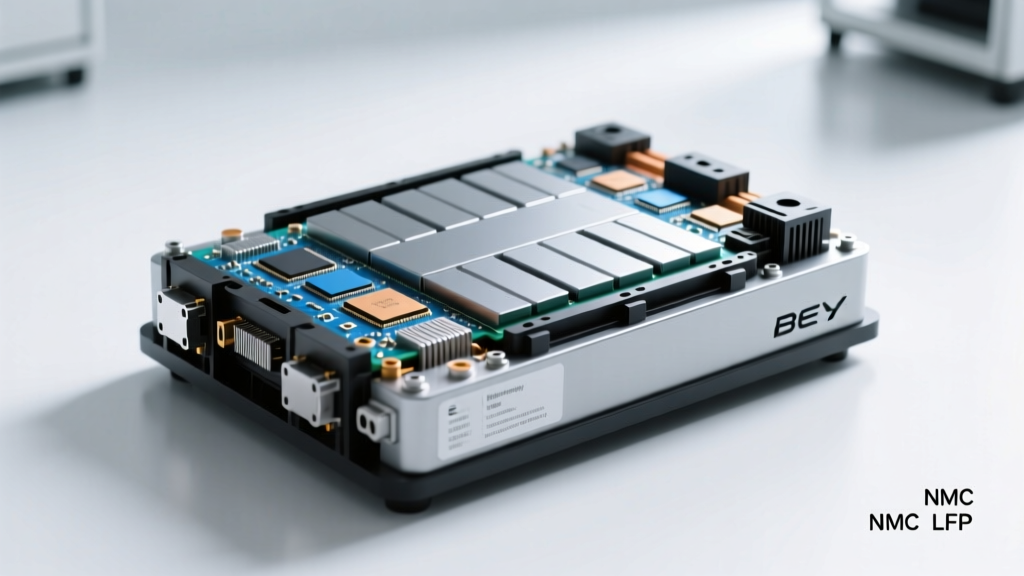
LFP vs NMC/NCA: Chemistry Trade-Offs Explained
Tesla uses two primary chemistries across its 2026 lineup, and the choice depends on the model and trim:
- LFP (Lithium Iron Phosphate): Used in standard-range Model 3 and Model Y (RWD trims). Sourced primarily from CATL.
- NMC/NCA (Nickel Manganese Cobalt / Nickel Cobalt Aluminum): Used in Long Range and Performance trims, and in the 4680-equipped Cybertruck and Model Y AWD from Giga Texas.
| Attribute | LFP | NMC / NCA (incl. 4680) |
|---|---|---|
| Energy Density (cell-level) | ~160–180 Wh/kg | ~230–260 Wh/kg (4680: ~244 Wh/kg est.) |
| Typical Cycle Life | 3,000–5,000+ cycles to 80% SoH | 1,000–2,000 cycles to 80% SoH |
| Cold-Weather Performance | More range loss below freezing (~30–40%) | Better cold performance (~20–30% loss) |
| Recommended Daily SoC | 100% (Tesla recommends periodic full charge) | 80–90% daily; 100% only for trips |
| Cost per kWh (cell) | Lower (~$80–100/kWh est.) | Higher (~$110–140/kWh est.) |
| Cobalt Content | None | Low but non-zero |
| SoC Estimation Accuracy | Flat voltage curve makes BMS estimation harder | Steeper curve allows more accurate SoC readout |
Which is better? It depends on your use case. If you want maximum range per charge, cold-weather capability, and faster DC charging, NMC (including 4680) is the answer — that's why it powers Long Range and Performance trims. If you prioritize longevity, lower cost, and can accept a shorter EPA range, LFP is remarkably durable and well-suited to daily commuting with regular 100% charging.
Real-World Degradation: What the Data Shows
Battery degradation — the gradual loss of usable capacity over time and charge cycles — is the single biggest long-term ownership concern. Here's what real-world data tells us across Tesla's fleet:
Typical Degradation Curve (Tesla Fleet Data, 2024–2026):
- Year 1 / ~15,000 miles: 2–4% capacity loss (initial formation loss)
- Year 3 / ~45,000 miles: 5–8% total loss
- Year 5 / ~75,000 miles: 7–10% total loss
- Year 8 / ~120,000 miles: 10–15% total loss (most packs remain above 85% SoH)
- 150,000+ miles: Data from high-mileage Model S/X (2170 and older 18650 cells) shows 12–20% loss; 4680 long-term data is still maturing as the oldest production packs are ~3 years old as of 2026.
Sources: Tesla Impact Reports, Tesla 2024 Impact Report, and aggregated owner data from Tessie and Recurrent Auto.
Key insight: Degradation is not linear. Most capacity loss occurs in the first 20,000–30,000 miles (the "formation" period), after which the curve flattens significantly. A 2023 Model Y with a 4680 pack at 50,000 miles might show 6–7% degradation — meaning an original EPA 330-mile range is now closer to 307–310 miles. That's noticeable but not operationally limiting for most drivers.
4680-specific note: Because 4680 volume production began in earnest in mid-2023 (Cybertruck) and expanded through 2024–2025 (Model Y AWD), we have approximately 2–3 years of fleet data. Early indicators from Recurrent Auto's battery health tracking suggest degradation rates broadly in line with 2170 NMC packs, with the structural pack's improved thermal management potentially offering a slight longevity edge. Definitive 5-year data will not be available until ~2028.
Battery Warranty: What Tesla Covers
Tesla's battery and drive unit warranty provides a contractual floor for capacity retention. Here's what's covered across the 2026 lineup:
| Model | Battery Warranty | Minimum Capacity Retention |
|---|---|---|
| Model 3 RWD (LFP) | 8 years / 100,000 miles | 70% |
| Model 3 Long Range / Performance | 8 years / 120,000 miles | 70% |
| Model Y (all trims incl. 4680) | 8 years / 120,000 miles | 70% |
| Cybertruck (4680 structural pack) | 8 years / 120,000 miles | 70% |
| Model S / Model X | 8 years / 150,000 miles | 70% |
What the warranty covers: Defects in materials or workmanship, and capacity loss below the 70% threshold during the warranty period. If your pack drops below 70% of original usable capacity (verified by Tesla's diagnostic tools), Tesla will repair or replace it — typically with a remanufactured pack of equivalent or better capacity.
What it doesn't cover: Damage from accidents, flooding, fire, unauthorized modifications, or using the vehicle as a stationary power source (unless using approved Powerwall/V2H integration). Normal degradation above 70% is not a warranty claim.
Real-world context: Based on fleet data, very few Tesla packs fall below 70% capacity within the 8-year/120,000-mile window. The warranty is a safety net that most owners will never need to use. According to Recurrent Auto's battery study, fewer than 1.5% of EV batteries across all brands have been replaced under warranty.
Battery Replacement Cost: When and How Much
If a battery fails outside warranty (or sustains physical damage), replacement is expensive but rarely necessary within a vehicle's typical ownership span.
| Model / Pack | Approx. Usable Capacity | Out-of-Warranty Replacement Cost (2026 est.) |
|---|---|---|
| Model 3 RWD (LFP, ~60 kWh) | ~57.5 kWh | $10,000–$13,000 |
| Model 3/Y Long Range (NMC, ~75–82 kWh) | ~75–79 kWh | $13,000–$16,000 |
| Model Y AWD 4680 (~75 kWh structural) | ~73 kWh | $14,000–$18,000 |
| Cybertruck (4680 structural, ~123 kWh) | ~120 kWh | $20,000–$28,000 |
| Model S/X (~100 kWh) | ~95 kWh | $15,000–$22,000 |
When is replacement typically needed? In practice, most EV batteries outlast the vehicle's economic life. The average age of a scrapped passenger vehicle in the US is roughly 15–17 years. At typical US driving distances (~13,500 miles/year per FHWA data), that's 200,000+ miles — within the demonstrated lifespan of well-maintained NMC packs and well within LFP cycle life.
The 4680 structural pack adds complexity: because cells are bonded into the chassis structure, a replacement requires more labor than swapping a module-based pack. This contributes to the higher estimated cost for Cybertruck and structural-pack Model Y replacements.
Factors That Accelerate (or Slow) Degradation
Not all miles are equal when it comes to battery wear. These factors have the most measurable impact on long-term State of Health:
What Hurts Battery Longevity
- Frequent DC fast charging above 150 kW: Occasional Supercharging is fine; daily DC fast charging accelerates degradation by ~1–2% additional loss over 5 years vs. primarily Level 2 charging (data from Recurrent Auto).
- Regularly charging to 100% on NMC/NCA: Sustained high SoC stresses nickel-based cathodes. Tesla recommends 80% daily for NMC; reserve 100% for road trips.
- Deep discharges below 10%: Repeatedly running the pack near empty stresses the anode. Try to keep SoC above 15–20% for daily use.
- Prolonged storage at extreme SoC: Leaving an NMC vehicle at 100% or below 5% for weeks in hot weather accelerates calendar degradation.
- Extreme ambient heat: Sustained operation in 100°F+ environments without active cooling (Tesla's thermal management is robust, but it still matters) increases degradation rate.
What Extends Battery Life
- Home Level 2 charging at 7–11 kW: Gentle charge rates produce less heat and stress.
- Keeping NMC between 20–80% daily: The "middle 60%" is the longevity sweet spot.
- Preconditioning before DC fast charging: Tesla's navigation-based preconditioning warms the pack to optimal temperature, reducing lithium plating risk during high-rate charging.
- LFP owners: charge to 100% at least weekly: This calibrates the BMS and prevents SoC estimation drift — LFP's flat voltage curve makes this necessary.
- Garage parking in extreme climates: Reduces thermal cycling stress on the pack.
How to Check and Monitor Battery Health (SoH)
Tesla does not display a simple "battery health percentage" on the vehicle's touchscreen the way some competitors do, but there are several ways to assess your pack's condition:
Method 1: Manual Range Calculation
Charge to 100% (for NMC, do this occasionally, not daily). Note the displayed range at 100%. Compare it to the original EPA-rated range for your specific model and trim. For example, if your 2024 Model Y Long Range originally showed 330 miles at 100% and now shows 310 miles, that's roughly 6% degradation. Note that the displayed range uses a fixed consumption factor and may not perfectly reflect actual usable capacity — it's an approximation.
Method 2: Third-Party Apps
Apps like Tessie and Stats (iOS) connect to Tesla's API and log charging sessions, calculating SoH over time by comparing energy added during charges to the expected capacity. These tools provide a more data-driven trend line than the in-car display alone.
Method 3: Tesla Service Diagnostic
If you suspect abnormal degradation (e.g., a sudden drop in displayed range, or a warranty claim), Tesla Service can run a full battery health diagnostic remotely or in-shop. This reads individual cell group voltages, internal resistance, and total usable capacity — the same data used for warranty determinations.
Method 4: OBD-II Dongles (Limited)
Some owners use OBD-II readers with Tesla-compatible software (e.g., Scan My Tesla with an ELM327 adapter) to read real-time pack data including nominal full-pack energy (kWh). This requires technical comfort but provides direct access to BMS-reported capacity.
Emerging Battery Tech: What's Next Beyond 4680
The 4680 is Tesla's current-generation cell, but the industry is actively developing next-generation technologies. Here's a realistic timeline assessment:
Silicon-Dominant Anodes
Replacing graphite anodes with silicon can theoretically boost energy density by 20–40%. Tesla has been incrementally increasing silicon content in 4680 anodes, but pure silicon anodes suffer from volume expansion during cycling (swelling up to 300%), which causes mechanical degradation. Companies like Sila Nanotechnologies and Group14 are working on silicon-carbon composites. Timeline: Incremental silicon increases in production now; high-silicon anodes at scale expected 2027–2029.
Solid-State Batteries
Solid-state cells replace the liquid electrolyte with a solid conductor, promising higher energy density (potentially 400+ Wh/kg at cell level), faster charging, and improved safety (no flammable electrolyte). Toyota, Samsung SDI, and QuantumScape are leading development. However, manufacturing yield, interfacial resistance, and cost remain unsolved at automotive scale. Timeline: Limited production in premium vehicles possible by 2028–2030; mainstream volume production not before 2030–2032. Do not delay an EV purchase waiting for solid-state.
Sodium-Ion Batteries
CATL and others are developing sodium-ion cells that eliminate lithium and cobalt entirely. Energy density is lower (~120–150 Wh/kg), making them suitable for city cars and energy storage but not long-range vehicles. Timeline: Entering production in Chinese-market budget EVs in 2025–2026; US-market availability uncertain and likely post-2028.
Dry Electrode Improvements (4680 Evolution)
Tesla's ongoing work on dry cathode manufacturing (currently only the anode uses the dry process at scale) could further reduce 4680 production costs and improve consistency. Timeline: Dry cathode at volume expected 2026–2027, per Tesla's Q4 2025 earnings guidance.
Frequently Asked Questions
How long do EV batteries last in years and miles?
Based on fleet data from Tesla and independent tracking by Recurrent Auto, most modern EV batteries (NMC and LFP) retain 80–90% of original capacity at 150,000 miles and 8–10 years of age. LFP packs have demonstrated 3,000+ charge cycles to 80% SoH, which translates to roughly 500,000+ miles in a vehicle with 250+ miles of range. The practical answer: for the vast majority of owners, the battery will outlast the vehicle's useful economic life. Catastrophic failure (sudden, total loss) is extremely rare — degradation is gradual and predictable.
How much does a Tesla battery cost to replace in 2026?
Out-of-warranty replacement costs range from approximately $10,000 for a Model 3 RWD LFP pack to $20,000–$28,000 for a Cybertruck 4680 structural pack. However, fewer than 1–2% of EV batteries ever require full replacement, and most failures occur within the 8-year/100,000–150,000-mile warranty window. If you're buying a used Tesla outside warranty, factor this cost as a low-probability risk, not a certainty.
What does the Tesla battery warranty actually cover?
Tesla's battery warranty covers defects and capacity loss below 70% of original usable capacity for 8 years and 100,000–150,000 miles (depending on model). It does not cover physical damage from accidents, flooding, unauthorized modifications, or normal degradation above the 70% threshold. Warranty replacements typically use remanufactured packs that meet or exceed the capacity retention threshold.
How do I check my Tesla's battery health?
The simplest method is to charge to 100%, note the displayed range, and compare it to the original EPA rating for your model. For ongoing tracking, third-party apps like Tessie log charging data and estimate SoH over time. For a definitive answer (especially before a warranty claim), Tesla Service can run a remote diagnostic that reads actual usable capacity from the BMS.
Is LFP or NMC better for daily driving?
For daily commuting and drivers who can charge at home, LFP is arguably the better choice: it tolerates regular 100% charging, has a longer cycle life, costs less, and contains no cobalt. The trade-off is lower energy density (less range per kWh) and worse cold-weather performance. For road-trip-heavy drivers, cold-climate residents, or those who need maximum range, NMC (including 4680) delivers better energy density and cold-weather efficiency — but requires more careful SoC management (20–80% daily) for optimal longevity.
Does frequent Supercharging damage the 4680 battery?
Occasional Supercharging (road trips, a few times per month) has minimal measurable impact on degradation. Daily DC fast charging at high rates (150–250 kW) does accelerate wear by approximately 1–2% additional capacity loss over 5 years compared to primarily Level 2 home charging, according to Recurrent Auto's fleet analysis. The 4680's tabless design and improved thermal management mitigate some of this, but the physics of high-rate lithium intercalation still apply. If you have access to home Level 2 charging, use it for daily needs and reserve Supercharging for trips.
Will solid-state batteries make current EVs obsolete?
Not in any timeframe that should affect a current purchase decision. Solid-state technology remains in pre-volume-production status as of 2026, with significant manufacturing and cost hurdles remaining. Mainstream availability is not expected before 2030 at the earliest. Current NMC and LFP batteries already deliver 250–400+ miles of range, 15–25 minute DC fast charging, and 150,000+ mile lifespans — which meets the needs of the vast majority of drivers today.