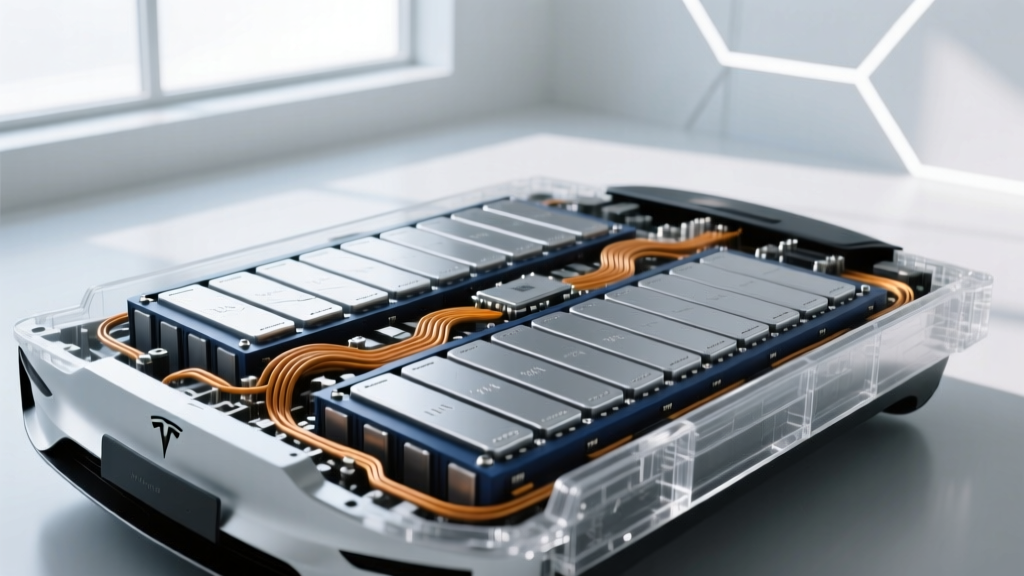
If you are researching the Tesla Model 3 battery capacity, you have probably noticed that Tesla does not publish a single, simple number. Depending on the trim and model year, the Model 3 uses fundamentally different battery chemistries, pack sizes, and charging profiles — and each choice has long-term implications for range retention, charging habits, and eventual replacement cost.
This guide breaks down every battery pack Tesla has installed in the current Model 3 lineup (and recent prior years), explains the chemistry trade-offs between LFP and NMC/NCA, reviews real-world degradation data, and gives you a practical framework for maximizing battery health over 200,000+ miles.
Current Tesla Model 3 Battery Capacity by Trim (2024–2026)
The refreshed "Highland" Model 3, introduced for the 2024 model year and continuing into 2026, uses two distinct battery architectures. The base Rear-Wheel Drive model uses a lithium iron phosphate (LFP) pack, while the Long Range and Performance trims use nickel-based chemistry (NMC/NCA). Here is the breakdown:
| Trim | Battery Chemistry | Usable Capacity | EPA Range | Peak DC Charge Rate | 10–80% Time | Base MSRP (2026) |
|---|---|---|---|---|---|---|
| Rear-Wheel Drive | LFP | ~60 kWh | 272 mi | 170 kW | ~25 min | $38,990 |
| Long Range AWD | NMC/NCA | ~82 kWh | 363 mi | 250 kW | ~18 min | $45,490 |
| Performance | NMC/NCA | ~82 kWh | 315 mi | 250 kW | ~18 min | $52,990 |
A few clarifications on these figures: kWh (kilowatt-hours) measures the battery's total energy capacity — think of it as the "fuel tank size." kW (kilowatts) measures the rate at which energy flows into the battery during charging. The two are never interchangeable. Usable capacity is what the car can actually draw from; Tesla includes a buffer above and below the displayed 0–100% to protect the cells from damage at extreme states of charge.
The EPA range figures above are laboratory estimates. In real-world driving — especially sustained highway speeds above 70 mph, cold weather below 30°F, or hilly terrain — expect 15–30% less range depending on conditions. The LFP RWD model typically delivers 220–240 miles in mixed real-world use; the Long Range delivers 290–320 miles.
LFP vs NMC/NCA: Which Battery Chemistry Does the Model 3 Use — and Why It Matters
The single biggest factor in your Model 3's long-term battery behavior is chemistry. Tesla uses two fundamentally different cell types across the lineup, and each has distinct strengths.
| Attribute | LFP (Lithium Iron Phosphate) | NMC/NCA (Nickel Manganese Cobalt / Nickel Cobalt Aluminum) |
|---|---|---|
| Used in Model 3 | Rear-Wheel Drive | Long Range, Performance |
| Energy Density | Lower (~160 Wh/kg cell-level) | Higher (~250–300 Wh/kg cell-level) |
| Cycle Life | 3,000–5,000+ cycles to 80% SoH | 1,000–2,000 cycles to 80% SoH |
| Cold Performance | Weaker — more range loss below freezing | Better — less cold-weather degradation |
| Recommended Daily SoC | 100% (Tesla recommends charging to full regularly) | 80% daily; 100% only for trips |
| Cost | Lower (no cobalt or nickel) | Higher (nickel and cobalt supply chain) |
| State of Charge Estimation | Less precise — flat voltage curve makes SoC harder to estimate | More precise — sloped voltage curve |
| Thermal Stability | Excellent — lower risk of thermal runaway | Good but lower threshold than LFP |
The practical takeaway: If you primarily drive in moderate climates, commute shorter distances, and want the longest possible calendar life from your battery, the LFP pack in the RWD model is arguably the more durable choice. If you need maximum range, regularly drive in cold weather, or want faster DC charging, the NMC/NCA pack in the Long Range or Performance is the better fit — but it requires more careful charging habits (avoiding prolonged 100% SoC).
Tesla recommends that LFP owners charge to 100% regularly to help the battery management system (BMS) recalibrate its SoC estimate. This is the opposite of NMC/NCA guidance, where daily charging to 80% is recommended to slow degradation. This single difference in ownership habit is important to understand before you buy.
Tesla Model 3 Battery Degradation: What the Real Data Shows
Battery degradation — the gradual loss of capacity over time and charge cycles — is the most common concern among prospective EV buyers. Fortunately, there is now substantial real-world data on Tesla batteries, particularly for the Model 3, which has been in high-volume production since 2018.
According to Tesla's 2023 Impact Report (the most recent comprehensive dataset published by the company), Model 3 and Model Y vehicles retained approximately 88% of their original battery capacity after 200,000 miles. This translates to roughly 12% degradation over what is, for most owners, 10–15 years of driving.
Independent data from fleet operators and owner-collected datasets (compiled by researchers like those publishing on the EPA's fueleconomy.gov and EV community databases) generally corroborate this, with most Model 3 packs showing:
- Year 1–2 (0–30,000 mi): 2–5% degradation — the steepest initial drop as the solid electrolyte interphase (SEI) layer stabilizes
- Year 3–5 (30,000–80,000 mi): Additional 3–5% loss, roughly linear
- Year 6–10 (80,000–200,000 mi): Slow, linear decline; total loss typically 10–15%
LFP packs appear to degrade more slowly in cycle-life terms, but their lower initial energy density means the absolute range loss in miles may feel similar. NMC/NCA packs degrade slightly faster per cycle but start with more capacity, so the real-world range experience converges over time.
Cold-weather note: Degradation is permanent capacity loss. Temporary range reduction in cold weather (which can be 20–30% below freezing) is a separate phenomenon caused by increased internal resistance and is not factored into the degradation figures above. Once the battery warms, the capacity returns.
Tesla Battery Warranty: What Is Covered and for How Long
Tesla provides one of the more straightforward battery warranties in the EV industry. Here are the current terms for the Model 3:
| Trim | Warranty Duration | Mileage Cap | Minimum Capacity Retention | What's Covered |
|---|---|---|---|---|
| Rear-Wheel Drive (LFP) | 8 years | 100,000 miles | 70% | Defects + capacity below threshold |
| Long Range AWD | 8 years | 120,000 miles | 70% | Defects + capacity below threshold |
| Performance | 8 years | 120,000 miles | 70% | Defects + capacity below threshold |
The warranty covers two scenarios: (1) any manufacturing defect in the battery pack, and (2) capacity degradation below 70% of the original usable capacity within the warranty period. Whichever limit — time or mileage — comes first ends the coverage.
In practice, warranty claims for degradation are rare. Based on the degradation curves described above, a Model 3 would need to lose more than 30% of its capacity within 8 years or 100,000–120,000 miles to qualify — a scenario that almost never occurs under normal use. Most warranty claims involve manufacturing defects (bad cell groups, BMS faults, coolant leaks) rather than normal wear.
For detailed current warranty terms, always check Tesla's official warranty documentation, as terms can shift with model year updates.
Tesla Model 3 Battery Replacement Cost: When and How Much
The fear of a $20,000 battery replacement is one of the most persistent barriers to EV adoption. Here is the reality for the Model 3:
| Pack Type | Estimated Replacement Cost (Out of Warranty) | Typical Trigger |
|---|---|---|
| 60 kWh LFP (RWD) | $12,000–$16,000 | Physical damage, coolant intrusion, rare cell failure |
| 82 kWh NMC/NCA (LR/Perf) | $14,000–$20,000 | Same — catastrophic failure, not normal degradation |
When is replacement actually needed? Almost never for degradation alone. The degradation data shows that most Model 3 packs will retain 85–90% capacity at 200,000 miles — well above the 70% threshold. The overwhelming majority of battery replacements occur due to physical damage (collision, flood), manufacturing defects caught within warranty, or coolant system failures that damage cells.
Tesla's approach to out-of-warranty replacement has also evolved. Rather than installing a brand-new pack, Tesla typically provides a remanufactured pack with cells tested to meet a minimum capacity threshold. This reduces cost and waste. Some independent EV repair shops are now also offering module-level repairs — replacing only the degraded or failed cell modules within the pack rather than the entire unit — for $3,000–$7,000 depending on the fault.
The bottom line: plan for the possibility, but do not base your purchase decision on it. The data strongly suggests that the vast majority of Model 3 batteries will outlast the vehicle's useful economic life.
Factors That Accelerate (or Slow) Battery Degradation
Battery longevity is not purely a function of time and miles. How you charge, store, and drive your Model 3 has a measurable impact on how quickly the pack degrades. Here are the factors ranked by impact, based on published battery research and fleet data:
High Impact
- Prolonged high state of charge (NMC/NCA only): Storing an NMC/NCA pack at 100% SoC for days or weeks accelerates electrolyte decomposition. Charge to 80% daily; set 100% only when departing on a trip.
- Extreme heat exposure: Sustained ambient temperatures above 95°F, especially combined with high SoC, stress cells. Use Tesla's cabin overheat protection and park in shade when possible.
- Frequent DC fast charging to high SoC: Repeatedly charging above 80% on Superchargers generates heat and lithium plating risk. The charge curve tapers above 80% partly to protect the battery, but habitual 100% DC fast charges still add stress.
Moderate Impact
- Very low SoC storage: Letting the battery sit below 10% for extended periods can cause copper dissolution in the anode. If storing the car, leave it at 50% SoC and plugged in.
- Aggressive driving in cold weather: High discharge rates when the battery is cold (below 40°F) increase internal resistance and mechanical stress on cells. Use preconditioning before hard acceleration.
Lower Impact
- Level 2 home charging frequency: Daily Level 2 charging (7–11 kW) is well within the battery's comfort zone and causes minimal additional wear.
- Regenerative braking intensity: Regen generates charge current, but at rates far below DC fast charging. No meaningful impact on degradation.
One often-overlooked practice: preconditioning. When you navigate to a Supercharger in the Tesla navigation system, the car automatically warms the battery to the optimal temperature for fast charging. This reduces charging time and, critically, reduces the lithium plating risk that occurs when cold cells receive high charge currents. Always navigate to your charging stop rather than driving to one without telling the car.
How to Check Your Tesla Model 3 Battery Health (State of Health)
Tesla does not display a direct "State of Health" (SoH) percentage on the vehicle's touchscreen the way some competitors do. However, there are several methods to assess your pack's condition:
Method 1: Range Comparison at 100% SoC
Charge the car to 100% (for LFP, do this regularly; for NMC/NCA, do it occasionally for assessment purposes). Note the displayed range. Compare it to the original EPA range for your trim. A 2024 Long Range that originally displayed 363 miles at 100% but now shows 335 miles has experienced roughly 8% degradation. This is not perfectly precise — the displayed range is an estimate influenced by recent driving patterns — but it gives a reasonable approximation.
Method 2: Service Mode (Energy Screen)
Tesla owners can access a rudimentary energy history through the car's trip meter. Reset the trip meter, drive a known distance, and compare the kWh consumed to the expected efficiency (Wh/mi). A sustained increase in Wh/mi over thousands of miles can indicate degradation, though it can also reflect changes in driving style, tire condition, or climate.
Method 3: Third-Party OBD-II Apps
Tools like Tessie, TeslaFi, or Scan My Tesla (using an OBD-II adapter) can read BMS data including nominal full-pack energy (kWh), which provides a more precise SoH estimate. The BMS-reported "nominal full pack" value compared to the original factory capacity gives the most accurate degradation figure available without a Tesla service center diagnostic.
Method 4: Tesla Service Diagnostic
If you suspect abnormal degradation or are approaching the warranty threshold, you can request a battery health test through the Tesla app. A service technician can run a full diagnostic that reads individual module voltages and overall pack capacity.
Looking Ahead: Solid-State, Silicon Anode, and Next-Gen Battery Tech
Battery technology continues to advance, and several next-generation chemistries are in development that could eventually reach the Model 3 platform:
Solid-state batteries: These replace the liquid electrolyte with a solid conductor, promising higher energy density (potentially 400+ Wh/kg), faster charging, and improved safety. Companies like QuantumScape and Toyota are targeting limited production in 2027–2028, but high-volume, affordable solid-state packs for mainstream vehicles like the Model 3 are realistically a 2029–2032 prospect. Do not delay a purchase waiting for this technology.
Silicon anode batteries: Replacing graphite anodes with silicon can increase energy density by 20–40%. Sila Nanotechnologies and others are beginning low-volume production for consumer electronics and specialty vehicles. Automotive-scale production for EVs is expected around 2027–2029. Tesla has already experimented with silicon in its 4680 cell development.
Tesla's 4680 cell evolution: Tesla continues to iterate on its in-house 4680 cell format (46mm diameter, 80mm height). Current 4680 cells use a dry-coated cathode process that reduces manufacturing cost. Future iterations may incorporate higher silicon content in the anode and improved electrolyte formulations. These are incremental improvements, not revolutionary leaps — expect 5–10% gains in energy density and cost reduction per generation.
For context, the current Model 3 battery packs represent mature, well-tested technology. The risk of obsolescence from next-gen batteries is low because degradation is slow enough that today's packs will still be functional when newer technology arrives.
Frequently Asked Questions
How long do Tesla Model 3 batteries last in years and miles?
Based on Tesla's published fleet data and independent tracking, most Model 3 batteries retain 85–90% of their original capacity at 200,000 miles. In terms of calendar life, 15–20 years is a reasonable expectation before the pack drops below 70% capacity under normal use. Many packs will outlast the vehicle itself.
How much does it cost to replace a Tesla Model 3 battery?
Out-of-warranty replacement costs range from approximately $12,000 to $20,000 depending on the pack size and whether Tesla installs a new or remanufactured unit. However, replacements due to normal degradation are extremely rare. Most replacements are triggered by physical damage or manufacturing defects covered under warranty.
What does the Tesla Model 3 battery warranty cover?
The warranty covers manufacturing defects and capacity degradation below 70% for 8 years or 100,000–120,000 miles (depending on trim). It does not cover damage from accidents, floods, or modifications. The 70% threshold means the pack must lose more than 30% of its original capacity to qualify — a scenario that rarely occurs within the warranty period based on current fleet data.
How do I check my Tesla Model 3's battery health?
The most accessible method is charging to 100% and comparing the displayed range to the original EPA figure. For more precision, third-party apps like TeslaFi or Tessie can read BMS data via OBD-II adapters to report the pack's nominal full capacity. Tesla service centers can also run a formal diagnostic on request.
LFP vs NMC — which Tesla Model 3 battery is better?
Neither is universally better; they serve different priorities. LFP (in the RWD model) offers longer cycle life, lower cost, and the convenience of daily 100% charging — ideal for commuters in moderate climates. NMC/NCA (in Long Range and Performance models) offers higher energy density, better cold-weather performance, and faster DC charging — ideal for road-trippers and cold-climate drivers who need maximum range.
Does frequent Supercharging damage the Model 3 battery?
Occasional DC fast charging has minimal impact. However, habitual daily Supercharging — especially to high SoC levels — does accelerate degradation slightly due to heat generation and lithium plating risk. If you have home Level 2 charging, use it for daily needs and reserve Supercharging for road trips. Tesla's preconditioning feature (activated by navigating to a Supercharger) mitigates much of the stress by warming the pack before charging begins.
Can I charge my LFP Model 3 to 100% every day?
Yes — and Tesla recommends it. LFP chemistry is not stressed by high SoC the way NMC/NCA is. In fact, charging to 100% regularly helps the battery management system recalibrate its state-of-charge estimate, which tends to drift on LFP packs due to their flat voltage curve. Set your charge limit to 100% and plug in nightly.
For more on EPA efficiency ratings and range data, consult fueleconomy.gov's Model 3 comparison tool. For current federal tax credit eligibility rules that may apply to your Model 3 purchase, review the IRS §30D clean vehicle credit page — note that income caps, MSRP limits, and battery sourcing requirements all apply and change periodically.