For most electric-vehicle owners, the high-voltage traction battery is the single most expensive component in the car — and the one surrounded by the most misinformation. Search forums and you will find polarized camps: one insisting batteries routinely fail at 100,000 miles, the other claiming they outlast the vehicle. The truth, backed by fleet data and manufacturer warranty claims, sits firmly in the middle and leans optimistic.
This guide addresses a question we hear with increasing frequency: should you plan to swap battery packs mid-ownership, or is the original pack engineered to last the life of the car? We will walk through chemistry trade-offs, real-world degradation curves, warranty fine print, replacement economics, and the daily habits that move the needle on longevity.
LFP vs NMC/NCA: Which Chemistry Is Under Your Floor?
Not all lithium-ion packs are created equal. The two dominant chemistries in the 2026 EV market are LFP (lithium iron phosphate) and NMC/NCA (nickel manganese cobalt / nickel cobalt aluminum). Your chemistry dictates energy density, cycle life, cold-weather behavior, and ultimately whether a swap battery scenario is even economically rational.
| Attribute | LFP (e.g., Tesla Model 3 RWD, BYD) | NMC / NCA (e.g., Hyundai Ioniq 5, Ford F-150 Lightning Extended) |
|---|---|---|
| Energy Density | Lower (~160 Wh/kg cell-level) | Higher (~250-300 Wh/kg cell-level) |
| Typical Cycle Life | 3,000-5,000+ cycles to 80% SoH | 1,000-2,000 cycles to 80% SoH |
| Cold Performance | More range loss below 32°F (~25-35% loss) | Better cold retention (~15-25% loss) |
| Cost per kWh (pack) | ~$90-110 | ~$120-150 |
| Recommended Daily SoC | 100% daily OK | 80% daily; 100% for trips only |
| Cobalt Content | None | Present (supply-chain/ethical concern) |
| Best For | Commuters, high-mileage drivers, hot climates | Long-range needs, cold climates, performance trims |
The practical takeaway: LFP packs degrade more slowly and tolerate daily full charges, making a swap battery event far less likely over a typical ownership period. NMC/NCA packs deliver more range in a lighter package but demand more careful state-of-charge management to maximize lifespan.
Real-World Degradation: What the Data Actually Shows
Manufacturer warranties set a floor, but fleet data from high-mileage operators tells the real story. Based on aggregated data from sources including Recurrent Auto's battery health studies and Tesla's own impact reports, here is what typical degradation looks like:
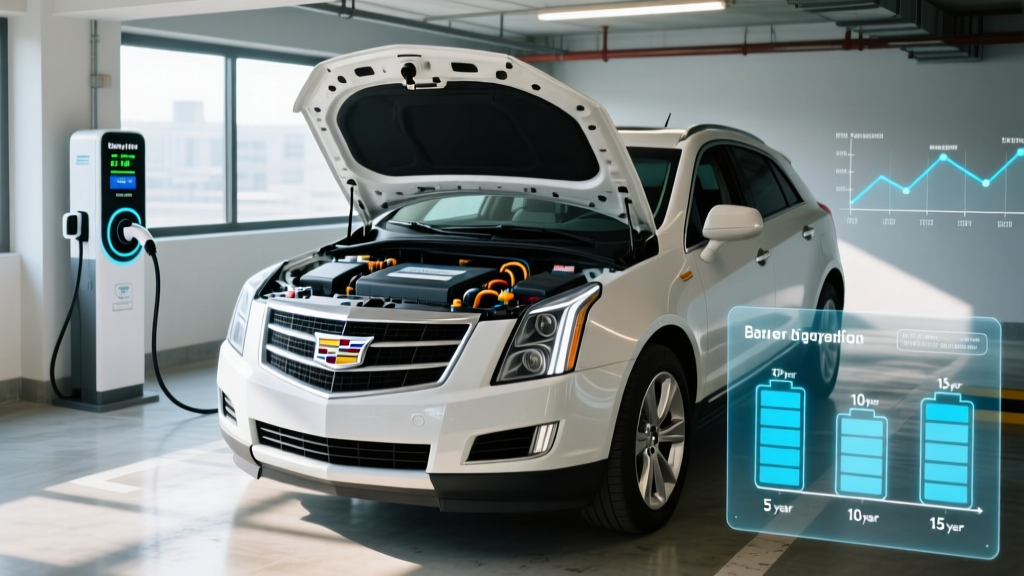
Typical Degradation Curve (NMC/NCA Packs, Mixed Use):
- Year 1 / 15,000 mi: ~2-4% capacity loss (initial "break-in" drop)
- Year 3 / 45,000 mi: ~6-8% total loss
- Year 5 / 75,000 mi: ~8-11% total loss
- Year 8 / 120,000 mi: ~10-15% total loss
- Year 10 / 150,000 mi: ~12-18% total loss (many packs still above warranty threshold)
LFP packs tend to track 3-5 percentage points better at each interval under equivalent use.
A concrete example: a 2022 Tesla Model 3 Long Range with a 75 kWh usable NMC pack and an EPA rating of 358 miles might show ~315 miles of range at 100% SoC after 80,000 miles — roughly 12% degradation. That is noticeable but rarely debilitating. Most owners adapt to the slight range reduction without considering a swap battery procedure.
What the Battery Warranty Actually Covers
Federal law mandates a minimum 8-year / 100,000-mile warranty on EV battery packs (extended to 10 years / 150,000 miles in California and states adopting CARB standards). However, the fine print matters enormously.
| Manufacturer | Term | Capacity Retention Threshold | Notes |
|---|---|---|---|
| Tesla (Model 3/Y RWD — LFP) | 8 yr / 120,000 mi | 70% | Higher mileage for LFP trims |
| Tesla (Model 3/Y LR/Perf — NMC) | 8 yr / 120,000 mi | 70% | — |
| Hyundai / Kia (E-GMP) | 10 yr / 100,000 mi | 70% | Among the longest terms |
| Ford (F-150 Lightning, Mach-E) | 8 yr / 100,000 mi | 70% | — |
| GM (Ultium platform) | 8 yr / 100,000 mi | 70% (60% for Bolt-era) | Varies by model year |
| BMW / VW Group | 8 yr / 100,000 mi | 70% | — |
The critical detail: warranties cover capacity loss below the threshold, not total failure alone. If your 75 kWh pack drops to 50 kWh (below 70%), the manufacturer must repair or replace it at no cost. In practice, very few packs breach this threshold within the warranty window — which is why a proactive swap battery strategy is rarely the optimal financial move.
EV Battery Replacement Cost: When and How Much
If your pack does fall outside warranty coverage — whether due to age, mileage, or physical damage — replacement costs remain significant but have trended downward as pack-level kWh prices have fallen from ~$200/kWh in 2020 to roughly $110-140/kWh in 2026.
| Vehicle (Battery Size) | Chemistry | Parts Cost | Labor | Total Estimate |
|---|---|---|---|---|
| Tesla Model 3 RWD (60 kWh) | LFP | $5,500 - $7,000 | $1,500 - $2,500 | $7,000 - $9,500 |
| Hyundai Ioniq 5 (77.4 kWh) | NMC | $9,000 - $12,000 | $2,000 - $3,000 | $11,000 - $15,000 |
| Ford F-150 Lightning Ext. (131 kWh) | NMC | $14,000 - $18,000 | $3,000 - $4,500 | $17,000 - $22,500 |
| Chevrolet Equinox EV (85 kWh) | NMC | $9,500 - $12,500 | $2,000 - $3,000 | $11,500 - $15,500 |
| Nissan LEAF (62 kWh) | NMC | $7,000 - $9,500 | $1,500 - $2,500 | $8,500 - $12,000 |
When is replacement typically needed? Based on current degradation data, most original packs reach 70-80% State of Health between 150,000 and 250,000 miles — well past the point where many owners have sold or traded the vehicle. A swap battery event is most common in three scenarios:
- High-mileage fleet/commercial use exceeding 200,000 miles within 6-8 years
- Physical damage from road debris, flooding, or collision (often covered by insurance)
- Early-generation EVs (2011-2017 model years) with less robust thermal management
For a 2026-model EV with active liquid thermal management, planning a mid-life swap battery is generally unnecessary. The math almost always favors riding out the original pack.
Five Factors That Accelerate (or Preserve) Battery Life
Battery longevity is not purely a function of time and miles. Your habits shift the degradation curve meaningfully:
Habits That Preserve Battery Health:
- ✅ Keep daily SoC between 20-80% for NMC/NCA packs; LFP owners can charge to 100% daily without penalty
- ✅ Precondition the battery before DC fast charging (most EVs do this automatically when you navigate to a charger)
- ✅ Use Level 2 home charging as your primary method; reserve DC fast charging for road trips
- ✅ Park in shade or a garage during sustained heat; extreme ambient heat accelerates degradation more than cold
- ✅ Drive it regularly — batteries prefer moderate cycling over sitting at high SoC for weeks
Habits That Accelerate Degradation:
- ❌ Frequent DC fast charging (3+ times per week) without preconditioning
- ❌ Leaving an NMC pack at 100% SoC for extended periods (days/weeks)
- ❌ Repeatedly draining below 10% SoC
- ❌ Sustained high-speed driving in hot weather (pack temperatures exceeding 104°F / 40°C)
- ❌ Aftermarket charging accessories that bypass OEM thermal protocols
One often-overlooked factor: DC fast charging generates significant heat. A 250 kW session can push cell temperatures to 95-104°F internally. Modern thermal management systems handle this well, but cumulative thermal stress from daily fast charging does measurably increase degradation — roughly 1-3% additional loss over 100,000 miles compared to Level 2-only charging, per fueleconomy.gov EV technology resources.
How to Monitor Your Battery's State of Health
Knowing your pack's State of Health (SoH) — the percentage of original capacity remaining — is essential before deciding whether to swap battery packs or stay the course.
OEM In-Vehicle Displays
Many 2026 EVs now include a battery health indicator in the infotainment system. Tesla displays estimated range at 100% SoC (compare to original EPA figure). Hyundai/Kia provides a battery health percentage in the EV settings menu on newer model years. GM's Ultium vehicles show a "Battery Health" screen accessible through the driver information center.
Third-Party Diagnostics
For a more granular view, services like Recurrent connect to your vehicle's telematics and provide monthly SoH reports with degradation trending. Independent EV shops with OEM-level scan tools can pull cell-level voltage variance data — the gold standard for detecting weak modules that might benefit from a partial swap (replacing individual modules rather than the entire pack, where the architecture permits).
The DIY Check
Charge to 100% on a mild day (60-75°F), note the displayed range, and compare it to the original EPA sticker. A 2023 Ioniq 5 Long Range originally rated at 303 miles EPA showing 270 miles at full charge indicates roughly 11% degradation — well within normal parameters at 60,000 miles and no cause for a swap battery intervention.
Battery Swapping vs. Replacement vs. Module Repair
If your diagnostics confirm significant capacity loss, you have three paths:
1. Full Pack Replacement (Dealer or Specialist)
The most straightforward and most expensive option. The entire pack is removed and replaced with a new or certified-refurbished unit. This is what most warranty claims result in. Out-of-pocket: $7,000 to $22,500 depending on vehicle and pack size.
2. Module-Level Repair
Some pack architectures (notably older Nissan LEAF, some BMW i3 configurations, and certain GM Ultium designs) allow individual module replacement. A shop identifies the degraded modules and swaps only those, reducing cost to $2,000-$6,000. Availability depends heavily on the specific pack design — not all manufacturers support this approach.
3. Battery Swap Stations (NIO Model)
Chinese automaker NIO operates a network of automated battery swap stations where a robotic system exchanges your depleted pack for a fully charged one in approximately 5 minutes. As of 2026, NIO's swap network remains primarily in China and parts of Europe — not available in the United States. The concept is compelling for fleet operators but faces infrastructure, standardization, and liability hurdles in the U.S. market. No other manufacturer has committed to a U.S. swap battery station network at this time.
Emerging Battery Tech: What's Next (and When)
Several next-generation technologies promise to make the swap battery question less relevant by extending pack lifespans dramatically:
- Solid-State Batteries: Replace the liquid electrolyte with a solid conductor, offering higher energy density, faster charging, and potentially 10,000+ cycle life. Toyota has announced limited solid-state production for 2027-2028, but these will debut in low-volume, high-price models. Broad market availability is realistically 2030 or later. All current solid-state announcements should be treated as preliminary.
- Silicon-Dominant Anodes: Companies like Sila Nanotechnologies and Group14 are replacing graphite anodes with silicon composites, boosting energy density by 20-40%. Early production applications are appearing in 2025-2026 model-year vehicles (notably the Mercedes G-Class EV). Cycle-life data at scale is still maturing.
- Sodium-Ion Batteries: Lower cost and abundant raw materials, but lower energy density limits them to city EVs and stationary storage. CATL and BYD are producing these for Chinese-market micro-EVs. U.S. availability in passenger vehicles is not expected before 2028.
None of these technologies are currently available in production U.S.-market EVs. If you are buying in 2026, you are choosing between LFP and NMC/NCA — both mature, well-understood chemistries with predictable degradation profiles.
Frequently Asked Questions
How long do EV batteries last in years and miles?
Based on current fleet data, most modern liquid-cooled EV battery packs retain 70-80% of original capacity at 150,000-250,000 miles, which typically corresponds to 12-20 years of average use (12,000-15,000 miles/year). LFP packs tend toward the higher end of this range. Many first-generation Tesla Model S packs have exceeded 300,000 miles with 75%+ SoH.
How much does an EV battery cost to replace in 2026?
Out-of-warranty replacement costs range from approximately $7,000 for smaller LFP packs (e.g., Tesla Model 3 RWD, 60 kWh) to $22,500 for large NMC packs (e.g., Ford F-150 Lightning Extended Range, 131 kWh), including parts and labor. Under warranty, replacement is free if capacity drops below the manufacturer's threshold (typically 70%).
What does the battery warranty actually cover?
EV battery warranties cover capacity loss below a specified threshold — usually 70% of original capacity — for 8 years/100,000 miles minimum (10 years/100,000 miles for Hyundai/Kia, 8 years/120,000 miles for Tesla). They cover defects, premature degradation, and total failure. They do not cover damage from accidents, flooding, or unauthorized modifications. Check your specific owner's manual for exact terms.
How do I check and maximize my EV battery health?
Monitor SoH through your vehicle's battery health display or third-party services like Recurrent. Maximize longevity by keeping NMC/NCA packs between 20-80% SoC for daily use (LFP can charge to 100%), using Level 2 home charging as your primary method, preconditioning before DC fast charging, and avoiding prolonged exposure to extreme heat. See our battery care checklist above for the complete list.
LFP vs NMC — which is better and why?
Neither is universally better; it depends on your use case. Choose LFP if you prioritize longevity, plan to own the vehicle 10+ years, live in a moderate-to-hot climate, and do not need maximum range (it is ideal for commuters). Choose NMC/NCA if you need 300+ miles of EPA range, regularly drive in cold weather, tow frequently, or value performance. LFP is winning the degradation and cost battle; NMC wins on energy density and cold performance.
Is battery swapping available in the United States?
As of 2026, no major battery swap station network operates in the U.S. for passenger EVs. NIO, the leading swap-station operator, has not announced U.S. expansion. Module-level swaps (replacing individual degraded modules within a pack) are available through specialized EV repair shops for certain vehicle platforms. For most owners, maintaining the original pack through good charging habits remains the most practical approach.
Should I buy an extended battery warranty?
For most buyers, the included 8-year/100,000-mile federal minimum warranty is sufficient given real-world degradation data showing most packs retain 80%+ capacity well beyond 100,000 miles. Extended warranties may make sense if you plan to keep the vehicle past 150,000 miles and want cost certainty, but carefully review what capacity threshold triggers coverage — some third-party warranties use a lower bar than the OEM's 70%.
The bottom line for 2026 EV buyers and owners: the data does not support planning a swap battery event as a routine ownership cost. Modern packs with active thermal management are lasting longer than early-generation EVs by a wide margin. Understand your chemistry, follow sensible charging habits, monitor your SoH annually, and let the warranty do its job if the unexpected happens. For the vast majority of owners, the original battery will outlast their ownership of the vehicle.