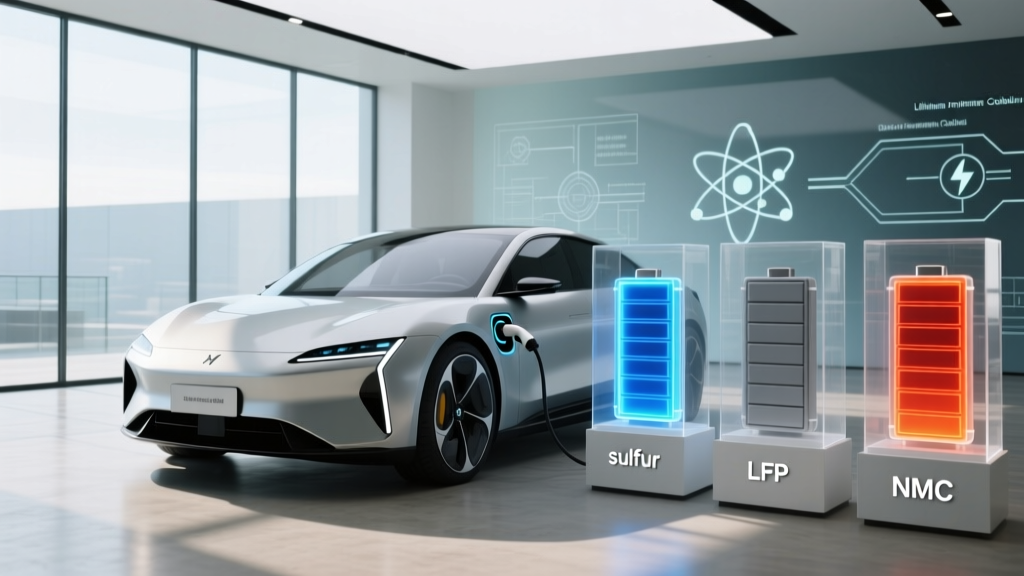
Search for "next-generation EV battery" and you'll inevitably encounter the term sulfur batteries — a chemistry promising two to four times the energy density of today's lithium-ion cells at a fraction of the raw-material cost. But while lithium-sulfur (Li-S) prototypes have been lighting up lab benches for over a decade, the chemistry in your driveway in 2026 is still overwhelmingly lithium iron phosphate (LFP) or nickel manganese cobalt (NMC/NCA). Understanding what's real today, what's coming, and how to protect the pack you already own matters far more than any headline about a technology still years from production.
Today's EV Battery Chemistries: LFP vs NMC/NCA
Every mass-market EV sold in the US in 2026 uses one of two cathode chemistries. The distinction affects range, longevity, cold-weather behavior, and price — and it's the single most under-discussed spec on a window sticker.
| Attribute | LFP (Lithium Iron Phosphate) | NMC/NCA (Nickel-based) |
|---|---|---|
| Energy density (cell-level) | 160–180 Wh/kg | 250–300 Wh/kg |
| Typical pack size (mid-size SUV) | 72–82 kWh usable | 75–100 kWh usable |
| Cycle life (to 80% SoH) | 3,000–5,000 cycles | 1,500–2,500 cycles |
| Cold-weather range loss (20°F) | ~30–35% | ~25–30% |
| Recommended daily SoC | 100% (no penalty) | 80% (to slow degradation) |
| Cobalt / nickel content | None | Significant |
| Cost per kWh (pack-level, 2026) | ~$95–$115 | ~$125–$155 |
| Example vehicles (2026) | Tesla Model 3 RWD, Model Y RWD, Ford Mustang Mach-E Select (LFP option), BYD Seal | Hyundai Ioniq 5, Kia EV6, Chevy Equinox EV, Rivian R1S, BMW iX |
LFP wins on longevity and cost. Tesla's shift to LFP for its standard-range vehicles was a calculated bet: slightly lower range per kWh, but a pack that can be charged to 100% daily without meaningful degradation penalty, and no cobalt supply-chain risk. Real-world fleet data from Tesla's 2025 Impact Report showed LFP packs retaining ~92% capacity at 100,000 miles — meaningfully better than the ~88% seen in NMC packs at the same mileage.
NMC/NCA wins on energy density and cold performance. If you need 320+ miles of EPA range in a crossover, or live in Minnesota where January highway driving at 70 mph can slash range by a third, NMC's higher energy density and slightly better low-temperature conductivity still matter. The trade-off is a stricter charging discipline: daily 80% SoC limits, avoiding prolonged storage above 90%, and accepting faster long-term degradation.
How Long Do EV Batteries Actually Last?
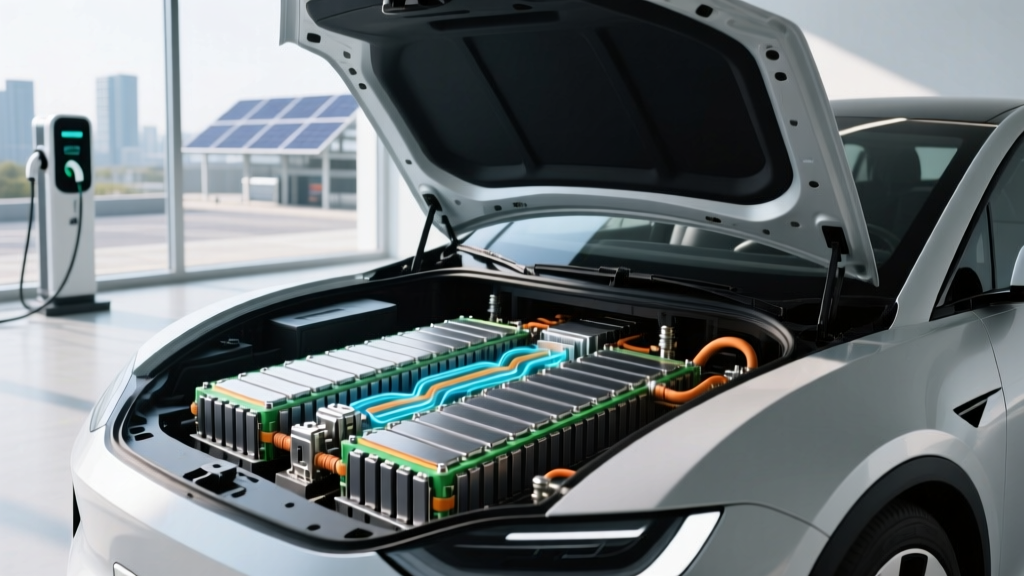
The fear that EV batteries die like smartphone batteries at year three is not supported by fleet data. The high-voltage traction battery — not the 12V auxiliary battery that powers accessories — is engineered for a fundamentally different duty cycle.
Real-World Degradation Data Points (Fleet Averages):
- Tesla Model 3/Y (NMC, 2020–2023 fleet): ~88% State of Health (SoH) at 100,000 miles; ~83% at 200,000 miles (Tesla Impact Report)
- Tesla Model 3/Y (LFP, 2022–2025 fleet): ~92% SoH at 100,000 miles; projected ~87% at 200,000 miles
- Nissan Leaf (40/62 kWh, passive cooling): ~85% SoH at 80,000 miles — faster degradation attributed to lack of active thermal management
- Chevrolet Bolt EV/EUV (NMC, liquid-cooled): ~90% SoH at 80,000 miles per fueleconomy.gov owner reports
- Hyundai Ioniq 5 (NMC, 77.4 kWh): ~91% SoH at 60,000 miles (early fleet data, 2022–2024 models)
The pattern is clear: liquid-cooled packs with active thermal management degrade 1–2% per year under normal use, while older passively-cooled designs (early Leaf, early Bolt pre-recall) degraded faster. Most modern EV batteries will outlast the vehicle's body, suspension, and interior — reaching 200,000+ miles with 75–85% capacity remaining. That's not a dead battery; that's a 260-mile EPA vehicle still delivering 200+ real-world miles.
What the Battery Warranty Actually Covers
Federal law mandates a minimum 8-year/100,000-mile battery warranty for EVs, but the details — specifically the capacity-retention threshold and what constitutes "defect" vs. "normal degradation" — vary by manufacturer.
| Manufacturer | Warranty Term | Capacity Threshold | Notes |
|---|---|---|---|
| Tesla (Model 3/Y LFP) | 8 yr / 120,000 mi | 70% retention | Longest mileage coverage in segment |
| Tesla (Model S/X) | 8 yr / 150,000 mi | 70% retention | Premium-tier extended mileage |
| Hyundai / Kia (Ioniq 5, EV6) | 10 yr / 100,000 mi | 70% retention | Best year coverage; applies to original owner |
| Ford (Mach-E, F-150 Lightning) | 8 yr / 100,000 mi | 70% retention | Transferable to second owner |
| GM (Equinox EV, Blazer EV) | 8 yr / 100,000 mi | 70% retention (60% for Bolt-era) | Ultium platform standard |
| Rivian (R1S/R1T) | 8 yr / 120,000 mi | 70% retention | Covers module-level replacement |
| BMW (iX, i4) | 8 yr / 100,000 mi | 70% retention | Includes thermal management system |
Key warranty nuance: The 70% threshold means a 300-mile EPA vehicle must drop below 210 miles of range before a warranty claim triggers. Given that most liquid-cooled packs hit ~85% SoH at 100,000 miles, warranty claims for capacity loss alone are rare. Most claims involve defective modules, BMS (battery management system) faults, or thermal-management failures — not gradual degradation.
EV Battery Replacement Cost: What You'd Actually Pay
This is the question that generates the most anxiety — and the most misleading headlines. A $20,000 replacement figure gets clicks, but context matters enormously.
| Vehicle | Pack Size | Full-Pack Replacement | Module-Level Repair | Typical Need Timeline |
|---|---|---|---|---|
| Tesla Model 3 (LFP, 60 kWh) | 60 kWh | $10,000–$13,000 | $2,500–$4,000 per module bank | Rarely before 250,000+ mi |
| Tesla Model Y (NMC, 75 kWh) | 75 kWh | $13,000–$16,000 | $3,000–$5,000 per module bank | Rarely before 200,000+ mi |
| Hyundai Ioniq 5 (77.4 kWh) | 77.4 kWh | $14,000–$18,000 | $3,500–$5,500 per module | Rarely before 200,000+ mi |
| Ford F-150 Lightning (Ext. Range, 131 kWh) | 131 kWh | $22,000–$28,000 | $5,000–$8,000 per module bank | Rarely before 180,000+ mi |
| Chevrolet Equinox EV (85 kWh) | 85 kWh | $12,000–$16,000 | $3,000–$5,000 per module | Rarely before 200,000+ mi |
| Rivian R1S (Large, 128 kWh) | 128 kWh | $20,000–$26,000 | $5,000–$7,500 per module bank | Rarely before 180,000+ mi |
Three realities soften these numbers. First, most EVs will never need a full pack replacement — the vehicle will be retired, sold, or totaled before the battery reaches end-of-life. Second, module-level repair is increasingly common: a single degraded module can be swapped without replacing the entire pack, cutting costs by 60–75%. Third, pack prices continue falling; BloombergNEF's 2025 battery price survey pegged average pack-level pricing at $115/kWh, down from $140/kWh in 2023, and replacement costs will follow.
Factors That Accelerate (or Slow) Battery Degradation
Battery chemistry sets the ceiling, but ownership habits determine where you land. These are the variables you control, ranked by impact based on published cell-testing data and fleet analyses.
Battery Care Checklist for Maximum Longevity
- Avoid sustained high SoC (NMC/NCA only): Store and daily-drive at 80% or below. LFP owners can ignore this — charge to 100% freely, and Tesla actually recommends periodic 100% charges for LFP BMS calibration.
- Minimize DC fast-charging frequency: Occasional road-trip fast charging is fine. Daily reliance on 150+ kW DCFC without preconditioning accelerates lithium plating. Aim for 80%+ of charging on Level 2 (home/work).
- Precondition before fast charging: Every modern EV with navigation-routed charging (Tesla, Hyundai/Kia, Ford, GM) warms the pack to ~95–105°F before arrival at a DCFC. This isn't optional — skipping preconditioning in cold weather can halve charge speed and stress cells.
- Avoid extreme SoC storage: Don't leave an NMC vehicle at 100% or below 10% for more than a few days. For long-term storage (2+ weeks), target 50% SoC.
- Manage heat exposure: Park in shade or a garage when possible. Repeated exposure to 100°F+ ambient with a high SoC is the single worst combination for NMC longevity.
- Use regenerative braking moderately in cold weather: Cold batteries resist charge acceptance; max-regen on a 20°F morning forces current into cells that aren't ready, causing micro-stress. Most EVs auto-limit regen when cold — let them.
How to Check Your EV's Battery Health (State of Health)
State of Health (SoH) is the percentage of original capacity your pack retains. A new 75 kWh pack at 90% SoH delivers ~67.5 kWh usable. Monitoring it is easier than most owners realize.
In-vehicle methods:
- Tesla: The Service menu (hold the model badge on the About screen for 3 seconds, enter "service" as the code) displays pack SoH and individual module voltage deltas. Tesla's mobile app also shows rated range, which — tracked over time at 100% charge — is a reliable SoH proxy for LFP models.
- Hyundai/Kia: The EV-specific trip computer shows "Battery Condition" as a percentage. Third-party OBD-II apps like Car Scanner or ABRP can pull detailed SoH via the vehicle's CAN bus.
- Ford/GM: SoH is accessible via dealer diagnostic tools. FordPass and myChevrolet apps show estimated range at full charge, which serves as a practical SoH indicator.
- Universal OBD-II method: A $30–$50 OBD-II dongle (e.g., OBDLink SX) paired with apps like Car Scanner EV or LeafSpy (Nissan) reads pack SoH, cell voltage spread, and pack temperature directly from the BMS.
What's normal vs. concerning: A cell voltage delta (max minus min across all cells) under 30 mV at rest is healthy. Deltas consistently above 50 mV suggest a weak module worth investigating under warranty. If your SoH drops more than 3% in a single year outside the first year (initial 1–2% "formation loss" is normal), document it and contact the dealer.
Sulfur Batteries and Other Emerging Chemistries: What's Real vs. Lab-Only
Lithium-sulfur (Li-S) batteries remain the most-promised, most-delayed alternative chemistry. The appeal is physics-based: sulfur is abundant, cheap (~$0.10/kg vs. $25+/kg for nickel), and theoretically enables energy densities of 400–500 Wh/kg at the cell level — roughly double today's best NMC. That translates to a 600-mile pack in a vehicle that weighs the same as today's 300-mile models.
The engineering obstacles are substantial and unsolved at production scale:
- Polysulfide shuttle effect: During discharge, sulfur forms intermediate lithium polysulfides that dissolve into the electrolyte, migrating away from the cathode and causing rapid capacity fade. Lab solutions (carbon-sulfur composites, protective coatings) work for hundreds of cycles but haven't demonstrated the 1,500+ cycles needed for automotive use.
- Cycle life: The best published Li-S results in 2025 show ~800 cycles to 80% SoH under controlled lab conditions — roughly half what NMC delivers and a third of LFP. Automotive-grade vibration, temperature cycling, and calendar aging add further stress.
- Volume expansion: Sulfur expands ~80% during lithiation, requiring pack designs that accommodate significant physical swelling — a packaging challenge automakers haven't solved in a production form factor.
Realistic timeline: Industry consensus from battery analysts at BloombergNEF and Benchmark Mineral Intelligence places Li-S in aviation and niche stationary-storage applications by 2029–2031, with automotive-grade production packs no earlier than 2032–2035. No automaker has announced a Li-S vehicle program.
More imminent technologies to watch:
- Solid-state batteries: Toyota, Nissan, and Samsung SDI have announced pilot production lines for sulfide-based solid-state cells targeting 2027–2028 limited-production vehicles. Expect initial availability in premium Japan-market models, not mass-market US vehicles, with broad adoption likely post-2030.
- Silicon-dominant anodes: Already in limited production (GM's Ultium cells use ~10% silicon in the anode; startups like Sila Nanotechnologies supply Mercedes). Silicon anodes boost energy density 15–25% without the cathode-side challenges of Li-S. Expect incremental adoption across 2026–2028 model years.
- Sodium-ion (Na-ion): CATL began mass-producing Na-ion cells in 2025 for Chinese-market city EVs. Lower energy density (~140 Wh/kg) limits use to short-range urban vehicles, but zero lithium/cobalt content and strong cold performance make it a viable LFP alternative for budget segments by 2027–2028.
For a buyer in 2026, these technologies are context — not purchase factors. The LFP or NMC pack in the vehicle you test-drive today is the chemistry you'll live with for a decade or more.
EV Battery FAQ: Straight Answers to Common Questions
How long do EV batteries last in years and miles?
Modern liquid-cooled EV batteries (2020+ models) typically retain 80–90% capacity at 100,000 miles and 75–85% at 200,000 miles. In calendar years, expect 15–20+ years of usable service before the pack drops below 70% SoH. Most EV batteries outlast the vehicle they're installed in.
How much does it cost to replace an EV battery?
Full pack replacements range from $10,000–$16,000 for a mid-size sedan/crossover (60–80 kWh) to $20,000–$28,000 for large truck/SUV packs (120–135 kWh). However, module-level repairs cost $2,500–$8,000 and are far more common. The vast majority of EVs never need a replacement — the vehicle is retired first.
What does the EV battery warranty cover?
Federal law requires a minimum 8-year/100,000-mile warranty covering defects and capacity loss below a stated threshold (typically 70% SoH). Hyundai/Kia offer 10 years/100,000 miles. Coverage includes the battery pack, BMS, and thermal management system. Normal gradual degradation above the threshold is not covered — but in practice, most liquid-cooled packs stay above 70% well past the warranty period.
LFP vs NMC — which battery chemistry is better for me?
Choose LFP if you prioritize longevity, want to charge to 100% daily without worry, drive under 300 miles between charges, and live in a moderate climate. Choose NMC/NCA if you need maximum EPA range (320+ miles), regularly drive in extreme cold, or need the longest possible single-charge road-trip distance. Neither is universally "better" — they solve different ownership patterns.
Will sulfur batteries make today's EVs obsolete?
Not for at least 6–10 years. Lithium-sulfur remains a lab-stage technology with unresolved cycle-life and packaging challenges. No automaker has announced a Li-S production vehicle. If you're considering an EV purchase now, waiting for sulfur batteries is not a practical strategy — today's LFP and NMC packs offer proven longevity with comprehensive warranties.
Does frequent DC fast charging damage my battery?
Occasional DCFC use (road trips, weekly top-ups) has minimal measurable impact on modern packs with active thermal management. Daily reliance on 150+ kW fast charging without preconditioning can accelerate degradation by 1–3% over several years. The practical recommendation: charge at home on Level 2 for 80%+ of your charging, and use DCFC freely for trips.
How do I check my EV battery's State of Health?
Most EVs display SoH or a capacity proxy in the vehicle's service menu, trip computer, or mobile app. For detailed cell-level data, a $30–$50 OBD-II dongle with apps like Car Scanner EV or LeafSpy reads SoH, cell voltage deltas, and pack temperature. Track your rated range at 100% charge over time — a declining trend is the simplest SoH indicator.
Sources: fueleconomy.gov (EPA range and efficiency data), Tesla Impact Report (fleet degradation data), manufacturer warranty documentation. Battery pricing per BloombergNEF 2025 Lithium-Ion Battery Price Survey. Tax-credit eligibility under IRS §30D is subject to MSRP caps, buyer income limits, and battery-sourcing requirements — verify current-year rules before purchase.