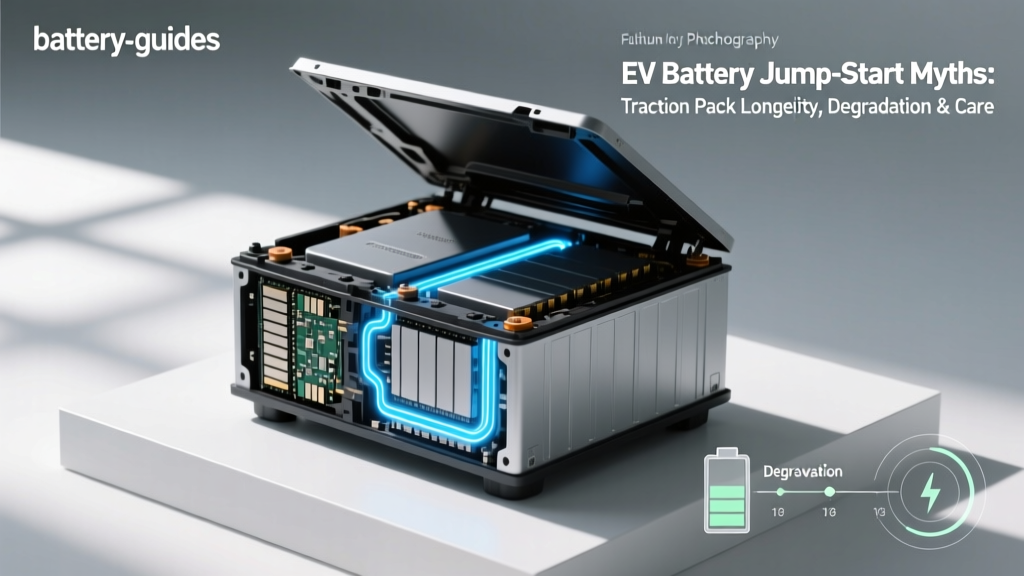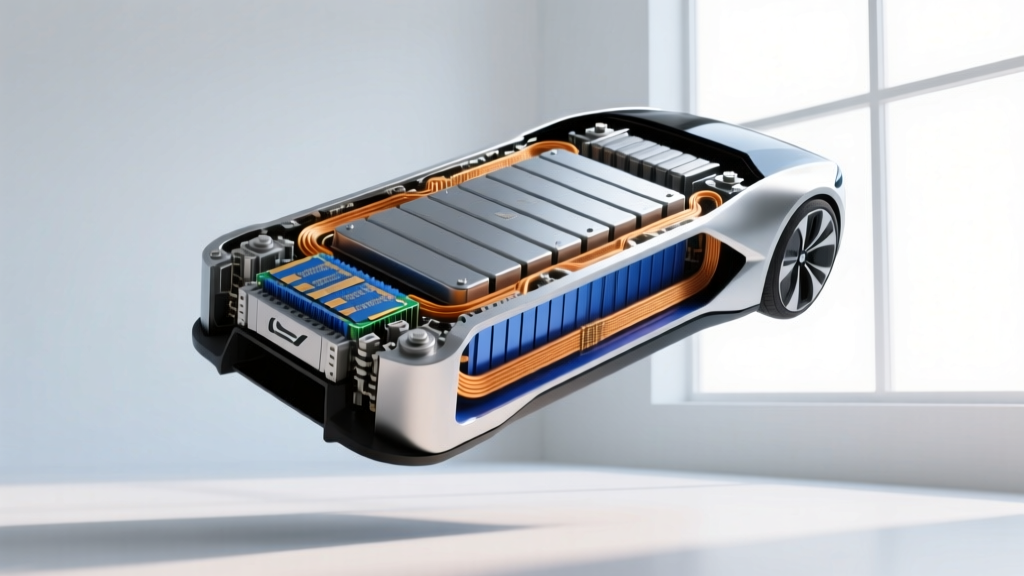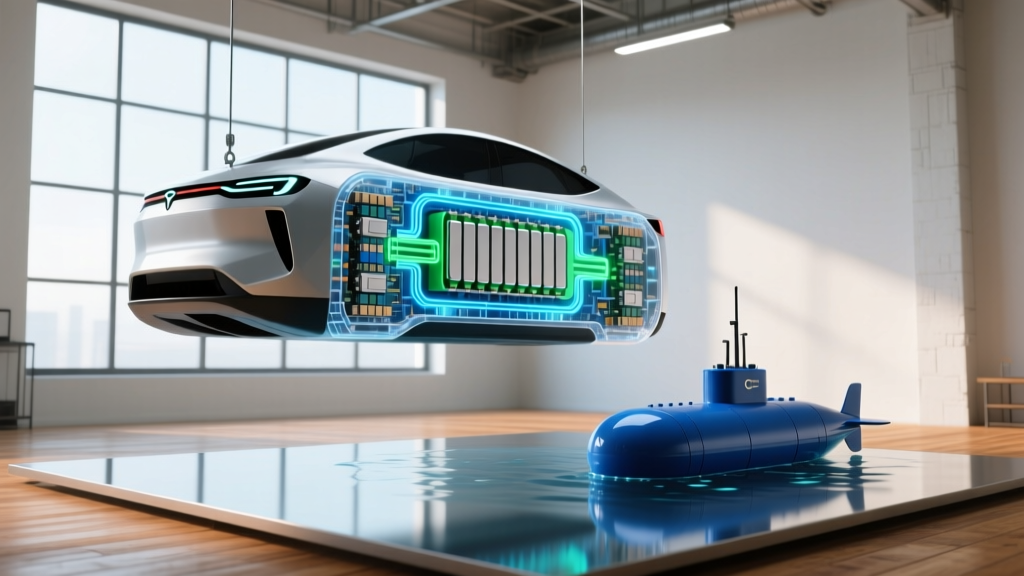
Search for "submarine battery" and you'll find a fascinating intersection of naval engineering and electric-vehicle technology. Modern nuclear submarines rely on massive, ultra-durable battery banks designed to operate for decades under extreme pressure and temperature cycles. While you won't find a Virginia-class submarine powertrain in your next EV, the engineering principles — and increasingly, the actual cell chemistries — overlap more than most buyers realize.
This guide uses that comparison as a lens to explain what actually matters for EV battery ownership in 2026: chemistry trade-offs, real degradation data, warranty coverage, replacement costs, and how to maximize the lifespan of your high-voltage traction battery.
Why Submarine Battery Design Matters to EV Buyers
Military and maritime battery systems prioritize three things above all else: cycle life, thermal resilience, and safety under abuse. Energy density (how much energy fits in a given volume) is secondary on a submarine — there's no need to minimize weight for a vessel that displaces thousands of tons.
EV batteries face a different calculus. Automakers must balance energy density (which determines range), cost, charge speed, safety, and longevity — all within a package light enough for a 4,000–5,500 lb vehicle. The result is that EV batteries share DNA with submarine-grade systems in their emphasis on cycle life and thermal management, but diverge sharply on energy density and cost optimization.
The chemistry choices available to EV buyers in 2026 — primarily LFP (lithium iron phosphate) and NMC/NCA (nickel manganese cobalt / nickel cobalt aluminum) — each tilt this balance differently.
LFP vs. NMC/NCA: The Chemistry Decision
Choosing between LFP and NMC/NCA is the single most consequential battery decision an EV buyer makes. Here's how they stack up across the metrics that matter:
| Metric | LFP (Lithium Iron Phosphate) | NMC / NCA (Nickel-based) |
|---|---|---|
| Energy Density | ~160–180 Wh/kg (cell level) | ~230–290 Wh/kg (cell level) |
| Typical Cycle Life | 3,000–6,000+ full cycles | 1,000–2,500 full cycles |
| Cold-Weather Performance | Reduced — greater range loss below 32°F; slower DC fast charging when cold | Better low-temp conductivity; less range penalty in winter |
| Cost (per kWh, pack level) | ~$85–$110/kWh | ~$120–$155/kWh |
| Thermal Stability / Safety | Excellent — higher thermal runaway threshold (~270°C) | Good — but lower thermal runaway threshold (~210°C); requires more active cooling |
| Recommended Daily Charge Limit | 100% (no penalty for full charges) | 80–90% for daily use; 100% for trips only |
| State-of-Charge Estimation | Flatter voltage curve makes SoC estimation harder for BMS | Steeper voltage curve — easier SoC estimation |
| Notable 2026 EVs Using It | Tesla Model 3/Y RWD, Ford Mustang Mach-E Select (LFP variant), Rivian R1S Standard, BYD Seal | Tesla Model 3/Y Long Range, Hyundai Ioniq 5/6, Kia EV6/EV9, BMW iX, Ford F-150 Lightning Extended |
Which Chemistry Is Better for You?
Choose LFP if: You plan to keep the vehicle 8+ years, you charge primarily at home (Level 2), you live in a moderate or warm climate, and you want the lowest cost of ownership. LFP's 3,000+ cycle life means a 75 kWh pack could theoretically deliver 225,000+ miles of full-cycle equivalent use before reaching 80% capacity — far more than most owners will drive.
Choose NMC/NCA if: You need maximum range in a single charge, you live in a cold-weather climate where winter range loss is a real concern, or you frequently DC fast-charge on road trips and want better cold-weather charge acceptance. NMC's higher energy density gives you 300+ EPA miles in packages that would weigh 150–200 lbs more with LFP.
How Long Do EV Batteries Actually Last?
The short answer: longer than most buyers expect, and usually longer than the rest of the car. But the data tells a more nuanced story than "they last forever."
According to aggregated fleet data published by Recurrent Auto and confirmed by warranty claim rates from major OEMs, the typical EV battery in 2026 degrades as follows:
- Year 1: 2–5% capacity loss (initial "break-in" drop is normal)
- Year 3 / 45,000 miles: 5–8% total loss
- Year 5 / 75,000 miles: 8–12% total loss
- Year 8 / 100,000 miles: 10–15% total loss (most batteries still above warranty threshold)
- Year 10 / 150,000 miles: 12–20% total loss (varies heavily by chemistry and use pattern)
LFP packs tend to cluster at the lower end of these ranges; NMC packs at the higher end, particularly if frequently DC fast-charged or routinely charged to 100%.
A critical distinction: degradation is non-linear. Most capacity loss occurs in the first 12–18 months, then the curve flattens considerably. A battery that has lost 8% in its first two years may lose only another 5% over the next five.
What the Battery Warranty Actually Covers
Federal law (under EPA and CARB regulations) mandates a minimum battery warranty of 8 years / 100,000 miles for EVs sold in the United States. Most automakers meet or exceed this. Here's what that coverage actually means:
| Manufacturer | Warranty Period | Capacity Retention Threshold | Notes |
|---|---|---|---|
| Tesla (Model 3/Y RWD — LFP) | 8 yr / 100,000 mi | 70% | Covers defects and capacity below threshold |
| Tesla (Model 3/Y LR — NMC) | 8 yr / 120,000 mi | 70% | Longer mileage for LR trims |
| Hyundai / Kia | 10 yr / 100,000 mi | 70% | Among the longest coverage in the industry |
| Ford (Mach-E, F-150 Lightning) | 8 yr / 100,000 mi | 70% | Includes battery components and management system |
| BMW (iX, i4, i7) | 8 yr / 100,000 mi | 70% | Modular pack design allows partial replacement |
| Rivian (R1T, R1S) | 8 yr / 175,000 mi | 70% | Higher mileage cap — strong for high-mileage drivers |
What's covered: Manufacturing defects, cell failures, battery management system (BMS) faults, and capacity loss below the stated threshold (typically 70% of original capacity).
What's NOT covered: Damage from accidents, flooding, improper modification, or (in some warranty fine print) consistent exposure to extreme temperatures without preconditioning. Read your specific warranty booklet.
EV Battery Replacement Cost: What You'd Actually Pay
This is the number that generates the most anxiety — and the most misinformation. Here's the reality for 2026:
| Vehicle / Battery Size | Battery Chemistry | Replacement Cost Range | When Typically Needed |
|---|---|---|---|
| Tesla Model 3 RWD (60 kWh) | LFP | $8,000–$12,000 | Rarely before 200,000+ mi |
| Tesla Model Y Long Range (75 kWh) | NMC | $12,000–$16,000 | Rarely before 150,000–180,000 mi |
| Hyundai Ioniq 5 (77.4 kWh) | NMC | $11,000–$15,000 | Rarely before 150,000+ mi |
| Ford F-150 Lightning Extended (131 kWh) | NMC | $18,000–$25,000 | Rarely before 150,000 mi; modular design may allow partial swap |
| BMW iX xDrive50 (111.5 kWh) | NMC | $17,000–$22,000 | Rarely before 150,000 mi; modular — single module replacement ~$3,000–$5,000 |
| Chevrolet Equinox EV (85 kWh) | NMC (Ultium) | $12,000–$16,000 | Rarely before 150,000 mi |
Key context: According to data from fueleconomy.gov and OEM service bulletins, the vast majority of EV batteries never require full replacement during typical ownership. The failure rate for complete pack replacement under 150,000 miles is estimated at under 2–3% across major manufacturers. Most batteries outlast the vehicle's useful economic life.
Additionally, modular pack architectures (used by BMW, GM's Ultium platform, and others) allow individual module replacement rather than full-pack swaps — reducing out-of-warranty costs to $3,000–$6,000 per module rather than $15,000+ for a complete pack.
Factors That Accelerate (or Protect) Battery Life
Not all miles are created equal. The same battery can degrade 8% or 18% over 100,000 miles depending on how it's treated. Here are the primary factors, ranked by impact:
1. State-of-Charge Habits (Highest Impact)
Keeping an NMC battery between 20–80% SoC for daily use dramatically extends cycle life. Routinely charging to 100% and letting the car sit at full charge accelerates degradation. LFP batteries are the exception — manufacturers recommend periodic 100% charges for BMS calibration, and daily 100% charging causes minimal additional wear.
2. DC Fast-Charging Frequency
Occasional DC fast charging (1–2x per week) has a modest impact. Exclusive reliance on DC fast charging (daily 150–250 kW sessions) can increase degradation rates by 3–5% over the battery's life compared to primarily Level 2 charging. The heat generated during high-C-rate charging is the culprit, not the electricity itself.
3. Temperature Exposure
Batteries degrade faster when exposed to sustained high temperatures (above 95°F ambient, particularly in vehicles parked unshaded for extended periods). Cold temperatures don't cause permanent degradation but do reduce usable range temporarily — typically 20–30% range loss at 20°F, per AAA testing. Preconditioning the battery before driving or charging in cold weather mitigates this.
4. Depth of Discharge
Shallow cycles (using 30–40% of capacity and recharging) are gentler on cells than deep cycles (using 80–90% of capacity). This is another reason the 20–80% rule works — it keeps cycles shallow.
- ✅ Set daily charge limit to 80% (NMC) or 100% (LFP)
- ✅ Use Level 2 home charging as your primary method
- ✅ Precondition the battery before DC fast charging in cold weather
- ✅ Avoid leaving the car at 100% SoC for more than a few hours
- ✅ Park in shade or a garage during hot summer months when possible
- ✅ Use the vehicle's built-in charge scheduling to finish charging just before departure (avoids prolonged high SoC)
- ❌ Don't DC fast-charge daily if Level 2 is available
- ❌ Don't let the battery sit at 0% SoC for extended periods — charge to at least 20% if storing
How to Monitor Battery Health (State of Health)
State of Health (SoH) is the percentage of a battery's original capacity that remains usable. A new battery is 100% SoH; a battery that can hold 68 kWh out of its original 75 kWh is at ~91% SoH.
Built-In Tools
Most 2026 EVs display battery health or estimated range relative to original spec somewhere in the vehicle's settings menu. Tesla's service mode (accessible via the software menu) shows a "Battery Health" percentage. Hyundai/Kia's infotainment system includes a battery diagnostics screen. BMW's iDrive system provides SoH under the vehicle information menu.
Third-Party Apps and OBD-II Readers
Apps like TeslaFi, Tessie, and ABRP (A Better Route Planner) track charge/discharge cycles and estimate SoH over time. For non-Tesla vehicles, OBD-II dongles paired with apps like LeafSpy (Nissan), Car Scanner, or OBDeleven (VW Group) can read the BMS-reported SoH directly.
Dealer Diagnostics
Any authorized dealer can run a full battery health report, typically during scheduled service visits. If you're approaching the warranty mileage limit and suspect degradation, request this proactively — if SoH has dropped below the warranty threshold (usually 70%), the manufacturer is obligated to replace or repair the pack.
What's Next: Solid-State, Silicon Anodes, and the Submarine Connection
Several next-generation battery technologies are in development, and some share lineage with military/maritime research programs:
Solid-State Batteries: Replace the liquid electrolyte with a solid ceramic or polymer, promising 30–40% higher energy density, faster charging, and improved safety. Toyota has announced solid-state EV prototypes targeting 2027–2028 production, and Samsung SDI is targeting 2027. However, manufacturing scalability and cost remain significant hurdles. Timeline: Limited production vehicles in 2028–2029; mainstream adoption not before 2030+.
Silicon Anode Cells: Replace graphite anodes with silicon-dominant materials, increasing energy density by 20–40%. Companies like Sila Nanotechnologies and Group14 are supplying cells for limited applications (Mercedes-Benz's G-Class EV uses silicon-anode cells from Group14). Timeline: Expanding through 2026–2028 across premium EVs; cost parity with graphite by ~2029.
Sodium-Ion Batteries: Lower cost, no lithium or cobalt required, excellent cold-weather performance, but ~30% lower energy density than LFP. CATL and BYD are producing sodium-ion cells for lower-cost EVs in China. Timeline: US-market vehicles unlikely before 2028; initially in budget segments.
Frequently Asked Questions
How long do EV batteries last in years and miles?
Most EV batteries retain 70–85% of their original capacity after 10 years or 150,000 miles. LFP chemistries typically outlast NMC in cycle life, though real-world degradation depends heavily on charging habits, climate, and fast-charging frequency. Many batteries remain functional well beyond 200,000 miles, albeit with reduced range.
How much does an EV battery cost to replace?
Full pack replacement costs range from approximately $8,000 for smaller LFP packs (Tesla Model 3 RWD) to $25,000 for large NMC packs (Ford F-150 Lightning Extended Range). However, fewer than 3% of EV batteries require replacement before 150,000 miles, and modular designs increasingly allow partial module swaps at $3,000–$6,000 per module.
What does the battery warranty cover?
Federal minimum is 8 years / 100,000 miles. Coverage includes manufacturing defects, cell failures, BMS faults, and capacity loss below a stated threshold (typically 70% of original capacity). Hyundai/Kia offers 10 years / 100,000 miles. Rivian offers 8 years / 175,000 miles. Damage from accidents, flooding, or unauthorized modifications is excluded.
How do I check and maximize my battery's health?
Use your vehicle's built-in battery health display, third-party apps (TeslaFi, Tessie, ABRP), or dealer diagnostics to monitor State of Health. Maximize longevity by charging to 80% daily (NMC) or 100% (LFP), using Level 2 as your primary charging method, preconditioning before cold-weather fast charging, and avoiding prolonged storage at 0% or 100% SoC.
LFP vs. NMC — which is better and why?
Neither is universally better. LFP wins on cycle life (3,000–6,000 cycles vs. 1,000–2,500), cost ($85–110/kWh vs. $120–155/kWh), safety, and daily charging convenience (100% OK). NMC wins on energy density (230–290 Wh/kg vs. 160–180 Wh/kg), cold-weather range retention, and cold-weather DC fast-charging speed. Choose LFP for maximum longevity and lowest cost; choose NMC for maximum range and better winter performance.