Why a 2015 Subaru Forester Battery Search Leads Straight to EV Battery Science
If you've typed "battery for Subaru Forester 2015" into a search bar, you're likely dealing with a dead 12-volt starter battery — a $150–$250 lead-acid or AGM unit that cranks a 2.5L flat-four engine. But that search also opens a window into a radically different battery world: the high-voltage lithium-ion traction packs powering today's electric vehicles. Understanding how modern EV batteries work — their chemistry, degradation curves, warranties, and replacement economics — is essential whether you're maintaining a legacy Subaru or shopping for a 2026 EV.
This guide covers the full landscape of EV battery technology: LFP versus NMC/NCA chemistries, real-world degradation data, warranty structures, replacement costs, and the emerging solid-state horizon. We'll also clarify the critical distinction between the 12V auxiliary battery in any car (including your Forester) and the 60–120 kWh traction battery that actually propels an electric vehicle.
12V Auxiliary vs. High-Voltage Traction Battery: Know the Difference
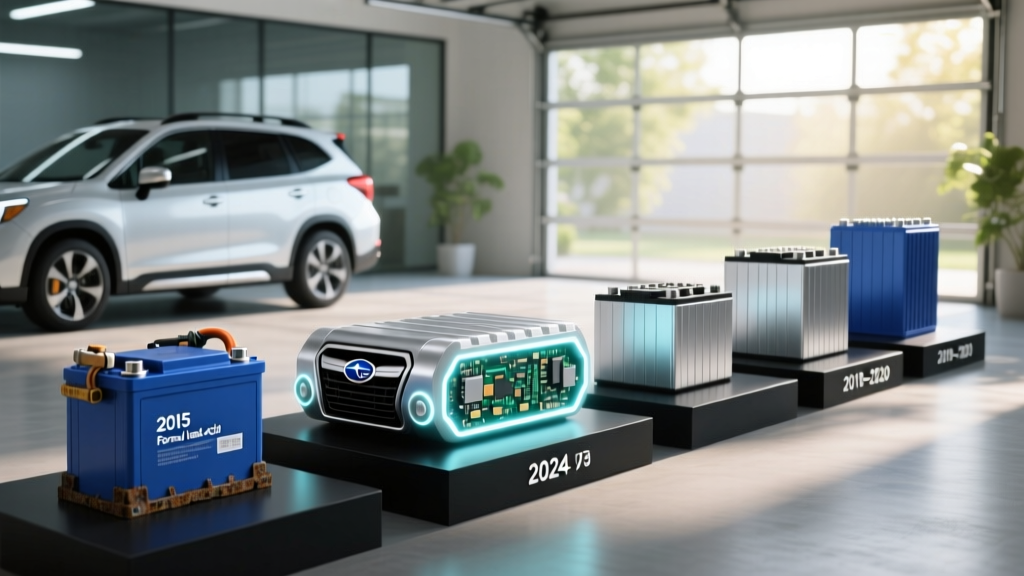
The 2015 Subaru Forester uses a Group 35 (or equivalent) 12V lead-acid battery rated around 550 cold-cranking amps (CCA). It powers the starter motor, lights, infotainment, and ECU. Replacement is straightforward and cheap.
An EV's high-voltage traction battery is an entirely different system. It stores 60–120+ kilowatt-hours (kWh) of energy — roughly 100,000 times more energy than a 12V car battery — and powers the electric drive motors. These packs operate at 400V or 800V, weigh 800–1,500 lbs, and require specialized high-voltage service procedures. Even EVs that retain a small 12V auxiliary battery (for accessories and safety systems) rely on the traction pack for propulsion.
LFP vs. NMC/NCA: The Chemistry Decision That Defines Your EV
Two dominant lithium-ion chemistries power today's EVs, and the choice between them affects range, longevity, cold-weather performance, and price.
| Attribute | LFP (Lithium Iron Phosphate) | NMC/NCA (Nickel Manganese Cobalt / Nickel Cobalt Aluminum) |
|---|---|---|
| Energy Density | ~160 Wh/kg (cell-level) | ~250–300 Wh/kg (cell-level) |
| Cycle Life | 3,000–5,000+ cycles to 80% SoH | 1,000–2,000 cycles to 80% SoH |
| Cold Performance | Reduced — ~15–25% range loss below 32°F | Better — ~10–20% range loss below 32°F |
| Thermal Stability | Excellent — very low thermal runaway risk | Good — requires more active thermal management |
| Cost | ~$80–100/kWh (pack-level, 2026) | ~$110–140/kWh (pack-level, 2026) |
| Typical Use | Standard-range models (Tesla Model 3 RWD, BYD, base Ford Mustang Mach-E) | Long-range/performance models (Model Y LR, Hyundai Ioniq 5, Rivian) |
| SoC Recommendation | Can charge to 100% regularly | Best kept 20–80% for daily use |
Which is better? LFP wins on longevity and cost, making it ideal for high-mileage drivers and fleet use. NMC/NCA wins on energy density, giving longer range in a lighter, more compact pack — better for cold climates and performance applications. For a 2026 buyer prioritizing a 15-year ownership horizon, LFP's cycle-life advantage is compelling. For those needing maximum range per charge in northern winters, NMC remains the pragmatic choice.
How Long Do EV Batteries Actually Last? Degradation Data
The fear that EV batteries "won't last" is the single biggest barrier to adoption — and the data tells a reassuring story. Modern lithium-ion traction batteries are engineered to outlast the vehicles they're installed in.
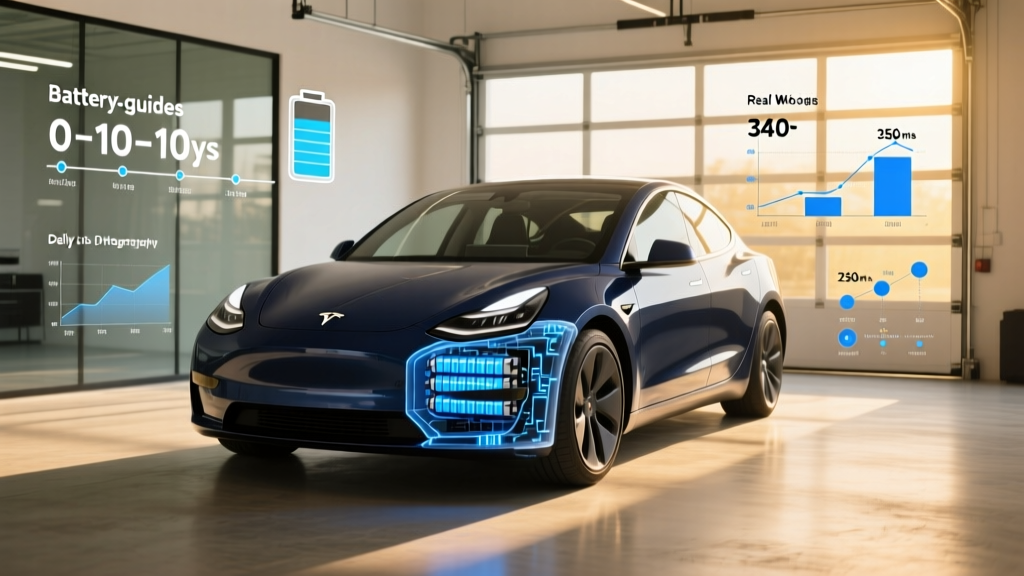
- Tesla Model 3/Y (NMC, 2019–2024): Average 12% capacity loss at 150,000 miles per Tesla's 2024 Impact Report. Most packs retain ~88% State of Health (SoH).
- Nissan Leaf (2011–2017, passive air cooling): Notable outlier — 20–30% degradation by 80,000 miles in hot climates due to lack of liquid thermal management. Modern liquid-cooled packs have largely solved this.
- Hyundai/Kia EV6/Ioniq 5 (NMC, 2022–2025): Early fleet data shows ~5–7% loss at 60,000 miles, tracking well within warranty thresholds.
- LFP packs (Tesla Model 3 RWD, BYD): Projected 5–8% loss at 200,000 miles based on cycle-life modeling; long-term fleet data still accumulating as of 2026.
Sources: Tesla Impact Report, Recurrent Auto fleet data
The typical degradation curve is nonlinear: a steeper initial drop of 2–4% in the first year or 10,000 miles (as the solid electrolyte interphase layer stabilizes), followed by a slow, linear decline of roughly 0.5–1% per year thereafter. Most 2026 EV batteries are projected to retain 80–85% of original capacity at 200,000 miles — well beyond the point where most gas vehicles have been scrapped.
Battery Warranty Terms: What's Actually Covered
Federal law (EPA emissions warranty requirements) and manufacturer policies mandate substantial battery coverage. Here's what the major brands offer as of 2026:
| Manufacturer | Duration | Mileage | Minimum Capacity Retention |
|---|---|---|---|
| Tesla | 8 years | 100,000–120,000 mi | 70% |
| Hyundai / Kia | 10 years | 100,000 mi | 70% |
| Ford | 8 years | 100,000 mi | 70% |
| GM (Chevrolet, Cadillac) | 8 years | 100,000 mi | 70% (Ultium packs) |
| Rivian | 8 years | 175,000 mi | 70% |
| BMW | 8 years | 100,000 mi | 70% |
What's covered: Capacity loss below the stated threshold (typically 70% of original kWh), manufacturing defects, and cell/module failures. What's not covered: Damage from accidents, flooding, unauthorized modifications, or failure to follow the manufacturer's charging and maintenance guidelines. Warranty transfers to subsequent owners in most cases, which supports used-EV resale values.
For context, if you bought a new EV in 2018 with an 8-year/100,000-mile warranty, that coverage is expiring in 2026 — making battery health checks especially relevant for second- and third owners of early-model EVs.
EV Battery Replacement Costs: The Real Numbers
Out-of-warranty battery replacement is the scenario that generates the most anxiety. Here's what it actually costs in 2026:
| Vehicle / Pack Size | Battery Capacity | Full Pack Replacement | Module-Level Repair |
|---|---|---|---|
| Tesla Model 3 (Standard Range, LFP) | ~60 kWh | $8,000–$12,000 | $1,500–$3,000 per module |
| Tesla Model Y (Long Range, NMC) | ~75 kWh | $12,000–$16,000 | $2,000–$4,000 per module |
| Hyundai Ioniq 5 (NMC) | 77.4 kWh | $13,000–$18,000 | $2,000–$4,500 per module |
| Ford F-150 Lightning (Extended Range) | ~131 kWh | $20,000–$28,000 | $3,000–$6,000 per module |
| Chevrolet Bolt EV/EUV (NMC) | 65 kWh | $9,000–$14,000 | $1,500–$3,500 per module |
Critical context: Full pack replacement is rarely necessary. Most degradation-related issues involve individual cell groups or modules, and many EV service centers now perform module-level repairs at a fraction of the full-pack cost. Battery prices have also fallen roughly 90% since 2010 (from ~$1,200/kWh to ~$100–140/kWh at the pack level in 2026, per BloombergNEF), and continued declines are expected.
When is replacement typically needed? For most owners, never during original ownership. The vast majority of EV batteries outlast the vehicle's economic life. Out-of-warranty replacements primarily affect high-mileage fleet vehicles, salvaged/rebuilt EVs, or early-generation models (like the air-cooled Nissan Leaf) that experienced accelerated degradation.
Factors That Affect Battery Life — and What You Can Control
Battery degradation is driven by electrochemical stress. Here's what accelerates it and how to mitigate each factor:
- Fast-charging frequency: DC fast charging above 150 kW generates significant heat. Occasional road-trip use is fine; daily DCFC use accelerates degradation by an estimated 1–3% over the pack's life. Favor Level 2 home charging (7–19 kW) for daily needs.
- State of Charge (SoC) habits: For NMC/NCA packs, keep daily SoC between 20–80%. Charging to 100% is fine before a road trip but avoid holding the pack at 100% for extended periods. LFP packs tolerate 100% daily charging well — Tesla recommends periodic 100% charges for LFP to recalibrate the BMS.
- Extreme temperatures: Prolonged exposure to ambient heat above 95°F accelerates calendar degradation. In extreme cold, precondition the battery (most EVs do this automatically when you set a departure time or navigate to a charger) before fast charging to avoid lithium plating.
- Deep discharge: Avoid regularly draining below 10% SoC. The battery management system (BMS) maintains a buffer, but consistently running the pack very low stresses cells.
- Storage: If storing an EV for weeks, leave it plugged in with SoC set to ~50%. Most modern EVs manage this automatically via scheduled charging limits.
How to Check and Monitor Battery Health (State of Health)
State of Health (SoH) is expressed as a percentage of original capacity. A new 75 kWh pack at 92% SoH holds ~69 kWh of usable energy. Here's how to check it:
- In-vehicle displays: Tesla's app and some Hyundai/Kia models show estimated range that indirectly reflects SoH. BMW's iDrive includes a dedicated battery health readout.
- OBD-II dongles + apps: Tools like OBDLink SX paired with apps such as EV Health or LeafSpy (for Nissan) can read BMS data including SoH, cell voltage variance, and pack temperature.
- Dealer diagnostics: Most manufacturers can run a full pack health report during service visits. Request this before purchasing a used EV.
- Third-party reports: Services like Recurrent provide battery health scores based on connected-car telemetry, useful for pre-purchase evaluation.
What's normal: A 3-year-old EV with 45,000 miles showing 93–96% SoH is tracking well. Below 85% at that mileage warrants investigation. Cell voltage variance above 100 mV between modules can indicate a weak cell group.
Emerging Battery Technology: Solid-State and Beyond
Next-generation battery chemistries promise step-change improvements, but timelines matter:
- Solid-state batteries: Replace the liquid electrolyte with a solid conductor, offering higher energy density (~400–500 Wh/kg projected), faster charging, and improved safety. Toyota has announced a solid-state EV target for 2027–2028 with ~450 miles of range and 10-minute fast charging. Samsung SDI and QuantumScape are also in advanced testing. Status as of 2026: pre-production validation; not yet available in any consumer vehicle.
- Silicon anode batteries: Replace graphite anodes with silicon to boost energy density by 20–40%. Sila Nanotechnologies and Group14 are supplying early production cells. Expect initial deployment in premium EVs by 2027–2028.
- Sodium-ion batteries: Use abundant sodium instead of lithium, cutting cost further (~$50–70/kWh projected). CATL has begun production for Chinese-market EVs. Energy density is lower (~140 Wh/kg), making them best suited for urban/short-range vehicles. US-market availability is estimated for 2028+.
These technologies will complement, not immediately replace, today's LFP and NMC packs. For a 2026 buyer, current lithium-ion chemistries are mature, well-understood, and backed by robust warranties — there's no compelling reason to delay a purchase waiting for solid-state.
Frequently Asked Questions
How long do EV batteries last in years and miles?
Most modern EV batteries are designed to retain 70–85% of original capacity at 200,000 miles or 15+ years. Real-world fleet data from Tesla, Recurrent Auto, and manufacturer warranty claims supports a typical service life exceeding the vehicle's economic lifespan. Early-generation EVs (pre-2015) with passive cooling showed faster degradation, but liquid-cooled packs from 2018 onward have proven far more durable.
How much does an EV battery cost to replace?
Full pack replacement ranges from ~$8,000 for a 60 kWh LFP pack to ~$28,000 for a 131 kWh extended-range pack, including labor. However, full replacements are rare — most issues are resolved with module-level repairs at $1,500–$6,000. Battery costs continue declining, and by the time most 2026 EVs need out-of-warranty service (2034+), prices will likely be substantially lower.
What does the EV battery warranty cover?
Federal law requires a minimum 8-year/100,000-mile warranty on EV battery packs. Most manufacturers guarantee at least 70% capacity retention over that period. Coverage includes manufacturing defects, cell failures, and excessive degradation. It typically excludes accident damage, unauthorized modifications, and failure to follow care guidelines. Hyundai/Kia leads with 10-year/100,000-mile coverage.
How do I check my EV's battery health?
Use the vehicle's built-in diagnostics (Tesla app, BMW iDrive), an OBD-II reader with EV-specific software, or request a dealer health report. Third-party services like Recurrent also offer connected battery health scores. Check SoH annually or before purchasing a used EV.
LFP vs NMC — which battery chemistry should I choose?
Choose LFP if you prioritize longevity (3,000–5,000 cycles), lower cost, and can accept slightly less range and reduced cold-weather performance. Charge to 100% freely. Choose NMC/NCA if you need maximum range, better cold-climate efficiency, and faster DC charging speeds — and are willing to follow 20–80% daily SoC habits for optimal lifespan.
Does a 2015 Subaru Forester have an EV traction battery?
No. The 2015 Forester uses a conventional 12V lead-acid or AGM battery (Group 35, ~550 CCA) for starting and accessories. Subaru's first EV with a high-voltage traction battery, the Solterra (co-developed with Toyota), launched for the 2023 model year with a 71.4 kWh NMC pack. The 12V battery in your Forester and an EV traction battery serve entirely different functions and are not interchangeable.