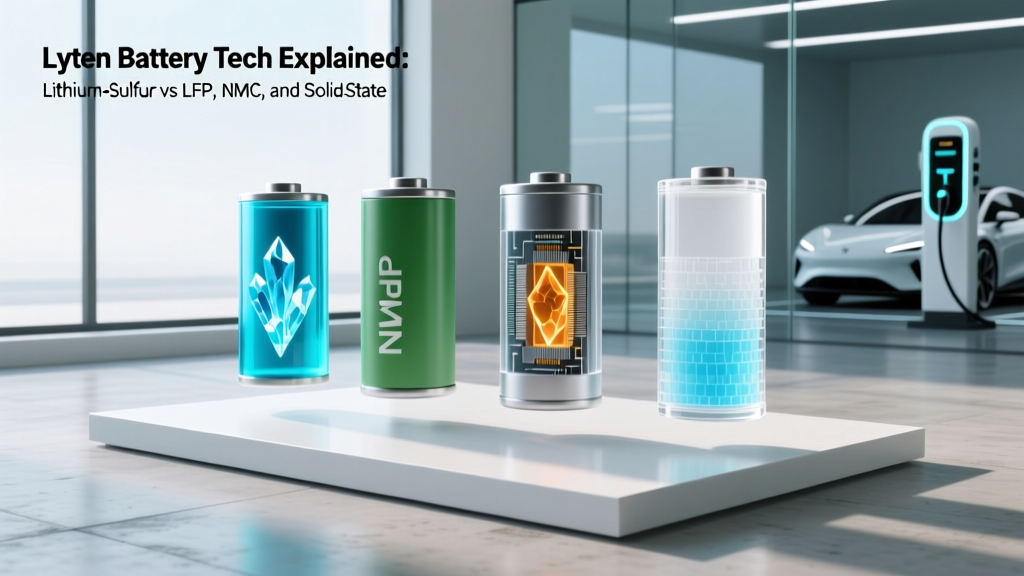
The Short Answer: No Mass-Market EV in the US Has Solid-State Batteries Yet
If you've been searching for what vehicles in the US are using solid-state batteries, the honest answer as of early 2026 is: none that you can walk into a dealership and buy. Despite years of headlines promising a solid-state revolution, every production EV currently sold in the United States uses a lithium-ion battery with a liquid or gel electrolyte — whether that's an NMC (nickel manganese cobalt), NCA (nickel cobalt aluminum), or LFP (lithium iron phosphate) cell.
That doesn't mean solid-state technology is vaporware. Toyota, Nissan, Samsung SDI, and QuantumScape are all running prototype or limited-production programs. But the gap between a lab cell and a mass-produced, cost-competitive battery pack that meets automotive safety and durability standards remains substantial. Here's where things actually stand, what's coming, and — critically — what you should know about the batteries powering today's EVs.
Solid-State Battery Programs: Who's Closest and When?
Several automakers and battery suppliers have publicly committed to solid-state production timelines. Here's what's been announced — with the caveat that timelines in battery development slip frequently:
| Company | Program Status (Early 2026) | Targeted Production | Key Claims |
|---|---|---|---|
| Toyota | Prototype testing; limited EV pilot planned | 2027–2028 (announced) | ~620-mile range target, 10-min 10–80% charge |
| Nissan | Pilot production line in Yokohama operational | 2028 (announced) | Halved battery cost vs. current NMC |
| Samsung SDI | Sample cells shipped to automaker partners | 2027 (announced) | 900+ Wh/L energy density target |
| QuantumScape / VW (PowerCo) | B-sample cells under validation | Late 2020s (estimated) | Anode-less lithium-metal design |
| IM Motors (SAIC, China) | L6 semi-solid-state in limited production (China only) | Available in China (not US) | Semi-solid electrolyte, ~620-mi CLTC range |
The critical distinction: semi-solid-state batteries (like those from IM Motors and NIO in China) use a hybrid electrolyte — part solid, part liquid — and are closer to production but offer incremental, not transformational, improvements. True all-solid-state cells, which replace the liquid electrolyte entirely with a solid ceramic, polymer, or sulfide material, remain in the prototype-to-pilot phase.
For US buyers, the earliest realistic window to purchase a solid-state EV is 2028–2030, and even then, expect initial availability in limited, premium models — not mainstream sedans and crossovers.
What's Actually Powering Today's EVs: LFP vs NMC vs NCA
Until solid-state arrives, the EV market runs on three dominant lithium-ion chemistries. Understanding the trade-offs is essential for making an informed purchase today.
| Attribute | LFP (Lithium Iron Phosphate) | NMC (Nickel Manganese Cobalt) | NCA (Nickel Cobalt Aluminum) |
|---|---|---|---|
| Energy Density | Lower (~160–180 Wh/kg cell-level) | Higher (~220–260 Wh/kg) | Highest (~250–280 Wh/kg) |
| Cycle Life | Excellent (3,000–5,000+ cycles) | Good (1,000–2,000 cycles) | Good (1,000–1,500 cycles) |
| Cold-Weather Performance | Weaker — more range loss below freezing | Better low-temp discharge capability | Similar to NMC |
| Cost | Lowest — no cobalt or nickel | Higher — cobalt/nickel price exposure | Highest |
| Thermal Stability | Best — highly resistant to thermal runaway | Moderate — requires robust BMS | Moderate — requires robust BMS |
| Charging to 100% | Recommended periodically for BMS calibration | Better kept at 80–90% daily | Better kept at 80–90% daily |
| Common US Examples (2026) | Tesla Model 3/Y RWD, Ford Mustang Mach-E Select (base) | Hyundai Ioniq 5, Kia EV6, Chevy Equinox EV, BMW iX | Tesla Model S/X, Rivian R1T/R1S (large pack) |
Which is better? It depends on your use case. If you prioritize longevity, lower cost, and can accept slightly less range per kWh of battery weight, LFP is the pragmatic choice — which is why Tesla shifted its standard-range vehicles to LFP and why CATL supplies LFP cells to multiple global automakers. If you need maximum range in a heavy vehicle or tow frequently, NMC/NCA's higher energy density justifies the cost and slightly faster degradation curve.
How Long Do EV Batteries Actually Last? Degradation Data
The fear that EV batteries need replacement every few years is not supported by fleet data. Modern lithium-ion traction batteries are engineered for the life of the vehicle — and real-world data confirms it.
- Tesla fleet data (2025 Impact Report): Model 3/Y batteries retain approximately 85% of original capacity at 150,000 miles — well above the warranty threshold.
- Geotab fleet study (2024, 10,000+ EVs): Average annual degradation across all brands was ~1.8% per year, meaning a typical EV retains ~82% capacity after 10 years.
- Recurrent Auto data (2025): LFP-equipped vehicles showed slower degradation curves than NMC equivalents, with many LFP packs retaining 92%+ after 80,000 miles.
- Nissan Leaf (passive-cooled, older gen): Early Leafs (2011–2017) with passive air cooling showed notably higher degradation — up to 20–25% loss over 8 years — underscoring the importance of active thermal management.
Most modern EVs with active liquid cooling and sophisticated battery management systems (BMS) will lose roughly 10–15% of total capacity over 150,000–200,000 miles. That means a vehicle with an EPA-estimated 300-mile range when new will still deliver approximately 255–270 miles after a decade of typical use — still entirely practical for daily driving.
Battery Warranties: What's Covered and for How Long
Federal law mandates that EV battery warranties cover a minimum of 8 years / 100,000 miles (in California Air Resources Board states, it's 10 years / 150,000 miles). Every major automaker meets or exceeds these thresholds.
| Automaker | Battery Warranty | Capacity Retention Threshold |
|---|---|---|
| Tesla (Model 3/Y) | 8 yr / 120,000 mi (LFP RWD); 8 yr / 100,000 mi (Long Range) | 70% |
| Hyundai / Kia | 10 yr / 100,000 mi | 70% |
| General Motors (Ultium) | 8 yr / 100,000 mi | 70% |
| Ford | 8 yr / 100,000 mi | 70% |
| BMW | 8 yr / 100,000 mi | 70% |
| Rivian | 8 yr / 175,000 mi | 70% |
| Volkswagen (ID.4) | 8 yr / 100,000 mi | 70% |
What the warranty actually covers: If your battery's usable capacity drops below the stated threshold (typically 70% of original) within the warranty period, the manufacturer will repair or replace the battery pack at no cost. This covers abnormal degradation — not damage from accidents, improper charging, or modifications. In practice, very few owners ever file a battery warranty claim, because degradation curves flatten well above the 70% line.
For details on warranty specifics and what qualifies as a defect versus normal wear, check your owner's manual or the manufacturer's warranty documentation. The U.S. Department of Energy's EV technology page also provides useful background on battery longevity expectations.
EV Battery Replacement Costs: The Reality
This is the number that generates the most anxiety — and the most misinformation. Let's ground it in actual figures.
| Vehicle / Pack Size | Estimated Replacement Cost (2026) | When Is It Typically Needed? |
|---|---|---|
| Tesla Model 3 RWD (~60 kWh LFP) | $8,000–$12,000 | Rarely before 200,000+ mi; most cars are scrapped or sold before needing replacement |
| Hyundai Ioniq 5 (~77.4 kWh NMC) | $12,000–$18,000 | Same — abnormal failure (e.g., cell defect) is covered under warranty |
| Ford F-150 Lightning Extended (~131 kWh) | $20,000–$30,000 | Out-of-warranty replacement extremely uncommon |
| Chevy Bolt EV (~65 kWh) | $9,000–$14,000 | GM recalled and replaced many packs proactively under the 2021–2022 recall |
| BMW iX xDrive50 (~111.5 kWh) | $18,000–$25,000 | Virtually no out-of-warranty replacements reported |
Key context: the vast majority of EV batteries outlive the vehicle itself. According to data from Consumer Reports and fleet operators, battery replacement due to end-of-life degradation is exceedingly rare in modern, liquid-cooled packs. When replacements do occur, they're often covered under warranty or involve swapping individual modules rather than the entire pack — reducing cost substantially.
Battery prices have also fallen dramatically. Pack-level costs dropped from over $1,000/kWh in 2010 to approximately $110–$130/kWh by 2025, and are projected to decline further. A replacement pack in 2030 will cost meaningfully less than today's prices.
Factors That Affect Battery Life — and What You Can Control
Not all miles are equal when it comes to battery wear. These are the primary factors that accelerate or slow degradation:
- Limit DC fast charging to road trips. Frequent use of 150+ kW DC fast chargers generates heat that accelerates cell wear. Daily Level 2 home charging (7–11 kW) is gentler on the pack.
- Avoid sustained 100% or 0% State of Charge. For NMC/NCA batteries, set your daily charge limit to 80–90%. LFP batteries are more tolerant and benefit from periodic 100% charges for BMS cell-balancing calibration.
- Precondition in extreme cold. Using your EV's preconditioning feature (available on virtually all modern EVs) warms the battery before driving and charging, reducing stress and improving charge acceptance.
- Park in shade or a garage when possible. Prolonged exposure to extreme heat (above 95°F / 35°C) while at high SoC accelerates calendar degradation — even when the car isn't being driven.
- Don't worry about regen braking. Regenerative braking does not meaningfully impact battery longevity. The BMS manages charge acceptance rates to protect cells.
The single biggest degradation factor is heat + high state of charge sustained over time. An NMC battery sitting at 100% SoC in a Phoenix driveway at 110°F will degrade faster than one stored at 60% in a cool garage. Active thermal management systems mitigate this substantially, but parking habits still matter over a 10-year ownership horizon.
Monitoring Battery Health: How to Check Your State of Health (SoH)
State of Health (SoH) is the percentage of your battery's original usable capacity that remains. A new battery has 100% SoH; a degraded battery might show 88% SoH, meaning it holds 88% of its original energy.
How to check SoH:
- In-vehicle displays: Some EVs (notably the Nissan Leaf and certain Hyundai/Kia models) display a battery health indicator in the instrument cluster or infotainment system. Tesla does not natively display SoH percentage but shows rated range, which correlates.
- OBD-II diagnostic apps: Third-party apps like Leaf Spy (Nissan), OBDeleven (VW/Audi/BMW), or Scan My Tesla can read the BMS directly and report SoH percentage, cell voltage variance, and cycle count.
- Dealer diagnostic reports: Any authorized service center can pull a battery health report during routine service. Request this before purchasing a used EV.
- Recurrent Auto / telematics services: Some fleet and insurance-linked services track battery degradation over time using connected-car data.
For used-EV buyers, checking SoH is as important as checking a Carfax report. A 2022 EV with 40,000 miles and 94% SoH is a better buy than the same model with 95% SoH but evidence of repeated DC fast charging in hot climates — because the degradation trajectory matters more than the snapshot.
Beyond Solid-State: Silicon Anodes and Other Near-Term Advances
While solid-state batteries capture headlines, other battery innovations are reaching production sooner and may deliver meaningful improvements before solid-state scales:
- Silicon-dominant anodes: Companies like Sila Nanotechnologies and Group14 are supplying silicon-carbon anode materials to automakers now. These boost energy density by 10–20% within existing lithium-ion cell formats. Mercedes-Benz's upcoming G-Class EV (announced for 2027) is expected to use silicon-anode cells from Factorial Energy.
- Sodium-ion batteries: CATL and BYD have begun limited production of sodium-ion cells for low-cost, shorter-range EVs in China. These use no lithium, cobalt, or nickel — dramatically reducing material costs — but offer lower energy density (~140 Wh/kg). US availability is unlikely before 2028.
- LMFP (lithium manganese iron phosphate): An evolution of LFP that adds manganese to boost energy density by ~15–20% while retaining LFP's cost and safety advantages. CATL and Gotion are scaling LMFP production, and it's expected to appear in US-market vehicles by 2027–2028.
These incremental advances are arguably more impactful for near-term buyers than solid-state promises. They improve today's proven cell formats rather than requiring entirely new manufacturing infrastructure.
Frequently Asked Questions
What vehicles in the US are using solid-state batteries right now?
None available for retail purchase as of early 2026. Toyota, Nissan, Samsung SDI, and QuantumScape have prototype or pilot-line programs targeting 2027–2030 production. China's IM Motors uses a semi-solid-state battery in the L6 sedan, but it is not sold in the US market.
How long do EV batteries last in years and miles?
Modern liquid-cooled EV batteries typically retain 80–85% of original capacity at 150,000–200,000 miles, translating to 12–15+ years of usable life for most owners. Fleet data from Tesla, Geotab, and Recurrent Auto consistently shows that the majority of packs outlive the vehicle they're installed in.
How much does it cost to replace an EV battery?
Out-of-warranty replacement costs range from approximately $8,000 for a smaller pack (Tesla Model 3 LFP, ~60 kWh) to $20,000–$30,000 for a large pack (Ford F-150 Lightning, ~131 kWh). However, most batteries never need replacement — abnormal failures within the 8-year/100,000-mile warranty period are covered by the manufacturer. Pack costs continue to decline year over year.
What does the EV battery warranty actually cover?
Federal law requires a minimum 8-year/100,000-mile warranty on EV batteries (10 years/150,000 miles in CARB states). The warranty covers capacity loss below a defined threshold — typically 70% of original capacity — as well as manufacturing defects. It does not cover damage from collisions, improper use, or unauthorized modifications.
LFP vs NMC — which battery chemistry should I choose?
Choose LFP if you want maximum cycle life, lower cost, better thermal safety, and don't mind slightly less range for a given pack weight. Choose NMC/NCA if you need the longest possible range, tow frequently, or regularly drive in very cold climates where NMC's better low-temperature performance matters. For most daily commuters, LFP is the pragmatic and increasingly popular choice.
Will solid-state batteries make current EVs obsolete?
Not immediately. When solid-state EVs do arrive (likely 2028–2030 for the US), they'll debut in limited, premium models at high prices. Current LFP and NMC EVs will remain cost-competitive and practical for years afterward — just as early LCD TVs didn't immediately kill the CRT market. The existing fleet of liquid-electrolyte EVs will depreciate normally but won't become functionally obsolete.
How can I check my EV's battery State of Health?
Use your vehicle's built-in battery health display (if equipped), connect an OBD-II reader with a compatible app (Leaf Spy, OBDeleven, Scan My Tesla), or request a battery health report from your dealer during service. For used-EV purchases, always verify SoH before committing.
For the latest on federal EV tax credit eligibility — which can offset up to $7,500 on qualifying new EVs under IRS §30D rules — check the IRS clean vehicle credit page, as income caps, MSRP limits, and battery-sourcing requirements apply and change periodically.