Every year, headlines promise that solid-state batteries are "just around the corner." As of 2026, that promise remains exactly that — a promise. Meanwhile, lithium iron phosphate (LFP) and nickel manganese cobalt (NMC) cells continue to dominate every EV on sale in the U.S., delivering proven reliability and steadily improving energy density.
This guide cuts through the hype. We'll map the realistic solid-state battery commercialization timeline from a 2026 vantage point, then ground you in the chemistry, degradation data, warranty coverage, and replacement economics of the batteries you can actually buy today.
Where Solid-State Batteries Stand in 2026
Solid-state batteries replace the liquid electrolyte in conventional lithium-ion cells with a solid material — typically a ceramic, sulfide, or polymer compound. The theoretical advantages are significant: higher energy density (potentially 400+ Wh/kg at the cell level versus roughly 250–300 Wh/kg for today's best NMC), faster charging without lithium plating risk, and improved thermal stability.
But theory and mass production are very different things. Here's where the major players stand as of early 2026:
- Toyota: Continues to lead in patent volume. Toyota has announced a solid-state battery for a limited-production EV expected in 2027–2028, initially targeting a small run of vehicles with ~460 miles of range and a 10-minute 10–80% charge capability. Mass-market deployment remains projected for 2030 or later. (Toyota global newsroom)
- Samsung SDI: Has begun sample shipments of all-solid-state cells to select automaker partners, with a stated target of mass production in 2027. Cell-level energy density claims are around 900 Wh/L volumetrically.
- QuantumScape: The Volkswagen-backed startup has delivered prototype cells to automotive partners for testing. Its multi-layer cells have demonstrated over 1,000 cycles with >80% capacity retention in lab conditions. Production timeline: pilot-scale in 2026, commercial volumes not expected before 2028–2029.
- Nissan: Announced a pilot production line for solid-state cells at its Yokohama plant, targeting 2028 for a production vehicle introduction.
- Chinese OEMs (BYD, CATL): Both have announced semi-solid-state or "condensed matter" battery products that bridge the gap — using gel-like or partially solid electrolytes. CATL's condensed-matter cell achieves ~500 Wh/kg and is entering limited aerospace and premium EV applications, but at costs that keep it out of mainstream vehicles.
Current Battery Chemistry: LFP vs NMC/NCA
While solid-state remains on the horizon, today's EV buyers choose between two dominant lithium-ion chemistries. Understanding the trade-offs is essential for matching a battery to your driving pattern.
| Attribute | LFP (Lithium Iron Phosphate) | NMC / NCA (Nickel-based) |
|---|---|---|
| Energy density | ~160–180 Wh/kg (cell) | ~250–300 Wh/kg (cell) |
| Typical range class | Standard-range models (200–270 mi EPA) | Long-range / performance models (300–400+ mi EPA) |
| Cycle life | 3,000–5,000+ cycles to 80% SoH | 1,000–2,000 cycles to 80% SoH |
| Calendar aging | Slower; less capacity loss at rest | Faster, especially at high SoC and heat |
| Cold-weather performance | More range loss in freezing temps (15–30% reduction); slower charge acceptance when cold | Better cold performance (10–20% reduction); heat pump systems mitigate further |
| Charging to 100% | Safe and recommended periodically for BMS calibration | Best kept at 80–90% daily; 100% for trips only |
| Thermal runaway risk | Very low — inherently stable chemistry | Low but higher than LFP; requires robust BMS |
| Cost per kWh | ~$90–110/kWh (pack-level, 2026 est.) | ~$120–150/kWh (pack-level, 2026 est.) |
| Notable 2026 vehicles | Tesla Model 3 RWD, Model Y RWD, Ford Mustang Mach-E Select (LFP option), BYD models | Tesla Model 3 LR, Hyundai Ioniq 5/6 LR, Chevrolet Equinox EV, Rivian R1T/R1S |
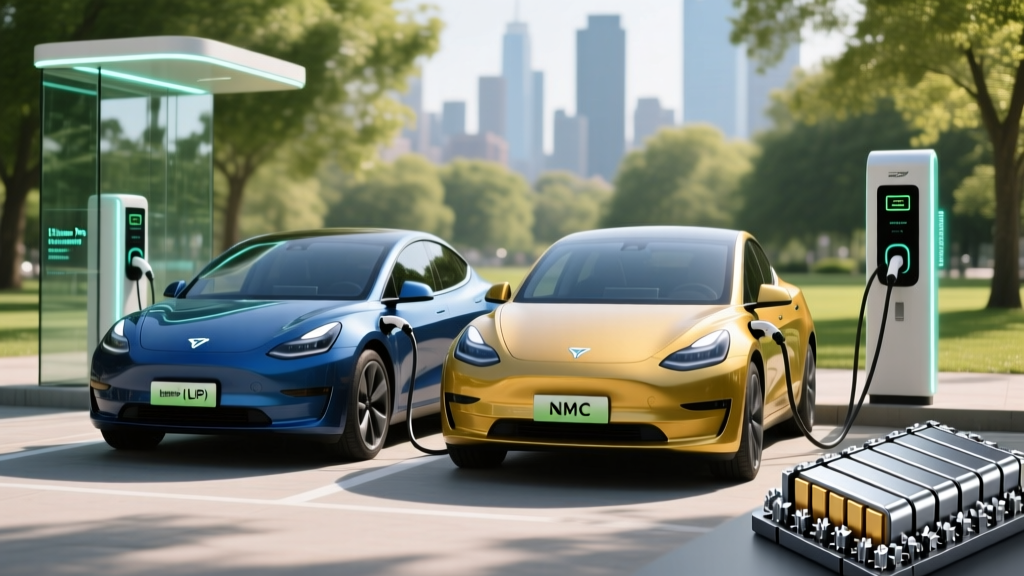
Which is better? There is no universal winner. LFP is the right choice for daily commuters who can charge at home, prioritize longevity, and don't need maximum range. NMC is the right choice for road-trip-heavy drivers, cold-climate owners, and anyone towing. Silicon-anode enhancements (adding silicon to the graphite anode) are gradually boosting NMC energy density by 5–10% without switching chemistry entirely — a bridge technology already in production in some 2026 models.
How Long Do EV Batteries Actually Last?
The short answer: longer than most buyers expect, and typically longer than the rest of the vehicle. Here's what the data shows.
Degradation Data Points (Real-World Sources)
- Tesla fleet data (2025 Impact Report): Model 3/Y batteries retain approximately 85% capacity after 200,000 miles. NMC Long Range variants show ~12% loss at 150,000 miles; LFP Standard Range variants show ~8–10% loss at the same mileage.
- Geotab fleet study (2024, ~10,000 vehicles): Average EV battery degradation across all brands was 1.8% per year, meaning roughly 82% State of Health (SoH) after 10 years. LFP-equipped vehicles averaged 1.2–1.5% per year.
- Hyundai/Kia 84 kWh NMC packs (Ioniq 5, EV6): Owner-reported data clusters show ~90–93% SoH at 50,000 miles and ~85–88% at 100,000 miles under mixed driving and DC fast-charging conditions.
- Chevrolet Bolt EV/EUV (65 kWh NMC): Post-recall replacement batteries show minimal degradation (<3% at 60,000 miles) owing to updated thermal management software.
Sources: Geotab EV Battery Health Report, Tesla Impact Reports, owner-forum aggregated data (InsideEVs, SpeakEV).
Most modern EV batteries are engineered to retain 70–80% of original capacity for 150,000–200,000 miles. At that point, the battery is not "dead" — it simply offers reduced range. A 300-mile EPA vehicle at 75% SoH still delivers ~225 miles, which is more than adequate for most daily driving.
What Does the Battery Warranty Cover?
Federal law mandates that EV batteries carry a minimum warranty of 8 years or 100,000 miles (10 years/150,000 miles in CARB states including California, New York, Massachusetts, and others). Most manufacturers exceed this baseline.
| Manufacturer | Warranty Period | Capacity Threshold | Notes |
|---|---|---|---|
| Tesla | 8 yr / 100,000–120,000 mi (varies by model) | 70% retention | 120k mi for Model 3/Y LR; 100k mi for RWD |
| Hyundai / Kia | 10 yr / 100,000 mi | 70% retention | Among the longest in the industry |
| Ford | 8 yr / 100,000 mi | 70% retention | Covers battery and hybrid/EV components |
| GM (Chevrolet, Cadillac) | 8 yr / 100,000 mi | 70% retention (60% for Bolt) | Ultium platform; varies by model year |
| Rivian | 8 yr / 175,000 mi | 70% retention | Highest mileage threshold in the segment |
| BMW | 8 yr / 100,000 mi | 70% retention | Includes i4, iX, i7 models |
What triggers a warranty claim? The battery must fall below the stated capacity threshold (typically 70% of original kWh) as measured by the manufacturer's diagnostic tool. Gradual degradation that stays above the threshold is considered normal wear and is not covered. Physical damage, flooding, unauthorized modifications, and improper charging (e.g., consistently ignoring manufacturer SoC guidelines) may void coverage.
Key nuance: Warranty replacement does not guarantee a brand-new battery. Manufacturers may install a refurbished or remanufactured pack that meets the capacity threshold. This is standard practice across the industry and is explicitly stated in most warranty booklets.
EV Battery Replacement Cost: What to Expect
Out-of-warranty battery replacement is the scenario that generates the most anxiety. Here are the real numbers for 2026.
| Vehicle (Battery Size) | Battery Replacement Cost (Parts + Labor) | Typical Replacement Timeline |
|---|---|---|
| Tesla Model 3 RWD (~60 kWh LFP) | $8,000–$12,000 | Rarely needed; projected 300,000+ mi cycle life |
| Tesla Model 3/Y LR (~75–82 kWh NMC) | $12,000–$16,000 | 200,000+ mi before 70% SoH in most cases |
| Hyundai Ioniq 5 (77.4 kWh NMC) | $11,000–$15,000 | Protected by 10 yr/100k warranty |
| Ford F-150 Lightning (131 kWh ext. range) | $20,000–$30,000 | Largest packs carry highest cost; modular repair may reduce |
| Chevrolet Equinox EV (~85 kWh Ultium) | $12,000–$18,000 | Ultium modular design may allow partial replacement |
| Rivian R1T (135 kWh Max Pack) | $22,000–$28,000 | Large pack; covered to 175k mi under warranty |
Context that matters: The vast majority of EV batteries never need full replacement during the vehicle's useful life. Data from fueleconomy.gov and fleet operators indicates that fewer than 2–3% of EV batteries require replacement before 150,000 miles, and most of those are covered under warranty. Pack-level costs continue to decline roughly 8–12% per year, meaning a replacement in 2035 will cost significantly less than today's prices.
Additionally, modular battery architectures (GM's Ultium, some CATL designs) increasingly allow technicians to replace individual modules rather than the entire pack, reducing costs by 40–60% for localized cell failures.
Factors That Accelerate Battery Degradation
Not all miles are created equal. The following habits and conditions measurably speed up capacity loss:
Battery Care Best Practices
- DC fast-charging frequency: Exclusive reliance on DC fast charging (150+ kW) can accelerate degradation by 1–2% per year compared to primarily Level 2 home charging. The heat generated during high-power charging stresses cells. Recommendation: use DC fast charging for road trips; rely on Level 2 (7–11 kW) for daily charging.
- State of charge extremes: For NMC batteries, routinely storing at 100% SoC or letting the battery sit below 10% SoC accelerates calendar aging. The sweet spot is 20–80% for daily use. LFP batteries tolerate 100% SoC better and benefit from periodic full charges for BMS calibration.
- Extreme heat exposure: Sustained ambient temperatures above 95°F (35°C), especially combined with high SoC, are the single most damaging condition for lithium-ion cells. Garage parking in hot climates measurably extends battery life.
- Extreme cold charging: Charging a cold-soaked battery (below 20°F / -7°C) without preconditioning forces lithium plating on the anode, causing permanent capacity loss. Always use the vehicle's preconditioning feature before charging in freezing weather.
- High-mileage fast-charge patterns: Fleet data shows that vehicles covering 50,000+ miles/year with frequent DC fast charging and minimal Level 2 charging show the highest degradation rates — up to 3–4% per year versus 1.5–2% for mixed-use patterns.
How to Monitor and Maximize Battery Health
Modern EVs provide several ways to track battery State of Health (SoH):
- In-vehicle displays: Most 2026 EVs show a battery health indicator in the settings menu, typically as a percentage or bar graph. Tesla provides a rated-range comparison to original EPA figures. Hyundai/Kia's infotainment system includes a battery condition screen on newer models.
- OBD-II diagnostic tools: Devices like the OBDLink MX+ paired with apps such as EVNotify or Car Scanner can read detailed battery parameters including SoH percentage, cell voltage spread, and pack temperature. These pull data from the vehicle's Battery Management System (BMS) via CAN bus.
- Dealer diagnostics: A service center can run a full battery health report, typically during scheduled maintenance. This is the most authoritative reading and is the method used for warranty claims.
- Third-party services: Companies like Recurrent Auto provide battery health reports based on connected-vehicle data, useful for pre-purchase inspections on used EVs.
Maximizing longevity: Beyond the care checklist above, the single highest-impact action is installing a Level 2 home charger (240V, 32–48 amps / 7.7–11.5 kW). This enables overnight charging at moderate power, avoids DC fast-charge heat stress, and allows you to schedule charging during off-peak hours when ambient temperatures are lower.
The Bridge Technologies: Silicon Anodes and Semi-Solid Cells
Between today's liquid-electrolyte lithium-ion batteries and a full solid-state future, two bridge technologies are already entering production:
Silicon-dominant anodes: Replacing graphite with silicon (or silicon-carbon composites) on the anode increases energy storage per unit mass by 10–25%. Sila Nanotechnologies and Group14 Technologies are supplying silicon-anode materials to manufacturers including Mercedes-Benz (for the upcoming G-Class electric) and other premium OEMs. Expect silicon-enhanced NMC cells in select 2026–2027 models, offering modestly higher range without changing pack size. Cycle life remains a challenge — pure silicon anodes swell during charging — but composite solutions have largely solved this for the near term.
Semi-solid and condensed-matter batteries: CATL's condensed-matter battery (announced 2023, entering limited production 2025–2026) uses a high-concentration gel electrolyte that mimics some solid-state benefits — improved safety and ~500 Wh/kg energy density — at lower manufacturing complexity. These cells are currently too expensive for mass-market EVs but are viable for aviation and ultra-premium vehicles. NIO's 150 kWh semi-solid pack (available in China for the ET7 sedan) demonstrates 620+ miles of range but costs roughly as much as the base vehicle itself.
These bridge technologies will deliver incremental gains while the industry solves solid-state manufacturing challenges — specifically, the difficulty of producing sulfide-based solid electrolytes at scale without moisture contamination, and the high cost of ceramic electrolyte sintering.
Solid-State Battery Timeline: Realistic Projections
Pulling together manufacturer announcements, pilot-line timelines, and analyst consensus, here is the most defensible projection for solid-state commercialization:
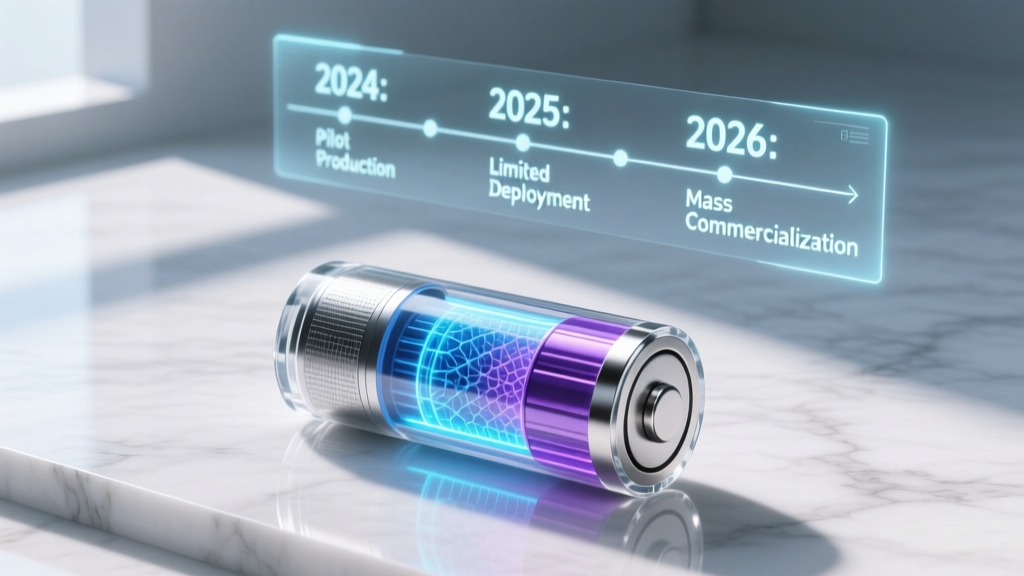
- 2026–2027: Pilot production lines operational at Toyota, Samsung SDI, and QuantumScape. Cells undergo automotive validation testing. No consumer vehicles available.
- 2028–2029: First limited-production vehicles with solid-state batteries reach market, likely in Japan and South Korea initially. Expect premium pricing (vehicles likely above $80,000 MSRP) and limited availability. Initial packs may be 60–80 kWh with 400+ mile range.
- 2030–2032: Solid-state batteries begin appearing in higher-volume models as manufacturing processes mature and costs decline. Still likely at a premium over NMC, but competitive in the long-range and performance segments.
- 2033+: Potential for solid-state to become cost-competitive with NMC at scale, depending on manufacturing yield improvements and raw material costs. LFP may remain dominant for standard-range and budget segments due to its inherent cost advantage.
Should You Wait for Solid-State?
Buy now if: You need a vehicle in the next 1–3 years. Today's LFP and NMC batteries are proven, warrantied for 8–10 years, and will likely outlast the vehicle. Depreciation and opportunity cost of waiting outweigh speculative future gains.
Wait if: Your current vehicle is reliable, you don't need an EV immediately, and you're targeting a premium long-range vehicle in the 2029–2031 timeframe. Solid-state may offer meaningful advantages by then — but "may" is doing heavy lifting in that sentence.
Frequently Asked Questions
How long do EV batteries last in years and miles?
Most modern EV batteries are designed to retain 70–80% of original capacity after 150,000–200,000 miles or 10–15 years of typical use. Fleet data from Geotab and Tesla's own impact reports show average degradation of 1.5–2.0% per year under mixed driving conditions. Many batteries remain functional well beyond 200,000 miles, albeit with reduced range.
How much does an EV battery cost to replace?
As of 2026, full battery replacement costs range from approximately $8,000 for a smaller LFP pack (e.g., Tesla Model 3 RWD, ~60 kWh) to $20,000–$30,000 for a large NMC pack (e.g., Ford F-150 Lightning extended range, 131 kWh). However, fewer than 3% of batteries require replacement before 150,000 miles, and most failures are covered under the 8–10 year federal-mandated warranty. Modular pack designs are also enabling partial replacements at 40–60% lower cost.
What does the EV battery warranty cover?
Federal law requires a minimum warranty of 8 years/100,000 miles (10 years/150,000 miles in CARB states). Coverage applies when the battery falls below a stated capacity retention threshold — typically 70% of original capacity. The warranty covers defects, premature degradation, and cell failures. It does not cover damage from accidents, flooding, unauthorized modifications, or normal wear above the threshold. Always review your specific manufacturer's warranty booklet.
How do I check my EV's battery health?
You can check battery State of Health (SoH) through your vehicle's infotainment settings menu, via OBD-II diagnostic apps (EVNotify, Car Scanner, or Torque Pro with EV PIDs), through a dealer service diagnostic report, or via third-party services like Recurrent Auto. For used EV purchases, always request a battery health report before buying.
LFP vs NMC — which battery chemistry is better for me?
Choose LFP if you primarily commute, charge at home, want maximum cycle life (3,000–5,000+ cycles), and don't need more than ~270 miles of EPA range. Choose NMC if you take frequent road trips, live in a cold climate, tow, or need 300+ miles of range. LFP is cheaper and longer-lasting; NMC offers more energy density and better cold-weather performance. Both chemistries are proven and reliable in 2026.
Will solid-state batteries make current EVs obsolete?
Not in the near term. Solid-state batteries are not expected in mass-market vehicles before 2030–2032 at the earliest. Current LFP and NMC batteries continue to improve incrementally (silicon anodes, better thermal management, manufacturing refinements). The EVs you buy today will remain competitive and supported for well over a decade. The transition to solid-state will be gradual, not disruptive.