Every few months, a headline declares that solid-state batteries are "just around the corner." For EV shoppers in 2026, the question is practical: should you wait for the next chemistry revolution, or buy the lithium-ion EV on the lot today? This guide breaks down the real commercialization status of solid-state batteries, then gives you the data you need on today's EV batteries — degradation curves, warranty terms, replacement costs, and the LFP vs. NMC decision that actually matters right now.
Where Solid-State Batteries Stand in 2026
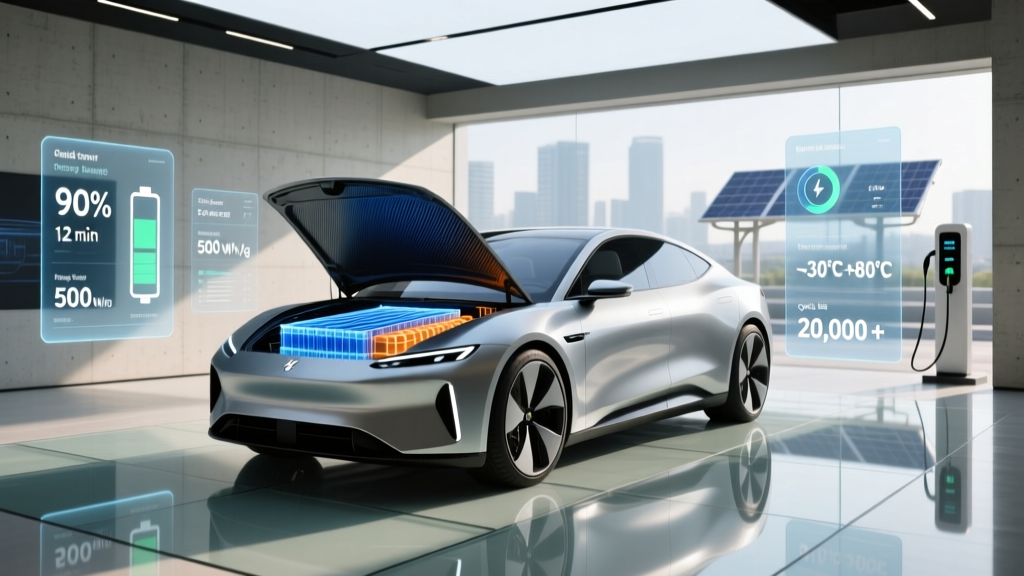
Solid-state batteries replace the liquid electrolyte in conventional lithium-ion cells with a solid material (ceramic, sulfide, or polymer). The theoretical advantages are significant: higher energy density (potentially 400–500 Wh/kg at the cell level vs. ~250–300 Wh/kg for today's best NMC), faster charging without lithium plating risk, and reduced flammability.
But theory and production are very different things. Here is where major programs stand as of early 2026:
- Toyota: Continues to lead in patent volume. Has announced a limited production run of solid-state-equipped vehicles for 2027–2028, initially in small numbers for the Japanese market. No US-market vehicles confirmed. Toyota's stated target is 750 km (~466 miles) of range with a 10-minute 10–80% charge, but these remain preliminary, pre-production claims.
- Samsung SDI: Has begun sample production of all-solid-state cells for automotive customers, with mass production targeted for 2027. No vehicle OEM has publicly committed to a specific model using Samsung SDI solid-state cells.
- QuantumScape: The Volkswagen-backed startup has delivered prototype cells to automotive partners for testing. Commercial production timelines have shifted multiple times; volume manufacturing remains targeted for late 2026 or 2027 at the earliest, and even then, initial output will be extremely limited.
- Nissan: Announced a pilot production line for solid-state cells, with a market-ready vehicle targeted for 2028.
- CATL: The world's largest battery maker has announced condensed-state (semi-solid) batteries in limited production for premium EVs in China, but these are hybrid designs using gel electrolytes, not true all-solid-state cells.
LFP vs. NMC/NCA: Today's Real Battery Chemistry Choice
While solid-state remains forward-looking, the chemistry decision you'll actually make in 2026 is between LFP (lithium iron phosphate) and NMC (nickel manganese cobalt) / NCA (nickel cobalt aluminum). Both are lithium-ion, but their trade-offs differ sharply.
| Attribute | LFP (LiFePO₄) | NMC / NCA |
|---|---|---|
| Energy density (cell-level) | ~160–200 Wh/kg | ~250–300 Wh/kg |
| Typical pack sizes | 50–82 kWh (Standard Range models) | 75–100+ kWh (Long Range / Performance) |
| Cycle life | 3,000–5,000+ cycles to 80% SoH | 1,000–2,000 cycles to 80% SoH |
| Cold-weather performance | More range loss below 32°F; slower charge acceptance when cold | Better low-temp performance; preconditioning still helps |
| Recommended daily SoC | 100% daily is fine — LFP tolerates full charge well | 80% daily recommended; 100% for trips only |
| Cost per kWh (pack-level) | ~$90–110/kWh | ~$120–150/kWh |
| Cobalt/nickel content | None (cobalt-free) | Contains nickel and cobalt (supply-chain and ESG considerations) |
| Common in (2026 US models) | Tesla Model 3/Y RWD, Ford Mustang Mach-E Select (base), BYD models | Tesla LR/Performance, Hyundai Ioniq 5/6, Rivian, BMW iX, most premium EVs |
Which is better? It depends on your use case. If you want maximum range, tow frequently, or live in a cold climate, NMC/NCA's superior energy density and cold-weather behavior make it the better fit. If you prioritize longevity, lower cost, and plan to keep the car 10+ years, LFP's vastly higher cycle life and 100% daily-charge tolerance are compelling. Neither is universally "better" — they solve different problems.
How Long Do EV Batteries Actually Last?
The fear that EV batteries need frequent replacement is not supported by fleet data. Most modern EV batteries are engineered to outlast the vehicle's economic life.
Real-World Degradation Data
Degradation is non-linear: batteries lose capacity fastest in the first year or two, then the curve flattens significantly. Here are representative data points from fleet studies and owner-reported data aggregated through 2025:
| Milestone | Average Capacity Retained | Notes |
|---|---|---|
| 1 year / 15,000 mi | ~95–97% | Initial "break-in" loss; mostly calendar aging |
| 3 years / 45,000 mi | ~91–94% | Curve flattens; driven by usage patterns |
| 5 years / 75,000 mi | ~87–92% | Well within warranty thresholds |
| 8 years / 120,000 mi | ~82–88% | Most packs still above 70% warranty threshold |
| 10 years / 150,000 mi | ~78–85% | Varies significantly by chemistry and care |
LFP packs generally show slower degradation than NMC in high-cycle scenarios (e.g., daily DC fast charging or high-mileage fleet use). Tesla's 2024 Impact Report noted that Model 3/Y batteries retained an average of ~85% capacity at 200,000 miles. Hyundai/Kia's 8-year/100,000-mile warranty with a 70% retention threshold has rarely been triggered in real-world claims, according to service-network data shared at industry conferences.
What the Battery Warranty Actually Covers
Federal law (EPA emissions warranty provisions and CARB requirements adopted by many states) effectively mandates that EV battery warranties cover at least 8 years/80,000 miles. Most automakers exceed this. Here is how major 2026 warranties compare:
| Manufacturer | Warranty Term | Capacity Retention Threshold | Notes |
|---|---|---|---|
| Tesla (Model 3/Y RWD — LFP) | 8 yr / 100,000 mi | 70% | LFP packs covered identically to NMC |
| Tesla (Model 3/Y LR, Model S/X) | 8 yr / 120,000 mi | 70% | Higher mileage threshold for larger packs |
| Hyundai / Kia | 8 yr / 100,000 mi | 70% | 10 yr/100,000 mi in CARB states for some models |
| Ford (Mustang Mach-E, F-150 Lightning) | 8 yr / 100,000 mi | 70% | Covers battery and electric drivetrain components |
| GM (Ultium-based: Equinox EV, Blazer EV, Silverado EV) | 8 yr / 100,000 mi | 70% | Some commercial fleet terms differ |
| Rivian (R1T / R1S) | 8 yr / 175,000 mi | 70% | Higher mileage cap reflects truck/adventure use case |
| BMW (iX, i4, i7) | 8 yr / 80,000 mi | 70% | Standard BMW HV battery warranty |
What's covered: Defects in materials/workmanship, and capacity loss below the stated threshold (typically 70% of original capacity). If your 82 kWh pack drops below ~57 kWh usable within the warranty period, the manufacturer must repair or replace it at no cost.
What's NOT covered: Cosmetic issues, damage from accidents or flooding, modifications to the battery system, or capacity loss from consistent abuse (e.g., repeatedly leaving the car at 100% SoC in 110°F heat for weeks). Normal gradual degradation above the threshold is expected wear, not a warranty claim.
EV Battery Replacement Cost: What to Expect
Out-of-warranty battery replacement is the most-cited fear among prospective EV buyers. Here is the reality for 2026:
| Vehicle Class / Example | Pack Size | Replacement Cost Range | Typical Need Timeline |
|---|---|---|---|
| Compact EV (Chevy Equinox EV, Tesla Model 3 RWD) | 60–75 kWh | $8,000–$13,000 | 12–15+ years (if ever) |
| Mid-size SUV (Hyundai Ioniq 5, Tesla Model Y LR) | 77–82 kWh | $11,000–$16,000 | 12–15+ years (if ever) |
| Full-size truck/SUV (F-150 Lightning, Rivian R1T) | 98–149 kWh | $15,000–$25,000 | 12–15+ years (if ever) |
| Luxury sedan (BMW i7, Mercedes EQS) | 100–108 kWh | $18,000–$30,000 | 12–15+ years (if ever) |
Several important caveats:
- Most original owners never need a replacement. The vast majority of EV batteries are still functional (above 70–80% SoH) at 150,000+ miles. Replacement typically becomes relevant only for second- or third-owner vehicles well outside the warranty period.
- Costs are declining. Pack-level prices have fallen from ~$400/kWh in 2015 to roughly $110–140/kWh in 2026 (per BloombergNEF battery price surveys). As manufacturing scales and recycling infrastructure matures, replacement costs will continue to trend downward.
- Module-level repair is often possible. Many packs allow individual module replacement rather than a full pack swap, reducing out-of-warranty costs to $2,000–$6,000 depending on the number of failed modules.
- Third-party and remanufactured packs are emerging. Companies like Redwood Materials and others are building battery recycling and remanufacturing pipelines that will offer lower-cost replacement options as the first-generation EV fleet ages.
Maximizing Battery Health: What Actually Matters
Battery longevity is not random — it is heavily influenced by how you charge, store, and drive. Here is a prioritized checklist based on lithium-ion electrochemistry fundamentals:
- Avoid extreme SoC storage: Never leave the car sitting at 100% or below 10% for extended periods (days/weeks). For NMC, store at 50–60% if parking for a week+. LFP tolerates 100% better but still benefits from not sitting at 0%.
- Minimize DC fast-charging frequency: Occasional road-trip fast charging is fine. Daily DCFC sessions (especially at 150+ kW) accelerate degradation through heat and lithium plating. Home Level 2 (7–11.5 kW) is the healthiest daily charging method.
- Precondition before fast charging: Use the car's navigation-to-charger feature (Tesla, Hyundai, Ford, BMW all offer this) to warm the battery to optimal temperature before arriving at a DC fast charger. This protects the cells and dramatically improves charge speed.
- Avoid deep discharges: Try not to regularly run the battery below 10–15%. The low-voltage stress accelerates degradation. Most EVs have a buffer (typically 2–5 kWh below the displayed 0%), but relying on it habitually isn't ideal.
- Moderate cabin preconditioning in extreme heat: Parking in shade or a garage when possible reduces the thermal load on the battery cooling system. Battery thermal management works harder in 100°F+ ambient temps.
- Don't obsess about 80% vs. 90% daily: The difference in long-term degradation between charging to 80% and 90% daily is small. The big wins are avoiding 100% storage and minimizing DCFC heat. Don't let battery-care anxiety outweigh the utility of your EV.
How to Check Your Battery's State of Health (SoH)
State of Health represents the battery's current maximum capacity as a percentage of its original capacity. Here is how to monitor it:
- In-car displays: Tesla shows estimated range at 100% (compare to original EPA figure). Hyundai/Kia provides a battery health percentage in the EV menu on newer models. BMW's iDrive shows SoH in the vehicle status screens.
- OBD-II diagnostic tools: Apps like OBDeleven, Car Scanner, or dedicated EV tools can read the BMS (Battery Management System) SoH estimate. Accuracy varies by vehicle — these are approximations, not lab measurements.
- Third-party services: Companies like Recurrent Auto offer battery health reports based on telematics data. Some dealerships can pull a detailed BMS log during service visits.
- The manual method: Charge to a known SoC (e.g., 100%), drive to a low SoC (e.g., 10%), and note the kWh consumed from the trip computer or charging log. Compare to the pack's original usable capacity. This is imprecise but directionally useful.
Emerging Technologies Beyond Solid-State
Solid-state gets the headlines, but several other battery innovations are closer to impacting your next purchase:
- Silicon-dominant anodes: Companies like Sila Nanotechnologies and Group14 are shipping silicon-blend anode materials that increase energy density by 10–20% within existing lithium-ion form factors. Expect to see these in premium EVs by 2027–2028, offering modest range bumps without a full chemistry change.
- Sodium-ion batteries: CATL has begun limited production of sodium-ion cells for lower-cost, lower-range EVs in China. Energy density is ~25–30% lower than LFP, making them suitable for city cars and micro-EVs. US-market availability is unlikely before 2028 at the earliest.
- LMFP (lithium manganese iron phosphate): A hybrid chemistry blending LFP's safety with manganese's higher voltage for ~15–20% more energy density. CATL and Gotion are producing LMFP cells, with Tesla and Ford among potential adopters. Expect US-market vehicles with LMFP by 2027.
- Dry electrode manufacturing: Tesla's acquisition of Maxwell Technologies and subsequent manufacturing process development aims to reduce battery production cost by 20–30% while improving energy density. This is a manufacturing innovation, not a chemistry change, but it directly affects pack pricing.
For a deeper look at current battery warranty rules and how they interact with federal EV incentives, the U.S. Department of Energy's EV tax credit resource and the IRS clean vehicle credit guidelines detail how battery sourcing requirements under §30D affect which vehicles qualify.
Frequently Asked Questions
How long do EV batteries last in years and miles?
Most modern EV batteries retain 80–88% of their original capacity at 8 years / 120,000 miles, based on fleet averages. LFP chemistries typically degrade more slowly, retaining 85–90%+ at the same milestone. Full pack failure is rare — most batteries remain usable well beyond 150,000 miles, though with reduced range.
How much does it cost to replace an EV battery?
Out-of-warranty replacement costs range from ~$8,000 for a compact EV pack (60–75 kWh) to $25,000+ for a large truck or luxury sedan pack (100–149 kWh). However, most original owners never need a replacement — the battery typically outlasts the car's economic life. Module-level repairs cost significantly less ($2,000–$6,000).
What does the EV battery warranty cover?
Federally mandated minimum coverage is 8 years/80,000 miles; most automakers offer 8 years/100,000 miles. The warranty covers defects and capacity loss below a threshold (typically 70% of original capacity). It does not cover accident damage, flooding, or abuse (e.g., prolonged storage at extreme SoC in extreme temperatures). Rivian notably offers 8 years/175,000 miles.
How do I check and maximize my EV's battery health?
Check SoH through your car's built-in display, an OBD-II diagnostic app, or a dealer service visit. Maximize longevity by: (1) avoiding long-term storage at 100% or near 0% SoC, (2) using Level 2 home charging instead of daily DC fast charging, (3) preconditioning the battery before fast charging, and (4) avoiding frequent deep discharges below 10%.
LFP vs NMC — which battery chemistry is better?
Neither is universally better. Choose LFP if you want maximum cycle life (3,000–5,000 cycles), lower cost, and the convenience of charging to 100% daily — ideal for daily commuters and long-term owners. Choose NMC/NCA if you need maximum range per charge, better cold-weather performance, or tow frequently — ideal for road-trippers, cold-climate drivers, and those who need every mile of EPA range.
Should I wait for solid-state batteries before buying an EV?
For most buyers, no. Solid-state batteries are not available in any US-market EV in 2026. Realistic commercialization timelines place limited solid-state vehicles in 2027–2028 (likely premium, low-volume models in Asia first), with broad availability not expected before 2030. Today's LFP and NMC batteries are proven, well-warrantied, and declining in cost. Waiting 4+ years for solid-state means forgoing years of EV ownership savings and utility.