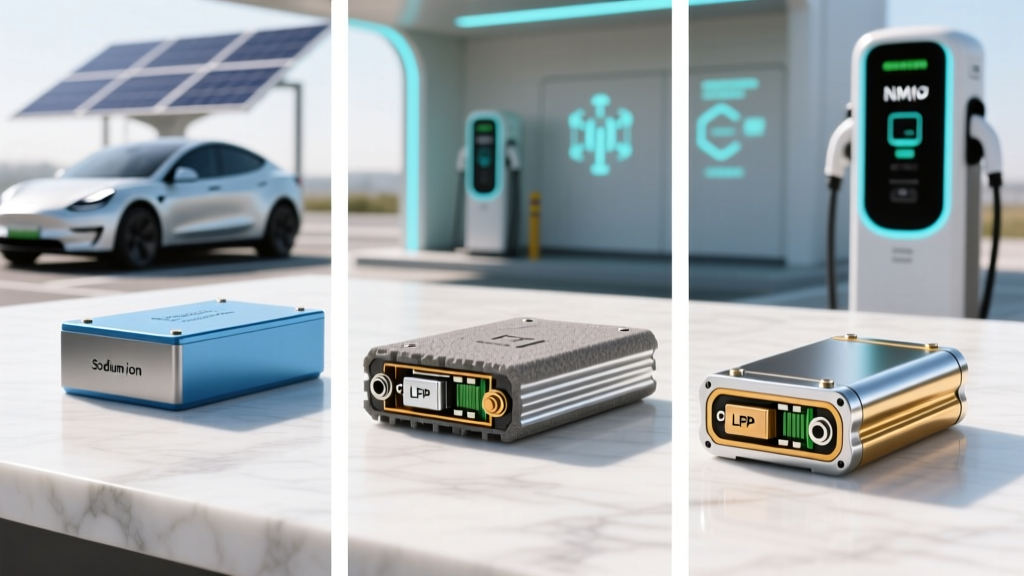
If you have been following EV battery headlines in 2026, you have likely seen sodium ion battery technology mentioned as the next big disruptor. CATL has begun shipping sodium-ion packs in Chinese-market micro-EVs, HiNa Battery is scaling production, and several automakers have announced dual-chemistry battery architectures that pair sodium-ion cells with lithium-based ones. But for US buyers shopping for a Tesla Model 3, Hyundai Ioniq 5, or Ford Mustang Mach-E today, the practical battery question remains grounded in two dominant chemistries: LFP (lithium iron phosphate) and NMC/NCA (nickel manganese cobalt / nickel cobalt aluminum).
This guide breaks down every chemistry you need to know about — including where sodium-ion fits in — alongside hard degradation data, warranty realities, replacement costs, and the habits that actually extend your pack's life.
LFP vs NMC vs Sodium-Ion: Chemistry Trade-Offs Explained
Every EV battery is defined by its cathode chemistry. That chemistry determines energy density (how far you can drive per kilogram of battery), cycle life (how many charge-discharge cycles before meaningful degradation), cold-weather performance, and raw material cost. Here is how the three chemistries relevant to 2026 buyers compare.
| Attribute | NMC/NCA | LFP | Sodium-Ion (Na-ion) |
|---|---|---|---|
| Energy density (cell-level) | 250–300 Wh/kg | 160–200 Wh/kg | 140–175 Wh/kg |
| Typical cycle life | 1,000–2,000 cycles | 3,000–5,000+ cycles | 2,000–4,000 cycles (early data) |
| Cold performance (-20°C) | ~70–75% capacity retention | ~55–65% capacity retention | ~80–85% capacity retention |
| Thermal stability | Lower — requires robust BMS | High — inherently stable | High — no thermal runaway risk at low SoC |
| Key raw materials | Lithium, nickel, cobalt, manganese | Lithium, iron, phosphate | Sodium, iron, manganese (no lithium) |
| Cell cost (2026 est.) | $100–$130/kWh | $70–$95/kWh | $50–$75/kWh (projected at scale) |
| Current US EV availability | Widely available (Tesla, Hyundai, Ford, GM, BMW, etc.) | Available (Tesla Model 3 RWD, some Ford/Chinese imports) | Not yet in US-market vehicles |
NMC/NCA dominates long-range and performance EVs because its superior energy density allows more kWh in the same physical pack volume. The Tesla Model 3 Long Range (82 kWh usable, NMC), Hyundai Ioniq 5 (77.4 kWh, NMC), and Ford Mustang Mach-E Extended Range (91 kWh, NMC) all rely on it. The trade-off is higher cost, dependence on nickel and cobalt supply chains, and a shorter cycle life than LFP.
LFP has become the standard for base-trim and mid-range EVs. Tesla's Model 3 Rear-Wheel Drive uses a ~60 kWh LFP pack. LFP's advantages are exceptional cycle life (many cells survive 5,000+ cycles with 80% capacity retention), lower cost, and no cobalt. The trade-off is lower energy density — meaning heavier packs for the same range — and worse cold-weather performance. If you live in Minnesota and park outside, an LFP pack will lose more range in January than an NMC pack will.
Sodium-ion battery technology eliminates lithium entirely, using abundant sodium instead. This is a supply-chain story as much as a chemistry one: sodium is roughly 1,000× more abundant than lithium and geographically distributed. CATL's first-generation sodium-ion cells achieve ~160 Wh/kg — competitive with LFP — and their cold-weather retention is genuinely impressive. However, as of 2026, sodium-ion packs are not installed in any vehicle sold in the United States. Expect early US-market appearances in budget city cars or as part of CATL's "AB battery" hybrid packs (which interleave sodium-ion and LFP cells) no earlier than 2027–2028.
How Long Do EV Batteries Actually Last?
The short answer: longer than most buyers expect, and usually longer than the rest of the car.
Real-world fleet data from sources including fueleconomy.gov, Recurrent Auto, and Geotab consistently show that modern EV battery packs degrade slowly and predictably. The steepest loss occurs in the first 1–2 years (typically 2–5%), after which the degradation curve flattens to roughly 1–2% per year.
Typical degradation trajectory (NMC and LFP packs, average US climate):
| Age / Mileage | NMC Avg. Capacity Retained | LFP Avg. Capacity Retained |
|---|---|---|
| Year 1 / ~12,000 mi | 96–98% | 97–99% |
| Year 3 / ~36,000 mi | 92–95% | 95–97% |
| Year 5 / ~60,000 mi | 88–92% | 92–95% |
| Year 8 / ~100,000 mi | 82–88% | 88–93% |
| Year 10 / ~120,000 mi | 78–85% | 85–91% |
Data synthesized from Recurrent Auto fleet reports (2024–2025), Geotab battery health studies, and manufacturer warranty thresholds. Individual results vary with climate, charging habits, and pack chemistry.
At 10 years and 120,000 miles, a well-maintained NMC pack typically retains 78–85% of its original capacity. An LFP pack of the same age often retains 85–91%. For a vehicle with an original EPA range of 310 miles, that translates to roughly 242–264 real-world miles at age 10 for NMC, or 264–282 miles for LFP — still practical for most daily driving.
Full pack failure (sudden, catastrophic capacity loss) is rare in modern packs. When it occurs, it is typically traced to a single defective module, and many shops now offer module-level replacement rather than swapping the entire pack.
What Does the Battery Warranty Actually Cover?
Federal law mandates that EV battery warranties cover a minimum of 8 years / 100,000 miles. In California Air Resources Board (CARB) states, that extends to 10 years / 150,000 miles. Most manufacturers meet or exceed these floors.
| Manufacturer | Warranty Term | Capacity Retention Threshold | Notes |
|---|---|---|---|
| Tesla (Model 3/Y NMC) | 8 yr / 120,000 mi | 70% | Long Range & Performance trims |
| Tesla (Model 3 RWD LFP) | 8 yr / 100,000 mi | 70% | Standard range |
| Hyundai / Kia | 10 yr / 100,000 mi | 70% | Ioniq 5, EV6, EV9 |
| Ford | 8 yr / 100,000 mi | 70% | Mustang Mach-E, F-150 Lightning |
| GM (Ultium) | 8 yr / 100,000 mi | 70% | Equinox EV, Blazer EV, Silverado EV |
| BMW | 8 yr / 100,000 mi | 70% | i4, iX, i7 |
| Volkswagen | 8 yr / 100,000 mi | 70% | ID.4 |
The critical detail is the capacity retention threshold — almost universally set at 70%. This means the manufacturer will repair or replace the battery only if its State of Health (SoH) drops below 70% of original capacity within the warranty period. A pack that degrades from 100% to 72% over 8 years is functioning "within spec," even though you have lost 28% of your original range.
In practice, very few modern packs breach the 70% threshold within warranty. The warranty is a safety net, not a prediction.
EV Battery Replacement Cost: What You Would Actually Pay
Battery replacement remains the single biggest fear for prospective EV buyers — and the most overstated one. Here is what replacement actually costs in 2026, and when (or whether) you will need it.
| Vehicle / Pack Size | Battery Chemistry | Full Pack Replacement Cost (2026) | Module-Level Repair |
|---|---|---|---|
| Tesla Model 3 RWD (~60 kWh) | LFP | $12,000–$16,000 | $2,500–$5,000 per module |
| Tesla Model 3 LR (~82 kWh) | NMC | $16,000–$22,000 | $3,000–$6,000 per module |
| Hyundai Ioniq 5 (77.4 kWh) | NMC | $14,000–$20,000 | $2,500–$5,500 per module |
| Ford Mustang Mach-E ER (91 kWh) | NMC | $18,000–$26,000 | $3,500–$7,000 per module |
| Ford F-150 Lightning ER (131 kWh) | NMC | $25,000–$35,000 | $4,000–$8,000 per module |
| Chevrolet Equinox EV (~85 kWh) | NMC (Ultium) | $14,000–$19,000 | $2,500–$5,000 per module |
These are out-of-warranty costs. Within the warranty period, the manufacturer absorbs the expense. Most EVs are retired, traded, or sold before the battery requires replacement — the average US vehicle age at scrappage is roughly 15 years, and current degradation data suggests most packs retain 70–80% capacity at that point.
Module-level repair is increasingly common. Instead of replacing a $20,000 pack, a specialist identifies the degraded module(s) and swaps only those — typically a $3,000–$6,000 job. This option is available through independent EV shops and is growing in availability as the first wave of mass-market EVs ages out of warranty.
Five Factors That Determine Your Battery's Lifespan
Not all miles are equal when it comes to degradation. These five factors have the largest measurable impact on how quickly your pack loses capacity.
1. Fast-Charging Frequency
DC fast charging at 150–350 kW generates significant heat inside the cells. Occasional road-trip fast charging is fine — the battery management system (BMS) actively cools the pack. But daily reliance on DC fast charging accelerates degradation. Data point: Geotab's fleet study found that EVs fast-charged more than 3 times per week showed approximately 1–2% additional capacity loss over 4 years compared to vehicles primarily charged on Level 2. For daily charging, a home Level 2 charger (7–11 kW) is dramatically gentler on the pack.
2. State of Charge (SoC) Habits
Lithium-ion cells experience the most stress at the extremes — sitting at 100% SoC or dropping to 0%. For NMC packs, the optimal daily range is 20–80% SoC. Tesla, Ford, and Hyundai all recommend setting a daily charge limit of 80% for NMC vehicles. LFP is the exception: Tesla and other manufacturers recommend charging LFP packs to 100% at least once per week because LFP's flat voltage curve makes SoC estimation inaccurate without regular full-charge calibration.
3. Extreme Temperature Exposure
Heat is the primary enemy of lithium-ion longevity. Parking in direct sun in Phoenix for extended periods, especially at high SoC, accelerates calendar degradation. Cold weather does not permanently damage the pack, but charging a cold battery without preconditioning forces lithium plating on the anode — a permanent capacity loss mechanism. Always use your vehicle's battery preconditioning feature before DC fast charging in cold weather.
4. Depth of Discharge
Shallow cycles (e.g., using 30% of the battery and recharging) are less stressful than deep cycles (using 80%+ before recharging). You do not need to obsess over this — modern BMS systems manage it well — but if your daily commute uses only 15% of the pack, there is no need to charge every night. Every other night at Level 2 is fine.
5. Calendar Aging
Batteries degrade even when not in use. A vehicle sitting at 100% SoC in a hot garage for weeks will lose more capacity than one stored at 50% SoC in a cool garage. If you plan to leave your EV unused for more than two weeks, set the charge limit to 50% and, if possible, park in a shaded or climate-controlled space.
How to Check and Monitor Battery State of Health (SoH)
State of Health (SoH) is the percentage of original capacity your battery can still hold. A new pack is 100% SoH; a pack that can hold 85 kWh out of an original 100 kWh is at 85% SoH.
Built-in vehicle tools: Most modern EVs display SoH or a range-estimate proxy in the infotainment system. Tesla provides estimated range at full charge, which you can compare to the original EPA figure. Hyundai and Kia include a battery health readout in the EV menu. GM's Ultium vehicles display battery health percentage in the diagnostics screen.
OBD-II diagnostic apps: For more precise readings, an OBD-II dongle paired with an app like EV Health, LeafSpy (for Nissan Leaf), or Scan My Tesla can read the BMS-reported SoH directly. These tools show cell-level voltage variance, which is a leading indicator of module imbalance.
Third-party testing: Companies like Recurrent Auto offer free battery health reports that compare your pack's degradation to a fleet of identical vehicles. This is valuable when buying a used EV — request a battery health report before purchase, just as you would request a Carfax.
What to watch for: A sudden drop in range that does not correlate with temperature changes, or a noticeable difference between displayed range at 100% charge and the range you actually achieve, may indicate cell imbalance or a failing module. This is a warranty claim scenario if you are within the coverage period.
What Comes Next: Solid-State, Silicon Anodes, and Sodium-Ion Timelines
Battery technology is advancing on multiple fronts. Here is where each emerging technology actually stands as of 2026 — with realistic timelines, not marketing promises.
Solid-state batteries replace the liquid electrolyte with a solid material, promising higher energy density (potentially 400–500 Wh/kg at the cell level), faster charging, and improved safety. Toyota has announced a solid-state battery for a limited-production EV expected in 2027–2028, and Samsung SDI is targeting 2027 for initial production. However, manufacturing yield challenges and cost remain significant barriers. Widespread solid-state availability in mainstream US-market EVs is unlikely before 2030. All current solid-state announcements should be treated as preliminary.
Silicon anode technology replaces graphite in the anode with silicon, which can store roughly 10× more lithium ions per unit mass. Companies like Sila Nanotechnologies and Group14 Technologies are already shipping silicon-dominant anode materials to battery manufacturers. Expect silicon-enhanced anodes in production EVs starting in 2026–2027, initially delivering 10–20% energy density improvements rather than the full theoretical potential. This is an incremental but meaningful improvement, not a revolution.
Sodium-ion battery technology is the most near-term disruptor for budget EVs. CATL's second-generation sodium-ion cells, announced in 2025, target 200 Wh/kg — approaching LFP territory — and the raw material cost advantage is substantial. The first US-market vehicles with sodium-ion packs are expected in 2027–2028, likely in entry-level models or as the lower-cost half of a dual-chemistry pack. For buyers shopping today, sodium-ion is a reason to be optimistic about future EV pricing, not a reason to delay a purchase.
Frequently Asked Questions
How long do EV batteries last in years and miles?
Most modern EV battery packs last 10–15 years and 150,000–200,000+ miles before degrading to 70–80% of original capacity. LFP packs typically outlast NMC packs by 2–3 years under equivalent conditions. Catastrophic failure is rare; gradual capacity loss is the norm. The battery will almost certainly outlast the vehicle's useful economic life.
How much does an EV battery cost to replace?
Full pack replacement ranges from $12,000 to $35,000 depending on pack size and vehicle, with most mid-size EVs falling in the $14,000–$22,000 range. Module-level repair — replacing only the degraded sections — costs $2,500–$8,000 and is increasingly available through independent EV shops. Within the 8-year/100,000-mile federal warranty period, the manufacturer covers the cost if capacity drops below 70%.
What does the EV battery warranty cover?
Federal law requires a minimum of 8 years / 100,000 miles of battery warranty coverage (10 years / 150,000 miles in CARB states). The warranty covers capacity loss below a specified threshold — typically 70% of original capacity — as well as defects and failures. It does not cover damage from accidents, flooding, or unauthorized modifications. Normal gradual degradation above the threshold is considered expected wear.
How do I check and maximize my EV battery health?
Check SoH through your vehicle's built-in diagnostics screen, an OBD-II app like Scan My Tesla or EV Health, or a third-party report from Recurrent Auto. To maximize lifespan: charge primarily on Level 2, set an 80% daily charge limit for NMC packs (100% weekly for LFP), avoid frequent DC fast charging, precondition the battery before fast charging in cold weather, and avoid leaving the vehicle at 100% SoC in hot conditions for extended periods.
LFP vs NMC — which battery chemistry is better?
Neither is universally better; the right choice depends on your priorities. Choose NMC if you need maximum range (300+ miles), tow frequently, or drive in a cold climate where its superior cold-weather retention matters. Choose LFP if you prioritize longevity (5,000+ cycle life), lower cost, cobalt-free sourcing, and primarily drive in moderate climates. LFP is the better daily-commuter battery; NMC is the better road-trip battery. Sodium-ion battery technology may eventually offer a third option combining LFP-like cost with better cold performance, but it is not yet available in US-market vehicles.
Will sodium-ion batteries be available in US EVs soon?
Not in 2026. CATL and HiNa Battery are producing sodium-ion packs for Chinese-market vehicles, and CATL's dual-chemistry "AB battery" architecture (pairing sodium-ion with LFP cells) has been demonstrated. The earliest realistic timeline for sodium-ion packs in US-market EVs is 2027–2028, likely in budget-oriented models. For current US buyers, the choice remains LFP or NMC.