Why a Sodium-Ion Battery Company Matters to Your Next EV Purchase
For over a decade, the EV battery conversation has been a two-horse race: NMC (nickel-manganese-cobalt) for maximum range, and LFP (lithium iron phosphate) for cost and longevity. Now a third player is entering the arena. Every major sodium-ion battery company — from CATL's commercialized first-generation cells to startups like Natron Energy and Faradion (backed by Reliance Industries) — is racing to prove that sodium, an earth-abundant alternative to lithium, can power everything from city cars to grid storage.
But what does this mean for you, the buyer? Sodium-ion cells are beginning to appear in select Chinese-market EVs (the Chery QQ Ice Cream and certain BYD models were early adopters), and a sodium-ion battery company like CATL has announced plans to bring cells to global OEMs. Before you evaluate whether to wait for sodium-ion or commit to today's proven chemistries, you need a clear picture of what's on the market now, how each chemistry degrades, what warranties actually cover, and what replacement costs look like in 2026.
This guide breaks down every chemistry you'll encounter — NMC, NCA, LFP, and emerging sodium-ion — with real degradation data, warranty specifics, and a practical decision framework for your next electrified purchase.
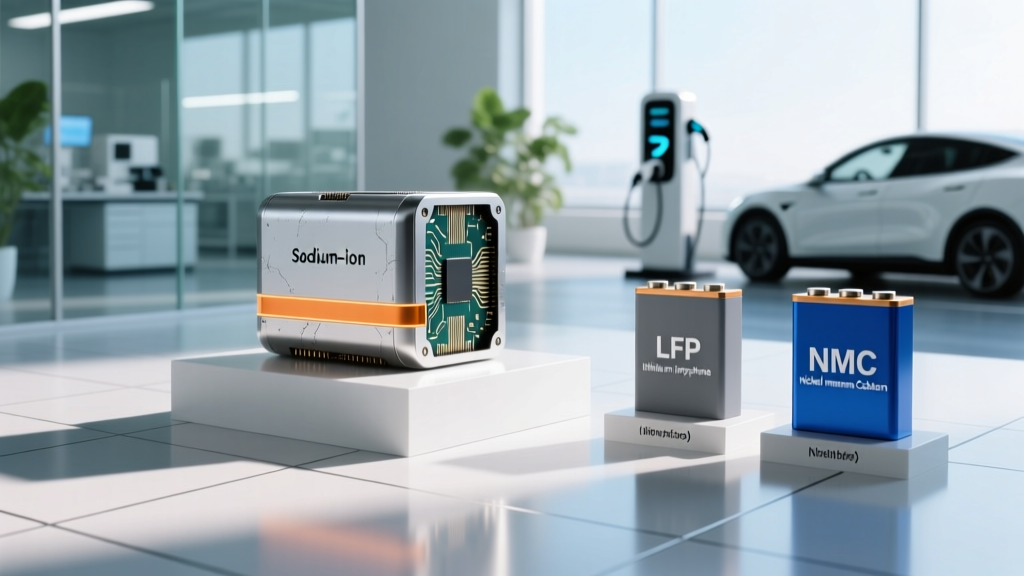
EV Battery Chemistries Compared: LFP, NMC, NCA, and Sodium-Ion
Understanding battery chemistry is the single most important factor in predicting how an EV will age, what range it delivers in winter, and how much you'll spend over a decade of ownership. Here's how the four chemistries stack up across the metrics that matter to owners.
| Attribute | NMC (Nickel-Manganese-Cobalt) | NCA (Nickel-Cobalt-Aluminum) | LFP (Lithium Iron Phosphate) | Sodium-Ion (First-Gen Commercial) |
|---|---|---|---|---|
| Cell-Level Energy Density | 220–300 Wh/kg | 240–300 Wh/kg | 150–180 Wh/kg | 120–160 Wh/kg |
| Typical Cycle Life | 1,000–2,000 cycles | 1,000–1,500 cycles | 3,000–5,000+ cycles | 3,000–4,000 cycles (projected) |
| Cold-Weather Performance | Moderate loss (~20-30% at -20°C) | Moderate loss (~20-30% at -20°C) | Higher loss (~25-35% at -20°C) | Better cold tolerance (~10-15% loss at -20°C) |
| Thermal Stability / Safety | Lower — requires robust BMS | Lower — requires robust BMS | Excellent — very resistant to thermal runaway | Excellent — inherently stable |
| Raw Material Cost (per kWh) | $90–$120 (cell-level, 2026) | $90–$120 | $55–$75 | $40–$60 (projected at scale) |
| Fast-Charge Tolerance | Good (peak 200–350 kW) | Good (peak 200–350 kW) | Good (peak 150–250 kW) | Excellent (fast charge without major degradation) |
| Common Vehicles (2026 US Market) | Hyundai Ioniq 5/6, Ford Mustang Mach-E, BMW i4, VW ID.4 | Tesla Model 3/Y Long Range, Lucid Air | Tesla Model 3/Y RWD, Ford F-150 Lightning Standard, BYD Seal | Not yet available in US-market vehicles |
LFP vs NMC — which is better and why? There is no universal winner. NMC delivers the highest energy density, meaning automakers can fit more kWh into a given pack volume — critical for long-range sedans and SUVs targeting 300+ EPA miles. LFP sacrifices roughly 30-40% of that energy density but compensates with dramatically longer cycle life (3-5× more charge cycles), lower cost, and superior thermal safety. For a daily commuter who charges to 100% regularly and plans to keep the car 10+ years, LFP is generally the smarter pick. For road-trippers who need maximum range per charge, NMC still leads.
How Long Do EV Batteries Last? Real Degradation Data
The most common question from prospective EV buyers is straightforward: how long do EV batteries last? The answer, backed by fleet data and manufacturer testing, is that most modern EV traction batteries outlast the vehicles they're installed in — but degradation is real and measurable.
Typical Capacity Retention Over Time (Industry Fleet Data)
| Milestone | NMC/NCA Average Retention | LFP Average Retention | Data Source / Context |
|---|---|---|---|
| 1 year / ~15,000 mi | 96–98% | 98–99% | Geotab fleet study, Recurrent Auto data |
| 3 years / ~45,000 mi | 92–95% | 96–98% | Recurrent Auto 2025 report |
| 5 years / ~75,000 mi | 88–93% | 94–97% | Tesla Impact Report, fleet averages |
| 8 years / ~120,000 mi | 82–90% | 90–95% | Warranty threshold benchmark |
| 10 years / ~150,000 mi | 78–87% | 88–94% | Projected from long-term fleet data |
Source context: Data aggregated from Recurrent Auto fleet monitoring of 15,000+ EVs, Tesla annual Impact Reports, and Geotab commercial fleet analysis. Individual results vary significantly based on charging habits, climate, and thermal management.
A few critical nuances:
- The degradation curve is not linear. Most batteries experience an initial "break-in" loss of 2-5% in the first year, then settle into a much slower decline of roughly 1-2% per year thereafter.
- Calendar aging matters as much as cycle aging. A garage-kept EV driven 5,000 miles/year will still lose capacity over time, especially if stored at 100% state of charge in hot climates.
- LFP's advantage compounds over time. The chemistry's flat voltage curve and inherent stability mean a 2026 Tesla Model 3 RWD (LFP) is likely to retain more usable range at year 10 than a comparable NMC pack — even though it started with fewer EPA miles.
What Does the Battery Warranty Actually Cover?
Federal law in the United States mandates that EV batteries carry a minimum warranty of 8 years or 100,000 miles (whichever comes first). In California Air Resources Board (CARB) states — which include California, New York, Massachusetts, Oregon, Washington, and several others — that mandate extends to 10 years or 150,000 miles. Most manufacturers meet or exceed these minimums.
| Manufacturer | Warranty Period | Capacity Retention Threshold | Chemistry |
|---|---|---|---|
| Tesla (Model 3/Y RWD — LFP) | 8 yr / 100,000 mi | 70% | LFP |
| Tesla (Model 3/Y Long Range — NCA) | 8 yr / 120,000 mi | 70% | NCA |
| Hyundai / Kia (Ioniq 5, EV6, EV9) | 10 yr / 100,000 mi | 70% | NMC |
| Ford (F-150 Lightning, Mach-E) | 8 yr / 100,000 mi | 70% | NMC / LFP (varies by trim) |
| General Motors (Blazer EV, Equinox EV, Silverado EV) | 8 yr / 100,000 mi | 70% (estimated) | NMC (Ultium) |
| BMW (i4, iX, i7) | 8 yr / 100,000 mi | 70% | NMC |
| Volkswagen (ID.4, ID.7) | 8 yr / 100,000 mi | 70% | NMC |
| Rivian (R1T, R1S) | 8 yr / 175,000 mi | 70% | NMC |
Key warranty details buyers miss:
- The 70% capacity retention threshold means a warranty claim is only valid if your battery degrades below 70% of its original capacity within the warranty window. If your 82 kWh pack holds 58 kWh (70.7%), you have no claim — even though you've lost nearly 30% of your range.
- Warranties typically cover defects and abnormal degradation, not damage from accidents, flooding, or unauthorized modifications.
- Some manufacturers (notably Hyundai/Kia) offer longer coverage periods, which adds genuine resale value — especially in CARB states where the 10-year/150,000-mile requirement applies.
- Always check the EPA fueleconomy.gov listing for your specific trim, as battery size and chemistry can vary even within a single model year.
EV Battery Replacement Cost: What to Expect in 2026
Here's the question that generates the most anxiety: how much does an EV battery cost to replace? The honest answer is that most EV batteries never need a full replacement — fleet data shows the vast majority retain 80%+ capacity at 150,000 miles. But when replacement is needed (due to manufacturing defect, physical damage, or extreme degradation outside warranty), the costs are significant.
| Vehicle / Pack Size | Battery Chemistry | Estimated Pack Cost (Parts) | Labor (Est.) | Total Range |
|---|---|---|---|---|
| Tesla Model 3 RWD (~60 kWh) | LFP | $8,000–$12,000 | $1,500–$3,000 | $9,500–$15,000 |
| Tesla Model Y LR (~82 kWh) | NCA | $12,000–$16,000 | $1,500–$3,000 | $13,500–$19,000 |
| Hyundai Ioniq 5 (~77.4 kWh) | NMC | $11,000–$15,000 | $2,000–$3,500 | $13,000–$18,500 |
| Ford F-150 Lightning Ext. Range (~131 kWh) | NMC | $18,000–$28,000 | $2,500–$4,000 | $20,500–$32,000 |
| Chevrolet Silverado EV (~200 kWh) | NMC (Ultium) | $25,000–$38,000 | $3,000–$5,000 | $28,000–$43,000 |
| BMW iX xDrive50 (~111.5 kWh) | NMC | $16,000–$22,000 | $2,500–$4,000 | $18,500–$26,000 |
Critical context on replacement costs:
- Most owners never pay this. The battery is covered under warranty for 8-10 years. If degradation crosses the 70% threshold within that window, the manufacturer replaces it at no cost to you.
- Cell-level pricing is falling. According to BloombergNEF's 2025 battery price survey, average lithium-ion pack prices dropped to approximately $115/kWh — down from $140/kWh in 2023. Sodium-ion cells from a commercial sodium-ion battery company could push prices below $80/kWh at scale, which would dramatically reduce future replacement costs for vehicles using that chemistry.
- Module-level repair is increasingly viable. Many modern packs (especially GM's Ultium and BMW's modular designs) allow technicians to replace individual modules rather than the entire pack, cutting costs by 50-70%.
- When is replacement typically needed? Based on current fleet data, a full pack replacement due to degradation alone is rare before 200,000+ miles. Most replacements that do occur are due to physical damage (collision, flood) or isolated manufacturing defects within the first few years.
Factors That Accelerate (or Preserve) Battery Life
Battery longevity is not purely a function of time and miles — your habits have a measurable, data-backed impact on how quickly your pack degrades. Here's what the research shows:
Battery Health Best Practices — Data-Backed Recommendations
- Avoid sustained 100% state of charge. For NMC/NCA batteries, daily charging to 80% and reserving 100% for road trips reduces degradation by an estimated 20-30% over the pack's life. LFP batteries are an exception — manufacturers like Tesla and BYD recommend periodic 100% charges for LFP to recalibrate the battery management system (BMS).
- Minimize DC fast charging frequency. Occasional fast charging (1-2x per week) has a modest impact, but daily DC fast charging at 150+ kW can accelerate degradation by 1-3% per year compared to Level 2 home charging. The heat generated during high-C-rate charging is the primary driver.
- Precondition before fast charging. Most 2026 EVs automatically precondition the battery when you navigate to a DC fast charger. This warms the cells to optimal temperature (typically 30-40°C), reducing internal resistance and stress. If your car offers manual preconditioning, always use it in cold weather.
- Avoid extreme storage states. Storing an EV at 100% SoC in high ambient temperatures (above 95°F / 35°C) for weeks accelerates calendar aging. If storing for extended periods, aim for 50-60% SoC in a cool environment.
- Let regen do the work. Aggressive acceleration and hard braking generate more heat in the battery. Using moderate regen settings and one-pedal driving reduces thermal cycling stress.
- Use a Level 2 home charger for daily charging. A 7-11 kW Level 2 charger adds roughly 25-44 miles of range per hour of charging and generates far less heat than DC fast charging. For most owners, overnight Level 2 charging is the single best thing they can do for long-term battery health.
How to Check and Monitor Your EV Battery Health (SoH)
State of Health (SoH) is the metric that tells you how much capacity your battery retains compared to its original specification. A new EV starts at 100% SoH; at 70% SoH, you'd trigger most warranty claims. Here's how to check yours:
In-Vehicle Displays
Most 2026 EVs do not display a direct SoH percentage on the dashboard. However, you can estimate it by comparing your current achievable range (at a known state of charge) to the EPA-rated range when new. For example, if your 2022 Ioniq 5 (EPA 256 mi) now shows 220 miles of projected range at 100% SoC, your approximate SoH is 220/256 = 86%.
OBD-II Diagnostic Tools
Third-party OBD-II dongles paired with apps like Car Scanner, LeafSpy (for Nissan Leaf), or manufacturer-specific tools can pull raw BMS data including actual kWh capacity, cell voltage variance, and cycle count. This is the most accurate consumer-accessible method.
Manufacturer Apps and Service Centers
Tesla's service mode (accessible through the touchscreen) shows battery health data. Hyundai, Kia, and Ford dealerships can run battery health reports during scheduled service visits. Request this report at every annual inspection — it provides a documented record useful for resale.
Third-Party Battery Health Reports
Companies like Recurrent Auto offer free battery health monitoring that connects to your vehicle's telematics and provides monthly SoH reports. This data is increasingly recognized by used-EV marketplaces and can boost resale value.
Emerging Battery Technologies: Solid-State, Silicon Anode, and Sodium-Ion
The battery landscape is evolving rapidly, but it's critical to separate what's available now from what's still in development.
Solid-State Batteries
Solid-state cells replace the liquid electrolyte with a solid material (ceramic, sulfide, or polymer), promising energy densities of 400-500 Wh/kg and improved safety. Toyota has announced a solid-state EV for 2027-2028, and Samsung SDI is targeting 2027 production. However, no solid-state EV battery is currently available in any production vehicle as of 2026. Manufacturing yield, cost, and scale remain unsolved challenges. Realistic timeline for mainstream availability: 2028-2030 at the earliest, likely debuting in premium vehicles above $80,000.
Silicon Anode Batteries
Replacing graphite anodes with silicon can boost energy density by 20-40%. Companies like Sila Nanotechnologies (partnered with Mercedes-Benz for the upcoming G-Class EV) and Group14 Technologies are commercializing silicon-dominant anode materials. Expect initial production vehicles with partial silicon anodes in 2026-2027, primarily in luxury segments. This is an incremental improvement to existing lithium-ion cells, not a full chemistry replacement.
Sodium-Ion Batteries — The Next Frontier?
This is where every sodium-ion battery company enters the conversation. Sodium-ion cells use sodium instead of lithium as the charge carrier, offering several compelling advantages:
- Abundant raw materials: Sodium is 1,000× more abundant than lithium in the Earth's crust, eliminating supply-chain bottlenecks and geopolitical risk.
- Lower cost: At scale, sodium-ion cells are projected to cost 30-40% less than LFP per kWh.
- Superior cold-weather performance: CATL's first-generation sodium-ion cells retain approximately 90% capacity at -20°C, significantly outperforming both LFP and NMC.
- Fast-charge tolerance: Sodium-ion cells can reach 80% charge in roughly 15 minutes with minimal degradation impact.
The trade-off: Energy density remains 30-45% lower than NMC, meaning sodium-ion packs will be heavier and bulkier for the same range. This makes the chemistry best suited for shorter-range city EVs (150-250 EPA miles), urban delivery vans, and stationary grid storage.
As of early 2026, CATL has begun mass-producing sodium-ion cells, and a sodium-ion battery company like HiNa Technology has partnered with Chinese automakers for initial vehicle deployments. US-market availability in a production EV is not expected before 2027-2028, and will likely debut in a budget-oriented model or a dual-chemistry pack (CATL's "AB battery" concept pairs sodium-ion and LFP modules in the same pack).
Frequently Asked Questions
How long do EV batteries last in real-world use?
Based on fleet data from Recurrent Auto and manufacturer reports, the average modern EV battery retains 85-93% of its original capacity at 100,000 miles (roughly 5-7 years of average driving). At 200,000 miles, most packs still hold 75-88% capacity. LFP batteries consistently outperform NMC/NCA in long-term retention. Full replacement before 150,000 miles is rare and usually due to defect or damage, not normal degradation.
How much does an EV battery cost to replace?
In 2026, a full battery pack replacement ranges from approximately $9,500 for a small LFP pack (Tesla Model 3 RWD, ~60 kWh) to $43,000 for a large NMC pack (Chevrolet Silverado EV, ~200 kWh). Most owners never pay this out of pocket — the federal warranty mandate covers defects and abnormal degradation for 8 years/100,000 miles minimum. Module-level repairs, where available, can reduce costs by 50-70%.
What does the battery warranty actually cover?
EV battery warranties cover capacity loss below a specified threshold (typically 70% of original capacity) and manufacturing defects for 8 years/100,000 miles (or 10 years/150,000 miles in CARB states). They do not cover damage from collisions, flooding, improper charging equipment, or unauthorized modifications. The warranty guarantees that if your battery falls below the threshold within the coverage period, the manufacturer will repair or replace it at no cost.
How do I check my EV battery's State of Health?
The most accessible methods are: (1) comparing your current maximum range at full charge to the original EPA rating, (2) using an OBD-II diagnostic tool with a compatible app to pull raw BMS data, (3) requesting a battery health report from your dealer during service, or (4) enrolling in a free telematics service like Recurrent Auto for ongoing monitoring.
LFP vs NMC — which chemistry should I choose?
Choose LFP if: you plan to keep the vehicle 8+ years, you charge at home daily and don't need 300+ miles of range, you live in a warm climate, or you want the lowest long-term degradation risk. Choose NMC/NCA if: you regularly take road trips requiring 300+ EPA miles, you need maximum range in a smaller vehicle footprint, or you live in a cold climate where NMC's slightly better cold-weather efficiency matters (though sodium-ion may eventually surpass both). Neither chemistry is universally "better" — the right choice depends on your driving pattern and ownership timeline.
Will sodium-ion batteries be available in US-market EVs?
Not in 2026. A sodium-ion battery company like CATL is already mass-producing cells for Chinese-market vehicles, but US-market adoption faces regulatory, supply-chain, and OEM integration timelines. The earliest realistic availability for a US-spec EV with sodium-ion cells is 2027-2028, likely in a budget model or as part of a dual-chemistry pack. The technology is worth watching but should not delay a purchase decision today.
Does frequent DC fast charging really damage the battery?
"Damage" is too strong, but accelerated degradation is measurable. Fleet data shows that vehicles DC fast-charged more than 3 times per week degrade approximately 1-3% faster over 5 years compared to vehicles primarily charged on Level 2. The heat generated at high charge rates (150-350 kW) stresses cell chemistry. For road trips, fast charging is perfectly fine — modern thermal management systems precondition the pack to handle it. For daily charging, Level 2 at home remains the longevity-optimal choice.
Understanding your EV's battery chemistry, monitoring its health, and adopting smart charging habits will ensure your pack delivers reliable service for well over a decade. Whether today's LFP and NMC cells or tomorrow's sodium-ion packs from an emerging sodium-ion battery company, the trajectory is clear: batteries are lasting longer, costing less, and getting smarter with every model year.