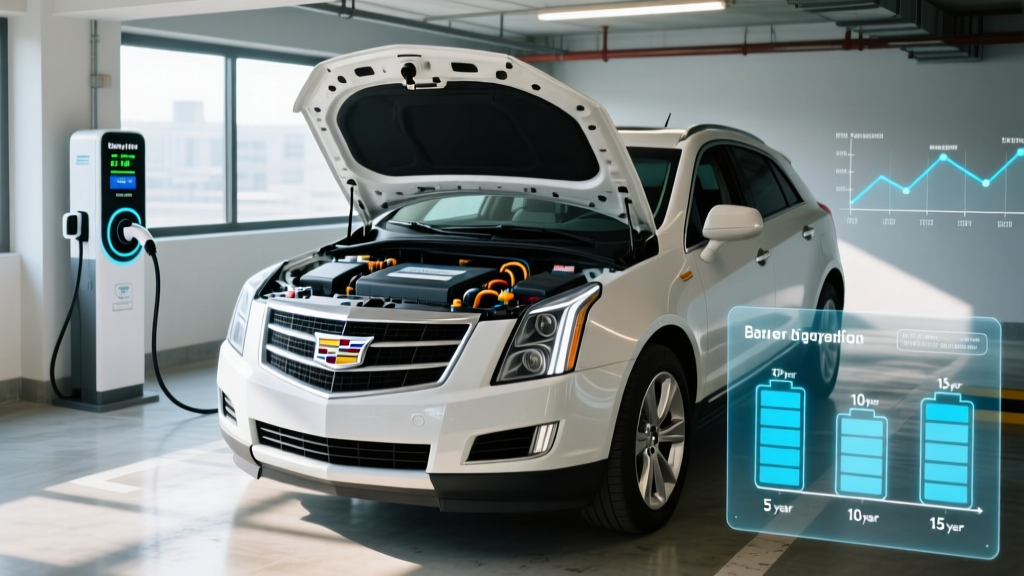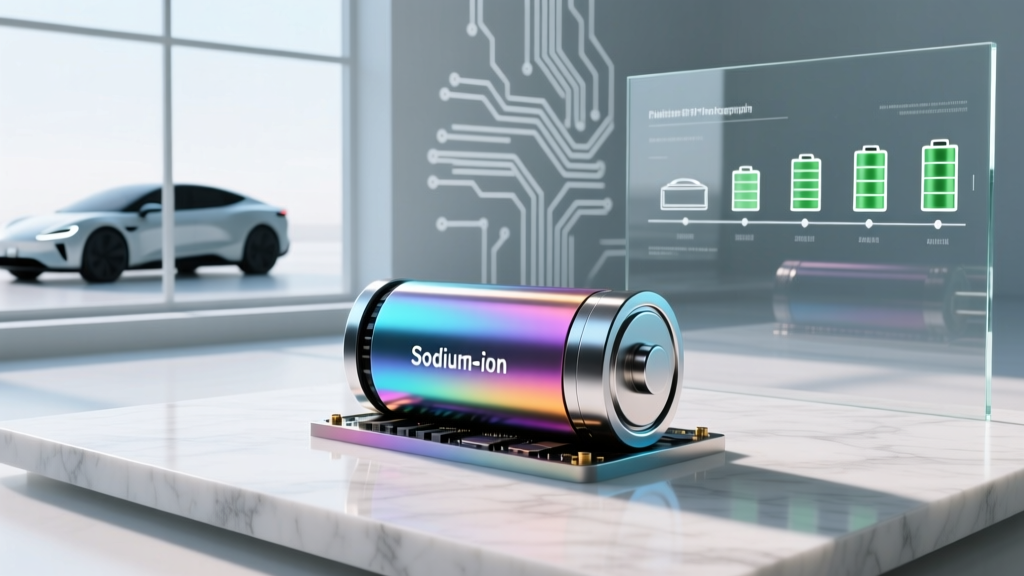
The electric vehicle battery landscape is shifting fast. While most EVs on US roads today run on lithium-ion cells — either NMC (nickel manganese cobalt) or LFP (lithium iron phosphate) — a new wave of sodium battery companies is pushing an alternative chemistry that promises lower costs, better cold-weather performance, and freedom from lithium supply constraints. CATL, BYD, HiNa Technology, and Faradion (backed by Reliance Industries) are among the players investing heavily in sodium-ion production lines.
But for EV buyers shopping today, the practical question is different: what chemistry is actually in the cars you can buy right now, how long will it last, and what happens when it degrades? This guide breaks down the battery chemistries available in 2026 model-year EVs, real-world degradation data, warranty protections, and what sodium-ion means for your next purchase.
Current EV Battery Chemistries: LFP vs NMC vs NCA
Every EV sold in the US in 2026 uses one of three lithium-ion cathode chemistries. Understanding the trade-offs is the single most important battery decision you'll make at purchase time.
| Attribute | LFP (Lithium Iron Phosphate) | NMC (Nickel Manganese Cobalt) | NCA (Nickel Cobalt Aluminum) |
|---|---|---|---|
| Energy Density | ~160-180 Wh/kg (lower) | ~220-260 Wh/kg (higher) | ~250-280 Wh/kg (highest) |
| Cycle Life | 3,000-6,000+ cycles | 1,000-2,500 cycles | 1,000-2,000 cycles |
| Cold Performance | Moderate — loses more range below freezing | Better cold tolerance | Better cold tolerance |
| Cost per kWh | ~$80-100 (lowest) | ~$120-150 | ~$130-160 |
| Safety / Thermal Runaway | Most stable — highest onset temp | Less stable than LFP | Least stable — requires robust BMS |
| Typical SoC Recommendation | Can charge to 100% regularly | Best at 80-90% daily; 100% for trips | |
| 2026 US EV Examples | Tesla Model 3 RWD, Model Y RWD, Ford Mustang Mach-E Select | Hyundai Ioniq 5, Kia EV6, VW ID.4, Rivian R1T/R1S |
The buyer's takeaway: LFP wins on longevity and cost but sacrifices range per pound — that's why it appears mostly in standard-range trims. NMC and NCA deliver the range and acceleration numbers that make headlines, but they degrade faster over time and cost more to replace. Neither is objectively "better" — the right choice depends on whether you prioritize maximum range today or maximum lifespan over a decade.
What Sodium Battery Companies Are Building — and When It Matters
Sodium-ion batteries replace lithium with sodium as the charge-carrying ion. Sodium is roughly 400x more abundant than lithium and can be sourced without the geopolitical supply-chain risks tied to lithium mining in Australia, Chile, and China.
As of 2026, the leading sodium battery companies include:
- CATL — began mass production of first-generation sodium-ion cells in China; announced for use in compact EVs and as part of a hybrid AB battery pack (sodium + lithium cells in one pack)
- BYD — developing sodium-ion cells targeting budget EV segments
- HiNa Technology — Chinese startup with pilot production lines, targeting energy storage and micro-EVs
- Faradion (Reliance) — UK-origin technology, scaling in India for two-wheelers and small EVs
- Northvolt — announced sodium-ion R&D, primarily targeting European energy storage
Where sodium stands vs lithium-ion:
- Energy density: ~120-160 Wh/kg — meaningfully lower than LFP, far below NMC
- Cost: potentially $50-70/kWh at scale, undercutting LFP by 20-30%
- Cold performance: superior — sodium cells retain ~90% capacity at -20°C vs ~70% for LFP
- Cycle life: 2,000-4,000 cycles — competitive with NMC, below LFP
Realistic timeline for US buyers: Sodium-ion will not appear in mainstream US-market EVs before 2028-2029 at the earliest. The chemistry is best suited to compact, budget-priced vehicles and energy storage — not the 300+ mile range expectations of American car buyers. If you're shopping now, lithium-ion (LFP or NMC) is what you'll drive home.
How Long Do EV Batteries Actually Last?
The fear of a $20,000 battery replacement at 80,000 miles is the single biggest psychological barrier to EV adoption. The data tells a more reassuring story.
Real-world degradation data (aggregated from fleet studies and owner reports):
| Milestone | Average Capacity Retention (NMC) | Average Capacity Retention (LFP) |
|---|---|---|
| 1 year / 15,000 miles | 96-98% | 97-99% |
| 3 years / 45,000 miles | 92-95% | 95-97% |
| 5 years / 75,000 miles | 88-92% | 92-95% |
| 8 years / 120,000 miles | 82-88% | 88-93% |
| 10 years / 150,000 miles | 78-85% | 85-90% |
Sources: Recurrent Auto fleet data, Geotab longitudinal study, manufacturer warranty thresholds. Individual results vary based on climate, charging habits, and thermal management system quality.
Key insight: Most modern EV batteries will outlast the vehicle itself. The average American keeps a car 8.4 years. At that point, even an NMC pack retains 82-88% of original capacity — meaning a 300-mile EPA vehicle still delivers 246-264 miles of range. LFP does even better. Total battery failure (sudden death) is rare; gradual capacity loss is the norm.
According to fueleconomy.gov, EV batteries are designed to last the lifetime of the vehicle, and the US Department of Energy reports that most manufacturers design for 1,000-2,000 full charge cycles before significant degradation.
EV Battery Warranty: What's Actually Covered
Federal law mandates a minimum 8-year/100,000-mile warranty on EV battery packs (10 years/150,000 miles in California and states that follow CARB standards). But the details matter enormously.
| Manufacturer | Warranty Term | Capacity Retention Threshold | Notes |
|---|---|---|---|
| Tesla (Model 3/Y LFP) | 8 yr / 100,000 mi | 70% | Covers defects + capacity below threshold |
| Tesla (Model 3/Y Long Range) | 8 yr / 120,000 mi | 70% | NMC/NCA — longer mile coverage |
| Hyundai / Kia | 10 yr / 100,000 mi | 70% | Among the longest time coverage |
| Ford (Mach-E, F-150 Lightning) | 8 yr / 100,000 mi | 70% | Components + capacity retention |
| Volkswagen (ID.4) | 8 yr / 100,000 mi | 70% | Net usable capacity threshold |
| Rivian | 8 yr / 175,000 mi | 70% | Highest mile threshold in segment |
| Chevrolet (Equinox EV, Blazer EV) | 8 yr / 100,000 mi | 60% | Note: lower threshold than competitors |
Critical fine print: The warranty triggers only when capacity drops below the stated threshold. A battery at 71% capacity at year 7 is not a warranty claim — it's normal wear. Warranties also typically exclude damage from collisions, flooding, improper charging equipment, or unauthorized modifications. Always read the specific battery warranty document, not the marketing summary.
Battery Replacement Cost: The Real Numbers
If your battery does fall below the warranty threshold — or if you're buying a used EV well past warranty coverage — replacement cost is the elephant in the room.
| Vehicle Category | Battery Size | Estimated Replacement Cost (2026) | Typical Replacement Timeline |
|---|---|---|---|
| Compact EV (e.g., Chevy Bolt, Nissan Leaf) | 60-65 kWh | $12,000 - $16,000 | Rarely needed before 200,000+ mi |
| Midsize crossover (e.g., Tesla Model Y, Ioniq 5) | 75-84 kWh | $15,000 - $22,000 | Rarely needed before 180,000+ mi |
| Large SUV / truck (e.g., F-150 Lightning, Rivian R1T) | 100-135 kWh | $20,000 - $32,000 | Rarely needed before 170,000+ mi |
| Luxury sedan (e.g., Lucid Air, Mercedes EQS) | 100-118 kWh | $22,000 - $35,000 | Rarely needed before 160,000+ mi |
Important context: These are out-of-pocket costs without warranty coverage. In practice, the vast majority of EV owners never replace their traction battery. Data from Recurrent Auto shows that fewer than 1.5% of EVs in their 15,000-vehicle study fleet required battery replacement — and most of those were early manufacturing defects covered under warranty, not end-of-life degradation.
Battery costs continue to decline. BloombergNEF reports pack-level lithium-ion prices fell below $120/kWh in 2025, and sodium-ion cells from sodium battery companies may push sub-$80/kWh pricing into the market by 2028, which would reduce future replacement costs substantially.
Factors That Accelerate — or Slow — Battery Degradation
Not all miles age a battery equally. The following factors have the largest measurable impact on long-term State of Health (SoH):
Battery Care Checklist: Maximize Your Pack's Lifespan
- Avoid sustained high SoC on NMC/NCA: Daily charging to 100% accelerates calendar aging on nickel-based chemistries. Set your charge limit to 80-90% for daily use; reserve 100% for road trips. LFP owners can charge to 100% regularly — Tesla recommends doing so at least weekly to help the BMS calibrate.
- Minimize DC fast charging frequency: Occasional road-trip fast charging is fine. But daily use of 150+ kW DC chargers generates sustained heat that stresses cells. If you can charge at home on Level 2 (7-11 kW), do so for 90%+ of your charging.
- Precondition before fast charging: Most modern EVs precondition the battery when you navigate to a charger. This brings cells to optimal temperature (~35-40°C), reducing charge time AND reducing thermal stress. Never skip preconditioning in cold weather.
- Avoid extreme SoC storage: If storing an EV for 2+ weeks, leave it at 50-60% SoC. Storing at 100% or near 0% accelerates degradation, especially in hot climates.
- Manage heat exposure: Parking in shade or a garage in hot climates (Arizona, Texas, SoCal) measurably slows calendar degradation. Battery thermal management systems help, but they can't fully offset 110°F ambient temps.
- Don't baby it too much: Driving and charging your EV normally is fine. The degradation difference between "perfect" habits and "normal" habits is typically 2-4 percentage points over 8 years — not worth the anxiety.
How to Check Your EV's Battery Health (State of Health)
State of Health (SoH) is the percentage of original capacity your battery retains. A new pack is 100% SoH; at 70% SoH, your 300-mile EV delivers roughly 210 miles of range.
Methods to check SoH in 2026:
- In-vehicle battery health display: Tesla, Hyundai/Kia, and BMW now show SoH percentage or a health bar in the vehicle settings menu. Tesla added a Battery Health test under Service mode in 2025 software updates.
- OBD-II diagnostic apps: Tools like LeafSpy (Nissan), Scan My Tesla, or OBDeleven (VW Group) read the BMS directly and report SoH, cell voltage spread, and cycle count. Cost: $20-50 for the adapter, free or $10 for the app.
- Dealer diagnostic check: Any authorized service center can run a battery health report. Some charge $50-150; others provide it free during routine service. Request this before buying any used EV.
- Third-party services: Companies like Recurrent and AVILOO offer remote battery health assessments using telematics data — useful for pre-purchase inspections on used EVs.
What to look for: A healthy battery shows SoH decline of roughly 1-2% per year in moderate climates, or 2-3% per year in extreme heat. Cell voltage spread (the difference between the highest and lowest cell in the pack) should be under 50 mV at rest. Larger spreads indicate cell imbalance that may warrant service.
Emerging Battery Technologies: Solid-State, Silicon Anode, and Beyond
Beyond sodium battery companies pushing lower-cost cells, several next-generation technologies are in development. Here's where each stands as of 2026:
- Solid-state batteries: Toyota, Samsung SDI, and QuantumScape have prototype cells with energy densities exceeding 350 Wh/kg — roughly 50% more than today's best NMC. Toyota has announced limited production in select 2028-2029 models, but mass-market availability remains 2030+ at earliest. Manufacturing yield and cost remain unsolved challenges.
- Silicon-dominant anodes: Companies like Sila Nanotechnologies and Group14 are replacing graphite anodes with silicon, boosting energy density by 10-20%. The Mercedes G-Class 580e (2025) uses Sila's silicon anode cells. Expect broader adoption in 2027-2028 premium models.
- Lithium-sulfur: Theoretical energy density is 3-5x lithium-ion, but cycle life remains below 200 cycles in lab settings. Commercial EV application is likely 2032+.
Bottom line on future tech: None of these are available in a vehicle you can buy today. Plan your 2026 purchase around current LFP or NMC chemistries — both are proven, well-warrantied, and backed by real-world degradation data spanning hundreds of thousands of vehicles.
Frequently Asked Questions
How long do EV batteries last in years and miles?
Most modern EV batteries retain 85-93% capacity at 10 years / 150,000 miles depending on chemistry (LFP outperforms NMC). The battery will typically outlast the vehicle. Full failure is rare — expect gradual range loss, not sudden death.
How much does an EV battery cost to replace?
Out-of-warranty replacement ranges from $12,000 for a compact EV (60 kWh) to $32,000+ for a large truck or luxury sedan (100+ kWh). However, fewer than 2% of EVs require battery replacement, and most failures occur within the warranty period.
What does the EV battery warranty cover?
Federal law requires at minimum 8 years / 100,000 miles of coverage. Warranties cover manufacturing defects and capacity loss below a stated threshold (typically 70% of original capacity, though Chevrolet uses 60%). They do not cover collision damage, improper charging, or normal degradation above the threshold.
How do I check and maximize my EV battery health?
Check SoH via the in-vehicle display, OBD-II apps, or dealer diagnostics. Maximize lifespan by charging NMC/NCA to 80-90% daily (LFP to 100%), minimizing DC fast charging, preconditioning before fast charges, and avoiding extreme SoC during long storage.
LFP vs NMC — which battery chemistry is better?
LFP offers longer cycle life (3,000-6,000 cycles), lower cost, better safety, and the ability to charge to 100% daily — but has lower energy density and worse cold-weather performance. NMC delivers more range per kWh and better cold tolerance but degrades faster and costs more. Choose LFP for daily commuting longevity; choose NMC if you need maximum range for road trips.
Will sodium batteries from sodium battery companies replace lithium-ion?
Not in mainstream US EVs before 2028-2029. Sodium-ion offers lower cost and better cold performance but significantly lower energy density (~120-160 Wh/kg vs 220-260 for NMC). It's best suited for budget compact EVs and stationary energy storage. Lithium-ion remains the practical choice for current buyers.
For official EV efficiency and range data, visit fueleconomy.gov. For current federal EV tax credit rules under IRS §30D, see irs.gov clean vehicle credits.