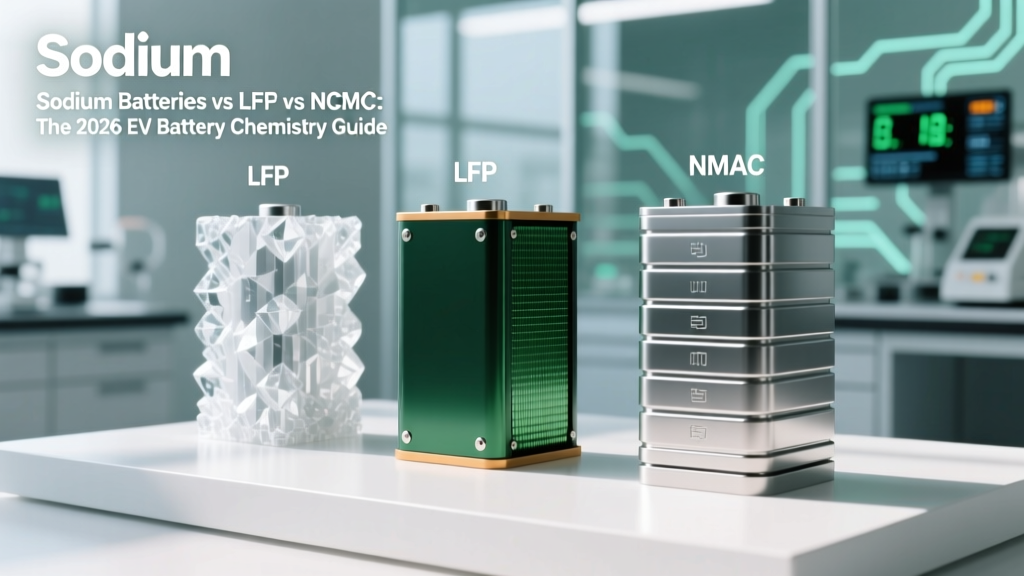
If you have been following EV battery headlines, you have likely seen the term sodium batteries (more precisely, sodium-ion or Na-ion cells) surface as the next big thing in energy storage. Chinese automakers like BYD and Chery have begun fitting sodium-ion packs into affordable city EVs, and CATL — the world's largest battery manufacturer — has committed to scaling Na-ion production through 2026 and beyond. But for US-based EV shoppers and owners, the practical question is different: how do sodium batteries stack up against the lithium-ion chemistries actually available in vehicles you can buy today?
This guide breaks down the three main EV battery chemistries heading into 2026 — NMC/NCA (nickel manganese cobalt / nickel cobalt aluminum), LFP (lithium iron phosphate), and the emerging sodium-ion — with hard data on degradation, warranty coverage, replacement costs, and daily care. Whether you are deciding between a Tesla Model 3 RWD (LFP) and a Long Range (NMC), or just wondering whether to wait for sodium, the numbers below will frame your decision.
The Three Chemistries: NMC, LFP, and Sodium-Ion Compared
Every EV battery is defined by its cathode chemistry, which determines energy density (how many kWh fit in a given weight and volume), cycle life (how many full charge-discharge cycles before meaningful degradation), thermal stability, cold-weather behavior, and raw-material cost. Here is how the three main options compare on paper and in practice.
| Attribute | NMC / NCA | LFP | Sodium-Ion (Na-ion) |
|---|---|---|---|
| Energy density (cell-level) | 250–300 Wh/kg | 150–180 Wh/kg | 120–160 Wh/kg |
| Typical cycle life | 1,000–2,000 cycles | 3,000–5,000+ cycles | 2,000–4,000 cycles (estimated) |
| Cold performance (capacity at -20°C / -4°F) | ~70–75% retention | ~55–65% retention | ~85–90% retention (lab data) |
| Thermal stability / safety | Good; requires robust BMS | Excellent; very resistant to thermal runaway | Excellent; can be stored/discharged to 0V safely |
| Key raw materials | Lithium, nickel, cobalt, manganese | Lithium, iron, phosphate | Sodium, iron, manganese (no lithium or cobalt) |
| Relative cell cost (2026) | Highest (~$110–130/kWh) | Mid (~$70–90/kWh) | Lowest target (~$50–70/kWh at scale) |
| Current US vehicle availability | Wide (Tesla LR, Hyundai, BMW, Ford, Rivian) | Growing (Tesla RWD, Ford base Mach-E, some BYD imports) | Not yet in US-market vehicles |
The takeaway is a clear trade-off triangle. NMC/NCA wins on energy density — it is why a Tesla Model Y Long Range can pack ~75 kWh of usable capacity and hit an EPA-estimated 310+ miles in a midsize crossover. LFP wins on longevity and cost, which is why Tesla uses it in the standard-range Model 3 and Model Y and recommends owners charge to 100% daily. Sodium-ion wins on raw-material cost and cold-weather performance, but its lower energy density limits it to shorter-range, lighter vehicles for now.
LFP vs NMC: Which Chemistry Is Better for You?
For US buyers in 2026, the real purchase decision is between LFP and NMC. Sodium-ion is not yet in stateside showrooms, so treat any Na-ion vehicle as announced/preliminary for the American market.
Choose NMC/NCA if: You need maximum EPA range in a given vehicle class, you regularly drive 300+ miles between charges, or you are buying a larger vehicle (truck, three-row SUV) where packing enough kWh with LFP would make the pack prohibitively heavy. The Tesla Model 3 Long Range AWD (75 kWh NMC, EPA 341 mi), Hyundai Ioniq 5 Long Range (77.4 kWh NMC, EPA 303 mi), and Rivian R1T Dual-Motor (141 kWh NMC, EPA 352 mi) all rely on NMC's density advantage.
Choose LFP if: You want maximum cycle life, you mostly charge at home and can top off to 100% daily without degradation guilt, or you are prioritizing lower purchase price. The Tesla Model 3 RWD (60 kWh LFP, EPA 272 mi) and base Ford Mustang Mach-E Select (70 kWh LFP, EPA 250 mi) are strong examples. LFP's main penalty is range-per-kWh and cold-weather capacity loss — expect roughly 30–40% range reduction in sustained sub-freezing driving versus NMC's 25–30%.
How Long Do EV Batteries Actually Last?
The short answer: almost certainly longer than you will own the car. Real-world fleet data consistently shows modern lithium-ion packs losing capacity gradually, not catastrophically, with most retaining well above 80% of original capacity past 150,000 miles.
Typical degradation trajectory (fleet averages, lithium-ion):
- Year 1 / 15,000 mi: ~2–3% loss (initial formation drop, then plateau)
- Year 3 / 45,000 mi: ~5–7% total loss
- Year 5 / 75,000 mi: ~7–10% total loss
- Year 8 / 120,000 mi: ~10–15% total loss
- Year 10+ / 150,000+ mi: ~12–20% total loss (highly usage-dependent)
Sources: Geotab fleet study of 6,300+ EVs; Tesla Impact Reports showing median <12% degradation at 200,000 miles for Model S/X NCA packs.
LFP packs generally degrade more slowly than NMC in calendar and cycle terms, which is why Tesla explicitly recommends daily 100% charging for its LFP vehicles — something that would accelerate wear in NMC. Sodium-ion, based on early CATL and HiNa data, is expected to land between the two, with strong cycle life but still maturing field data.
What the Battery Warranty Actually Covers
Federal law (EPA emissions-warranty precedent and CARB-influenced rules in states like California) pushes automakers toward robust battery coverage, and most brands exceed the minimum. The industry standard is 8 years / 100,000 miles (10 years / 150,000 miles in CARB states) with a capacity-retention threshold of 70%. If your pack falls below that threshold during the warranty period, the manufacturer must repair or replace it at no cost.
| Automaker (2026 models) | Battery warranty | Capacity threshold | Notes |
|---|---|---|---|
| Tesla (Model 3/Y RWD, LFP) | 8 yr / 120,000 mi | 70% | Longer mileage than LR/Performance trims |
| Tesla (Model 3/Y LR, NMC) | 8 yr / 120,000 mi | 70% | |
| Hyundai / Kia (Ioniq 5/6, EV6/9) | 10 yr / 100,000 mi | 70% | Among the longest term in the US |
| Ford (Mustang Mach-E, F-150 Lightning) | 8 yr / 100,000 mi | 70% | |
| Rivian (R1T, R1S) | 8 yr / 175,000 mi | 70% | Highest mileage cap in the segment |
| GM (Chevy Equinox EV, Blazer EV, Silverado EV) | 8 yr / 100,000 mi | 70% | Ultium NMC packs |
| BMW (i4, iX, i5) | 8 yr / 100,000 mi | 70% |
Critical fine print: warranties cover defects and abnormal degradation, not cosmetic range loss from normal aging above the threshold. They also typically exclude damage from collisions, flooding, improper modifications, or use as a stationary power source outside approved V2H/V2L configurations. Read your specific warranty booklet — not the brochure.
EV Battery Replacement Cost: What to Budget (and When)
Replacement cost is the single biggest fear among prospective EV buyers, and it is also the most misunderstood. The vast majority of EVs are retired, sold, or totaled in accidents before their traction battery needs replacement. But if you are planning a 15-year ownership horizon or buying used out of warranty, here is what out-of-pocket replacement looks like in 2026.
| Vehicle (example) | Pack size / chemistry | Replacement cost range (parts + labor) |
|---|---|---|
| Tesla Model 3 RWD | ~60 kWh LFP | $12,000–$16,000 |
| Tesla Model Y Long Range | ~75 kWh NMC | $16,000–$22,000 |
| Hyundai Ioniq 5 | 77.4 kWh NMC | $15,000–$20,000 |
| Ford F-150 Lightning Extended Range | 131 kWh NMC | $25,000–$35,000 |
| Rivian R1T Max Pack | 141 kWh NMC | $28,000–$38,000 |
| Chevy Bolt EV (used, out of warranty) | 65 kWh NMC | $9,000–$14,000 |
Two mitigating factors: (1) Module-level repair is increasingly common. Many packs are built from 8–16 modules, and a single degraded or failed module can often be swapped for $2,000–$5,000 rather than replacing the entire pack. (2) Cell prices continue to fall. Pack-level pricing has dropped from ~$200/kWh in 2020 to roughly $100–130/kWh for NMC and $70–90/kWh for LFP in 2026, and sodium-ion is targeting sub-$60/kWh as production scales. A replacement pack in 2032 will almost certainly cost less than today's, not more.
Five Factors That Actually Shorten Battery Life
Chemistry sets the ceiling, but your habits determine where your pack lands on the degradation curve. Based on fleet data and OEM guidance, these are the behaviors with measurable impact:
- Chronic 100% SoC parking (NMC/NCA): Storing an NMC pack at full charge for days or weeks accelerates calendar aging. For daily commuting, set the charge limit to 80–90% and only charge to 100% when you will drive immediately. LFP is the exception — Tesla and BYD recommend 100% at least weekly to keep the BMS calibrated.
- Deep discharges below 10% SoC: Regularly draining the pack to near-zero stresses the cells. The low-SoC buffer (usually 2–4 kWh hidden below the "0%" display) protects against true damage, but repeated deep cycles still add wear. Plug in when you hit 15–20%.
- Exclusive DC fast-charging: Packs charged primarily on DCFC (150–350 kW) show measurably more degradation than packs charged primarily on Level 2 (7–19 kW). Tesla's own data suggests the difference is modest (~2–3% additional loss at 100,000 miles) but real. Use Level 2 as your daily charger; reserve DCFC for road trips.
- Extreme heat exposure: Sustained ambient temperatures above 95°F / 35°C, especially combined with high SoC, accelerate electrolyte breakdown. If you live in Phoenix or Las Vegas, park in shade or a garage when possible, and precondition while plugged in.
- Extreme cold without preconditioning: Charging a cold pack (below ~32°F / 0°C) without thermal preconditioning risks lithium plating on the anode, which causes permanent capacity loss. Always precondition before DC fast-charging in winter — most modern EVs do this automatically when you navigate to a charger.
How to Check and Monitor Battery Health (SoH)
State of Health (SoH) is the percentage of original capacity your pack can still hold. A brand-new pack is 100% SoH; one that held 75 kWh when new and now holds 67.5 kWh is at 90% SoH.
OEM tools: Tesla displays battery health indirectly through the range estimate at 100% charge compared to the original EPA figure. Hyundai/Kia's infotainment includes an EV battery-status screen showing recent efficiency and a health indicator. Ford's Pass app reports estimated range trends.
Third-party diagnostics: Services like Recurrent Auto (free enrollment, passive data collection) provide a detailed SoH score benchmarked against similar vehicles. Independent shops with tools like AVILOO or OEM scan tools can run a full capacity test — typically a controlled discharge from 100% to 0% while logging actual kWh delivered. This is the gold standard and costs $150–$300 at a specialist.
DIY check: Charge to 100% on Level 2, immediately drive to near-zero under normal conditions, and log the kWh consumed via your charger's meter or the car's trip computer. Compare to the pack's original usable capacity. Do this once or twice a year for a trend line. Note: this is less precise than a controlled test, but it catches major deviations.
Sodium Batteries: Where the Technology Actually Stands in 2026
Sodium-ion batteries use abundant, cheap sodium instead of lithium in the cathode and typically a hard-carbon anode. The chemistry eliminates lithium, cobalt, and nickel entirely — a major supply-chain and cost advantage. CATL's first-generation Na-ion cells (announced 2021, in production since 2023–2024) deliver roughly 160 Wh/kg at the cell level, with second-generation cells targeting 200 Wh/kg.
In China, sodium-ion packs are already appearing in affordable micro-EVs and compact cars from BYD, Chery, and JAC, typically in vehicles priced under $15,000 USD equivalent with 150–250 km (90–155 mi) of range. CATL has also introduced an AB battery architecture that mixes LFP and Na-ion cells in a single pack — LFP modules for energy density, Na-ion modules for cold performance and cost — a pragmatic bridge strategy.
For US buyers, sodium-ion is not yet available in any production vehicle as of early 2026. The barriers are manufacturing scale (no Na-ion gigafactories in North America), energy-density limitations that clash with American range expectations (300+ mi EPA is the market norm), and the fact that LFP prices have fallen fast enough to blunt sodium's cost advantage in the near term. Realistically, expect sodium-ion to appear first in US-market energy storage systems and commercial fleet vehicles before reaching consumer cars — likely in the 2028–2030 timeframe, and initially in budget-oriented or urban-focused models.
Beyond Sodium: Solid-State and Silicon-Anode Timelines
Two other emerging chemistries deserve context, marked clearly as forward-looking:
Solid-state batteries replace the liquid electrolyte with a solid ceramic or polymer layer, promising 400+ Wh/kg energy density, faster charging, and near-zero fire risk. Toyota, Nissan, and Samsung SDI have announced solid-state pilot production for 2027–2028, with limited vehicle deployment expected around 2028–2030. Cost and manufacturing yield remain unsolved at scale. Treat any claim of "solid-state EVs on sale now" as either misleading or referring to semi-solid hybrid designs (e.g., NIO's 150 kWh semi-solid pack in China, which still uses liquid electrolyte in part).
Silicon-anode cells (used by startups like Sila Nanotechnologies and Group14) replace the graphite anode with silicon-dominant material, boosting energy density 15–25% without changing the cathode. These are already shipping in limited applications (Mercedes G-Class 580e prototype, consumer electronics) and are expected to appear in production EVs in the 2026–2028 window as an incremental improvement to existing NMC/NCA cells rather than a wholesale chemistry change.
Frequently Asked Questions
How long do EV batteries last in years and miles?
Most modern EV batteries are engineered to outlast the vehicle itself. Fleet data from Geotab and OEM reports show typical lithium-ion packs retaining 85–90% of original capacity at 100,000 miles and 75–85% at 200,000 miles. LFP packs generally last longer in cycle terms than NMC. In calendar years, expect 15–20+ years of usable service under normal ownership.
How much does it cost to replace an EV battery?
Out-of-warranty replacement ranges from roughly $9,000 for a small pack (Chevy Bolt EV, ~65 kWh) to $35,000+ for a large truck pack (F-150 Lightning Extended Range, 131 kWh). However, most packs never need full replacement — module-level repair ($2,000–$5,000) is increasingly common, and cell prices continue to fall. The vast majority of EVs are retired or sold before the pack fails.
What does the EV battery warranty cover?
The industry standard is 8 years / 100,000 miles (10 yr / 150,000 mi in CARB states) with a 70% capacity-retention threshold. If your pack degrades below that level during the warranty period, the automaker covers repair or replacement. Warranties do not cover collision damage, flooding, unauthorized modifications, or normal capacity loss that remains above the threshold.
How do I check my EV's battery health?
Three approaches: (1) Monitor the displayed range at 100% charge over time and compare to the original EPA figure. (2) Use a third-party service like Recurrent Auto for a benchmarked SoH score. (3) Have a qualified shop perform a controlled full-discharge capacity test (~$150–$300). For a DIY trend check, log kWh consumed on a full 100%-to-near-0% drive twice a year.
LFP vs NMC — which is better?
Neither is universally better; it depends on your use case. NMC offers higher energy density and more range per kWh, making it ideal for long-range and large vehicles. LFP offers longer cycle life, better thermal safety, lower cost, and the ability to charge to 100% daily without accelerated wear — ideal for daily commuters with home charging. If range is your top priority, pick NMC. If longevity and cost are, pick LFP.
Are sodium-ion batteries available in US EVs yet?
No. As of early 2026, sodium-ion batteries are in production for Chinese-market affordable EVs and energy storage but are not available in any US-market vehicle. Expect potential US consumer-vehicle adoption in the 2028–2030 timeframe, likely in budget or urban-focused models first.