The Chevrolet Silverado EV rides on GM's Ultium platform, which gives it one of the largest traction batteries available in any production electric truck. For 2026, Chevy offers the Silverado EV with two primary battery configurations, and understanding the difference between them — along with the chemistry inside, realistic degradation expectations, and long-term replacement economics — is essential before you sign a purchase order.
This guide breaks down every Silverado EV battery size available, the NMC chemistry that powers them, and what you can actually expect over 100,000+ miles of ownership. We'll also cover the broader EV battery landscape so you can contextualize how the Silverado's pack compares.
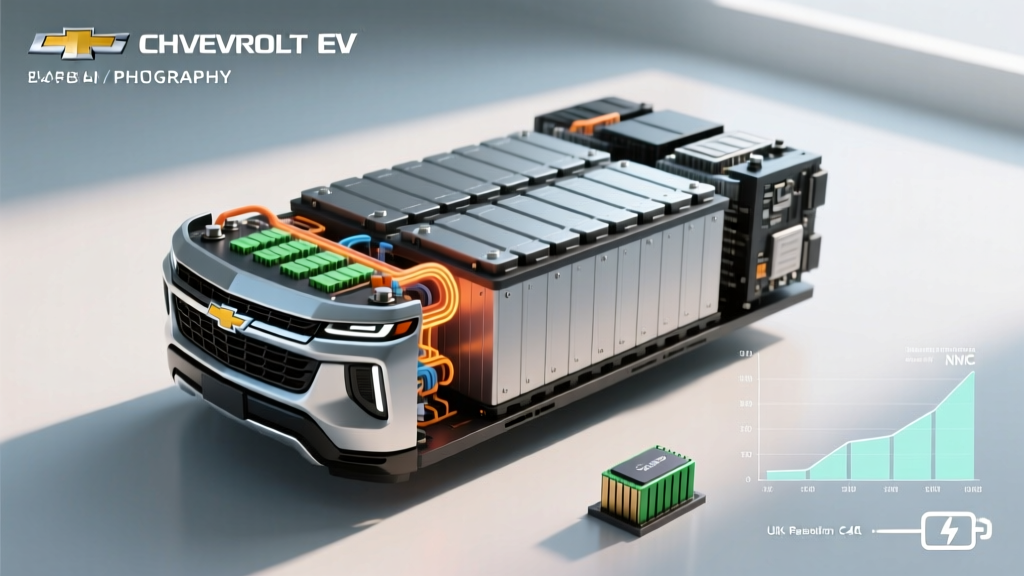
Silverado EV Battery Sizes: 200 kWh vs. 205 kWh Ultium Packs
GM's Ultium architecture uses a modular, pouch-cell design that allows the same basic platform to scale across vehicles from the Cadillac Lyriq to the GMC Hummer EV. In the Silverado EV, two pack sizes are currently in production for the 2026 model year:
| Specification | Standard Pack (WT / Fleet) | Max Range Pack (RST / 4WT) |
|---|---|---|
| Usable Capacity | ~200 kWh | ~205 kWh |
| Chemistry | NMC (Nickel Manganese Cobalt) | NMC (Nickel Manganese Cobalt) |
| Cell Format | Ultium pouch cells | Ultium pouch cells |
| EPA Range | ~360 mi (WT 4WT trim) | ~440 mi (4WT Extended Range) |
| Real-World Highway Range | ~290–320 mi | ~350–390 mi |
| Max DC Fast Charge Rate | ~270 kW (peak) | ~350 kW (peak) |
| 10–80% DC Fast Charge | ~45 min | ~38 min |
| Level 2 Charge Rate (AC) | 11.5 kW (standard) / 19.2 kW (available) | 19.2 kW |
| Thermal Management | Liquid-cooled and heated | Liquid-cooled and heated |
| Estimated Pack Weight | ~2,400 lbs | ~2,600 lbs |
The 200 kWh pack is standard on Work Truck (WT) and some fleet-oriented trims. The 205 kWh Max Range pack is available on the RST and higher-spec 4WT Extended Range models. Both use the same fundamental NMC pouch-cell chemistry, but the Max Range pack uses a denser cell arrangement and a slightly revised module configuration to squeeze out additional capacity.
Ultium NMC Chemistry: What's Inside the Silverado EV Battery
GM's Ultium platform uses a variant of NMC (nickel manganese cobalt) chemistry in its pouch cells. This is the same chemistry family used by most long-range EVs from manufacturers including Tesla (Model 3/Y Long Range), Ford (F-150 Lightning Extended Range), and Hyundai (Ioniq 5). It's worth understanding why GM chose NMC over LFP (lithium iron phosphate) for the Silverado EV, and what the trade-offs mean for your ownership experience.
| Attribute | NMC (Silverado EV / Ultium) | LFP (e.g., Tesla Model 3 RWD, Rivian Standard) |
|---|---|---|
| Energy Density | High (~250–300 Wh/kg cell-level) | Moderate (~160–200 Wh/kg cell-level) |
| Typical Cycle Life | 1,000–2,000 full cycles | 3,000–5,000+ full cycles |
| Cold-Weather Performance | Better low-temp capacity retention | More capacity loss below freezing |
| Cost per kWh | Higher (cobalt/nickel supply cost) | Lower (iron/phosphate are abundant) |
| Thermal Stability | Good; requires active management | Excellent; inherently more stable |
| Recommended Charge Habit | 20–80% daily; 100% only when needed | OK to charge to 100% regularly |
| Best For | Max range per pound; heavy trucks, long-range sedans | Standard-range vehicles; high-mileage fleet use |
For a full-size electric truck like the Silverado EV, NMC makes engineering sense. The Silverado already weighs over 8,700 pounds in some trims; using LFP cells (which are heavier for the same energy capacity) would push weight higher and reduce payload and efficiency. NMC's superior energy density is what enables the 440-mile Max Range pack to exist at all within the vehicle's physical footprint.
The trade-off is that NMC cells are more sensitive to sustained high states of charge. GM's battery management system (BMS) handles much of this automatically, but owners should understand that daily charging to 100% accelerates NMC degradation. Setting your charge limit to 80% for daily use — and saving 100% for road trips — is the single most impactful thing you can do for pack longevity.
Battery Degradation: What the Data Actually Shows
EV battery degradation is not a cliff — it's a gradual, mostly predictable curve. Most lithium-ion packs lose capacity fastest in the first year or two (typically 2–5%), then the rate of loss flattens significantly for the remainder of the battery's life.
- Year 1 / 15,000 mi: ~2–3% capacity loss (initial formation losses)
- Year 3 / 45,000 mi: ~5–7% total loss from new
- Year 5 / 75,000 mi: ~7–10% total loss from new
- Year 8 / 100,000 mi: ~10–15% total loss from new
- Year 10 / 150,000 mi: ~12–18% total loss from new (varies widely by use pattern)
Sources: Geotab fleet battery health study, Recurrent Auto battery degradation data. Note: These are aggregated figures across multiple NMC-equipped vehicles. Individual results vary based on climate, charging habits, and DC fast-charging frequency.
For the Silverado EV specifically, long-term fleet data is still accumulating — the truck only went on sale for the 2024 model year. However, GM's Ultium cells share fundamental chemistry with packs that have been in the Chevrolet Bolt EV/EUV since 2017 (albeit in a different form factor). Bolt packs have shown roughly 8–12% degradation at 100,000 miles in owner-reported data, which gives a reasonable baseline expectation for Ultium NMC pouches under similar use patterns.
With the Silverado EV's 200+ kWh pack, even 15% degradation still leaves you with roughly 170–175 kWh of usable capacity — enough for approximately 310–375 miles of real-world range depending on the original pack size. That's still more range than most EVs on the road when new.
Silverado EV Battery Warranty: What GM Covers
GM provides a battery warranty that meets and slightly exceeds the federal minimum. Here are the exact terms for the 2026 Silverado EV:
| Warranty Component | Coverage |
|---|---|
| Duration | 8 years / 100,000 miles (whichever comes first) |
| Capacity Retention Threshold | 70% of original usable capacity |
| What Triggers a Claim | Battery falls below 70% SoH as measured by GM diagnostic tools |
| What's Covered | Battery module repair or replacement to restore above 70% capacity |
| What's NOT Covered | Damage from accidents, flooding, unauthorized modifications, or improper charging equipment |
| Transferable? | Yes — transfers to subsequent owners automatically |
| Powertrain Warranty | 5 years / 60,000 miles (motors, inverters, reduction gears) |
The 70% threshold is industry-standard. Tesla, Ford, Rivian, and Hyundai all use similar benchmarks. In practice, it is quite rare for a modern liquid-cooled NMC pack to drop below 70% within 8 years/100,000 miles under normal use. The warranty is there as a backstop, but most owners will never need to file a claim.
One important nuance: GM's warranty covers capacity degradation, not just complete failure. If your Silverado EV's battery diagnostic shows 68% State of Health at 90,000 miles, GM is obligated to repair or replace modules to bring it back above the threshold. This is different from some early EV warranties that only covered total pack failure.
EV Battery Replacement Cost: Silverado EV and Industry Context
This is the question that keeps prospective EV buyers up at night — and it deserves an honest, data-driven answer rather than fear-mongering headlines.
| Vehicle | Battery Size | Estimated Full Replacement Cost | Module-Level Repair Cost |
|---|---|---|---|
| Chevrolet Silverado EV (Standard) | ~200 kWh | $25,000–$35,000 (out of warranty) | $2,500–$6,000 per module |
| Chevrolet Silverado EV (Max Range) | ~205 kWh | $28,000–$38,000 (out of warranty) | $2,500–$6,000 per module |
| Ford F-150 Lightning (Extended Range) | ~131 kWh | $18,000–$25,000 | $2,000–$5,000 per module |
| Tesla Model 3 Long Range | ~82 kWh | $12,000–$16,000 | Varies by module |
| Chevrolet Bolt EV | ~65 kWh | $9,000–$14,000 | $1,500–$3,500 per module |
| Hyundai Ioniq 5 | ~77.4 kWh | $11,000–$15,000 | $2,000–$4,000 per module |
Several critical points about these numbers:
- Most owners will never pay this. The vast majority of modern EV batteries outlast their vehicles. Data from Recurrent Auto shows that fewer than 1.5% of EV batteries across all brands have been replaced outside of recalls as of 2025.
- Module-level repair is the norm. The Ultium platform was specifically designed for module-level service. If one section of the pack degrades unevenly, a technician can replace individual modules rather than the entire pack — dramatically reducing cost.
- Prices are falling. Battery pack costs have dropped roughly 80% since 2013 on a per-kWh basis. By the time a 2026 Silverado EV is out of warranty in 2034, replacement pack costs will almost certainly be substantially lower than today's estimates.
- Warranty covers the early years. If a defect causes premature degradation within 8 years/100,000 miles, GM covers it.
Maximizing Silverado EV Battery Life: What Actually Works
Battery longevity is not mysterious — it's physics and chemistry. Here's what the data says about the factors that most impact NMC cell lifespan, and what you should do about each one.
- Set daily charge limit to 80%. NMC cells experience the most stress above 80% and below 20% SoC. Use the MyChevrolet app or in-vehicle settings to set a daily charge target of 80%. Charge to 100% only before long trips.
- Minimize DC fast charging when possible. Occasional DC fast charging (road trips) is fine. Daily DC fast charging at 200+ kW generates sustained heat that accelerates degradation. If you rely on public charging daily, choose Level 2 (7–19 kW) whenever your schedule allows.
- Precondition before fast charging. The Silverado EV's navigation system can precondition the battery when you route to a DC fast charger. This warms the cells to the optimal temperature window (roughly 77–95°F / 25–35°C), enabling faster charging and reducing thermal stress. Always use nav-to-charger when possible.
- Avoid prolonged storage at extreme SoC. If the truck will sit unused for more than a week, leave it plugged in with the charge limit set to 50–60%. Do not store it at 100% or near 0%.
- Use the battery's thermal management system. In cold climates, plug in whenever possible so the truck can use grid power to warm the battery rather than draining the pack. The Silverado EV's heat pump and liquid heating loop are most effective when the truck is plugged in.
- Don't baby it too much. Occasional 100% charges, fast charging on road trips, and cold-weather driving will not destroy your battery. Modern BMS systems have large buffers (typically 5–10 kWh reserved above and below the displayed SoC range). Normal use is fine — just avoid habitual extremes.
Factors That Accelerate Degradation (Ranked by Impact)
- Sustained high SoC (above 90%) + high temperatures: The worst combination. Parking a fully charged Silverado EV in 100°F+ heat for days at a time is the single most damaging thing you can do.
- Very frequent DC fast charging: Daily 350 kW sessions generate substantial heat. Fleet data shows vehicles that DC fast charge more than 80% of the time degrade roughly 1–3% faster over 5 years than those that primarily use Level 2.
- Deep cycling (regularly running to near 0%): Running the pack down below 10% frequently stresses cells more than partial cycles. Try to charge before you drop below 20%.
- Extreme cold without preconditioning: Charging a cold battery (below 32°F) at high power can cause lithium plating on the anode. The Silverado's BMS limits charge rate when cold, but preconditioning eliminates the risk entirely.
Checking Battery Health: How to Monitor Your Silverado EV's SoH
GM provides several ways to check your battery's State of Health (State of Health = current maximum capacity as a percentage of original capacity):
- MyChevrolet App: The app includes a battery health indicator that shows estimated remaining capacity. This is updated periodically based on full charge cycles.
- Dealer Diagnostic Scan: Any Chevrolet dealer can run a full battery diagnostic that reads individual module voltages, internal resistance, and overall SoH. Request this during routine service visits — it's typically free under warranty.
- Full charge cycle method: Charge the truck to 100% and note the displayed range. Compare it to the original EPA-rated range when new (adjusted for the buffer). A 2026 Silverado EV 4WT that originally displayed 440 miles at 100% but now shows 400 miles has experienced roughly 9% degradation. This isn't perfectly precise (the displayed range estimate also factors in recent driving efficiency), but it gives a useful trend line.
- OBD-II tools: Third-party apps like LeafLogix or Torque Pro (with appropriate EV PIDs) can read battery management data through the OBD-II port, though GM's Ultium platform support in aftermarket tools is still expanding as of 2026.
We recommend checking SoH at least twice per year and recording the data. A gradual, linear decline is normal and healthy. A sudden drop in capacity (e.g., 5% in a single month) warrants an immediate dealer diagnostic, as it may indicate a failing module that the warranty should cover.
What's Next: Solid-State, Silicon Anode, and Future Battery Tech
If you're researching Silverado EV battery sizes, you've probably seen headlines about solid-state batteries and other next-generation technologies. Here's a realistic assessment of what's coming and when it might matter for full-size electric trucks:
- Solid-state batteries: These replace the liquid electrolyte in current lithium-ion cells with a solid material, potentially offering 30–50% higher energy density, faster charging, and improved safety. Toyota, Nissan, and several startups have announced solid-state production timelines for 2027–2030. However, these are initially targeting smaller passenger cars, not heavy-duty truck packs. A solid-state Silverado EV is unlikely before the early 2030s at the earliest, given the scale of cells required for a 200+ kWh pack.
- Silicon anode technology: Companies like Sila Nanotechnologies and Group14 are commercializing silicon-dominant anodes that can increase energy density by 20–40%. GM has invested in this space. Incremental silicon anode integration into Ultium cells is plausible within the next 3–5 years, potentially enabling even larger effective capacities without increasing pack weight.
- Sodium-ion batteries: CATL and other manufacturers are producing sodium-ion cells for lower-cost, standard-range applications. These are unlikely to appear in a full-size truck like the Silverado EV (energy density is too low), but they may power future compact EVs and fleet vehicles.
- LMFP (lithium manganese iron phosphate): A hybrid chemistry that combines LFP's cost advantages with manganese for higher energy density. Several Chinese OEMs are already deploying LMFP packs. This could eventually offer an LFP-like alternative for trucks, but it remains in early commercialization as of 2026.
The practical takeaway: the NMC Ultium pack in today's Silverado EV is not a dead-end technology. It's a mature, well-understood chemistry with a proven track record in millions of EVs globally. Future chemistries will improve, but waiting for solid-state means waiting many years — and today's battery is more than capable of lasting the life of the truck.
Frequently Asked Questions
How long do Silverado EV batteries last in years and miles?
Based on NMC chemistry degradation data and GM's Ultium platform design, a Silverado EV battery should retain 80–88% of its original capacity at 150,000 miles (roughly 10 years of average use). The pack will remain functional well beyond 200,000 miles, though with progressively reduced range. The 8-year/100,000-mile warranty with a 70% capacity threshold provides a guaranteed floor, but most packs will never approach that threshold under normal use.
How much does it cost to replace a Silverado EV battery out of warranty?
Full pack replacement for the 200–205 kWh Ultium battery is estimated at $25,000–$38,000 depending on the pack size, at current 2026 pricing. However, module-level repair (replacing only degraded sections) typically costs $2,500–$6,000 per module. Battery replacement costs have been declining steadily, and by the time a 2026 Silverado EV exits its warranty period around 2034, replacement costs are expected to be significantly lower. Fewer than 1.5% of EV batteries across all brands have required out-of-warranty replacement.
What does the Silverado EV battery warranty actually cover?
GM covers the high-voltage battery for 8 years or 100,000 miles, guaranteeing that it will retain at least 70% of its original usable capacity. If the pack falls below that threshold, GM will repair or replace battery modules to restore capacity above 70%. The warranty is transferable to subsequent owners and covers both gradual capacity loss and sudden defects. It does not cover damage from accidents, flooding, unauthorized modifications, or use of non-certified charging equipment.
How do I check my Silverado EV's battery health?
You can check State of Health through the MyChevrolet app (which displays an estimated battery health percentage), through a dealer diagnostic scan (which reads individual module data), or by comparing your displayed range at 100% charge to the original EPA rating. We recommend checking SoH twice per year and tracking the trend. A slow, linear decline is normal; any sudden drop should prompt a dealer visit.
Is NMC or LFP better for the Silverado EV?
For a full-size electric truck, NMC is the better choice today. NMC's higher energy density is what makes a 440-mile range possible in a truck that already weighs nearly 9,000 pounds. LFP cells would add hundreds of pounds of weight for the same capacity, reducing payload and efficiency. LFP does offer longer cycle life (3,000–5,000 cycles vs. 1,000–2,000 for NMC) and can be charged to 100% daily without concern — advantages that matter more for compact cars and high-mileage fleet vehicles. For the Silverado EV's use case, NMC is the right engineering decision.
Does frequent DC fast charging hurt the Silverado EV battery?
Occasional DC fast charging — such as on road trips — has minimal impact on battery health. The concern arises with daily DC fast charging at high power (200–350 kW), which generates sustained heat. Fleet data across multiple EV brands shows that vehicles relying primarily on DC fast charging degrade roughly 1–3% more over 5 years than those using Level 2 charging. The Silverado EV's liquid thermal management system mitigates much of this, but if you have access to Level 2 charging at home or work, it's the gentler option for daily use.
Can I charge my Silverado EV to 100% every day?
You can, but you shouldn't with an NMC battery. Sustained time at 100% SoC stresses NMC cells and accelerates capacity loss. Set your daily charge limit to 80% using the MyChevrolet app or in-vehicle settings. Reserve 100% charges for when you actually need the full range — typically road trips or heavy towing days. This single habit can add years of useful life to the pack.
Sources: EPA range data via fueleconomy.gov; battery degradation data from Geotab and Recurrent Auto; Chevrolet Silverado EV specifications from chevrolet.com.