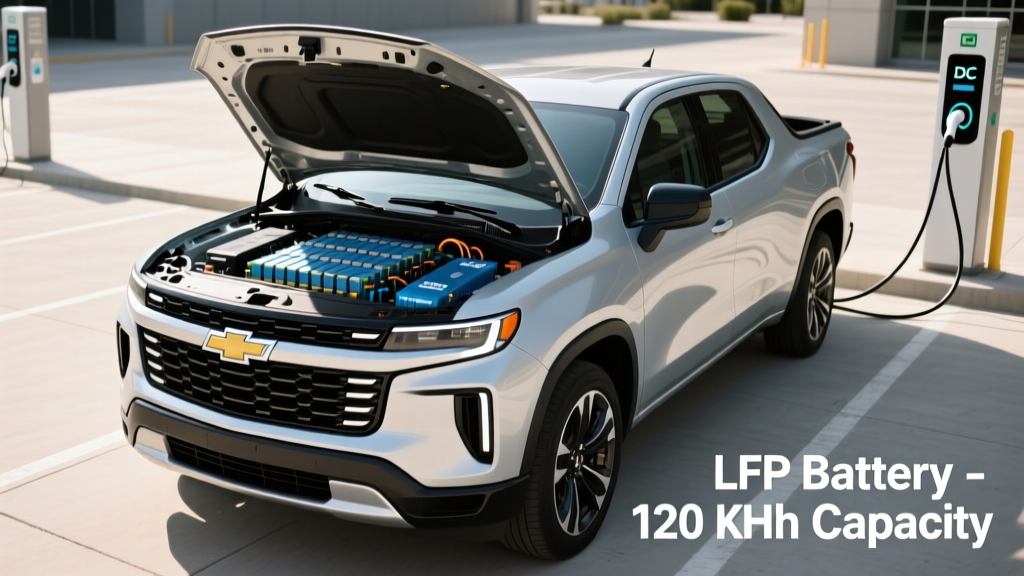
The Chevrolet Silverado EV sits at the extreme end of the electric-truck spectrum — not just in towing and payload, but in the sheer scale of its battery pack. For 2026, GM's Ultium-platform Silverado EV offers two primary usable battery capacities depending on trim and configuration, and understanding what those numbers mean for real-world range, longevity, and eventual replacement cost is essential before signing a six-figure truck order.
This guide breaks down the Silverado EV battery capacity options, the NMC chemistry inside them, realistic degradation trajectories, warranty coverage, and what owners can do to maximize pack life over a decade or more of ownership.
Silverado EV Battery Capacity by Trim (2026 Specs)
GM uses its modular Ultium platform across the Silverado EV lineup, but not every trim gets the same pack. The two main configurations for 2026 are:
| Configuration | Usable Capacity | Chemistry | EPA Range | Max DC Charge Rate | 10–80% Time | Starting MSRP |
|---|---|---|---|---|---|---|
| Standard Pack (WT / LT trims) | ~175 kWh | NMC (NCMA) | ~370 mi | ~200 kW | ~40 min | ~$57,000 |
| Extended Pack (RST / WT Max Range) | ~205 kWh | NMC (NCMA) | ~440 mi | ~350 kW | ~35 min | ~$80,000+ |
A few things worth noting from these figures:
- kWh vs kW: The battery capacity is measured in kilowatt-hours (kWh) — the total energy stored. The charge rate is measured in kilowatts (kW) — how fast energy flows in. They are not interchangeable.
- Usable vs gross capacity: GM quotes usable capacity. The gross (total physical) capacity is slightly higher, with buffers at the top and bottom of the pack to prevent overcharge and deep-discharge damage. This buffer is key to long-term health.
- Real-world range caveat: The EPA estimates above assume mixed driving. In real-world highway testing at 70+ mph, expect roughly 10–15% less range — so the 205 kWh pack delivers closer to 370–400 highway miles. In sub-freezing temperatures, knock off another 15–25% due to cabin heating demand and reduced battery efficiency. A 440-mile EPA truck may realistically deliver 280–320 miles on a cold winter highway run.
Ultium NMC Chemistry: What's Inside the Pack
The Silverado EV uses GM's Ultium battery platform with NCMA (nickel-cobalt-manganese-aluminum) cathode chemistry — a variant of the broader NMC family. This is the same platform underpinning the GMC Hummer EV, Cadillac Lyriq, and Chevrolet Blazer EV, though pack sizes vary.
NCMA is GM's evolution of traditional NMC, adding aluminum to the cathode to improve thermal stability and reduce cobalt content. The trade-offs versus LFP (lithium iron phosphate) chemistry are significant and worth understanding:
| Attribute | LFP (e.g., Tesla Model 3 RWD) | NMC/NCMA (Silverado EV) |
|---|---|---|
| Energy Density | Lower (~160–180 Wh/kg cell) | Higher (~220–260 Wh/kg cell) |
| Cycle Life | Superior (3,000–5,000+ cycles) | Good (1,000–2,000 cycles) |
| Cold-Weather Performance | Weaker (more range loss below freezing) | Better (less cold-weather degradation) |
| Cost per kWh | Lower ($80–100/kWh cell) | Higher ($110–140/kWh cell) |
| Max State of Charge | Can charge to 100% regularly | Best kept 20–80% for daily use |
| Thermal Stability | Excellent (very resistant to thermal runaway) | Good (improved with aluminum doping) |
Why GM chose NMC/NCMA for the Silverado EV: A full-size truck with 440+ miles of range and serious towing capacity needs maximum energy density. LFP simply can't pack enough energy into a physically feasible pack for a vehicle this size without unacceptable weight and volume penalties. The 205 kWh Extended pack is already one of the largest production EV batteries in the world — in LFP, it would be substantially heavier.
The trade-off is that NCMA packs are more sensitive to sustained high states of charge and have a lower total cycle life than LFP. But for a truck that most owners will drive 12,000–15,000 miles per year, 1,000–2,000 cycles translates to well over 200,000 miles before significant capacity loss — which leads us to degradation.
Battery Degradation: What the Data Actually Shows
EV battery degradation is not linear. The typical pattern is a steeper initial drop in the first year or two (roughly 2–5%), followed by a long, slow linear decline. For Ultium-platform NMC packs, we can project degradation based on GM's own testing disclosures, third-party fleet data from similar NMC chemistries, and early Silverado EV owner reports.
Year 1 / 15,000 mi: ~96–98% capacity retained
Year 3 / 45,000 mi: ~92–95% retained
Year 5 / 75,000 mi: ~88–92% retained
Year 8 / 120,000 mi: ~82–88% retained (warranty threshold period)
Year 10 / 150,000 mi: ~78–85% retained
Sources: Geotab fleet battery health data, GM Ultium platform disclosures. Individual results vary based on charging habits and climate.
For context, a 205 kWh pack at 82% retention still holds roughly 168 kWh usable — enough for approximately 350+ miles of real-world mixed driving. The truck doesn't become unusable when it degrades; it simply loses range gradually, much like a gas truck losing fuel economy over time.
According to Geotab's analysis of over 10,000 EVs, the average EV battery loses about 2.3% capacity per year across all chemistries. NMC packs in larger vehicles with active thermal management — like the Silverado EV's liquid-cooled system — tend to track near or slightly below that average.
Factors That Accelerate (or Slow) Degradation
Not all Silverado EV owners will see the same degradation curve. Several variables push capacity loss faster or slower:
- State of charge habits: For daily driving, set charge limit to 80%. Reserve 100% charges for road trips. NMC chemistry degrades faster when held at high SoC for extended periods.
- DC fast charging frequency: Occasional DCFC is fine. Daily DCFC at 350 kW generates significant heat. Use Level 2 (11.5–19.2 kW) at home as your primary charging method.
- Extreme heat exposure: Parking in direct sun in 100°F+ climates for weeks on end stresses the pack. Use a garage or shaded parking when possible. The Silverado EV's active thermal management helps, but prevention is better.
- Cold-weather preconditioning: In winter, precondition the battery before fast charging (the Silverado EV does this automatically when a DCFC station is set as your navigation destination). This reduces lithium plating risk.
- Avoid deep discharge: Don't regularly drive the pack below 10% SoC. The bottom buffer protects against the worst damage, but repeated deep cycles still stress NMC cells.
- Storage: If storing the truck for weeks, leave it at ~50% SoC — not full, not empty.
Silverado EV Battery Warranty: What GM Covers
GM backs the Silverado EV battery with its standard EV component warranty, which is among the more straightforward in the industry:
| Component | Duration | Mileage Limit | Capacity Retention Threshold |
|---|---|---|---|
| High-voltage battery pack | 8 years | 100,000 miles | 70% of original capacity |
| Battery management system | 8 years | 100,000 miles | Functional coverage |
| Electric drive unit(s) | 8 years | 100,000 miles | Functional coverage |
What this means in practice: If your 205 kWh Silverado EV battery drops below 70% capacity (roughly 143.5 kWh usable) within 8 years or 100,000 miles — whichever comes first — GM will repair or replace the pack at no cost. Based on the degradation data above, hitting 70% within the warranty period would be highly unusual and would likely indicate a manufacturing defect rather than normal wear.
Note that California and states adopting CARB emissions rules may require extended battery warranty coverage (typically 10 years / 150,000 miles). Check your state's specific requirements via your local EPA emissions standards guide.
Battery Replacement Cost: When and How Much
This is the question that generates the most anxiety — and the most misinformation. Let's ground it in data:
| Pack Size | Cell Cost (est. 2026) | Full Pack Replacement (w/ labor) | Typical Replacement Timeline |
|---|---|---|---|
| Silverado EV 175 kWh | $14,000–$17,500 | $20,000–$28,000 | Rarely needed; most packs outlive the vehicle |
| Silverado EV 205 kWh | $16,400–$20,500 | $24,000–$34,000 | Rarely needed; most packs outlive the vehicle |
| Mid-size EV 75–85 kWh (e.g., Model Y) | $6,000–$8,500 | $10,000–$16,000 | Uncommon before 200,000 mi |
| Compact EV 50–65 kWh (e.g., Bolt) | $4,000–$6,500 | $7,000–$12,000 | Uncommon before 200,000 mi |
The critical context that most coverage omits: Full battery replacements are exceedingly rare for liquid-cooled packs with active thermal management. According to data from Consumer Reports, the vast majority of modern EV batteries outlast the vehicle itself. When replacements are needed, they're usually due to manufacturing defects covered under warranty, not gradual wear-out.
GM's Ultium platform is also designed for module-level service. If one cell group degrades disproportionately, technicians can potentially replace individual modules rather than the entire pack — significantly reducing out-of-warranty costs. The exact module count and service pricing for the Silverado EV hasn't been publicly detailed by GM as of early 2026, but this modular approach is a core Ultium design principle.
By the time a Silverado EV battery genuinely needs replacement (likely 15+ years / 200,000+ miles), cell costs will have dropped substantially further. Industry projections place NMC cell costs below $80/kWh by 2030, which would bring a 205 kWh replacement pack's cell cost to under $16,400.
Monitoring Battery Health: How to Check SoH
State of Health (SoH) is the percentage of original capacity your battery can still hold. Here's how Silverado EV owners can track it:
- myChevrolet app: GM provides battery health data through the vehicle's connected services. The app displays estimated range and can flag battery system faults. For precise SoH percentage, request a diagnostic readout from your Chevrolet dealer.
- Dealer diagnostic scan: Any Chevy EV-certified service center can pull the battery's detailed SoH report, including individual module voltage balance and thermal history. Request this annually or before/after a long road trip season.
- Charge-to-full test (DIY): Charge the pack to 100% (do this occasionally, not daily) and note the displayed range. Compare it to the original EPA sticker. A new 205 kWh Silverado EV showing 440 mi at 100% that later shows 410 mi at 100% has roughly 93% SoH. This isn't lab-precise, but it tracks trends.
- OBD-II third-party tools: Devices like the OBDLink MX+ paired with apps such as Torque Pro can read battery management system data on many GM vehicles. Check compatibility with the Silverado EV's specific CAN bus protocol before purchasing.
Looking Ahead: Solid-State and Silicon-Anode Batteries
Several next-generation battery technologies are in development that could eventually appear in GM's Ultium platform or its successor:
- Solid-state batteries: Replace the liquid electrolyte with a solid material, promising higher energy density, faster charging, and improved safety. Toyota, Samsung SDI, and Solid Power are leading development. GM has not announced a solid-state timeline for the Silverado EV specifically. Realistic availability in a production full-size truck: 2030–2032 at the earliest, likely in a next-generation platform.
- Silicon-anode cells: Replace graphite anodes with silicon, boosting energy density by 20–40%. Companies like Sila Nanotechnologies and Group14 are scaling production. GM has invested in silicon-anode research. Expect initial deployment in performance/luxury models before trickling to trucks — 2027–2029 timeline for early production vehicles.
- Sodium-ion batteries: Cheaper, cobalt-free, but lower energy density. Better suited for compact EVs and stationary storage than a 440-mile truck. Not expected in the Silverado EV platform.
Important: None of these technologies are available in any production vehicle as of 2026. Announced timelines from manufacturers should be treated as targets, not guarantees. If you need a truck now, the current Ultium NMC pack is the technology you're buying.
Frequently Asked Questions
How long do Silverado EV batteries last in years and miles?
Based on Ultium NMC degradation projections and fleet data from similar chemistries, a Silverado EV battery should retain 78–88% of its original capacity at 150,000 miles / 10 years. Most packs will remain functional well beyond 200,000 miles, though with progressively reduced range. Full failure is rare; gradual capacity loss is the norm.
How much does a Silverado EV battery cost to replace?
A full out-of-warranty replacement for the 205 kWh Extended pack is estimated at $24,000–$34,000 including labor (2026 pricing). The 175 kWh Standard pack replacement is estimated at $20,000–$28,000. However, most packs will never need full replacement — module-level repair is possible, and packs typically outlast the vehicle's useful life.
What does the Silverado EV battery warranty cover?
GM covers the high-voltage battery for 8 years or 100,000 miles (whichever comes first), guaranteeing at least 70% of original capacity. If the pack drops below this threshold within the warranty period, GM will repair or replace it. The electric drive units and battery management system carry the same 8-year/100,000-mile coverage.
How do I check my Silverado EV battery health?
Use the myChevrolet app for basic monitoring, request an annual SoH diagnostic from your Chevy dealer for precise data, or perform a DIY charge-to-100% range comparison. Third-party OBD-II tools may also read BMS data, depending on protocol compatibility.
LFP vs NMC — which chemistry is better for a truck?
For a full-size truck requiring 370–440 miles of range, NMC (specifically GM's NCMA variant) is the practical choice due to its superior energy density. LFP offers longer cycle life and simpler charging habits (100% daily OK), but its lower energy density would require a heavier, larger pack that isn't feasible in the Silverado EV's architecture. LFP is better suited to compact and mid-size vehicles where total range requirements are lower.
Does frequent DC fast charging damage the Silverado EV battery?
Occasional DC fast charging (road trips, weekly top-ups) causes negligible additional degradation thanks to the Silverado EV's active liquid cooling system. However, daily 350 kW DCFC sessions generate sustained heat that accelerates NMC wear over time. For daily charging, a home Level 2 charger (11.5–19.2 kW) is gentler on the pack and significantly cheaper per kWh.