The Promise of Silicon Anode Batteries
If you've followed EV battery headlines in 2025 and 2026, you've likely encountered the term silicon batteries — more precisely, silicon-anode or silicon-dominant-anode lithium-ion cells. The pitch is compelling: by replacing the graphite anode in a conventional lithium-ion cell with silicon (or a silicon-carbon composite), manufacturers can store significantly more lithium ions per unit of weight and volume. The result is a potential 20-40% increase in energy density at the cell level, which translates directly into more range without a larger, heavier pack.
Companies like Sila Nanotechnologies, Group14 Technologies, and Enovix have been shipping silicon-anode materials to consumer electronics and specialty automotive applications. Mercedes-Benz's upcoming electric G-Class (announced for late 2026/2027 production) is expected to be among the first production vehicles using Sila's silicon-anode cells. But for the vast majority of EVs on the road and on sale today, the traction battery is still built on one of two mature chemistries: NMC/NCA (nickel-manganese-cobalt or nickel-cobalt-aluminum cathode with a graphite anode) or LFP (lithium iron phosphate cathode with a graphite anode).
This guide breaks down what silicon batteries actually change, how they stack up against today's LFP and NMC packs on the metrics that matter — energy density, cycle life, cost, cold-weather performance, and degradation — and what realistic timelines look like for mainstream adoption.
Today's EV Battery Chemistries: LFP vs. NMC/NCA
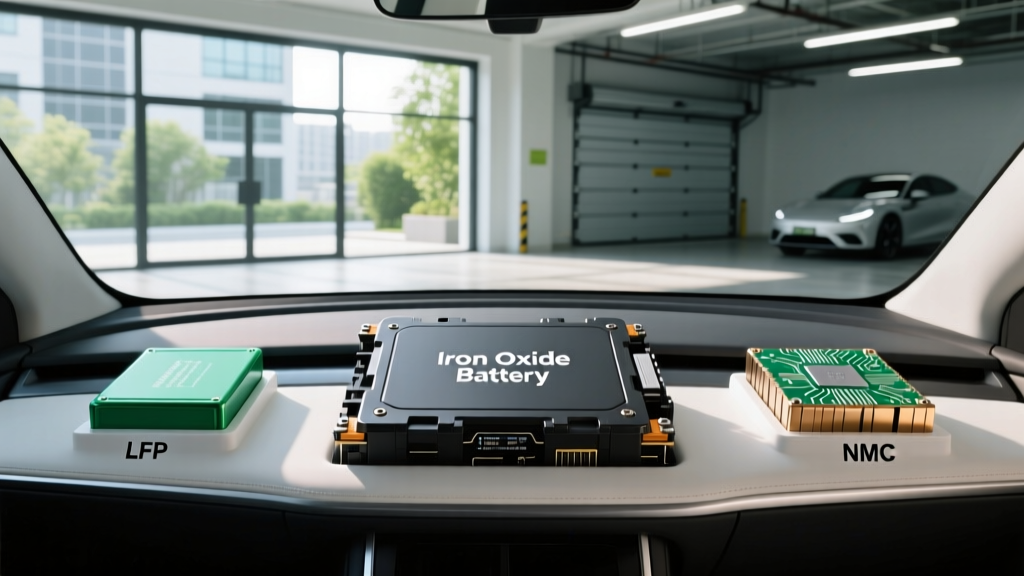
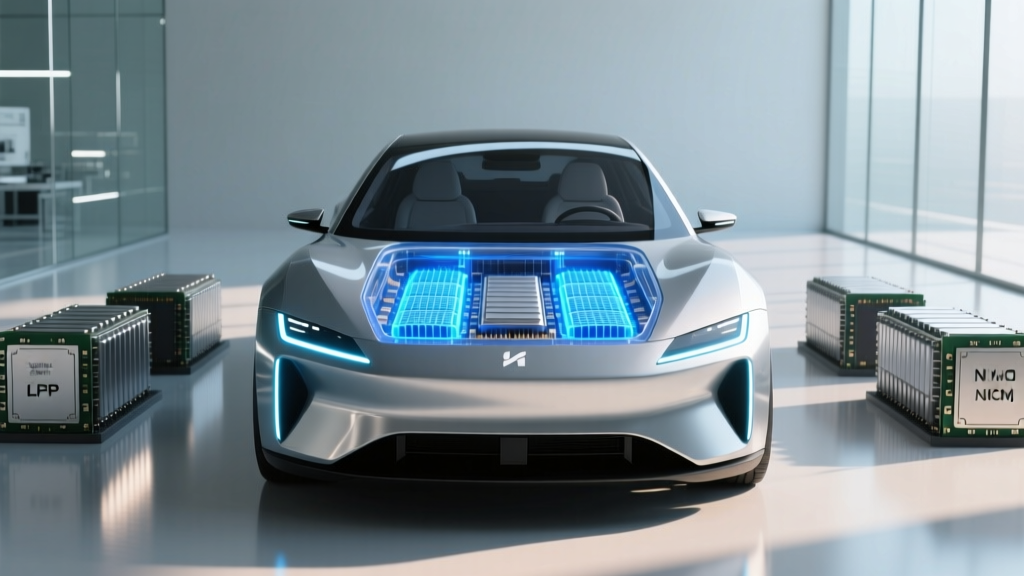
Before evaluating silicon, you need a clear picture of the two chemistries dominating the 2026 EV market. The cathode chemistry determines most of the pack's characteristics; the anode in both cases is currently graphite (or a graphite-silicon blend in small percentages).
| Metric | LFP (Lithium Iron Phosphate) | NMC/NCA (Nickel-Based) |
|---|---|---|
| Cell-Level Energy Density | 160–180 Wh/kg | 230–300 Wh/kg |
| Typical Cycle Life (to 80% SoH) | 3,000–6,000+ cycles | 1,000–2,500 cycles |
| Cold-Weather Performance | More range loss below freezing; slower charge acceptance | Better low-temp discharge; preconditioning still required |
| Cost per kWh (cell level, 2026) | ~$60–80/kWh | ~$90–120/kWh |
| Thermal Stability / Safety | Excellent — higher thermal runaway threshold (~270°C) | Good but lower threshold (~210°C); requires robust BMS |
| Cobalt Content | None | Some (NMC); None (NCA variants vary) |
| Recommended Daily Charge Limit | 100% (LFP benefits from periodic full charges for BMS calibration) | 80–90% for daily use; 100% only before long trips |
| Common 2026 Vehicles | Tesla Model 3/Y RWD, Ford Mustang Mach-E Select (LFP option), BYD models | Hyundai Ioniq 5/6, Kia EV6/EV9, Tesla Long Range/Performance, Rivian, BMW iX |
Which is better? Neither is universally superior. NMC/NCA wins on energy density — critical for long-range and performance vehicles where pack weight and volume are constrained. LFP wins on longevity, cost, and safety, making it ideal for standard-range models and fleet/high-mileage applications. If you drive a 250-mile daily route and charge nightly, LFP's 4,000+ cycle life means the battery will likely outlast the vehicle. If you need 350+ miles of EPA range in a midsize SUV, NMC is still the practical choice in 2026.
What Silicon Anodes Actually Change
Silicon's theoretical lithium-storage capacity is roughly 10 times that of graphite by weight (4,200 mAh/g vs. 372 mAh/g). The engineering challenge has always been physical: silicon expands up to 300% by volume when it absorbs lithium during charging. This swelling causes particle cracking, loss of electrical contact, and rapid capacity fade in early-generation cells.
Modern silicon-anode solutions address this through nanostructured silicon particles embedded in a carbon or polymer matrix that accommodates expansion. Sila's approach uses silicon nanoparticles within a porous scaffolding; Group14 uses a silicon-carbon composite material called SCC55. These are anode innovations — the cathode can remain NMC, NCA, or even LFP. In practice, most near-term silicon-anode cells pair with nickel-rich cathodes to maximize total cell energy density.
Real-world gains from current silicon-anode implementations:
- Cell energy density: 20–40% improvement over equivalent graphite-anode cells (e.g., 280–350 Wh/kg at the cell level vs. 230–280 Wh/kg for conventional NMC)
- Pack-level range gain: Roughly 10–20% more miles in the same physical pack enclosure, because packing efficiency and thermal management hardware don't change proportionally
- Fast-charge potential: Silicon anodes can accept lithium faster in some configurations, potentially reducing 10–80% charge times — but this depends heavily on cell design and thermal management
- Cost: Currently 1.5–3x the cost of mature graphite anodes at the material level. Volume production is expected to narrow this gap by 2028–2030
Real-World Degradation: What the Data Shows
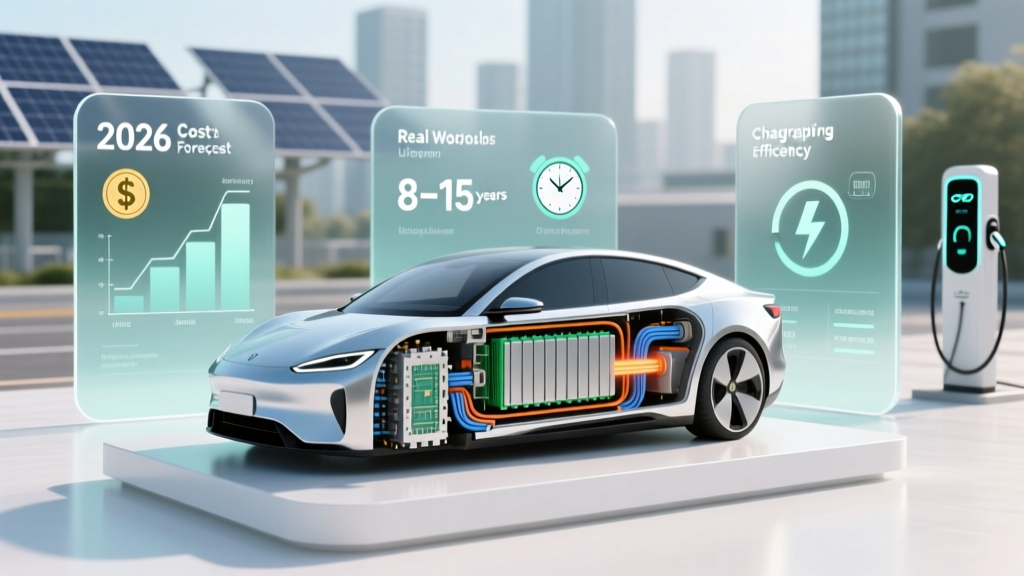
Battery degradation — the gradual loss of usable capacity over time — remains the top long-term ownership concern. Here's what aggregated fleet data and manufacturer testing show for current chemistries:
| Mileage | LFP Packs (avg. retention) | NMC/NCA Packs (avg. retention) |
|---|---|---|
| 30,000 mi / 2 years | 97–98% | 95–97% |
| 60,000 mi / 4 years | 94–96% | 91–94% |
| 100,000 mi / 7 years | 90–94% | 86–91% |
| 150,000 mi / 10 years | 86–91% | 80–87% |
| 200,000 mi / 13+ years | 82–88% | 75–83% |
Sources: Recurrent Auto fleet data (2024–2025), Geotab longitudinal study, manufacturer warranty claims data. Figures represent averages across multiple models; individual results vary with climate, charging habits, and thermal management system quality.
Several important patterns emerge from this data:
- The degradation curve is nonlinear. Most packs lose 2–5% in the first year (a "break-in" period as the solid-electrolyte interface stabilizes), then degrade at a slower, roughly linear rate of 1–2% per year thereafter.
- LFP degrades more slowly and more linearly, which is why Tesla recommends 100% daily charging for LFP-equipped Model 3/Y RWD — the chemistry tolerates it, and full charges help the battery management system (BMS) maintain accurate state-of-charge readings.
- NMC/NCA packs show more variability depending on thermal management. Vehicles with active liquid cooling (Hyundai E-GMP platform, Tesla, BMW) consistently outperform passively cooled packs in longevity.
- Most packs outlive the vehicle. At 150,000 miles, even an NMC pack retaining 83% of its original capacity still delivers meaningful range. A 300-mile EPA vehicle at 83% SoH still offers ~249 miles — adequate for most drivers.
Battery Warranty Terms: What's Actually Covered
Federal law mandates a minimum EV battery warranty of 8 years / 100,000 miles for emissions-related components, and most manufacturers apply this standard to the traction battery. California and states adopting CARB standards extend this to 10 years / 150,000 miles. Here's how major manufacturers structure coverage in 2026:
| Manufacturer | Warranty Term | Capacity Retention Threshold | What Triggers a Claim |
|---|---|---|---|
| Tesla (Model 3/Y) | 8 yr / 120,000 mi (LR/AWD); 8 yr / 100,000 mi (RWD) | 70% | SoH drops below 70% as measured by Tesla diagnostics |
| Hyundai / Kia (E-GMP) | 10 yr / 100,000 mi | 70% | Capacity below 70% verified by dealer scan tool |
| Ford (Mach-E, F-150 Lightning) | 8 yr / 100,000 mi | 70% | Battery capacity below 70% of original |
| GM (Ultium platform) | 8 yr / 100,000 mi | 70% (some models 60% for Lyft/fleet) | Capacity below threshold per OnStar diagnostics |
| BMW | 8 yr / 100,000 mi | 70% | Verified capacity loss below threshold |
| Rivian | 8 yr / 175,000 mi (Max pack) | 70% | Capacity below 70% per Rivian telemetry |
Key warranty caveats:
- Warranties cover capacity degradation below the threshold, not gradual range loss you simply notice over time. A pack at 72% SoH at 95,000 miles is not a warranty claim.
- Most warranties exclude damage from accidents, flooding, improper charging equipment, or unauthorized modifications.
- The warranty covers repair or replacement at the manufacturer's discretion — often with a refurbished or remanufactured pack, not necessarily a brand-new one.
- Some manufacturers require adherence to charging guidelines (e.g., not routinely leaving NMC packs at 100% SoC for extended periods) to maintain coverage, though this is rarely enforced in practice.
Replacement Costs: The Numbers and the Reality
This is where fear-mongering outpaces reality. Yes, a full traction battery replacement is expensive. But the data shows most original batteries last the usable life of the vehicle, and costs have been declining.
| Vehicle / Pack Size | Battery Capacity | Estimated Replacement Cost (parts + labor) | Typical Replacement Trigger |
|---|---|---|---|
| Tesla Model 3 RWD (LFP) | ~60 kWh | $8,000–$12,000 | Rare before 200,000+ mi; out-of-warranty failure |
| Hyundai Ioniq 5 (NMC) | 77.4 kWh | $12,000–$16,000 | Rare before 150,000+ mi; module-level repair often possible |
| Ford F-150 Lightning (Extended) | ~131 kWh | $20,000–$28,000 | Very large pack; module replacement more common than full swap |
| Chevrolet Bolt EV (older NMC) | 65 kWh | $9,000–$14,000 | Recall-replaced packs for 2017–2019 models; newer packs more durable |
| BMW iX xDrive50 | ~105 kWh usable | $18,000–$25,000 | Premium segment; module-level repair preferred |
| Rivian R1T (Max Pack) | ~149 kWh | $22,000–$30,000 | Large pack; under warranty through 175,000 mi |
Context that matters:
- Module-level repair is increasingly standard. Most modern packs are composed of 8–24 modules. If one module fails or degrades disproportionately, a qualified EV service center can replace just that module for $2,000–$5,000 rather than swapping the entire pack.
- Out-of-warranty replacements are uncommon. According to Recurrent Auto's 2025 fleet analysis, fewer than 1.5% of EVs required a full battery replacement outside of warranty coverage through 200,000 miles.
- Costs are declining. Pack-level pricing has fallen from ~$200/kWh in 2020 to roughly $100–130/kWh in 2026 for NMC, and lower for LFP. Replacement costs follow this trend with a lag.
- Compare to ICE powertrain replacements. A modern engine or transmission replacement on a gas vehicle runs $4,000–$10,000 and is far more common at 120,000–180,000 miles than EV battery failure.
Factors That Accelerate (or Preserve) Battery Life
Battery longevity isn't purely a function of time and miles. How you charge, store, and drive your EV has a measurable impact on degradation rate. Here's what the electrochemistry tells us:
What Accelerates Degradation
- Frequent DC fast charging above 150 kW without preconditioning — elevated cell temperatures and high C-rates stress the anode. Occasional fast charging is fine; daily 200+ kW sessions without thermal prep add up.
- Sustained high state of charge — storing an NMC pack at 100% SoC for days or weeks (especially in heat) accelerates cathode oxidation. LFP is more tolerant but not immune.
- Deep discharges to 0% — regularly running the pack to near-empty stresses the cells. The BMS maintains a buffer (typically 2–5% at the bottom), but repeatedly hitting that buffer is suboptimal.
- Extreme heat exposure — sustained ambient temperatures above 95°F with a high SoC is the worst-case scenario for calendar aging. Garage parking matters in Phoenix and Las Vegas.
- Charging in extreme cold without preconditioning — lithium plating can occur when charging a cold NMC pack at high rates. Most 2026 vehicles with heat pumps and pack heaters mitigate this automatically when you navigate to a charger.
What Preserves Battery Health
- Daily charging to 80% (NMC) or 100% (LFP) — follow your manufacturer's recommendation. Tesla's app now lets you set separate daily and trip-charge limits.
- Level 2 home charging as your primary method — 7–11 kW charging generates far less heat than DC fast charging and is the gentlest way to add miles.
- Preconditioning before fast charging — navigating to a DC fast charger via the vehicle's nav system (Tesla, Hyundai, Ford) triggers pack heating/cooling to optimize the charge curve and reduce stress.
- Moderate SoC for long-term storage — if leaving your EV for 2+ weeks, aim for 50–60% SoC. Most 2026 vehicles offer a "storage mode" that limits charge to this range.
- Garage or shaded parking in hot climates — reducing peak pack temperature by even 10°F meaningfully slows calendar aging.
How to Monitor Your Battery's State of Health
State of Health (SoH) is the percentage of original usable capacity your pack currently retains. A new pack is 100% SoH; a pack that held 77.4 kWh when new and now holds 70 kWh is at ~90.4% SoH.
How to check SoH in 2026:
- In-vehicle displays: Tesla (via the Service menu or third-party apps), Hyundai/Kia (via the dealer scan tool or the EV battery health screen on newer infotainment versions), and BMW (iDrive battery health readout) now offer varying levels of SoH visibility directly in the car.
- Manufacturer apps: The Tesla app, FordPass, Hyundai Bluelink, and myChevrolet apps increasingly include battery health metrics or estimated range vs. original range comparisons.
- OBD-II dongles and third-party tools: Devices like the OBDLink MX+ paired with apps such as EV Health or LeafSpy (Nissan-specific) can pull SoH data from the BMS. This is the most reliable method for used-EV buyers.
- Dealer diagnostic reports: Any authorized dealer can run a full battery health report. Request this when buying a used EV or before a warranty claim.
- Recurrent Auto and Geotab: If you opt into fleet-data programs, these services provide ongoing SoH tracking and benchmarking against similar vehicles.
A practical rule: check your SoH at least twice a year, and always before and after a road-trip-heavy season. A sudden drop of more than 2–3% in a short period warrants a dealer diagnostic.
Where Silicon, Solid-State, and Next-Gen Tech Stand
Silicon anodes are the most commercially advanced of the "next-generation" battery technologies, but they are not the only one in development. Here's a realistic 2026 snapshot:
- Silicon-anode lithium-ion: In low-volume production for premium automotive (Mercedes, select Porsche applications) and consumer electronics. Mainstream EV availability projected for 2028–2030. Energy density gain: 20–40% at cell level. Cost premium: significant but declining. Cycle life: approaching parity with graphite-anode NMC in latest generations (~1,500–2,000 cycles to 80% SoH).
- Semi-solid-state: Cells using a hybrid liquid/solid electrolyte (e.g., NIO's 150 kWh pack from WeLion, available in China for the ET7 sedan). Offers modest energy density gains with improved safety. Limited to the Chinese market in 2026; US/EU availability not before 2028.
- True solid-state: Toyota, Samsung SDI, and QuantumScape have demonstrated prototype cells with solid ceramic or sulfide electrolytes. Toyota has announced a 2027–2028 production target for limited models. Challenges remain in manufacturing yield, interfacial resistance, and cost. Realistic mainstream availability: 2030+ at the earliest.
- Sodium-ion: Lower energy density (~120–160 Wh/kg) but extremely low cost and no lithium or cobalt. CATL and BYD are producing sodium-ion packs for budget city cars in China. Not relevant for US long-range EVs but potentially significant for affordable urban models globally.
Frequently Asked Questions
How long do EV batteries actually last?
Based on aggregated fleet data from Recurrent Auto and Geotab, the average EV battery retains 86–94% of its original capacity at 100,000 miles and 80–91% at 150,000 miles. LFP packs trend toward the higher end of these ranges. Most packs will deliver 15–20 years of usable service before dropping below 70% SoH — the point at which range reduction becomes noticeable for daily driving. Full battery failure (non-functional) is extremely rare; gradual capacity loss is the norm.
How much does it cost to replace an EV battery?
A full traction battery replacement in 2026 ranges from roughly $8,000 for a compact LFP pack (Tesla Model 3 RWD, ~60 kWh) to $28,000+ for a large NMC pack (F-150 Lightning Extended Range, ~131 kWh). However, module-level repairs — replacing one or two degraded modules rather than the full pack — cost $2,000–$5,000 and are increasingly the standard repair approach. Fewer than 1.5% of EVs require out-of-warranty full pack replacement through 200,000 miles.
What does the EV battery warranty cover?
All major manufacturers warrant the traction battery for a minimum of 8 years / 100,000 miles against capacity loss below a specified threshold (typically 70% of original capacity). In CARB states, coverage extends to 10 years / 150,000 miles. The warranty covers defects and abnormal degradation — it does not cover damage from accidents, misuse, or unauthorized modifications. Coverage applies to repair or replacement at the manufacturer's discretion, often with a refurbished pack.
How do I check my EV battery health?
Check State of Health (SoH) through your vehicle's infotainment system (if supported), the manufacturer's mobile app, an OBD-II diagnostic tool like OBDLink MX+ with an EV-compatible app, or a dealer diagnostic report. For used-EV purchases, always request a dealer battery health report or use a third-party OBD-II tool to verify SoH before committing.
LFP vs. NMC — which battery chemistry should I choose?
Choose LFP if you prioritize longevity (4,000+ cycle life), lower cost, cobalt-free sourcing, and plan to charge at home nightly to 100%. Choose NMC/NCA if you need maximum range (300–400+ EPA miles), better cold-weather performance, or faster DC fast-charge capability. For most daily commuters covering under 200 miles, LFP offers the best long-term ownership economics. For road-trip-heavy drivers or those in cold climates without garage parking, NMC remains the practical choice.
Will silicon batteries make my current EV obsolete?
No. Silicon-anode batteries will offer 10–20% more range in equivalent pack sizes, but they won't be widely available in mainstream EVs until 2028–2030. Your current LFP or NMC pack, properly maintained, will deliver reliable service for 150,000–200,000+ miles. The EV you buy today won't be functionally obsolete when silicon packs arrive — just as 300-mile EVs from 2022 remain perfectly capable daily drivers in 2026.