If you own a Tesla—or one of the growing number of EVs with a standby surveillance feature—you've likely noticed the range drop after leaving Sentry Mode active overnight. The sentry mode battery drain is real, measurable, and worth understanding not just for daily range planning but for what it means to your high-voltage traction battery's long-term health.
This guide breaks down exactly how much energy Sentry Mode consumes, how that parasitic drain interacts with battery chemistry and degradation, and what you can do to protect your pack over a 10-year ownership horizon. We'll also cover the bigger picture: EV battery lifespan, replacement costs, warranty coverage, and the LFP vs NMC chemistry choice that fundamentally shapes how you should think about standby drain.
What Sentry Mode Actually Does to Your Battery
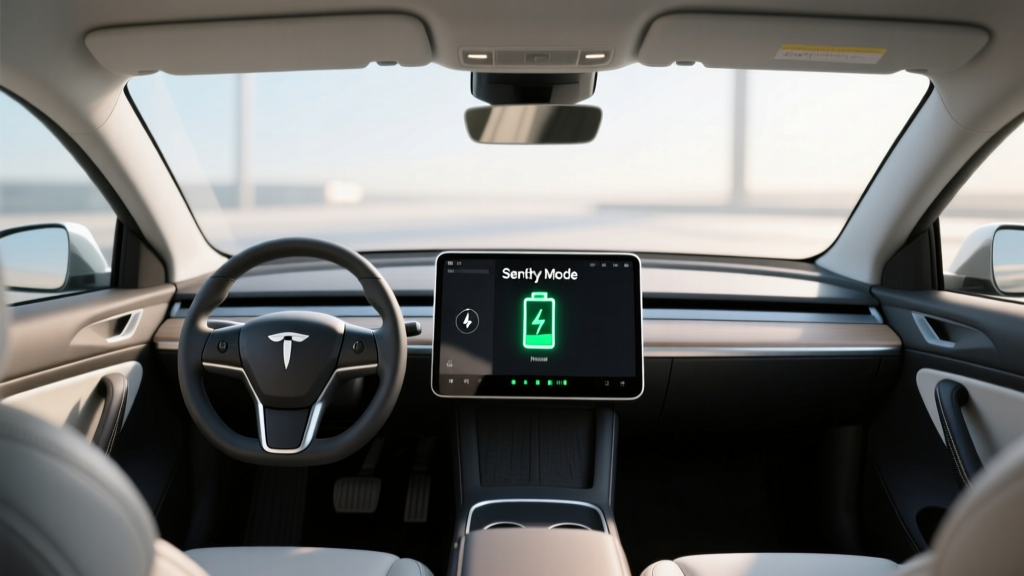
Sentry Mode keeps the vehicle's cameras, onboard computer, and thermal management systems in a low-power standby state, ready to begin recording when a proximity trigger fires. On a Tesla Model 3 or Model Y, this draws roughly 200–300 watts continuously. Over a 12-hour parking session, that translates to approximately 2.4–3.6 kWh of energy consumed—equivalent to about 8–14 miles of EPA-rated range on a Model 3 Long Range.
To put that in context: a Model 3 Long Range AWD (2026) carries a 75 kWh usable NMC battery with an EPA range of 341 miles. Losing 3.6 kWh to overnight Sentry Mode represents roughly 4.8% of usable capacity. It's not catastrophic for a single night, but it compounds.
1 hour: ~0.25 kWh (~1 mi range loss)
8 hours (workday): ~2.0 kWh (~7 mi range loss)
12 hours (overnight): ~3.0 kWh (~11 mi range loss)
24 hours (airport parking): ~6.0 kWh (~22 mi range loss)
Based on Tesla Model 3/Y observed data; actual varies with ambient temperature and trigger frequency.
The concern isn't just the lost range—it's the depth of discharge pattern. If you regularly let Sentry Mode pull your state of charge (SoC) from 50% down to 40% or lower without plugging in, you're adding micro-cycles that contribute to cumulative degradation. This matters more for NMC chemistry than for LFP, as we'll explore below.
LFP vs NMC: Which Chemistry Handles Standby Drain Better?
Your EV's battery chemistry determines not just range and charging speed but how well the pack tolerates the kind of slow, parasitic drain that Sentry Mode produces. The two dominant chemistries in 2026 passenger EVs are LFP (lithium iron phosphate) and NMC/NCA (nickel manganese cobalt / nickel cobalt aluminum).
| Attribute | LFP (e.g., Tesla Model 3 RWD, standard range) | NMC/NCA (e.g., Model 3 LR, Hyundai Ioniq 5, most long-range EVs) |
|---|---|---|
| Energy Density | ~160 Wh/kg (lower — heavier pack for same kWh) | ~250–280 Wh/kg (higher — more range per kg) |
| Cycle Life | 3,000–5,000+ cycles to 80% SoH | 1,000–2,000 cycles to 80% SoH |
| Cold Performance | More range loss below 32°F; slower charge acceptance | Better low-temp performance; faster cold charging |
| Cost per kWh | ~$90–$110 (2026 pack-level) | ~$120–$145 (2026 pack-level) |
| Recommended Daily SoC | 100% daily is fine; LFP benefits from periodic full charges for BMS calibration | 80% daily; 100% only for trips |
| Sentry Mode Tolerance | Excellent — high cycle life absorbs micro-drain with minimal degradation impact | Moderate — sustained low-SoC parasitic drain adds wear; plug in when possible |
| Thermal Stability | Superior — less prone to thermal runaway | Good but requires more active thermal management |
Bottom line for Sentry Mode users: If your EV has an LFP pack (common in Tesla Model 3 RWD, some BYD models, and standard-range variants), the cycle-life advantage means overnight standby drain is essentially a non-issue for long-term health. NMC owners should aim to plug in at home when using Sentry Mode regularly, keeping SoC above 40% to minimize calendar and cycle degradation.
How Long Do EV Batteries Actually Last?
The fear of a $20,000 battery swap at year five is outdated. Real-world degradation data from 2024–2026 fleet analyses shows that most modern EV packs lose 8–15% of original capacity over the first 8 years / 100,000 miles, depending on chemistry, climate, and charging habits.
| Milestone | NMC/NCA Average Capacity Retention | LFP Average Capacity Retention | Source Context |
|---|---|---|---|
| 1 year / 15,000 mi | 96–98% | 97–99% | Early settling; most loss is initial formation |
| 3 years / 45,000 mi | 92–95% | 95–98% | Linear degradation phase |
| 5 years / 75,000 mi | 88–93% | 93–97% | Still well within warranty threshold |
| 8 years / 100,000 mi | 85–90% | 90–95% | Warranty period end for most manufacturers |
| 10 years / 150,000 mi | 80–88% | 88–94% | Out-of-warranty; pack still functional |
Data from Geotab's fleet battery health studies across thousands of vehicles confirms that the average EV battery degrades at roughly 1.5–2.3% per year under typical use. Heavy DC fast charging, extreme heat exposure, and consistently operating at very low or very high SoC accelerate this rate.
For Sentry Mode specifically: the additional drain adds roughly 300–1,000 extra partial cycles per year (depending on frequency of use). For NMC, this might accelerate degradation by an estimated 0.2–0.5% per year above baseline. For LFP, the impact is nearly negligible given the chemistry's 3,000+ cycle endurance.
Battery Warranty: What's Actually Covered?
Every major EV manufacturer provides a high-voltage battery warranty that covers capacity loss below a specified threshold. Here's what the current landscape looks like for 2026 model-year vehicles:
| Manufacturer | Warranty Period | Mileage Limit | Capacity Retention Threshold |
|---|---|---|---|
| Tesla (Model 3/Y NMC LR/AWD) | 8 years | 120,000 miles | 70% |
| Tesla (Model 3 RWD LFP) | 8 years | 100,000 miles | 70% |
| Hyundai / Kia | 10 years | 100,000 miles | 70% |
| Ford (Mustang Mach-E) | 8 years | 100,000 miles | 70% |
| GM (Ultium-based) | 8 years | 100,000 miles | 70% (some models 60% for commercial) |
| BMW / Mercedes-Benz | 8 years | 100,000 miles | 70% |
Key detail: The warranty covers defects and abnormal degradation—not range loss from normal use. If your pack falls below the threshold (typically 70% of original capacity), the manufacturer will repair or replace modules to bring capacity back above that line. Tesla's warranty documentation, for instance, explicitly states that the battery is warranted to retain at least 70% of its capacity over the warranty period.
Sentry Mode drain alone will not void your warranty. However, if you consistently deep-cycle an NMC pack to very low SoC (below 10%) via unattended Sentry Mode use without charging, you're accelerating wear that could push you toward that 70% threshold sooner. Staying plugged in at home while Sentry Mode is active essentially eliminates this risk.
EV Battery Replacement Cost: What to Expect
Most EV batteries outlast the vehicle itself. Full pack replacement is rare and typically occurs only after collision damage, manufacturing defect, or extreme degradation well beyond 150,000 miles. That said, here are the current out-of-warranty replacement cost ranges:
| Vehicle | Battery Size (Usable) | Chemistry | Replacement Cost Range |
|---|---|---|---|
| Tesla Model 3 RWD | 57.5 kWh | LFP | $8,000–$12,000 |
| Tesla Model 3/Y Long Range | 75 kWh | NMC | $12,000–$16,000 |
| Hyundai Ioniq 5 (LR AWD) | 77.4 kWh | NMC | $13,000–$18,000 |
| Ford Mustang Mach-E (ER) | 88 kWh | NMC | $15,000–$20,000 |
| Chevrolet Equinox EV | 85 kWh | NMC (Ultium) | $14,000–$19,000 |
| Rivian R1T / R1S (Max) | 149 kWh | NMC | $22,000–$30,000 |
Costs have fallen roughly 40% since 2020 thanks to declining cell prices and improved module-level repair capability. Many shops can now replace individual modules (a fraction of the full pack) for $2,000–$5,000 rather than swapping the entire battery. This trend will continue as pack architectures become more serviceable.
Maximizing Battery Health: A Practical Care Checklist
Whether you use Sentry Mode daily or rarely, these practices will extend your traction battery's useful life:
- Daily SoC target: Set charge limit to 80% for NMC/NCA; 100% is fine for LFP. Use your car's scheduled charging to hit this target by departure time.
- Sentry Mode best practice: Plug in at home when Sentry Mode is active. This powers the surveillance system from the grid, not the battery, eliminating parasitic drain entirely.
- Avoid sustained low SoC: Don't leave an NMC vehicle sitting below 20% for more than a few days. Calendar degradation accelerates at low voltage states.
- DC fast charging: Use DCFC for road trips, not daily charging. Frequent 150+ kW sessions elevate cell temperature and stress. Level 2 home charging (7–11 kW) is gentler and cheaper.
- Thermal management: In extreme heat (>95°F), park in shade or a garage when possible. In extreme cold (<20°F), use preconditioning before charging to protect the pack.
- Don't store at 100%: If leaving the vehicle unused for a week or more, set SoC to 50–60% for NMC. LFP tolerates 100% storage better but 50–80% is still ideal.
- Monitor SoH quarterly: Check your battery's State of Health through the vehicle's app or third-party tools (see next section).
How to Check Your Battery's State of Health (SoH)
State of Health (SoH) is the percentage of your battery's current maximum capacity relative to its original capacity when new. A brand-new pack is 100% SoH; a pack that can now hold only 65 kWh of its original 75 kWh is at 86.7% SoH.
How to check SoH by brand:
- Tesla: The in-car service menu (accessed via the software screen in 2025+ models) shows a battery health test result. Third-party apps like Tessie or Stats can also log and estimate SoH from charging data.
- Hyundai/Kia: The dealer can pull an SoH readout via the diagnostic tool. Some owners use OBD-II dongles with apps like Car Scanner to access the BMS (Battery Management System) directly.
- Ford: The FordPass app provides battery health status. A full capacity test is available at the dealer.
- GM (Ultium): The myChevrolet/myCadillac app shows a battery health indicator. Dealer diagnostics provide the precise SoH percentage.
What to look for: If your SoH drops more than 3% in a single year or falls below 85% before 80,000 miles, it's worth a dealer diagnostic check—this could indicate a defective module that may be covered under warranty.
Factors That Accelerate Battery Degradation (Beyond Sentry Mode)
Sentry Mode is a minor contributor compared to these larger degradation drivers:
- Frequent DC fast charging: Vehicles that DCFC more than 3 times per week show degradation rates 1.5–2× higher than those primarily charging on Level 2, according to Geotab fleet data.
- High-temperature exposure: Sustained ambient temperatures above 95°F without active thermal management accelerate electrolyte decomposition. EVs with liquid-cooled packs (most modern models) handle this far better than passively cooled packs.
- Operating at extremes of SoC: Regularly driving an NMC pack below 10% or storing it at 100% for extended periods stresses the cathode material. The 20–80% operating window remains the sweet spot.
- High-mileage accumulation: A vehicle driven 25,000+ miles per year will hit cycle-count thresholds faster. Each full equivalent cycle (0–100–0%) contributes incrementally to wear.
Emerging Battery Tech: What's on the Horizon
While current LFP and NMC packs are proven and durable, next-generation chemistries are in development:
- Solid-state batteries: Toyota, Samsung SDI, and QuantumScape are targeting 2028–2030 production timelines. Solid-state cells promise 30–50% higher energy density, faster charging, and longer cycle life. These are not yet available in any production vehicle as of 2026.
- Silicon-dominant anodes: Companies like Sila Nanotechnologies and Group14 are replacing graphite anodes with silicon composites, boosting energy density by 15–25%. Early production applications are appearing in limited models, with broader rollout expected by 2027–2028.
- Sodium-ion batteries: CATL and BYD are producing sodium-ion cells for lower-cost, shorter-range EVs. These offer excellent cycle life and cold performance but lower energy density—likely reserved for urban commuter vehicles and fleet applications.
For current buyers, these technologies are forward-looking and should not factor into a purchase decision today. The LFP and NMC packs in 2026 vehicles are mature, well-understood, and backed by robust warranties.
Frequently Asked Questions
How much range does Sentry Mode use per day?
Expect approximately 8–14 miles of EPA range loss per 12-hour period on a Tesla Model 3/Y, depending on ambient temperature and how often the cameras are triggered. In cold weather, the draw increases because the thermal management system may also activate to keep the battery within operating temperature.
Will Sentry Mode drain my battery to zero if I leave it unplugged?
Tesla's software will automatically disable Sentry Mode when SoC drops below approximately 20% to protect the battery. You won't wake up to a dead pack—but you may find less range than expected if you parked at a low SoC. Other manufacturers with similar features implement comparable low-SoC cutoffs.
Does using Sentry Mode void my battery warranty?
No. Sentry Mode is a factory feature, and using it as designed does not void the battery warranty. The warranty covers capacity retention (typically ≥70% over 8 years / 100,000–120,000 miles) regardless of feature usage. Abusing the pack by consistently running it to near-zero via unattended standby is a different story—plug in when possible.
LFP vs NMC — which is better for my use case?
If you prioritize longevity, lower cost, and don't need maximum range, LFP is the better daily-driver choice—it tolerates 100% charging, Sentry Mode drain, and high cycle counts with minimal wear. If you need maximum range, faster cold-weather charging, and lighter weight, NMC/NCA is the right call—just be more disciplined about SoC management (20–80% daily, plug in during Sentry Mode use).
How do I minimize Sentry Mode battery drain?
The single most effective step: plug in at home. When connected to a Level 2 charger, Sentry Mode draws power from the grid rather than the battery. You can also restrict Sentry Mode to specific locations (e.g., exclude "Home" in Tesla's settings), disable it during warm weather when thermal management isn't needed, or use the "exclude" feature for safe parking areas.
When should I actually worry about battery replacement?
Rarely before 150,000 miles under normal use. If your SoH drops below 70% within the warranty period, file a claim. Out of warranty, module-level repairs ($2,000–$5,000) are increasingly available as an alternative to full pack replacement. Most EV batteries will outlast the vehicle's economic life.