Every EV owner or buyer eventually confronts the same questions: How long will this battery last? What happens when it degrades? And what's coming next that might make today's packs look obsolete? The buzz around Samsung solid battery technology — specifically Samsung SDI's solid-state cell development — has amplified these questions, promising a future of faster charging, longer range, and near-zero degradation. But promises and production are very different things.
This guide cuts through the hype. We'll break down the battery chemistry powering today's EVs (LFP vs. NMC/NCA), show you real degradation data across hundreds of thousands of miles, explain exactly what your warranty covers, and give you a grounded timeline on when Samsung SDI's solid-state cells might actually reach a vehicle you can buy.
LFP vs. NMC/NCA: The Chemistry Decision Every EV Buyer Faces
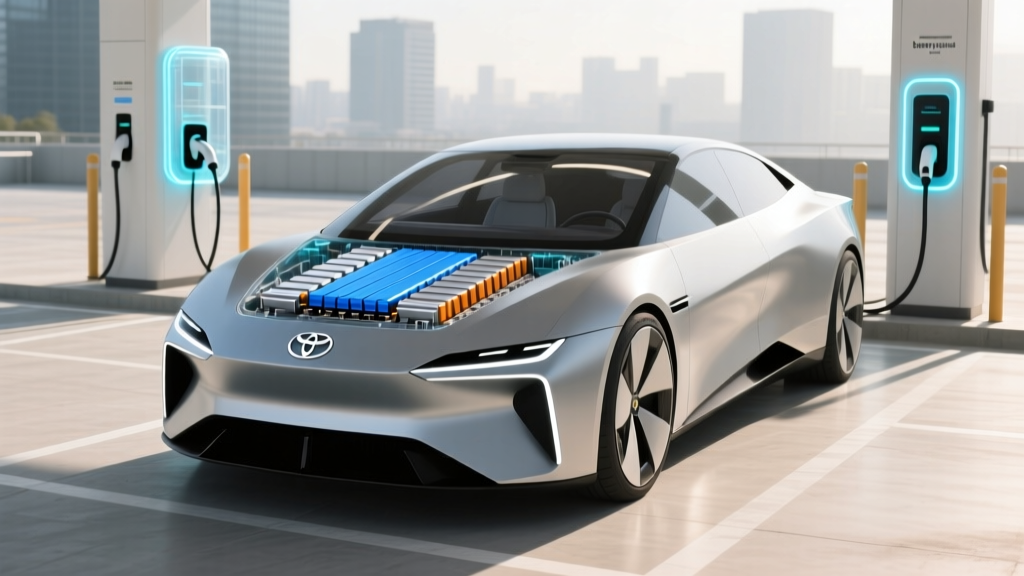
Every EV battery pack uses one of several lithium-ion cathode chemistries, and the two dominant families in 2026 are LFP (lithium iron phosphate) and NMC/NCA (nickel manganese cobalt / nickel cobalt aluminum). The chemistry inside your pack dictates your range, how the battery ages, how it handles cold weather, and ultimately what you paid for the car.
kWh (kilowatt-hours) measures the energy stored in your battery — think of it as the size of your fuel tank. kW (kilowatts) measures the rate of power flow — how fast you can charge or discharge. These are not interchangeable, and confusing them is the single most common mistake in EV discussions.
| Attribute | LFP (Lithium Iron Phosphate) | NMC / NCA (Nickel-based) |
|---|---|---|
| Energy Density | Lower (~160–180 Wh/kg cell-level) | Higher (~220–260 Wh/kg cell-level) |
| Typical Range Impact | Slightly shorter range for same pack weight | More range per kg — preferred for long-range models |
| Cycle Life | 3,000–5,000+ full cycles to 80% SoH | 1,000–2,500 full cycles to 80% SoH |
| Cold-Weather Performance | Greater range loss in freezing temps (~30–40% at 20°F) | Better cold retention (~20–30% loss at 20°F) |
| Cost per kWh | Lower — no cobalt or nickel | Higher — commodity metal price exposure |
| State of Charge Recommendation | Can be charged to 100% daily without significant harm | Best kept at 80% daily; 100% only for trips |
| Thermal Stability | Excellent — very low thermal runaway risk | Good, but requires more active thermal management |
| Common In (2026 US Models) | Tesla Model 3/Y RWD, Ford Mustang Mach-E Select, BYD models | Tesla Long Range, Hyundai Ioniq 5/6, Rivian, BMW iX, most performance trims |
Which is better? Neither — it depends on your driving pattern. If you commute 30 miles daily, have home charging, and live in a mild climate, LFP's longer cycle life and 100% daily charging convenience make it ideal. If you regularly drive 200+ miles, need maximum range, or live where winters are harsh, NMC's higher energy density and better cold-weather performance justify the trade-offs. The data from fueleconomy.gov shows that real-world efficiency differences between chemistries are often smaller than driving style and climate effects.
How Long Do EV Batteries Actually Last? Real Degradation Data
The fear of a dead battery pack at 80,000 miles is the single biggest psychological barrier to EV adoption. The data tells a different story.
Battery degradation is measured as a loss in State of Health (SoH) — the percentage of original capacity remaining. A battery at 90% SoH holds 90% of its original kWh. Most manufacturers warrant their packs down to 70% SoH over 8 years or 100,000 miles (whichever comes first). In practice, very few batteries hit that threshold within the warranty period.
Observed Degradation Curves (Aggregated Fleet Data)
| Timeframe | Typical SoH Loss (NMC) | Typical SoH Loss (LFP) | Notes |
|---|---|---|---|
| Year 1 / ~15,000 mi | 2–5% | 1–3% | Initial "formation" loss — steepest part of the curve |
| Year 3 / ~45,000 mi | 6–10% | 3–6% | Curve flattens significantly after year 1 |
| Year 5 / ~75,000 mi | 8–14% | 5–9% | Most packs still well above 85% SoH |
| Year 8 / ~120,000 mi | 12–18% | 7–12% | Approaching warranty threshold for some NMC packs with heavy DCFC use |
| Year 10+ / ~150,000+ mi | 15–25% | 10–16% | Still functional — a 75 kWh pack at 80% SoH holds 60 kWh, plenty for daily driving |
Sources: Geotab fleet battery health reports, Recurrent Auto battery data (2024–2025), Tesla Impact Report fleet sampling. Individual results vary by climate, charging habits, and thermal management system quality.
The critical insight: degradation is non-linear. You lose the most capacity in the first year or two, then the curve flattens dramatically. A Tesla Model 3 Long Range (82 kWh usable, NMC) that shows 94% SoH at 30,000 miles is on a trajectory to retain roughly 85–88% at 150,000 miles. Tesla's own fleet data, published in their annual Impact Report, shows their packs retaining approximately 88% capacity at 200,000 miles on average.
For context, the average US driver covers about 14,000 miles per year according to the FHWA. At that rate, an EV battery reaching 150,000 miles represents over a decade of driving — and most data shows the pack will still hold 80%+ of its original capacity.
Battery Warranty Terms: What's Actually Covered
Federal law mandates a minimum EV battery warranty of 8 years / 100,000 miles (10 years / 150,000 miles in California and states adopting CARB standards). But the details matter enormously.
| Manufacturer | Warranty Term | Capacity Retention Threshold | What Triggers a Claim |
|---|---|---|---|
| Tesla (Model 3/Y) | 8 yr / 120,000 mi (LR/AWD); 8 yr / 100,000 mi (RWD) | 70% SoH | Measured capacity below threshold via service diagnostic |
| Hyundai / Kia | 10 yr / 100,000 mi | 70% SoH | Capacity below threshold confirmed by dealer scan |
| Ford (Mach-E, F-150 Lightning) | 8 yr / 100,000 mi | 70% SoH | Diagnostic-confirmed capacity loss below threshold |
| GM (Ultium-platform) | 8 yr / 100,000 mi | 70% SoH (some models 60% for specific components) | Capacity or power output below spec |
| BMW | 8 yr / 100,000 mi | 70% SoH | Verified via BMW diagnostic system |
| Rivian | 8 yr / 175,000 mi | 70% SoH | Capacity below threshold — notably higher mileage limit |
Key caveats: Warranties cover defects and excessive degradation, not damage from accidents, flooding, or improper modifications. If you hit a curb and crack the pack casing, that's collision insurance, not warranty. Also, "excessive degradation" means falling below the stated threshold — a pack at 72% SoH with a 70% threshold does not qualify for replacement, even though you've lost over a quarter of your range.
Most warranty claims are resolved with module-level replacement (swapping individual degraded modules within the pack) rather than a full pack swap, which keeps the manufacturer's cost down and gets you back on the road faster.
EV Battery Replacement Cost: The Numbers and When It's Needed
This is where fear-mongering runs rampant, so let's anchor this in reality: the vast majority of EV batteries outlive the useful life of the vehicle. Full pack replacement outside of warranty is rare. But when it is needed — typically due to physical damage, manufacturing defect discovered post-warranty, or extreme degradation in high-mileage commercial use — the costs are significant.
| Vehicle / Pack Size | Battery Cost (Parts) | Labor | Total Estimate |
|---|---|---|---|
| Tesla Model 3 RWD (~60 kWh, LFP) | $8,000–$11,000 | $2,000–$3,500 | $10,000–$14,500 |
| Tesla Model Y LR (~82 kWh, NMC) | $12,000–$16,000 | $2,500–$4,000 | $14,500–$20,000 |
| Hyundai Ioniq 5 (~77.4 kWh, NMC) | $11,000–$15,000 | $2,000–$3,500 | $13,000–$18,500 |
| Ford F-150 Lightning Ext. Range (~131 kWh) | $18,000–$25,000 | $3,000–$5,000 | $21,000–$30,000 |
| Chevrolet Bolt EV (~65 kWh, NMC) | $9,000–$13,000 | $2,000–$3,000 | $11,000–$16,000 |
Estimates based on dealer and independent EV shop quotes, 2024–2025. Prices declining ~5–8% annually as cell costs fall. Refurbished/remanufactured packs offer 30–40% savings where available.
For perspective, a conventional car's engine or transmission replacement can run $4,000–$8,000, and many gas cars need that work between 120,000–180,000 miles. The EV battery replacement is more expensive but typically occurs later — if at all — and the EV owner has saved thousands in fuel and maintenance over those miles. The total cost of ownership math still favors the EV in most scenarios.
Factors That Accelerate (or Preserve) Battery Life
Not all miles are equal when it comes to battery wear. The following factors have the most measurable impact on long-term State of Health:
Battery Care Best Practices
- Daily charge limit: Set to 80% for NMC/NCA packs; 100% is fine for LFP. This single habit has the largest impact on long-term SoH.
- DC fast charging frequency: Occasional DCFC (road trips) is fine. Daily DCFC, especially at 150+ kW without preconditioning, accelerates degradation by an estimated 1–3% over the pack's life compared to Level 2 home charging.
- Extreme heat exposure: Sustained ambient temperatures above 95°F, especially combined with high SoC (above 90%), stress NMC chemistry. Garage parking in hot climates measurably helps.
- Extreme cold charging: Charging a cold battery (below 32°F) without preconditioning causes lithium plating on the anode. Always use your vehicle's preconditioning feature before charging in cold weather.
- Storage at high SoC: Leaving an NMC pack at 100% for weeks without driving accelerates calendar degradation. If storing, set to 50–60% SoC.
- Deep discharge: Letting the pack sit at or near 0% SoC for extended periods can cause irreversible cell damage. Avoid storing below 10%.
Modern EV thermal management systems (liquid cooling/heating) mitigate many of these factors automatically. Tesla, Hyundai's E-GMP platform, and GM's Ultium all feature active thermal conditioning that preheats or cools the pack during charging and driving. But software can't fully compensate for consistent abuse — habitual 100% charges on NMC packs parked in Phoenix summers will show measurable extra degradation over five years.
How to Check and Monitor Your Battery's State of Health
Knowing your battery's SoH is essential for peace of mind, resale value assessment, and warranty claim timing. Here's how to check it:
In-vehicle displays: Some manufacturers (Tesla, BMW, Mercedes) provide a battery health readout in the service menu or via the companion app. Tesla's service mode (accessible by holding the model name on the About screen) shows a "Battery Health Test" that estimates SoH as a percentage.
OBD-II diagnostic tools: Devices like the OBDLink MX+ paired with apps such as EV Health or Scan My Tesla can read BMS (Battery Management System) data directly, including estimated SoH, cell voltage variance, and cumulative energy throughput.
Third-party services: Companies like Recurrent Auto offer free battery health reports by connecting to your vehicle's telematics data (with your permission). They compare your pack's degradation against a fleet of identical vehicles, giving you a percentile ranking.
Dealer diagnostic: If you suspect a warranty claim, the dealer will run a manufacturer-specific diagnostic that measures actual pack capacity by performing a controlled discharge test. This is the gold standard for warranty purposes but requires a service appointment.
DIY range test: Charge to a known SoC (e.g., 100%), reset the trip meter, drive your normal route until you reach a low SoC (e.g., 10%), and calculate kWh used from the energy screen. Compare against the pack's original usable capacity. It's imprecise (temperature, driving style, and terrain all affect the result) but gives a ballpark SoH estimate.
Samsung SDI Solid-State Battery: What's Real and What's Not (Yet)
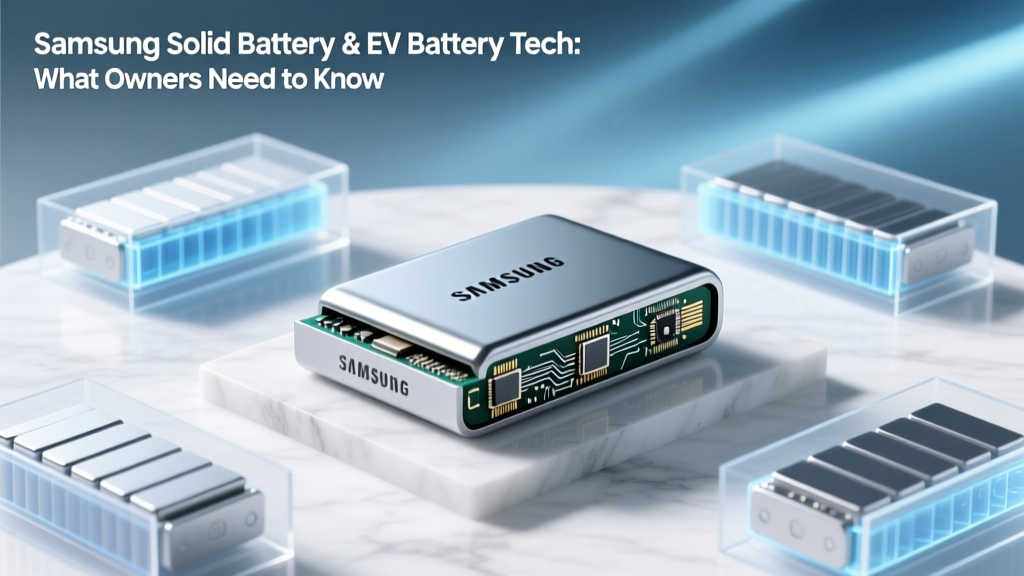
Samsung SDI has been one of the most vocal developers of solid-state battery technology for electric vehicles, and the term "Samsung solid battery" has become shorthand in EV forums for the next generational leap in energy storage. Here's what we know with certainty as of 2026:
What Samsung SDI has demonstrated: At InterBattery 2024 and subsequent trade shows, Samsung SDI showcased prototype all-solid-state cells with energy densities exceeding 900 Wh/L (volumetric) — roughly double today's best NMC cells. They've claimed these cells can charge from 10% to 80% in approximately 9 minutes under lab conditions and offer a cycle life exceeding 1,000 full cycles with minimal degradation. Samsung SDI has also demonstrated a "sulfide-based" solid electrolyte that eliminates the flammable liquid electrolyte found in current lithium-ion cells, theoretically improving safety.
Production timeline: Samsung SDI has publicly targeted 2027 for initial mass production of solid-state cells, with automotive customer deliveries expected shortly after. However, the path from lab prototype to automotive-grade production at scale is historically long. Toyota, which has arguably the most advanced solid-state patent portfolio globally, has pushed its own solid-state production timeline from 2025 to 2027–2028, initially in limited hybrid applications.
Realistic availability in a vehicle you can buy: If Samsung SDI hits its 2027 production target, the earliest a consumer EV with Samsung solid-state cells would reach US showrooms is 2028–2029, likely in a premium model from a partner OEM (BMW and Hyundai Motor Group are among Samsung SDI's existing cell customers). Initial production volumes will be small, and the cells will carry a significant cost premium — expect them in high-end trims first, not in a $35,000 commuter EV.
What solid-state actually solves: Higher energy density (more range in the same pack volume), faster charging without degradation concerns, improved safety (no flammable electrolyte), and potentially better cold-weather performance. What it does not solve: the cost of raw lithium, manufacturing complexity, or the need for charging infrastructure.
Other emerging technologies to watch: Silicon-anode batteries (used in limited form by Porsche and in development by companies like Sila Nanotechnologies) offer 20–40% energy density improvements using existing liquid-electrolyte manufacturing. These are closer to mass production than solid-state and may bridge the gap between today's cells and the solid-state future.
Frequently Asked Questions
How long do EV batteries last in years and miles?
Based on aggregated fleet data from Geotab, Recurrent Auto, and manufacturer reports, the average EV battery retains 80–90% of its original capacity at 150,000 miles (roughly 10–12 years of average US driving). Many packs exceed 200,000 miles before falling below 70% SoH. Battery replacement is rarely needed within the vehicle's practical lifespan.
How much does it cost to replace an EV battery?
Out-of-warranty replacement costs range from approximately $10,000 for a smaller pack (Tesla Model 3 RWD, ~60 kWh) to $25,000+ for large packs (F-150 Lightning Extended Range, ~131 kWh), including parts and labor. However, most replacements are covered under the federally mandated 8-year/100,000-mile warranty, and cell prices continue to decline 5–8% annually. Refurbished packs offer additional savings.
What does the EV battery warranty actually cover?
Federal law requires a minimum 8-year/100,000-mile warranty (10/150,000 in CARB states) covering defects and capacity loss below a stated threshold — typically 70% State of Health. It does not cover physical damage from accidents, improper modifications, or natural disasters. Check your specific manufacturer's warranty terms, as mileage limits and SoH thresholds vary (see our warranty table above).
How do I check my EV battery's health?
Options include your vehicle's built-in service menu (Tesla, BMW, Mercedes), OBD-II scanners with EV-compatible apps (Scan My Tesla, EV Health), third-party telematics services like Recurrent Auto, or a dealer diagnostic test. For warranty claims, the dealer diagnostic is required. For routine monitoring, an OBD-II tool or telematics service gives you the best ongoing visibility.
LFP vs NMC — which battery chemistry should I choose?
Choose LFP if you want maximum cycle life, can charge to 100% daily without worry, prioritize lower cost, and don't need the absolute longest range or best cold-weather performance. Choose NMC/NCA if you need maximum range per charge, drive in cold climates frequently, or want the highest energy density for towing or long road trips. Both chemistries will comfortably outlast 150,000 miles with proper care.
Will Samsung SDI's solid-state battery be available in EVs soon?
Samsung SDI targets 2027 for initial mass production, but the earliest a consumer vehicle with these cells would reach US buyers is 2028–2029, likely in a premium model. The technology promises roughly double the energy density and significantly faster charging, but manufacturing scale-up and cost reduction remain major hurdles. Don't delay an EV purchase waiting for solid-state — today's lithium-ion packs are proven, warrantied, and improving incrementally every model year.
Sources: fueleconomy.gov (EPA range and efficiency data), IRS §30D clean vehicle credit guidelines (for EV purchase incentive context), Samsung SDI InterBattery presentations (2024–2025), Geotab Battery Electric Vehicle Fleet Report, Recurrent Auto battery health data.