If you have been following battery headlines, you have likely seen the term salt batteries surface as a potential disruptor to lithium-ion dominance. The name is shorthand for sodium-ion (Na-ion) batteries, which use abundant sodium instead of scarce lithium as their charge-carrying ion. With companies like CATL, BYD, and HiNa shipping sodium-ion cells to Chinese-market EVs and energy-storage projects, the question for U.S. buyers is practical: Are salt batteries relevant to your next EV purchase, or still a laboratory curiosity?
This guide breaks down exactly where sodium-ion technology stands in 2026, how it stacks up against the two dominant lithium-ion chemistries — LFP (lithium iron phosphate) and NMC/NCA (nickel manganese cobalt / nickel cobalt aluminum) — and what it means for degradation, warranty, replacement cost, and long-term ownership.
What Are Salt Batteries (Sodium-Ion)?
Sodium-ion batteries operate on the same rocking-chair principle as lithium-ion cells: ions shuttle between a cathode and an anode through an electrolyte during charge and discharge. The difference is the ion itself. Sodium (Na) sits directly below lithium (Li) on the periodic table, shares similar electrochemistry, and is roughly 1,000 times more abundant in Earth's crust — extracted from common salt (NaCl), soda ash, and trona ore.
The trade-off is physics: a sodium ion is roughly 55% heavier and 18% larger in ionic radius than a lithium ion. That means:
- Lower energy density — current Na-ion cells deliver 140–170 Wh/kg at the cell level, versus 200–260 Wh/kg for NMC and 160–180 Wh/kg for LFP.
- Lower operating voltage — Na-ion cells nominally run at ~3.0–3.1 V versus ~3.6–3.7 V for LFP and NMC, requiring more cells in series for the same pack voltage.
- Heavier packs for equivalent kWh capacity, which penalizes range in passenger vehicles.
As of 2026, sodium-ion EVs are sold in China (e.g., Chery QQ Ice Cream, JAC Yiwei E10X, JMEV GSE-based models) with pack sizes in the 25–35 kWh range, delivering roughly 120–180 miles of CLTC range. No sodium-ion passenger EV is currently sold or announced for the U.S. market.
The Big Three: LFP vs NMC vs Sodium-Ion Chemistry
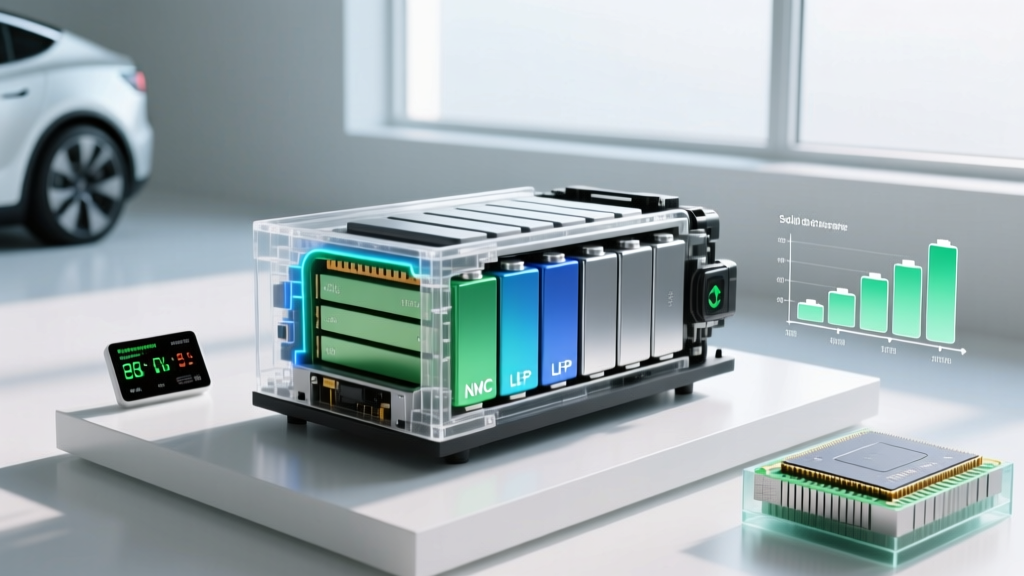
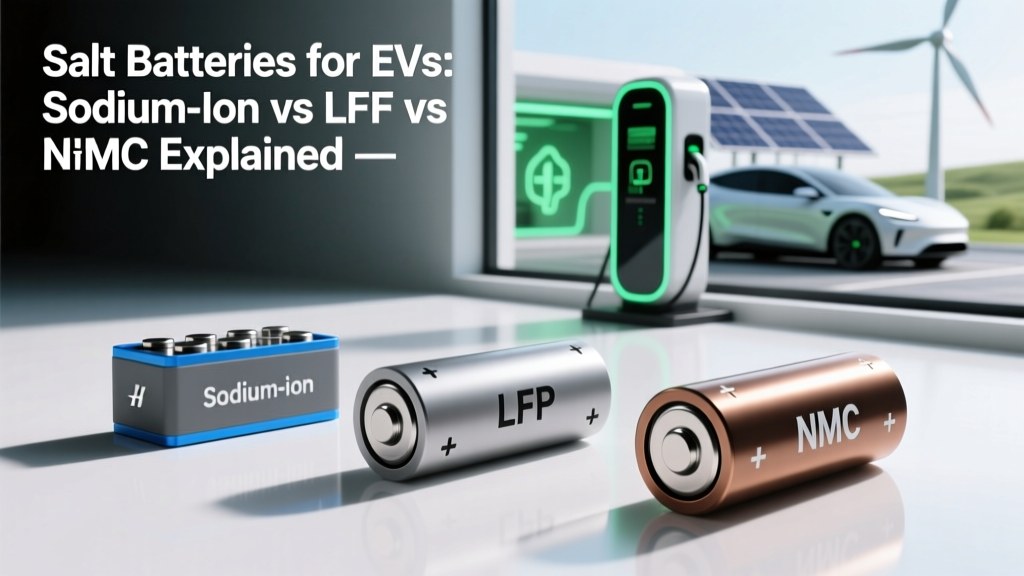
Understanding where salt batteries fit requires a direct comparison with the lithium-ion chemistries already in your garage. Below is a side-by-side of the three chemistries across the metrics that matter to owners.
| Attribute | NMC / NCA | LFP | Sodium-Ion (Na-ion) |
|---|---|---|---|
| Cell energy density | 200–260 Wh/kg | 160–180 Wh/kg | 140–170 Wh/kg |
| Pack-level energy density | 150–180 Wh/kg | 120–140 Wh/kg | 100–120 Wh/kg |
| Nominal cell voltage | 3.6–3.7 V | 3.2–3.3 V | 3.0–3.1 V |
| Cycle life (to 80% capacity) | 1,000–2,000 | 3,000–5,000+ | 2,000–4,000 (lab); ~2,000 field |
| Cold performance (-10°C retention) | ~80–85% | ~70–75% | ~85–90% |
| Thermal runaway risk | Moderate | Low | Very low |
| Raw-material cost exposure | High (Ni, Co, Li) | Medium (Li, Fe, P) | Low (Na, Fe, Mn — no Li, no Co) |
| Typical 2026 application | Long-range sedans, SUVs, trucks | Standard-range EVs, L2 chargers, fleet | City EVs, microcars, ESS (China) |
| U.S. EV availability (2026) | Widely available | Widely available (Tesla, Ford, Rivian base trims) | Not available in U.S. passenger EVs |
LFP vs NMC: Which Chemistry Is Better for You?
Before considering a future salt-battery EV, most U.S. buyers are choosing between LFP and NMC today. Here is how to decide:
Choose NMC/NCA if:
- You need maximum EPA range (300+ miles) in a single-charge package — e.g., road-trip-heavy households, towing.
- You drive a large SUV or truck where pack weight is already high and energy density matters.
- Examples: Tesla Model Y Long Range, Hyundai Ioniq 5 (Long Range), Ford F-150 Lightning Extended Range.
Choose LFP if:
- Your daily commute is under 200 miles round-trip and you charge at home nightly.
- You want the longest calendar/cycle life and plan to keep the vehicle 10+ years.
- You prefer charging to 100% SoC daily without degradation anxiety (LFP tolerates full-SoC storage better than NMC).
- Examples: Tesla Model 3 RWD, Tesla Model Y RWD, Ford Mustang Mach-E Select (LFP pack), Rivian Standard pack.
LFP has won the standard-range segment decisively because its cycle life (3,000–5,000 cycles to 80% capacity) effectively outlasts the vehicle, and its cobalt-free supply chain insulates it from geopolitical price shocks. NMC remains the choice when every kilogram of battery must deliver maximum miles.
Where Salt Batteries Could Fit in the U.S. Market
Sodium-ion's advantages — low cost, excellent cold-weather performance, no lithium or cobalt — make it attractive for specific niches:
- Urban commuter EVs with 120–180 miles of range, priced under $25,000 before incentives.
- Fleet and delivery vans that return to depot nightly and prioritize cycle life and safety over range.
- Plug-in hybrid (PHEV) buffer packs where a smaller, cheaper Na-ion pack handles 30–40 miles of electric-only driving.
- Cold-climate markets (Northern U.S., Canada, Alaska) where Na-ion's 85–90% capacity retention at -10°C beats LFP's ~70%.
CATL's first-generation sodium-ion cells entered mass production in 2024, with a second generation targeting 200 Wh/kg (cell-level) expected around 2027–2028. At that density, a mid-size U.S. sedan could plausibly carry a 70 kWh Na-ion pack weighing roughly 500 kg — heavy, but viable for a value-priced model. Industry analysts project U.S.-market Na-ion EVs no earlier than 2028–2029, pending supply-chain buildout and U.S./EU trade policy on Chinese battery imports.
EV Battery Degradation: What the Data Actually Shows
Regardless of chemistry, every EV battery loses capacity over time and use. The good news: modern packs degrade far more slowly than early-2010s EVs (looking at you, first-gen Nissan Leaf with passive air cooling).
Typical capacity retention by chemistry and mileage (2026 field data):
- NMC/NCA: ~95% at 50,000 miles; ~90% at 100,000 miles; ~85% at 150,000 miles. Source: Geotab fleet data, 2024 update, corroborated by Recurrent Auto.
- LFP: ~97% at 50,000 miles; ~93% at 100,000 miles; ~90% at 150,000 miles. LFP's slower degradation is consistent across Tesla Model 3 RWD and BYD Blade pack field data.
- Sodium-Ion (projected from lab + early China field data): ~94% at 50,000 miles; ~88% at 100,000 miles; ~82–85% at 150,000 miles. Limited real-world data; figures based on CATL Gen-1 cell test protocols.
Calendar aging (time-based degradation independent of mileage) adds roughly 1.5–2.5% loss per year across all chemistries, with LFP aging slightly slower than NMC. A 10-year-old LFP pack with 80,000 miles might retain 85–88% of original capacity — well above the 70% warranty threshold most automakers guarantee.
EV Battery Warranty: What's Covered and for How Long
Federal law mandates that EV battery packs sold in the U.S. carry a minimum warranty of 8 years / 100,000 miles (10 years / 150,000 miles in California and states adopting CARB standards). Most automakers meet or exceed this floor. The warranty guarantees the pack will retain a specified percentage of original capacity — typically 70% — over the term.
| Automaker | Warranty Term | Capacity Retention Threshold | Chemistry Covered |
|---|---|---|---|
| Tesla (Model 3/Y RWD) | 8 yr / 100,000 mi | 70% | LFP |
| Tesla (Model 3/Y LR, S/X) | 8 yr / 120,000 mi | 70% | NMC/NCA |
| Hyundai / Kia | 10 yr / 100,000 mi | 70% | NMC |
| Ford (Mach-E, F-150 Lightning) | 8 yr / 100,000 mi | 70% | NMC (LFP on select trims) |
| Rivian | 8 yr / 175,000 mi | 70% | NMC (Large); LFP (Standard) |
| GM (Ultium-based) | 8 yr / 100,000 mi | 70% | NMC |
| BMW | 8 yr / 100,000 mi | 70% | NMC |
What the warranty covers: Capacity loss below the threshold, manufacturing defects, cell/module failures, and BMS (battery management system) faults. What it typically excludes: Damage from accidents, flooding, unauthorized modifications, or use outside the manufacturer's specified temperature/charging parameters.
EV Battery Replacement Cost: The Real Numbers
This is the number that keeps prospective EV buyers up at night — and it is almost always overstated in online forums. Here is the reality in 2026:
| Vehicle / Pack Size | Chemistry | Battery Cost (Parts) | Labor + Programming | Total Installed |
|---|---|---|---|---|
| Tesla Model 3 RWD (~60 kWh) | LFP | $8,000–$10,000 | $2,000–$3,000 | $10,000–$13,000 |
| Tesla Model Y LR (~82 kWh) | NMC | $12,000–$15,000 | $2,500–$3,500 | $14,500–$18,500 |
| Hyundai Ioniq 5 (~77.4 kWh) | NMC | $11,000–$14,000 | $2,000–$3,000 | $13,000–$17,000 |
| Ford F-150 Lightning Ext. (~131 kWh) | NMC | $18,000–$24,000 | $3,000–$5,000 | $21,000–$29,000 |
| Chevrolet Bolt EV (~65 kWh) | NMC | $9,000–$12,000 | $2,000–$2,500 | $11,000–$14,500 |
Critical context: Full pack replacement is rare. Modern packs are modular — a single failed module ($500–$2,000) can be replaced without swapping the entire pack. According to Recurrent Auto's 2025 fleet analysis, fewer than 2.5% of EVs in their 15,000-vehicle dataset required any battery-related service under or out of warranty. Most EV batteries outlive the vehicle's economic life.
How to Maximize Battery Life: Owner Habits That Matter
Chemistry determines the ceiling, but your habits determine where you land within that range. The following factors have the largest measurable impact on pack longevity:
Do:
- Keep SoC between 20–80% for daily use (NMC/NCA). LFP owners can charge to 100% regularly — in fact, BMS calibration benefits from periodic full charges.
- Use Level 2 home charging as your primary method. Slower charge rates (~7–11 kW) generate less heat and stress than repeated DC fast charging.
- Precondition the battery before DC fast charging in cold weather. Most EVs do this automatically when you navigate to a charger; it warms the cells to 25–35°C for optimal charge acceptance and reduced lithium plating risk.
- Park in shade or a garage when possible. Sustained pack temperatures above 40°C (104°F) accelerate calendar aging.
- Drive it. Batteries that sit at high SoC for weeks degrade faster than batteries in regular use.
Avoid:
- Daily DC fast charging if you have Level 2 access. Occasional road-trip DCFC is fine; daily 150 kW sessions add measurable degradation over 3–5 years.
- Storing at 100% SoC for extended periods (especially NMC). If leaving for a week+, set charge limit to 50–60%.
- Deep discharges to 0%. The low-voltage cutoff protects the cells, but repeatedly running the pack to near-empty stresses the anode.
- Aftermarket "range-extender" modifications or non-OEM charging equipment that bypasses the BMS.
How to Check Your Battery's State of Health (SoH)
State of Health (SoH) is the percentage of original capacity your pack currently holds. A new EV starts at 100% SoH; a pack at 85% SoH that originally held 75 kWh now holds ~63.75 kWh usable.
In-vehicle methods:
- Tesla: Service menu (hold model name for 3 seconds) → Battery Health test, which runs a controlled discharge and reports SoH. Available since 2023 software updates.
- Hyundai/Kia: MyHyundai / Kia Connect app displays estimated SoH under EV battery status.
- Ford: FordPass app shows battery health percentage for Mach-E and F-150 Lightning.
- GM (Ultium): myChevrolet / myCadillac app includes battery health readout.
Third-party methods:
- Recurrent Auto (free enrollment) — connects to your vehicle's telematics and provides monthly SoH reports benchmarked against a fleet of identical vehicles.
- OBD-II dongles + apps like EVbatmon or LeafSpy (Nissan) read BMS data directly, including cell voltage imbalance, which is an early indicator of module-level degradation.
- Dealer diagnostic scan — any authorized service center can pull a full BMS report with cell-level voltage data, internal resistance, and SoH calculation. Request this at your annual service visit.
Emerging Battery Tech: Beyond Salt, LFP, and NMC
Sodium-ion is one of several next-generation chemistries in development. Here is where they stand as of 2026:
- Solid-state batteries: Replace the liquid electrolyte with a solid ceramic or polymer, enabling lithium-metal anodes and energy densities of 350–500 Wh/kg (cell-level). Toyota, Samsung SDI, and QuantumScape have demonstrated prototype cells, but manufacturing yield and cost remain unsolved at scale. Realistic U.S. passenger-vehicle availability: 2029–2032 in limited, premium applications. See U.S. DOE solid-state research overview.
- Silicon-anode lithium-ion: Replaces graphite anodes with silicon, boosting energy density 20–40%. Sila Nanotechnologies and Group14 are shipping cells to consumer electronics; automotive-scale production is expected 2027–2028. Mercedes-Benz and GM have announced partnerships.
- Lithium-sulfur (Li-S): Theoretical energy density of 500+ Wh/kg, but cycle life remains below 200 cycles in practical cells. Lab-only; no commercial timeline for EVs.
- Sodium-ion Gen 2: CATL targets 200 Wh/kg cells by ~2027, which would make Na-ion viable for 250-mile U.S. EVs at aggressive price points. Still 2–3 years from U.S. market relevance.
None of these technologies are available in a U.S.-market EV you can buy today. All announced timelines are preliminary and subject to manufacturing delays.
Frequently Asked Questions
How long do EV batteries last in years and miles?
Modern liquid-cooled EV batteries (LFP and NMC) are designed for 150,000–200,000 miles and 10–15 years of service while retaining 70–85% of original capacity. Field data from Geotab and Recurrent Auto shows average degradation rates of 1.5–2.5% per year. Many early Tesla Model S packs (2012–2014) are still in service at 200,000+ miles with 75–80% capacity retention. Sodium-ion batteries are projected to offer comparable lifespan based on lab cycle-life data (2,000–4,000 cycles), but long-term field data does not yet exist.
How much does it cost to replace an EV battery?
Full out-of-warranty pack replacement ranges from $10,000–$13,000 for a compact EV (Tesla Model 3 RWD, Chevrolet Bolt) to $21,000–$29,000 for a large truck (Ford F-150 Lightning Extended Range). However, full replacement is uncommon — most battery service involves replacing individual modules at $500–$2,000 per module. Under the federally mandated 8-year/100,000-mile warranty (10/150,000 in CARB states), replacement due to capacity loss below 70% is covered at no cost to the owner.
What does the EV battery warranty actually cover?
The standard warranty guarantees the high-voltage traction battery will retain at least 70% of its original capacity over 8 years or 100,000 miles (whichever comes first). It covers cell failures, module degradation, BMS faults, and manufacturing defects. It does not cover the 12V auxiliary battery (which is covered under the separate bumper-to-bumper warranty), accident damage, flood damage, or degradation from misuse (e.g., sustained storage at 100% SoC in extreme heat). Always read your specific owner's manual warranty section — terms vary by automaker.
How do I check and maximize my EV battery health?
Check SoH via your vehicle's app (Tesla, Ford, Hyundai, GM all provide in-app readouts), a third-party service like Recurrent Auto, or a dealer diagnostic scan. To maximize lifespan: keep NMC packs between 20–80% SoC for daily use (LFP can charge to 100%), rely on Level 2 home charging rather than daily DC fast charging, precondition before fast charging in cold weather, avoid prolonged storage at high SoC or in extreme heat, and keep the battery in regular use rather than sitting idle for weeks.
LFP vs NMC — which is better and why?
Neither is universally better; the right choice depends on your driving pattern. NMC/NCA delivers higher energy density (200–260 Wh/kg cell-level), enabling 300+ mile EPA ranges in mid-size vehicles — ideal for road-trippers, towing, and large SUVs. LFP offers superior cycle life (3,000–5,000 cycles vs. 1,000–2,000), lower thermal runaway risk, cobalt-free sourcing, and tolerance for daily 100% charging — ideal for commuters, fleet vehicles, and owners planning 10+ year ownership. For most U.S. drivers covering under 40 miles daily with home charging, LFP is the lower-stress, longer-lasting choice.
Will salt batteries (sodium-ion) be available in U.S. EVs?
Not in 2026. Sodium-ion EVs are currently sold only in China, in small city cars with 120–180 miles of CLTC range. For Na-ion to reach the U.S. market, manufacturers need to achieve ~200 Wh/kg cell density (expected ~2027–2028), build non-Chinese supply chains to comply with U.S. trade policy and §30D tax-credit critical-mineral sourcing rules, and integrate Na-ion packs into platforms designed for U.S. safety and range expectations. A realistic timeline for a U.S.-market Na-ion EV is 2028–2029 at the earliest, likely in a value-priced compact or fleet vehicle.