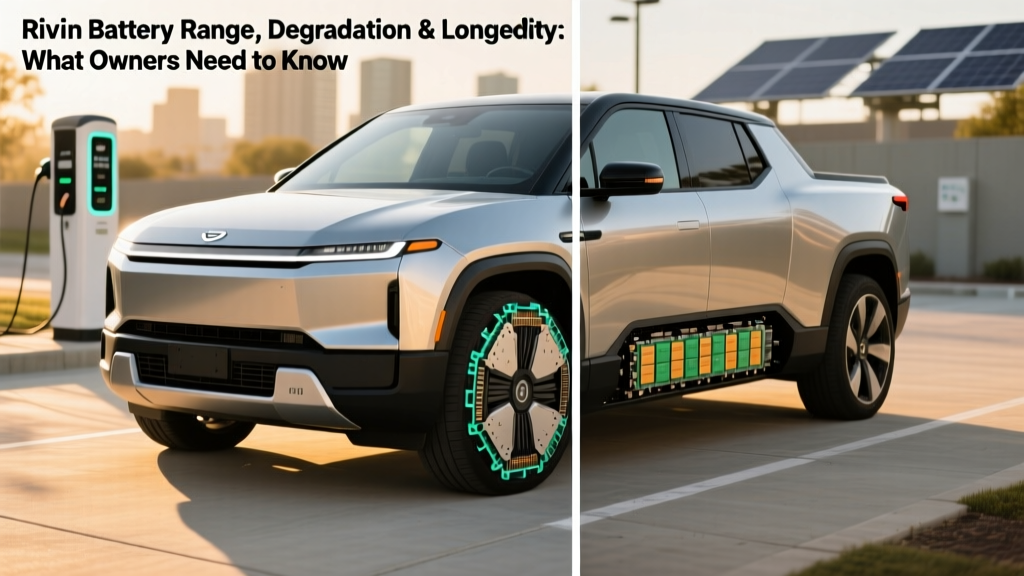
When shoppers research the Rivian battery range for the R1T pickup or R1S SUV, most focus on the EPA sticker number — 352 miles for the Dual-Motor Max Pack, or 270 miles for the Standard battery. But the more consequential question for long-term ownership is how that range holds up after 50,000, 100,000, or 200,000 miles on the odometer. Battery degradation, chemistry choice, charging habits, and warranty coverage all determine whether your Rivian delivers usable range a decade from now or becomes an expensive liability.
This guide dissects the real-world data on Rivian battery health, compares the NMC and LFP chemistries Rivian uses across its lineup, explains what the warranty actually covers, and projects replacement costs based on current market figures. Whether you're evaluating a new 2026 R1T or a used R1S, these are the numbers that matter.
Rivian Battery Range by Model and Pack Size
Rivian offers multiple battery configurations across the R1T and R1S, each with distinct range, chemistry, and pricing implications. The figures below reflect 2026 EPA estimates; real-world highway and cold-weather performance typically falls 10–20% below these stickers.
| Battery Pack | Usable Capacity (kWh) | Chemistry | EPA Range (mi) | Real-World Highway Estimate | Peak DC Charge Rate (kW) | 10–80% Time |
|---|---|---|---|---|---|---|
| Standard (Dual-Motor) | ~106 kWh | LFP | 270 | ~220–240 mi | 200 kW | ~28 min |
| Large (Dual-Motor) | ~135 kWh | NMC | 328 | ~270–295 mi | 220 kW | ~24 min |
| Max (Dual-Motor) | ~149 kWh | NMC | 352 | ~290–315 mi | 220 kW | ~26 min |
NMC vs LFP: Which Battery Chemistry Does Rivian Use?
Rivian's current lineup uses two distinct lithium-ion chemistries, and understanding the trade-offs is essential for predicting long-term range retention and choosing the right pack for your driving pattern.
| Attribute | LFP (Lithium Iron Phosphate) | NMC (Nickel Manganese Cobalt) |
|---|---|---|
| Energy Density | Lower (~160 Wh/kg cell-level) | Higher (~250 Wh/kg cell-level) |
| Cycle Life | 3,000–5,000+ cycles to 80% SoH | 1,000–2,000 cycles to 80% SoH |
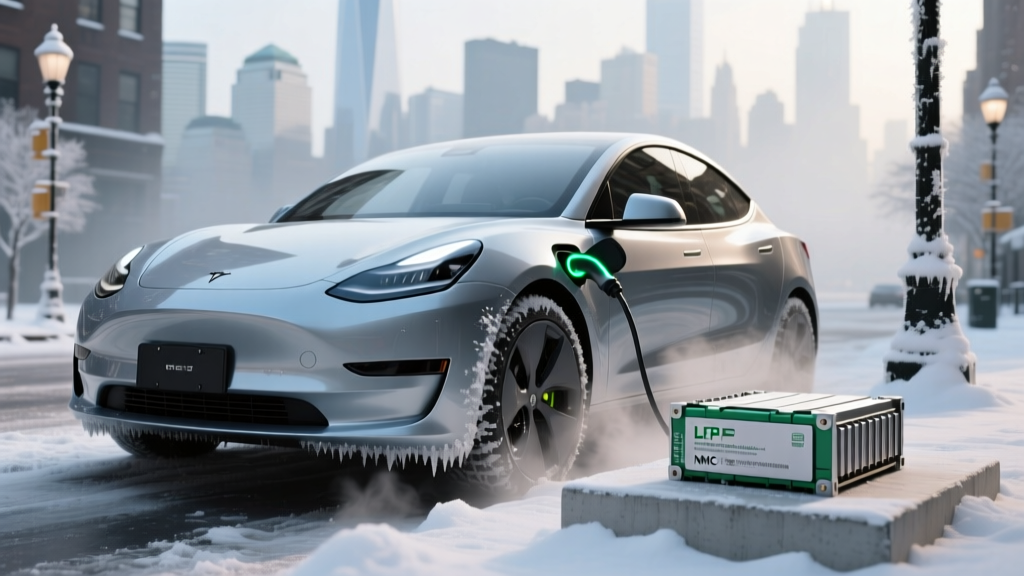
| Cold-Weather Performance | More range loss below 32°F (~25–30% reduction) | Better cold performance (~15–20% reduction) |
| Cost per kWh | Lower (~$80–100/kWh at pack level) | Higher (~$120–150/kWh at pack level) |
| Thermal Stability | Excellent — lower runaway risk | Good — requires more active thermal management |
| Recommended SoC for Daily Use | 100% (LFP tolerates full charges well) | 80–90% (prolongs cycle life) |
| Rivian Application | Standard Pack (R1T/R1S) | Large & Max Packs (R1T/R1S) |
The practical takeaway: If you drive mostly in moderate climates, charge at home nightly, and don't need maximum range, the LFP Standard Pack offers superior longevity with less degradation anxiety. If you regularly road-trip, tow, or live in a cold-weather state, the NMC Large or Max Pack gives you the energy density and cold-weather resilience you need — at the cost of somewhat faster long-term degradation and a higher replacement price if something goes wrong out of warranty.
How Long Do Rivian Batteries Last? Degradation Data
Rivian does not publish granular degradation curves, but we can piece together a reliable picture from owner-reported data on forums like Rivian Owners Club, early fleet telemetry, and industry-wide lithium-ion benchmarks validated by NREL battery testing.
- Year 1 / 15,000 mi: ~2–4% capacity loss (initial formation loss)
- Year 3 / 45,000 mi: ~5–8% total loss
- Year 5 / 75,000 mi: ~7–11% total loss
- Year 8 / 120,000 mi: ~10–15% total loss (NMC); ~6–10% (LFP)
- Year 10 / 150,000 mi: ~12–18% total loss (NMC); ~8–12% (LFP)
These figures assume typical mixed use — a combination of Level 2 home charging, occasional DC fast charging (1–2 times per week at most), and avoidance of prolonged 100% or 0% states of charge. Owners who DC fast-charge daily or routinely leave the vehicle at 100% SoC for extended periods will see degradation at the higher end of these ranges, or beyond them.
For context, a 2026 R1T Max Pack owner starting with 352 EPA miles could expect roughly 300–315 miles of usable range at the 8-year mark under normal conditions. An LFP Standard Pack owner starting at 270 miles might retain 245–255 miles over the same period. Neither scenario renders the vehicle unusable — but the difference matters if you're buying used and need every mile of range.
Rivian Battery Warranty: What's Actually Covered?
Rivian's high-voltage battery warranty aligns with the federal minimum established under EPA emissions-related warranty guidelines, and it is consistent with competitors like Ford, GM, and Hyundai.
| Coverage Item | Term | Details |
|---|---|---|
| Battery Capacity Retention | 8 years / 175,000 miles (whichever comes first) | Rivian warrants the battery will retain at least 70% of original usable capacity |
| Battery Defect Coverage | 8 years / 175,000 miles | Manufacturing defects, cell failures, BMS faults |
| Drive Unit (Motor) Warranty | 8 years / 175,000 miles | Electric drive motors and power electronics |
| 12V Auxiliary Battery | 3 years / 36,000 miles | Standard lead-acid or lithium 12V — separate from traction battery |
Key nuance: The 70% retention threshold means Rivian is only obligated to replace or repair the battery if degradation exceeds 30% within the warranty period. Based on current degradation data, very few Rivian batteries will hit that threshold under normal use — most project to retain 82–90% at the 8-year mark. The warranty is a safety net, not a prediction of typical performance.
For buyers in California and states that have adopted CARB regulations, additional battery warranty requirements may apply. Always verify your state's specific mandates through your dealer or the California Air Resources Board.
EV Battery Replacement Cost: What Would It Take?
This is the question that generates the most anxiety among prospective EV buyers. Let's ground it in real numbers.
| Battery Pack | Capacity | Estimated Pack Cost | Labor & Programming | Total Estimated Cost |
|---|---|---|---|---|
| Standard (LFP) | ~106 kWh | $10,000–$14,000 | $2,500–$4,000 | $12,500–$18,000 |
| Large (NMC) | ~135 kWh | $15,000–$20,000 | $2,500–$4,000 | $17,500–$24,000 |
| Max (NMC) | ~149 kWh | $17,000–$23,000 | $2,500–$4,000 | $19,500–$27,000 |
These estimates are based on current pack-level pricing of $100–150/kWh for NMC and $80–110/kWh for LFP, plus Rivian service-center labor rates. They are subject to change as battery costs continue their long-term decline — BloombergNEF projects pack prices falling below $80/kWh by 2030, which would meaningfully reduce out-of-warranty replacement costs.
When is replacement actually needed? Almost never during the vehicle's practical lifespan for most owners. Catastrophic failure (a defective cell group or BMS fault) is covered under warranty. Gradual degradation to 70% capacity — the point where you might want a replacement for range reasons — typically takes 150,000–250,000+ miles for NMC packs and potentially 300,000+ miles for LFP. The vast majority of Rivian batteries will outlast the vehicle's body, suspension, and interior before they need replacement.
Factors That Accelerate (or Slow) Battery Degradation
Not all miles are equal when it comes to battery wear. The following factors have the greatest measurable impact on long-term State of Health (SoH):
- Minimize DC fast charging to 1–2x/week. Daily 200+ kW charging accelerates electrolyte decomposition. Level 2 (7–11 kW) home charging is the gold standard for longevity.
- Set daily charge limit to 80–90% (NMC) or 100% (LFP). NMC cells degrade fastest when held at high SoC. LFP cells are more tolerant of full charges and actually benefit from periodic 100% charges for BMS calibration.
- Use preconditioning before fast charging. Rivian's navigation-to-charger preconditioning warms the battery to optimal temperature (~95°F), reducing charge-induced stress and improving charge speed.
- Avoid prolonged storage at 0% or 100% SoC. If storing the vehicle for more than a week, target 50–70% SoC.
- Garage the vehicle in extreme heat. Sustained ambient temperatures above 100°F with a high SoC accelerate calendar aging. Cold weather temporarily reduces range but causes less permanent degradation than extreme heat.
- Update firmware regularly. Rivian pushes BMS and thermal-management refinements via OTA updates that can improve charge profiles and longevity.
How to Check Your Rivian's Battery Health (SoH)
Rivian provides battery health visibility through the vehicle's infotainment system and the Rivian mobile app, though the depth of information is more limited than what some competitors offer.
What you can check today:
- Rivian App — Estimated Range at Full Charge: If your R1T Max Pack showed 352 miles when new and now shows 325 miles at 100% SoC, that's roughly a 7.7% degradation indicator. Track this number quarterly.
- Service Mode Diagnostics: Rivian service centers can pull detailed SoH reports showing individual cell-group voltage variance, total energy throughput, and capacity retention percentage.
- OBD-II Scan Tools: Third-party tools like OBDeleven or dedicated EV diagnostic apps can sometimes read BMS-reported SoH, though Rivian's API access is more restricted than Tesla's.
What Rivian does not currently expose to owners: A direct State of Health percentage on the dashboard (unlike the Nissan Leaf's 12-bar system or Tesla's battery health metric in service mode). If you want a precise SoH reading, request it during a scheduled service visit.
For used-Rivian buyers, requesting a battery health report from the seller or a Rivian service center before purchase is strongly recommended — treat it as essential as a compression test on a used gas vehicle.
What's Next? Solid-State and Silicon-Anode Batteries
The battery landscape is evolving rapidly, and Rivian has signaled interest in next-generation chemistries. Here's what's realistic versus hype:
Silicon-Anode Batteries: Companies like Sila Nanotechnologies and Group14 are producing silicon-dominant anode materials that boost energy density by 20–40% over conventional graphite anodes. These are entering production in 2025–2027 and could appear in future Rivian pack revisions, offering more range in the same physical footprint. Timeline for Rivian adoption: 2028–2030 at the earliest, based on current supply agreements.
Solid-State Batteries: Fully solid-state cells promise higher energy density, faster charging, and improved safety by replacing the liquid electrolyte with a solid conductor. Toyota, QuantumScape, and Samsung SDI have demonstrated prototype cells, but mass production at automotive scale remains unproven. Realistic timeline for availability in a production Rivian: 2030 or later. Any claims of solid-state EVs being "just around the corner" should be treated with skepticism until gigawatt-hour-scale factories are operational.
Sodium-Ion Batteries: CATL and other manufacturers are scaling sodium-ion cells for lower-cost, lower-energy-density applications. These are unlikely to appear in Rivian's adventure-oriented vehicles (which prioritize range and performance) but could be relevant for future commercial or fleet models.
The practical advice: don't delay a purchase waiting for next-generation batteries. Current lithium-ion technology — particularly LFP — is mature, reliable, and cost-effective. The incremental improvements from silicon anodes will be welcome but not transformative enough to justify waiting 3–5 years.
Frequently Asked Questions
How long do Rivian batteries last in years and miles?
Based on current degradation data, Rivian's NMC batteries (Large and Max packs) are projected to retain 82–90% of original capacity at 8 years / 120,000 miles. LFP batteries (Standard pack) retain an estimated 90–94% over the same period. In practical terms, most Rivian batteries will provide usable service for 15–20 years or 200,000–300,000 miles before degradation makes the vehicle impractical for its original use case.
How much does it cost to replace a Rivian battery?
Out-of-warranty replacement costs range from approximately $12,500 for the Standard LFP pack to $27,000 for the Max NMC pack, including parts and labor. However, most batteries will never require full replacement — individual cell-group repairs or module replacements (where supported) can cost significantly less. Battery costs are projected to decline 30–40% by 2030.
What does the Rivian battery warranty cover?
Rivian warrants the high-voltage traction battery against capacity loss below 70% of original capacity and against manufacturing defects for 8 years or 175,000 miles, whichever comes first. The 12V auxiliary battery carries a separate 3-year/36,000-mile warranty. Damage from accidents, modifications, or improper use is not covered.
How do I maximize my Rivian's battery health?
Charge primarily on Level 2 at home, limit NMC packs to 80–90% SoC for daily use (100% is fine for LFP), use preconditioning before DC fast charging, avoid storing the vehicle at extreme SoC levels, and keep up with OTA firmware updates. Minimize DC fast charging to 1–2 sessions per week when possible.
Is LFP or NMC better for a Rivian?
Neither is universally better — they serve different needs. LFP (Standard Pack) offers longer cycle life, lower cost, and better tolerance for daily 100% charges, making it ideal for commuters and home-chargers who don't need maximum range. NMC (Large and Max Packs) delivers higher energy density, better cold-weather performance, and more range for road trips and towing — at the cost of somewhat faster degradation and higher replacement expense. Choose based on your driving pattern, not the spec sheet alone.
Does frequent Rivian Supercharging degrade the battery faster?
Yes, but the effect is manageable. DC fast charging at 200+ kW generates significant heat and accelerates electrolyte breakdown compared to Level 2 charging. Rivian's thermal management system actively cools the pack during fast charging to mitigate this, but daily fast charging will push degradation toward the higher end of projected ranges. For optimal longevity, use Level 2 as your primary charging method and reserve DC fast charging for road trips.