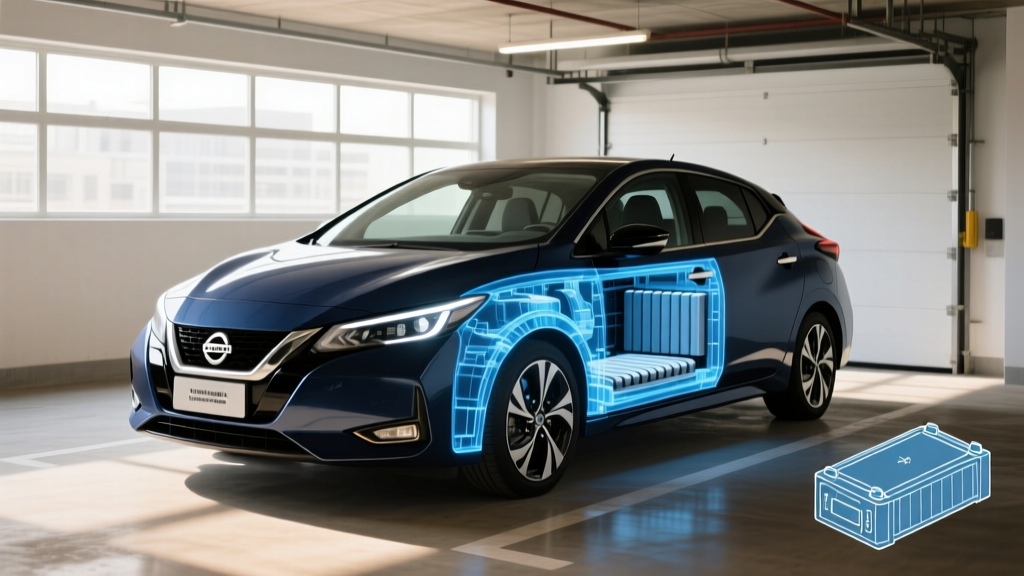
The Nissan Leaf is one of the most widely sold electric vehicles in history, with over 650,000 units delivered globally since its 2010 debut. But as first- and second-generation Leafs age, owners and prospective used buyers face a critical question: what happens when the high-voltage traction battery degrades — and how much does a replacement cost?
This guide covers everything you need to know about Nissan Leaf battery replacement, including real degradation data across all three battery sizes (24 kWh, 40 kWh, and 62 kWh), warranty terms, replacement pricing, and practical steps to maximize battery health. We also compare the Leaf's air-cooled battery design to the liquid-cooled systems used by most modern EVs — the single biggest factor affecting Leaf battery longevity.
How Long Does a Nissan Leaf Battery Last?
The honest answer depends heavily on which generation and battery size you own, your climate, and your charging habits. Nissan Leaf batteries use passive air cooling rather than the active liquid thermal management found in vehicles like the Chevrolet Bolt or Tesla Model 3. This design choice makes Leaf batteries more susceptible to heat-driven degradation, particularly in hot climates and with frequent DC fast charging.
Here is what real-world data and owner reports show across the three Leaf battery generations:
Nissan Leaf Battery Degradation by Generation
| Battery / Generation | Usable Capacity (kWh) | Typical 5-Year SoH | Typical 8-Year SoH | Key Degradation Factor |
|---|---|---|---|---|
| Gen 1 (2011–2017) 24 kWh | ~21–22 kWh | 75–85% | 65–78% | Heat + CHAdeMO fast charging |
| Gen 2 (2018–2023) 40 kWh | ~38 kWh | 82–90% | 72–85% | Improved chemistry, still air-cooled |
| Gen 2 Plus (2019–2023) 62 kWh | ~59 kWh | 85–92% | 76–88% | Larger buffer, better cell design |
SoH = State of Health (percentage of original capacity remaining). Data synthesized from owner-reported LeafSpy readings, Recurrent Auto battery studies, and Nissan service bulletins. Individual results vary by climate and usage.
The 24 kWh Gen 1 Leafs are the most affected. Many 2013–2017 models in hot states like Arizona and Texas have dropped below 70% SoH by year eight, triggering warranty claims. The 40 kWh and 62 kWh packs introduced in the second generation use improved cell chemistry and slightly larger usable buffers, which has slowed the degradation curve — but the fundamental air-cooling limitation remains.
For context, liquid-cooled EV batteries from Tesla, Hyundai, and GM typically retain 88–95% SoH at the eight-year mark, according to Recurrent Auto's longitudinal battery study. The Leaf's air-cooled design is the primary reason its degradation curve sits below that benchmark.
Nissan Leaf Battery Warranty: What's Covered
Nissan provides two layers of battery warranty coverage for the Leaf. Understanding both is essential before you pay out of pocket for any replacement.
| Warranty Type | Coverage Period | Threshold / Terms |
|---|---|---|
| Lithium-Ion Battery Capacity Warranty | 8 years / 100,000 miles | Replaces battery if SoH drops below ~66% (4 bars lost on the dash capacity gauge) for 24 kWh; below ~66% for 40/62 kWh packs |
| EV System Warranty (defects) | 5 years / 60,000 miles | Covers manufacturing defects in battery pack, inverter, motor, and related components |
| California / PZEV States | 10 years / 100,000 miles (capacity) | Extended battery capacity coverage in CARB states (CA, CT, ME, MD, MA, NJ, NY, OR, RI, VT, WA) |
Source: Nissan USA warranty guide. Always verify with your specific model-year owner's manual and a Nissan dealer, as terms have shifted across model years.
The capacity warranty threshold is critical: Nissan will only replace the battery under warranty if the State of Health drops below approximately 66% of original capacity — displayed as losing 4 or more bars on the Leaf's dashboard capacity gauge (the rightmost set of bars on the instrument cluster). If your battery is degraded but still above that threshold, you're responsible for replacement costs.
One important caveat: if your Leaf has a salvaged or rebuilt title, the battery warranty is typically voided. Used-car buyers should always verify warranty transferability through a Nissan dealer using the VIN before purchasing an older Leaf.
How Much Does a Nissan Leaf Battery Replacement Cost?
If your Leaf battery falls outside warranty coverage, replacement costs are substantial but have moderated in recent years as the supply of refurbished and aftermarket packs has grown. Here is the current pricing landscape for 2026:
| Battery Pack | New OEM (Dealer) | Refurbished / Remanufactured | Used (Salvage Yard) | Labor (Additional) |
|---|---|---|---|---|
| 24 kWh (Gen 1, 2011–2017) | $6,500–$8,500 | $3,500–$5,000 | $2,000–$3,500 | $800–$1,500 |
| 40 kWh (Gen 2, 2018–2023) | $8,000–$10,500 | $5,000–$7,000 | $3,500–$5,500 | $800–$1,500 |
| 62 kWh (Leaf Plus, 2019–2023) | $9,500–$13,000 | $6,500–$9,000 | $4,500–$7,000 | $800–$1,500 |
Prices are approximate ranges based on dealer quotes, independent EV shops, and salvage market data as of early 2026. Always get a written estimate. Some independent shops offer battery module-level repair (replacing individual degraded cells) for $2,000–$4,000, which can be a cost-effective alternative for packs with isolated cell failures.
A few practical realities about Leaf battery replacement:
- Gen 1 (24 kWh) Leafs are the most common replacement candidates. These vehicles are now 9–15 years old, and many have exceeded the warranty period. The total replacement cost (battery + labor) for a new OEM 24 kWh pack can approach or exceed the vehicle's Kelley Blue Book value, which makes refurbished packs or module-level repairs the economically rational choice.
- Nissan has offered battery upgrade paths. In some markets, Nissan dealers can install a 40 kWh pack into a Gen 1 Leaf chassis (a "battery upgrade" program that was available in Japan and selectively in the US). Availability and pricing vary — contact your local dealer.
- Refurbished packs are increasingly viable. Companies like Green Bean Battery and independent EV shops offer tested, reconditioned Leaf packs with 1–3 year warranties. These typically use matched cells from lower-mileage donor packs.
Why the Leaf's Air-Cooled Battery Matters for Longevity
The single most important thing to understand about Nissan Leaf battery health is the thermal management design. Unlike virtually every other modern EV — from the Tesla Model 3 to the Hyundai Ioniq 5 to the Ford Mustang Mach-E — the Leaf uses passive air cooling for its high-voltage battery pack. There is no liquid coolant loop circulating through the battery modules.
This design decision has compounding effects:
- Heat is the #1 enemy of lithium-ion cells. Sustained battery temperatures above 95°F (35°C) accelerate chemical degradation. In hot climates (Phoenix, Houston, Los Angeles summers), Leaf battery temperatures regularly exceed this threshold during driving and charging.
- DC fast charging generates significant heat. A 50 kW CHAdeMO session on a Gen 1 Leaf can raise battery temperature 15–25°F. Without active cooling, that heat dissipates slowly. Repeated fast charging in hot weather — the infamous "Rapidgate" issue that affected 2018–2019 Leafs — can cause the car to throttle charging speed to protect the battery.
- Cold weather reduces range but doesn't degrade the battery. Unlike heat, cold temperatures temporarily reduce available capacity (expect 20–30% range loss at 20°F) but do not cause permanent degradation. The Leaf's lack of a battery heater means cold-weather charging is slow, but it doesn't harm long-term SoH.
This is why a 2015 Leaf in Seattle may show 82% SoH at 100,000 miles, while the same model year in Phoenix might sit at 68% SoH. Climate is the dominant variable for Leaf battery life, more so than for liquid-cooled EVs.
LFP vs. NMC Battery Chemistry: What Leaf Owners Should Know
The Nissan Leaf has historically used NMC (nickel manganese cobalt) lithium-ion cells, supplied primarily by AESC (Automotive Energy Supply Corporation, formerly a Nissan-NEC joint venture). NMC chemistry offers high energy density — critical for fitting meaningful range into the Leaf's compact platform — but trades off some cycle life and thermal stability compared to LFP (lithium iron phosphate).
| Factor | NMC (Nissan Leaf) | LFP (Tesla Model 3 RWD, BYD, others) |
|---|---|---|
| Energy Density | Higher (~150–220 Wh/kg cell-level) | Lower (~130–170 Wh/kg cell-level) |
| Cycle Life | ~1,000–2,000 full cycles to 80% SoH | ~3,000–5,000+ full cycles to 80% SoH |
| Thermal Stability | Moderate — more prone to heat-driven degradation | Excellent — inherently more stable at high temps |
| Cold Performance | Better low-temp capacity retention | Greater range loss in sub-freezing temps |
| Cost per kWh | Higher (cobalt, nickel content) | Lower (iron, phosphate — no cobalt) |
| Charging to 100% Regularly | Not recommended — accelerates degradation | Recommended — LFP needs full charges for BMS calibration |
Neither chemistry is universally "better." NMC suits vehicles prioritizing range per pound; LFP suits cost-sensitive, high-cycle-life applications. The Leaf's air-cooling makes its NMC cells more vulnerable than NMC cells in liquid-cooled packs.
For Leaf owners, the practical takeaway: your NMC battery will serve you well if you minimize heat exposure and avoid habitual fast charging. But if you're comparing a used Leaf to a newer LFP-equipped vehicle (like the base Tesla Model 3 RWD or BYD models available in some markets), the LFP pack will likely outlast the vehicle itself with far less degradation anxiety.
How to Check and Maximize Your Leaf's Battery Health
Monitoring your Leaf's State of Health (SoH) is straightforward, and there are several tools available beyond the basic dashboard indicator.
Methods to Check Battery SoH
- Dashboard capacity bars: The Leaf displays 12 capacity bars on the right side of the instrument cluster. A new battery shows all 12. Each lost bar represents roughly 6.25% capacity loss. At 8 bars (approximately 66% SoH), you may qualify for a warranty replacement.
- LeafSpy Pro (recommended): This third-party app, used with an OBD-II Bluetooth dongle (~$20–$35), provides granular battery data including precise SoH percentage, cell voltage variance, battery temperature, and cycle count. It's the gold standard for Leaf battery monitoring and is widely used in Leaf owner communities.
- Nissan dealer diagnostic: A dealer can run a battery health report that provides an official SoH reading. This is useful for warranty claims and pre-purchase inspections on used Leafs.
Battery Care Checklist for Nissan Leaf Owners
- Avoid daily DC fast charging. Limit CHAdeMO sessions to road trips or when necessary. Frequent 50 kW+ charging on an air-cooled pack is the fastest path to degradation.
- Charge to 80% for daily use (Gen 1). The 24 kWh Leaf allows setting an 80% charge limit via the dashboard or NissanConnect app. Use it. For the 40/62 kWh packs, set a charge limit via timer or smart charger if possible.
- Avoid parking in extreme heat when fully charged. A Leaf sitting at 100% SoC in 100°F+ ambient heat is the worst-case degradation scenario. If you must park in hot weather, aim for 50–60% SoC.
- Use Level 2 (240V) home charging as your primary method. A 6.6 kW Level 2 charge generates far less heat than a 50 kW DC session and is ideal for the Leaf's air-cooled design.
- Precondition while plugged in. Use the NissanConnect app to pre-heat or pre-cool the cabin while connected to shore power. This draws from the grid, not the battery, preserving range.
- Monitor cell voltage variance with LeafSpy. Growing variance between individual cells (above ~100 mV delta) can signal an imbalanced pack that may benefit from a slow, full charge cycle to rebalance.
Factors That Accelerate Leaf Battery Degradation
Understanding the specific stressors helps you make informed decisions about daily use and long-term ownership:
- DC fast charging frequency: Data from Idaho National Laboratory studies shows that EVs charged primarily via DC fast charging degrade faster than those charged predominantly on Level 2. For the air-cooled Leaf, this effect is amplified. If more than 30% of your charging is DC fast, expect accelerated SoH loss.
- Ambient temperature: Average battery temperature is the strongest predictor of Leaf degradation. Owners in the Southwest US consistently report 3–5% more capacity loss per year than Pacific Northwest owners.
- State of charge extremes: Regularly charging to 100% and letting the battery sit, or frequently draining below 10%, stresses NMC cells. The sweet spot for daily use is 20–80% SoC.
- High-mileage fast-charge cycles: Fleet Leafs (taxis, delivery vehicles) that combine high mileage with frequent fast charging show the steepest degradation curves — sometimes losing 20%+ capacity in three years.
Emerging Battery Technology: What's on the Horizon
If you're weighing whether to replace a Leaf battery now or wait for future technology, here is the realistic timeline for next-generation battery chemistries:
- Solid-state batteries: Nissan has announced a solid-state battery pilot program targeting production by 2028–2029, with promises of 2x energy density and faster charging. However, these are unlikely to be retrofit-compatible with existing Leaf platforms. Solid-state remains in the prototype/pilot phase as of 2026.
- Silicon-anode cells: Companies like Sila Nanotechnologies and Group14 are bringing silicon-dominant anodes to market, offering 15–25% energy density improvements over graphite anodes. These are appearing in premium vehicles first (Mercedes EQG, Porsche) and will trickle down over 3–5 years.
- Sodium-ion batteries: CATL and BYD have begun producing sodium-ion cells for lower-cost, shorter-range EVs. These offer excellent cycle life and cold performance at lower energy density — a potential fit for budget city cars but not a Leaf retrofit option.
The practical reality: none of these technologies will be available as drop-in replacements for your current Leaf. If your battery needs replacing now, the decision is between a refurbished OEM pack, a new OEM pack, or trading into a newer EV with modern thermal management.
Should You Replace the Battery or Trade In?
This is the core financial decision for aging Leaf owners. Here is a framework:
Decision Framework
Replace the battery if:
- Your Leaf is otherwise in good condition (body, interior, suspension) and you want to keep it 3+ more years
- You can source a refurbished pack for under $5,000 installed
- You use the Leaf primarily for commuting and local driving where 100–150 miles of range is sufficient
- You have access to affordable home Level 2 charging
Trade in or sell if:
- The replacement cost exceeds 50% of the vehicle's current market value
- You regularly need more than 150 miles of range
- You live in a hot climate and want a liquid-cooled battery for long-term reliability
- You want access to the federal §30D tax credit (up to $7,500 for qualifying new EVs, subject to MSRP caps, income limits, and battery sourcing rules — verify current eligibility at IRS.gov)
Frequently Asked Questions
Can I upgrade my 24 kWh Leaf to a 40 kWh or 62 kWh battery?
In some cases, yes. Nissan offered a battery upgrade program (primarily in Japan) that allowed Gen 1 Leaf owners to swap to a 40 kWh pack. In the US, this has been available through select dealers on a limited basis, and some independent EV shops perform aftermarket upgrades using adapter kits. Expect to pay $6,000–$9,000 for a 40 kWh upgrade including labor. Always confirm compatibility with your specific model year and VIN.
Does the Nissan Leaf battery warranty transfer to a second owner?
Yes. Nissan's lithium-ion battery capacity warranty (8 years/100,000 miles) is tied to the vehicle, not the original owner. As long as the vehicle has a clean title and hasn't exceeded the mileage/time limits, the warranty remains in effect. Always verify with a Nissan dealer using the VIN before buying a used Leaf.
How do I know if my Leaf battery qualifies for warranty replacement?
If your dashboard capacity gauge shows 8 bars or fewer (out of 12) and your Leaf is within the 8-year/100,000-mile warranty window, you likely qualify. A Nissan dealer will confirm with an official battery health diagnostic. In CARB/PZEV states, the coverage extends to 10 years/100,000 miles.
Is it safe to buy a used Nissan Leaf with a replaced battery?
Generally yes, provided the replacement was done by a Nissan dealer or reputable EV shop, and you can verify the replacement battery's SoH (via LeafSpy or dealer diagnostic). Ask for documentation: was it a new OEM pack, refurbished, or used? What warranty came with it? A Leaf with a recently replaced battery at 90%+ SoH can be a strong value.
How much range will I lose as my Leaf battery degrades?
Range loss roughly tracks with SoH loss. A 40 kWh Leaf rated at 149 miles EPA when new, with 80% SoH, will deliver approximately 119 miles of EPA-equivalent range — and expect 95–105 miles in real-world highway or cold-weather driving. A 62 kWh Leaf Plus (226 miles EPA new) at 80% SoH yields roughly 181 miles EPA-equivalent.
Can extreme cold permanently damage my Leaf battery?
No. Cold temperatures temporarily reduce available capacity and slow charging speeds, but they do not cause permanent degradation. The Leaf's lack of a battery heater means winter charging will be slow (the car may limit DC fast charge rates to protect cold cells), but this is a protective measure, not damage. Heat, not cold, is the long-term threat to Leaf battery health.