The Chemistry Question Every EV Buyer Eventually Faces
If you have spent any time researching electric vehicles in 2026, you have encountered the alphabet soup of battery chemistries: NMC, NCA, LFP — and now, increasingly, discussions around RAD batteries (radical anode design) and other next-generation architectures. For most buyers, the traction battery is the single most expensive component in the vehicle, and its chemistry determines everything from daily range and fast-charging speed to long-term degradation and cold-weather behavior.
This guide cuts through the marketing noise. We will cover the chemistries actually shipping in production EVs today, the real-world degradation data accumulated over hundreds of thousands of fleet miles, what warranties actually protect, and where emerging technologies like RAD batteries and solid-state cells fit on a realistic timeline.
NMC vs NCA vs LFP: The Production Chemistry Breakdown
Three lithium-ion chemistries dominate the 2026 EV market. Each carries distinct engineering trade-offs that affect your ownership experience in measurable ways.
| Attribute | NMC (Nickel Manganese Cobalt) | NCA (Nickel Cobalt Aluminum) | LFP (Lithium Iron Phosphate) |
|---|---|---|---|
| Energy Density (cell-level) | 250–300 Wh/kg | 260–300 Wh/kg | 160–200 Wh/kg |
| Typical Cycle Life | 1,000–2,000 cycles | 800–1,500 cycles | 3,000–5,000+ cycles |
| Cold Performance (–10°C range loss) | ~20–30% | ~20–30% | ~30–40% |
| Thermal Stability | Moderate | Moderate | Excellent |
| Cost per kWh (pack-level, 2026) | $120–$145 | $115–$140 | $80–$100 |
| Recommended Daily SoC | 80% (charge to 100% before trips) | 80% (charge to 100% before trips) | 100% (regular full charges recommended) |
| Common 2026 Applications | Hyundai Ioniq 5/6, VW ID.4, BMW iX | Tesla Model S/X, Rivian R1T/R1S (Dual) | Tesla Model 3/Y RWD, Ford Mustang Mach-E Select, Rivian Standard |
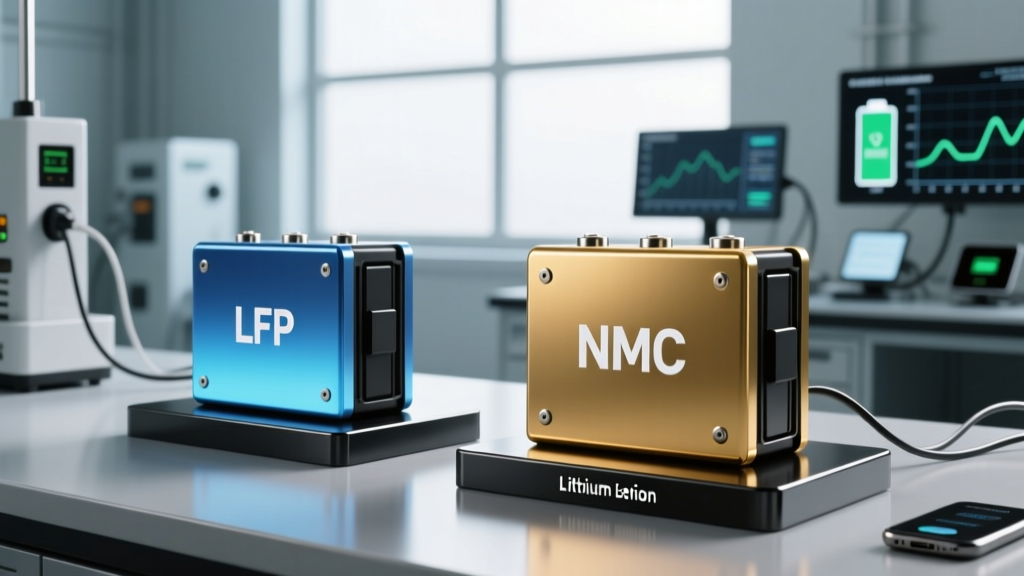
The practical translation: NMC and NCA cells pack more energy into a smaller, lighter package — which is why they appear in long-range and performance trims. LFP cells are heavier and less energy-dense, but they tolerate daily 100% charging, last significantly more cycles, and cost substantially less. For a commuter who charges at home nightly and rarely road-trips, LFP is often the more rational choice. For a buyer who needs 320+ miles of EPA range and frequent DC fast charging on road trips, NMC or NCA delivers.
What Are RAD Batteries and Where Do They Fit?
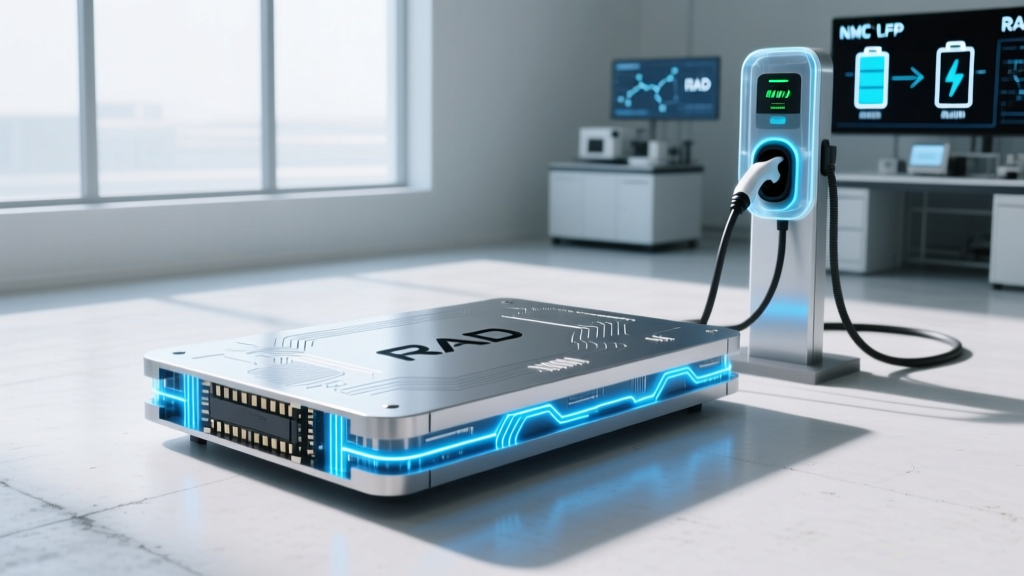
RAD batteries — referring to radical anode design architectures — represent an emerging class of cell construction that rethinks the anode layer to improve energy density, charge acceptance, and cycle life simultaneously. The term encompasses several approaches under active development in 2026, including silicon-dominant anodes, lithium-metal anodes with protective interlayers, and advanced anode binder systems.
Companies like Sila Nanotechnologies, Group14 Technologies, and Enovix have been shipping silicon-anode cells in limited consumer electronics and early automotive validation programs. The promise is compelling: silicon can theoretically store roughly 10 times the lithium ions per gram compared to the graphite anodes used in today's NMC and LFP cells. In practice, current silicon-blend anodes (where silicon is mixed with graphite at 5–20% ratios) deliver a 10–20% energy density improvement at the cell level.
Where RAD batteries stand in 2026:
- Available now: Silicon-blend anodes in limited production cells (e.g., Mercedes G-Class 580e prototype partnership with Sila; Panasonic 4680 cells with incremental silicon content for Tesla)
- Validation/pilot phase: Higher silicon-content anodes (>30% silicon) targeting 2027–2029 model-year vehicles
- Lab/early prototype: Pure silicon anodes and lithium-metal anodes — projected availability 2029–2032+
For buyers shopping today, RAD battery technology is a forward-looking consideration, not a purchasing decision. The chemistries in your driveway are NMC, NCA, or LFP — and all three have proven track records when properly managed.
How Long Do EV Batteries Actually Last? Degradation Data
The most persistent fear among prospective EV buyers is that the traction battery will fail prematurely, leaving them with a five-figure replacement bill. The data tells a more reassuring story — but with important nuance.
Real-World Degradation Data Points (Fleet & Owner Aggregations):
| Vehicle / Chemistry | Mileage | Average Capacity Retention | Source Context |
|---|---|---|---|
| Tesla Model 3/Y (NMC/NCA, 2018–2021) | 100,000 mi | ~90–93% | Tesla Impact Report 2024; fleet telematics |
| Tesla Model 3/Y (LFP, 2022–2024) | 80,000 mi | ~95–97% | Owner-reported; Recurrent Auto data |
| Chevrolet Bolt EV (NMC, 2017–2022) | 100,000 mi | ~92–95% | Post-recall replacement fleet data |
| Hyundai Kona Electric (NMC, 2019–2023) | 80,000 mi | ~90–94% | European fleet aggregations |
| Nissan LEAF (LMO/NMC, passive cooling, 2013–2017) | 80,000 mi | ~75–85% | Known accelerated degradation; no active thermal mgmt |
Key takeaway: Modern EVs with active liquid thermal management (which includes virtually every EV sold since 2018 from Tesla, Hyundai/Kia, GM, Ford, BMW, Rivian, and others) are retaining 88–95% of original capacity at the 100,000-mile mark. The outlier above — the early Nissan LEAF — illustrates exactly why thermal management matters. Passive air cooling allowed repeated heat cycling that accelerated cell degradation, a lesson the industry internalized.
A typical degradation curve is non-linear: expect a steeper 3–5% loss in the first 15,000–25,000 miles as cells stabilize, followed by a much gentler linear decline of roughly 1–2% per year or every 12,000–15,000 miles. Projected to 200,000 miles, most current-generation packs should retain 80–88% of original capacity — well above the threshold where most owners notice meaningful range reduction in daily driving.
What the Battery Warranty Actually Covers
Federal law mandates a minimum 8-year/100,000-mile warranty on EV traction batteries (extended to 10 years/150,000 miles in California and states that adopted CARB standards). Here is how major manufacturers structure their coverage as of the 2026 model year:
| Manufacturer | Warranty Term | Capacity Retention Threshold | Notes |
|---|---|---|---|
| Tesla | 8 yr / 120,000 mi (Model 3/Y); 8 yr / 150,000 mi (S/X) | 70% | Covers defect and degradation below threshold |
| Hyundai / Kia | 10 yr / 100,000 mi | 70% | Among the longest terms in the industry |
| Ford | 8 yr / 100,000 mi | 70% | Applies to Mustang Mach-E, F-150 Lightning |
| GM (Chevrolet/Cadillac) | 8 yr / 100,000 mi | 70% (60% on some commercial) | Ultium platform vehicles |
| BMW | 8 yr / 100,000 mi | 70% | Covers iX, i4, i7 lineup |
| Rivian | 8 yr / 175,000 mi (R1T/R1S Max); 8 yr / 120,000 mi (Standard) | 70% | Higher mileage cap on larger packs |
Critical detail: These warranties cover the battery if capacity drops below the stated threshold (typically 70%) within the term. Gradual degradation from 100% to 72% over 8 years is considered normal and is not a warranty claim. If your pack falls to 68% at year 7, however, the manufacturer must repair or replace it at no cost. Per fueleconomy.gov, most modern packs never reach this threshold under normal use.
EV Battery Replacement Cost: What the Numbers Say
Out-of-warranty battery replacement remains a legitimate concern for second- and third-owners, even though data shows most packs outlast the vehicles they power. Costs vary enormously by pack size, chemistry, and whether the replacement uses new, refurbished, or module-level repair.
| Vehicle / Pack Size | Full Pack Replacement (New OEM) | Refurbished / Remanufactured | Module-Level Repair |
|---|---|---|---|
| Tesla Model 3 RWD (~60 kWh LFP) | $12,000–$15,000 | $8,000–$11,000 | $2,500–$5,000 (per module) |
| Tesla Model Y Long Range (~82 kWh NMC) | $16,000–$20,000 | $11,000–$15,000 | $3,000–$6,000 |
| Hyundai Ioniq 5 (~77.4 kWh NMC) | $14,000–$18,000 | $10,000–$13,000 | $2,500–$5,500 |
| Ford F-150 Lightning Extended (~131 kWh NMC) | $22,000–$30,000 | $16,000–$22,000 | $4,000–$8,000 |
| Chevrolet Bolt EV (~65 kWh NMC) | $13,000–$16,000 | $9,000–$12,000 | $2,000–$4,500 |
Context that matters: Pack-level replacement costs have declined roughly 40–50% since 2018 as cell prices fell and the refurbishment market matured. More importantly, module-level repair — where a technician identifies and replaces only the degraded or failed modules within the pack — is increasingly viable and dramatically cheaper. Independent EV shops and mobile technicians now offer this service for many popular models.
The realistic scenario: if you buy a new EV and drive it 10–12 years / 150,000–200,000 miles, the odds of needing a full out-of-pocket pack replacement remain low. Most first owners will sell or trade the vehicle before the battery degrades to a functionally limiting level. The risk concentrates on high-mileage used buyers purchasing vehicles already outside warranty coverage.
Five Factors That Accelerate (or Preserve) Battery Health
What actually moves the needle on long-term battery health:
- Charging habits (high impact): For NMC/NCA packs, routinely charging to 100% and letting the car sit at full SoC accelerates electrolyte decomposition. Set your daily charge limit to 80% and only charge to 100% when you will drive immediately. LFP packs are the exception — manufacturers like Tesla recommend periodic 100% charges for LFP to allow the BMS to recalibrate cell balancing.
- DC fast-charging frequency (moderate impact): Occasional road-trip fast charging is fine. Daily reliance on 150+ kW DC fast charging, particularly in hot climates without preconditioning, adds cumulative stress. Data from Recurrent Auto shows that Teslas that fast-charge more than 90% of the time exhibit roughly 2–3% additional degradation at 100,000 miles compared to predominantly Level 2 home-charged vehicles — noticeable but not catastrophic.
- Extreme temperature exposure (moderate-to-high impact): Sustained exposure to ambient temperatures above 95°F (35°C) without garage parking accelerates calendar aging. Similarly, repeated deep discharges in sub-freezing temperatures without preconditioning cause lithium plating risk. Active thermal management mitigates this substantially, but parking in shade or a garage when possible extends pack life.
- Depth of discharge patterns (moderate impact): Shallow cycles (charging from 30% to 70%) are gentler than deep cycles (5% to 95%). You do not need to obsess over this, but avoiding routinely draining below 10% unless necessary is a good habit.
- Software updates and BMS calibration (low-moderate impact): Manufacturer over-the-air updates occasionally refine battery management algorithms, thermal thresholds, and charge curves. Keeping your vehicle current ensures you benefit from ongoing optimization.
How to Monitor Your Battery's State of Health (SoH)
State of Health (SoH) is the percentage of original usable capacity your battery currently retains. Unlike State of Charge (SoC), which fluctuates daily, SoH declines slowly over months and years. Here is how to track it:
Native vehicle tools:
- Tesla: The mobile app does not display SoH directly, but you can estimate it by charging to 100% and comparing the displayed range to the original EPA figure (adjusted for known software/rating changes). Third-party apps like Tessie or TeslaFi calculate SoH from charge logs.
- Hyundai/Kia: Some model years expose a battery health percentage in the engineering-mode service menu, accessible via the infotainment head unit. Consult owner forums for your specific model year.
- BMW: The iDrive system on current iX and i4 models provides a battery health indicator in the vehicle settings menu.
- OBD-II scanners: Tools like the OBDLink SX paired with apps such as ABRP (A Better Route Planner) or EV-specific diagnostic software can read the BMS-reported SoH value directly from the CAN bus on most vehicles.
When to be concerned: If your SoH drops more than 3–4% in a single year after the initial break-in period, or if you observe sudden range loss that does not correlate with temperature, schedule a dealer diagnostic. This can indicate a cell imbalance or module failure that may be covered under warranty.
Looking Ahead: Solid-State, Silicon Anodes, and What's Realistic
The battery technology pipeline is active, but timelines consistently slip — a pattern smart buyers should internalize.
Solid-state batteries (which replace the liquid electrolyte with a solid ceramic, polymer, or sulfide conductor) promise higher energy density, faster charging, and improved safety. Toyota has announced a 2027–2028 production target for a solid-state-equipped EV with a claimed 750 km (WLTP) range and 10-minute fast charging. Samsung SDI, QuantumScape (backed by Volkswagen), and Solid Power (partnered with BMW and Ford) are all in pilot production phases. Realistic volume-production availability for mainstream US-market vehicles: 2029–2031 at the earliest, with initial deployment likely in premium segments.
Silicon-anode batteries (a subset of RAD battery architectures) are closer. As noted above, silicon-blend anodes are already in limited production. Expect 2027–2028 model-year vehicles from Mercedes, potentially GM, and others to feature higher silicon-content anodes delivering 15–25% more energy density at the cell level. This translates directly to either more range in the same pack volume, or the same range in a lighter, cheaper pack.
Sodium-ion batteries (CATL, HiNA) are entering production for lower-range, cost-sensitive applications — primarily in China-market vehicles and potentially as secondary batteries in dual-chemistry packs. They offer excellent cold performance and low cost but lower energy density than even LFP. US-market relevance: limited before 2028.
For buyers deciding today, the pragmatic advice is unchanged: buy the chemistry that fits your driving pattern now. Waiting for solid-state or high-silicon-anode cells means waiting 3–5+ years, during which current NMC, NCA, and LFP packs will serve reliably with proper care.
Frequently Asked Questions
How long do EV batteries last in years and miles?
Based on current fleet data, most modern EV batteries with active thermal management retain 80–90% of original capacity at 150,000–200,000 miles, typically corresponding to 12–18 years of average use. Catastrophic failure (complete pack death) is rare. The more relevant question is whether 80% of original range still meets your daily needs — and for most drivers with 300-mile EPA-rated vehicles, 240 miles of real-world range at 200,000 miles remains entirely practical.
How much does an EV battery cost to replace?
Full OEM pack replacements range from approximately $12,000 for a ~60 kWh LFP pack (Tesla Model 3 RWD) to $30,000 for a ~131 kWh NMC pack (F-150 Lightning Extended Range). Refurbished packs typically cost 30–40% less. Module-level repairs, where only failed sections are replaced, can cost $2,500–$8,000 depending on the vehicle. These costs have been declining steadily and will likely continue to do so as the refurbishment supply chain matures.
What does the battery warranty cover?
Federally mandated minimum coverage is 8 years/100,000 miles (10 years/150,000 miles in CARB states). The warranty covers defects in materials and workmanship, plus capacity degradation below a stated threshold — typically 70% of original capacity. It does not cover gradual, normal degradation above that threshold, damage from accidents, improper modifications, or use of non-approved charging equipment. Always read the specific warranty booklet for your vehicle; terms vary. See IRS.gov for related clean vehicle credit information that may offset purchase cost.
LFP vs NMC — which is better and why?
Neither is universally better; they solve different problems. LFP wins on cycle life (3,000–5,000+ vs 1,000–2,000 cycles), cost ($80–100/kWh vs $120–145/kWh at the pack level), thermal safety, and the convenience of daily 100% charging. NMC wins on energy density (250–300 Wh/kg vs 160–200 Wh/kg), cold-weather performance (roughly 10% less range loss at –10°C), and total vehicle range per charge. Choose LFP if you commute daily, charge at home, and prioritize long-term value. Choose NMC if you need maximum range, frequently road-trip in cold climates, or tow.
How do I check and maximize my EV battery health?
Monitor SoH through your vehicle's native display (if available), third-party telemetry apps (TeslaFi, Tessie, ABRP), or an OBD-II scanner reading BMS data. To maximize health: set daily charge limits to 80% for NMC/NCA (100% is fine for LFP), minimize sustained storage at extreme SoC levels, precondition before DC fast charging, park in shade or a garage in hot climates, and keep your vehicle software updated. None of these require obsessive behavior — modern battery management systems are robust, and following these guidelines as general habits rather than rigid rules will serve you well.