If you own a Tesla—or any modern EV—thermal management is the single biggest factor you can control for long-term battery health. Knowing how to precondition your Tesla battery from the app isn't just a convenience trick for faster Supercharging; it's a core ownership habit that reduces cell stress, preserves range, and helps your high-voltage traction pack deliver reliable service well past 150,000 miles.
This guide walks through exactly how preconditioning works, why Tesla's battery management system (BMS) demands specific temperatures for fast charging and regen braking, and how preconditioning fits into a broader battery-care strategy that includes chemistry awareness, charging habits, and State of Health (SoH) monitoring.
What Battery Preconditioning Actually Does
Preconditioning warms or cools the high-voltage traction battery to its optimal operating window—typically between 30°C and 40°C (86°F–104°F) for fast charging, and above roughly 15°C (59°F) for full regenerative braking. Lithium-ion cells experience increased internal resistance when cold, which limits charge acceptance, reduces regen capability, and accelerates lithium plating on the anode during high-current charging.
When you navigate to a Supercharger in your Tesla's built-in navigation, the vehicle automatically begins preconditioning the battery en route. The BMS draws energy from the pack (or from the grid if plugged in) to run the thermal management loop—circulating heated or chilled glycol through the battery cooling plates. This can consume 2–5 kW of power for 15–45 minutes depending on ambient temperature and starting battery temperature.
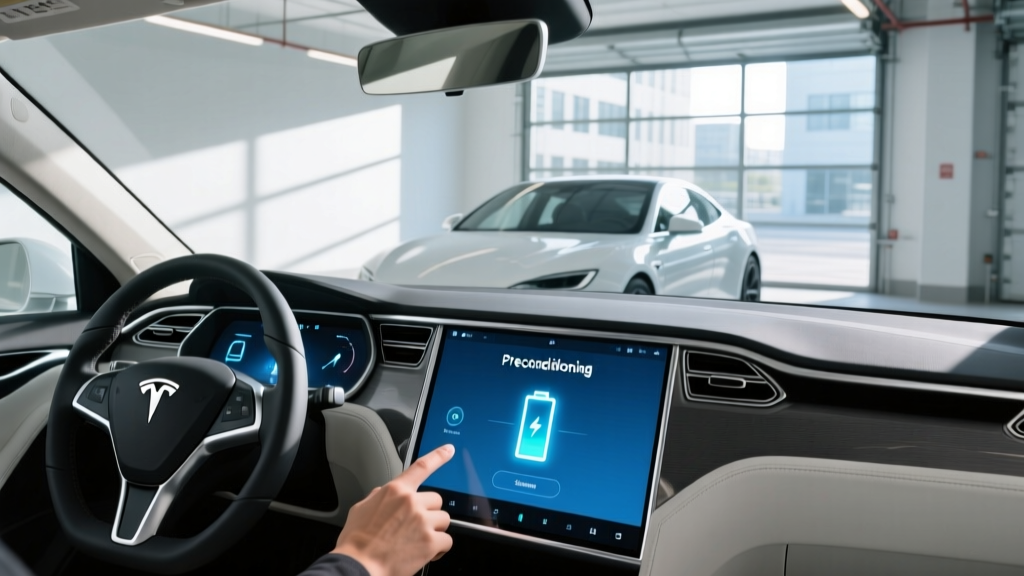
If you're not navigating to a charger but want to warm the battery for a fast departure or upcoming DC fast charge, you can trigger preconditioning manually from the Tesla app.
How to Precondition Your Tesla Battery from the App
Tesla does not expose a standalone "precondition battery" button in the app the way it does for cabin climate. However, you can achieve battery preconditioning through these methods:
- Set a Scheduled Departure time (via the app or in-car): Under Charging → Schedule, set a departure time and enable "Precondition." When plugged into a Level 2 charger, Tesla will warm both the cabin and the battery pack using grid power in the minutes before your scheduled departure. This is the most effective app-initiated method because it uses shore power rather than draining the pack.
- Turn on Climate Control remotely: Activating climate from the app warms the cabin and, in cold conditions, will also begin warming the battery if temperatures are low enough to trigger the BMS thermal loop. This is less targeted than Scheduled Departure but still effective in winter.
- Navigate to a Supercharger: Once you enter a Supercharger as your destination (from the car's nav or by sending it from the app's location feature), the car begins active battery preconditioning automatically. Expect 15–45 minutes of thermal preparation depending on outside temperature.
LFP vs NMC/NCA: Know Which Chemistry Your Tesla Has
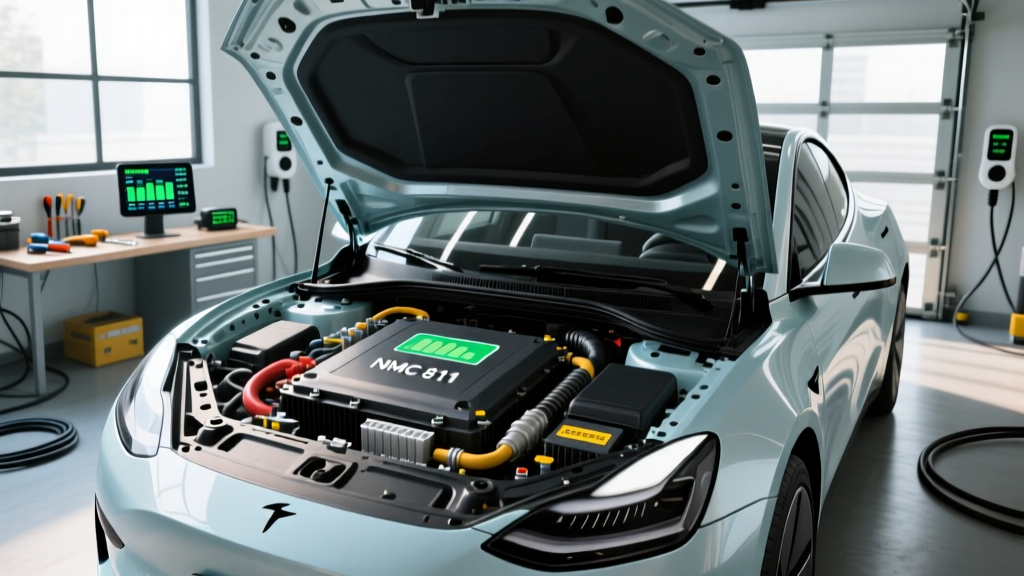
Tesla uses two distinct battery chemistries across its 2025–2026 lineup, and preconditioning behavior—along with charging habits—differs meaningfully between them.
| Attribute | LFP (Lithium Iron Phosphate) | NMC / NCA (Nickel-based) |
|---|---|---|
| Models using it | Model 3 RWD, Model Y RWD (Standard Range) | Model 3 Long Range/Performance, Model Y Long Range/Performance, Model S, Model X, Cybertruck |
| Energy density | Lower (~160 Wh/kg cell-level) | Higher (~250–270 Wh/kg cell-level) |
| Cycle life | 3,000–5,000+ cycles to 80% SoH | 1,000–2,000 cycles to 80% SoH |
| Cold-weather performance | More range loss in cold; slower cold charging | Better cold tolerance; preconditioning still critical |
| Recommended daily SoC | 100% (charge to full regularly) | 80% daily; 100% only for trips |
| Cost per kWh | Lower (~$90–110/kWh cell-level) | Higher (~$120–150/kWh cell-level) |
| Thermal runaway risk | Very low | Low but higher than LFP |
If you own an LFP-equipped Model 3 or Model Y RWD, preconditioning is especially important in cold weather because LFP cells have higher internal resistance at low temperatures, making fast charging painfully slow—or even unavailable—until the pack is warmed. Tesla's BMS will limit DC fast-charge rates to as little as 30–50 kW on a cold LFP pack versus a potential peak of 170 kW once preconditioned.
For NMC/NCA owners, preconditioning matters most for preserving long-term health. Charging a cold NMC pack at high current promotes lithium plating—a permanent, irreversible degradation mechanism that reduces capacity and increases the risk of internal short circuits over time.
Real-World Battery Degradation: What the Data Shows
EV battery degradation follows a characteristic curve: a steeper initial drop in the first 10,000–20,000 miles as the solid electrolyte interphase (SEI) layer stabilizes, followed by a long, gradual linear decline. Here's what aggregated fleet data shows for Tesla packs:
| Mileage | Average Capacity Retained | Notes |
|---|---|---|
| 0–25,000 mi | 95–97% | Initial SEI formation; most noticeable drop |
| 50,000 mi | 92–95% | Curve flattens significantly |
| 100,000 mi | 88–93% | Most packs well above warranty threshold |
| 150,000 mi | 85–91% | NMC packs on lower end; LFP often higher |
| 200,000 mi | 80–88% | Approaching warranty threshold for some NMC packs |
Data from Tesla's 2024 Impact Report and third-party aggregators like Tesla's published fleet statistics indicate that the average Tesla battery retains approximately 85% of original capacity at 200,000 miles. LFP packs in Model 3 RWD vehicles are showing slower degradation curves in early fleet data, with many retaining 92%+ at 100,000 miles.
The key takeaway: the vast majority of EV batteries outlast the useful life of the vehicle itself. Catastrophic battery failure requiring full replacement is rare—most owners will sell or retire the car before the pack drops below 70% capacity.
What the Tesla Battery Warranty Actually Covers
Tesla's battery and drive unit warranty is one of the more straightforward in the industry, but the details matter—especially the capacity retention threshold.
| Model / Trim | Warranty Period | Mileage Limit | Minimum Capacity Retention |
|---|---|---|---|
| Model 3 RWD (LFP) | 8 years | 100,000 miles | 70% |
| Model 3 Long Range / Performance | 8 years | 120,000 miles | 70% |
| Model Y (all trims) | 8 years | 120,000 miles | 70% |
| Model S / Model X | 8 years | 150,000 miles | 70% |
| Cybertruck | 8 years | 120,000 miles | 70% |
If your battery drops below 70% of original usable capacity within the warranty period (whichever limit comes first—years or miles), Tesla will replace or refurbish the pack to bring it back to at least 70%. This warranty covers manufacturing defects and abnormal degradation, but not damage from accidents, flooding, or unauthorized modifications.
According to Tesla's official warranty documentation, the warranty is transferable to subsequent owners, which supports resale value.
How Much Does a Tesla Battery Replacement Cost?
Out-of-warranty battery replacement is the number one fear among EV shoppers. Here's the reality with current pricing:
| Model | Battery Size (usable) | Estimated Replacement Cost | Typical Need Timeline |
|---|---|---|---|
| Model 3 RWD (LFP) | ~60 kWh | $8,000–$12,000 | Rarely needed; 200,000+ mi typical life |
| Model 3/Y Long Range (NMC) | ~75–82 kWh | $12,000–$16,000 | Rarely needed; 150,000–200,000+ mi |
| Model S / Model X | ~95–100 kWh | $14,000–$20,000 | Older packs (pre-2020) more likely to need service |
| Cybertruck | ~123 kWh | $18,000–$25,000 | Too new for fleet data; expected 200,000+ mi |
These figures include the battery pack and labor but can vary by service center and whether Tesla installs a new or remanufactured pack. Remanufactured packs (rebuilt with a mix of new and tested modules) are increasingly common and reduce cost.
Context is critical: data from fueleconomy.gov and industry analyses show that fewer than 2% of Tesla vehicles have required out-of-warranty battery replacements. Most degradation-related replacements occur under warranty. The fear of a surprise $20,000 bill is statistically unlikely for any owner who follows basic battery-care practices.
How to Check and Maximize Your Battery's State of Health
Tesla does not display a direct State of Health (SoH) percentage in the vehicle UI or app the way some competitors do. Here's how to assess and protect your pack:
Checking Battery Health
- Range comparison method: Charge to 100% (or calculate from a lower SoC) and compare the displayed range to the original EPA sticker. A 2025 Model 3 Long Range with an EPA rating of 363 miles that shows 330 miles at 100% has approximately 91% SoH. Account for temperature—cold weather temporarily reduces displayed range without indicating permanent degradation.
- Third-party apps: Tools like Tessie, Stats (iOS), or TeslaFi log charging data and can estimate SoH over time by comparing energy added during charges to the displayed SoC change.
- Service Mode: Some Tesla owners access limited battery health data through Service Mode (available in the software menu), though Tesla has restricted access to certain fields in recent updates.
Battery Care Checklist for Maximum Longevity
- Precondition before every DC fast charge — navigate to the Supercharger so the car handles it automatically, or use Scheduled Departure if starting from home.
- Set daily charge limit to 80% for NMC/NCA packs — only charge to 100% when you need the full range for a trip. LFP owners should charge to 100% at least once weekly for BMS calibration.
- Avoid letting SoC drop below 10% for extended periods — if storing the vehicle, leave it at ~50% SoC and plugged in.
- Minimize frequent DC fast charging — if you have home Level 2 access, use it for 80%+ of your charging. Occasional Supercharging (1–2 times per week) shows negligible degradation impact in fleet data, but daily DC fast charging accelerates wear.
- Precondition in cold weather even for local driving — this enables regenerative braking (which is limited or disabled on a cold pack) and reduces the mechanical brake wear that results from absent regen.
- Keep the vehicle plugged in during extreme heat — the BMS will run the cooling system on grid power to keep cell temperatures below 45°C, preventing accelerated calendar degradation.
Factors That Accelerate Battery Degradation
Understanding the physics behind degradation helps prioritize which habits matter most:
High State of Charge storage: Storing an NMC/NCA pack at 100% SoC for days or weeks accelerates electrolyte oxidation and cathode structural degradation. Calendar aging at 100% SoC and 40°C ambient can cause 3–5% capacity loss per year versus 1–2% at 50% SoC and 20°C.
DC fast charging without preconditioning: Pushing 150–250 kW into cold cells causes lithium plating—metallic lithium deposits on the anode surface that permanently reduce capacity and can form dendrites. This is why preconditioning is non-negotiable for fast charging.
Extreme heat exposure: Sustained cell temperatures above 45°C (113°F) accelerate SEI layer growth, consuming lithium inventory. This is why Tesla's BMS actively cools the pack even when parked—and why keeping it plugged in during Arizona or Texas summers is recommended.
Deep discharge cycles: Regularly driving below 5% SoC stresses the cells and can trigger copper dissolution in the anode current collector. The BMS maintains a bottom buffer (typically 2–4 kWh of hidden reserve), but repeatedly hitting the buffer boundary is not ideal.
What's Next: Solid-State and Silicon-Anode Batteries
The battery landscape is evolving, but timelines matter more than headlines:
Solid-state batteries promise higher energy density (potentially 400+ Wh/kg), faster charging, and improved safety by replacing the liquid electrolyte with a solid ceramic or polymer. Toyota, Samsung SDI, and QuantumScape have all announced pilot production, but mass-market automotive solid-state packs are not expected before 2028–2030 at the earliest, with meaningful volume likely post-2030. No current-production vehicle uses a solid-state traction battery.
Silicon-anode technology is closer to reality. Companies like Sila Nanotechnologies and Group14 are supplying silicon-dominant anode materials that boost energy density by 15–25% over graphite anodes. These are beginning to appear in limited production applications and could reach mainstream EV packs by 2027–2028. Tesla's own 4680 cell roadmap includes incremental anode improvements, though the company has not publicly confirmed a silicon-anode production timeline.
For today's buyers: current lithium-ion technology (both LFP and NMC) is mature, well-understood, and proven to deliver 150,000–200,000+ miles of service. Waiting for solid-state is not a practical purchase strategy for anyone who needs a vehicle in the next 2–3 years.
Frequently Asked Questions
How long do Tesla batteries last in years and miles?
Based on fleet data, Tesla's NMC/NCA packs retain approximately 85–90% capacity at 200,000 miles, while LFP packs are showing even slower degradation. In terms of years, calendar aging adds roughly 1–2% loss per year under normal conditions. Most Tesla batteries will outlast 15–20 years of typical driving before dropping below the 70% warranty threshold.
Does preconditioning use a lot of battery?
Preconditioning typically consumes 2–8 kWh depending on ambient temperature and duration (15–45 minutes). On a 75 kWh pack, that's 3–10% of capacity. When plugged into a Level 2 charger, this energy comes from the grid at zero cost to your range. Always precondition while plugged in when possible.
Can I precondition a Tesla battery without navigating to a Supercharger?
Yes. Use Scheduled Departure with the "Precondition" option enabled (set through the app under Charging → Schedule). This warms the battery using grid power before your planned departure. You can also activate Climate Control remotely, which triggers battery warming in cold conditions as a secondary effect.
Is it bad to Supercharge my Tesla every day?
Occasional daily Supercharging is not catastrophic—Tesla's BMS and thermal management are designed to handle it. However, fleet data shows slightly higher degradation rates in vehicles that rely exclusively on DC fast charging versus those using primarily Level 2 home charging. If you can charge at home on Level 2 for most sessions and Supercharge for road trips or 1–2 times per week, your pack will degrade more slowly.
Does the battery warranty cover gradual degradation?
Yes, but only if capacity drops below 70% within the warranty period (8 years and 100,000–150,000 miles depending on model). Normal gradual degradation above 70% is expected and not covered. Tesla measures capacity through diagnostic tools at service centers—not through the in-car range estimate, which fluctuates with temperature and driving style.
LFP or NMC—which battery chemistry should I choose?
Choose LFP (Model 3/Y RWD) if you prioritize longevity, lower cost, and the simplicity of charging to 100% daily. Choose NMC/NCA (Long Range/Performance) if you need maximum range, better cold-weather performance, and faster peak charging speeds. Both chemistries are proven; the right choice depends on your driving patterns and climate.