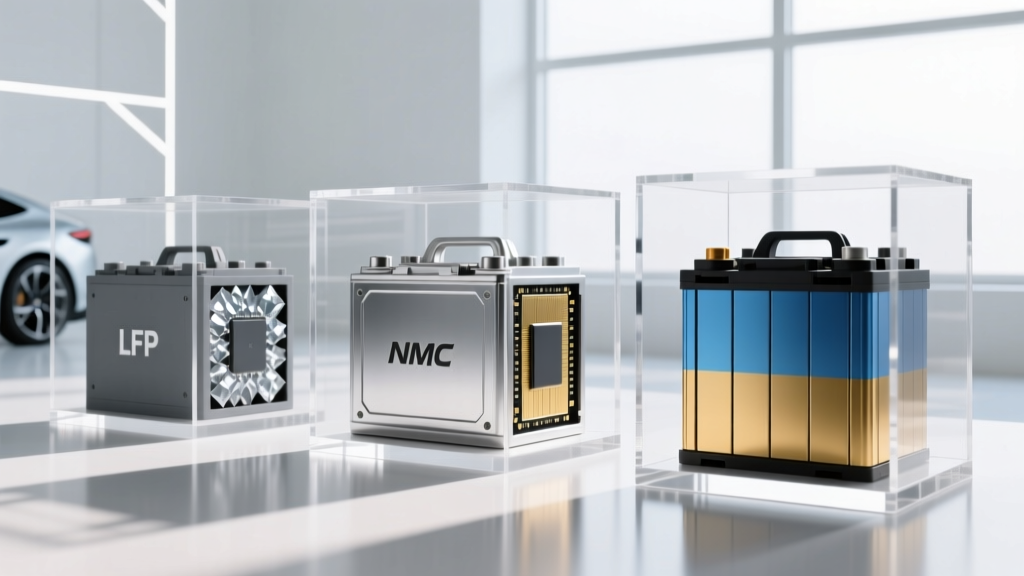
If you've researched EV battery technology, you've likely encountered the term NMC battery — shorthand for a lithium-ion cell built with a nickel-manganese-cobalt cathode. As of 2026, NMC (and its close cousin NCA, nickel-cobalt-aluminum) remains the dominant chemistry in long-range electric vehicles sold in North America, powering models from Tesla, Hyundai, Ford, BMW, and others. But a competing chemistry — LFP (lithium iron phosphate) — has gained significant market share in standard-range and lower-cost EVs.
Understanding the difference isn't academic. The chemistry inside your EV's high-voltage traction battery directly affects how far you can drive, how the pack degrades over a decade, how well it performs in freezing weather, and what you'll pay if it ever needs replacement. This guide breaks down NMC battery technology with the exact numbers, warranty terms, and ownership data you need to make an informed decision.
What Is an NMC Battery?
An NMC battery uses a cathode composed of varying ratios of nickel, manganese, and cobalt — typically expressed as a ratio like NMC 811 (80% nickel, 10% manganese, 10% cobalt) or NMC 622. The nickel content drives energy density, manganese adds thermal stability, and cobalt improves cycle life. Over the past decade, manufacturers have steadily increased nickel content and reduced cobalt to lower cost while boosting the energy stored per kilogram of cell weight.
In practical terms, NMC cells offer higher energy density than LFP cells — meaning automakers can fit more kilowatt-hours (kWh) of usable capacity into the same physical pack volume. That's why nearly every EV advertising 300+ miles of EPA range uses NMC or NCA chemistry. For example, the 2026 Hyundai Ioniq 6 Long Range uses an NMC-based 77.4 kWh usable pack to achieve an EPA-estimated 361 miles of range, while the LFP-equipped standard-range variant tops out at around 240 miles from a smaller, heavier pack.
It's critical to distinguish kWh (kilowatt-hours, a measure of energy capacity — the size of your "fuel tank") from kW (kilowatts, a measure of power — how fast you charge or discharge). An NMC pack's advantage is in kWh per kilogram, not in charge speed, which is governed by the vehicle's thermal management and charge protocol.
NMC vs. LFP: Chemistry Trade-Offs Side by Side
Choosing between NMC and LFP is the single most impactful battery decision a buyer makes. Here's how the two chemistries compare across the metrics that matter for daily ownership:
| Attribute | NMC / NCA | LFP (Lithium Iron Phosphate) |
|---|---|---|
| Energy density (cell-level) | ~250–300 Wh/kg | ~160–200 Wh/kg |
| Typical EV range application | Long-range trims (270–400+ mi EPA) | Standard-range trims (200–270 mi EPA) |
| Cycle life (full cycles to 80% capacity) | ~1,000–2,000 | ~3,000–5,000+ |
| Cold-weather performance | Better low-temp discharge; less range loss | More range loss in sub-freezing temps |
| Thermal runaway risk | Higher (requires robust BMS and cooling) | Lower (inherently more stable chemistry) |
| Optimal daily charge limit | 80% recommended for daily use | 100% is fine daily |
| Cost per kWh (cell-level, 2026) | ~$110–$130 | ~$75–$95 |
| Cobalt content | Yes (supply chain/ethical considerations) | None |
| State-of-charge estimation accuracy | More linear voltage curve; easier to estimate | Flat voltage curve; SoC estimation harder |
The takeaway: NMC is better if you need maximum range, drive in cold climates, or want a lighter pack. LFP is better if you prioritize longevity, lower cost, and prefer the simplicity of charging to 100% daily without degradation concerns. Neither chemistry is universally "better" — the right choice depends on your driving profile.
How Long Do NMC EV Batteries Actually Last?
The fear of a dead EV battery costing $20,000 is the most persistent anxiety in EV adoption. The data tells a more reassuring story — but with important nuance.
Modern NMC packs are engineered to retain at least 70–80% of their original capacity after 150,000–200,000 miles. Real-world fleet data from sources like Recurrent Auto and telematics analyses show that most liquid-cooled NMC packs lose roughly 5–8% capacity in the first two years (an initial "break-in" degradation phase), then settle into a slow, linear decline of about 1–2% per year thereafter.
- Tesla Model 3 Long Range (NCA/NMC, 75 kWh): Fleet data shows ~10–12% degradation at 100,000 miles, with most packs retaining 85%+ at 150,000 miles.
- Hyundai Ioniq 5 (77.4 kWh NMC): Early fleet reports indicate ~5–7% loss at 60,000 miles under mixed driving and DC fast-charging use.
- Chevrolet Bolt EUV (65 kWh NMC): Recurrent data shows median ~8% degradation at 80,000 miles — a strong result partly due to conservative buffer management.
- BMW i4 eDrive40 (83.9 kWh NMC): Limited long-term data, but similar architecture to iX fleet vehicles suggests ~6–9% loss at 75,000 miles.
To answer the core question directly: most NMC EV batteries last 15–20 years or 200,000+ miles before reaching 70% state of health — and many will outlast the vehicle they're installed in. Battery replacement before end-of-vehicle-life is the exception, not the rule. According to fueleconomy.gov, modern EV battery systems are among the most durable components in the vehicle.
Battery Warranty Terms: What's Actually Covered
Federal law mandates that EV battery warranties cover a minimum of 8 years or 100,000 miles (10 years/150,000 miles in California and states that follow CARB standards). But the details vary significantly between automakers — particularly the capacity retention threshold that triggers a warranty claim.
| Manufacturer | Warranty Period | Mileage Limit | Capacity Threshold |
|---|---|---|---|
| Tesla (Model 3/Y Long Range) | 8 years | 120,000 mi | 70% retention |
| Hyundai / Kia | 10 years | 100,000 mi | 70% retention |
| Ford (Mustang Mach-E) | 8 years | 100,000 mi | 70% retention |
| General Motors (Ultium-based) | 8 years | 100,000 mi | 70% retention (60% for Bolt) |
| BMW | 8 years | 100,000 mi | 70% retention |
| Volkswagen (ID.4) | 8 years | 100,000 mi | 70% retention |
The 70% threshold is the industry standard. If your NMC pack drops below 70% of its original usable capacity within the warranty period, the manufacturer will repair or replace it — typically with a refurbished or remanufactured unit, not necessarily a brand-new pack. Note that warranties cover defects and abnormal degradation, not damage from accidents, flooding, or unauthorized modifications.
EV Battery Replacement Cost: What to Expect
Out-of-warranty battery replacement is rare but not unheard of, especially for higher-mileage vehicles or those with manufacturing defects that surface late. Costs vary enormously by pack size, chemistry, and whether you receive a new, remanufactured, or refurbished unit.
| Vehicle / Pack Size | Chemistry | Replacement Cost Range | Notes |
|---|---|---|---|
| Chevrolet Bolt EV/EUV (~65 kWh) | NMC | $14,000–$16,000 | GM recalled/replaced many packs under warranty; out-of-pocket costs remain high |
| Tesla Model 3 Long Range (~75–82 kWh) | NCA/NMC | $13,000–$16,000 | Remanufactured packs available at lower cost (~$10,000–$12,000) |
| Hyundai Ioniq 5 (~77.4 kWh) | NMC | $12,000–$18,000 | Modular pack design may allow partial module replacement |
| Ford F-150 Lightning Extended (~131 kWh) | NMC | $20,000–$28,000 | Largest consumer pack; cost scales with kWh |
| BMW iX xDrive50 (~111.5 kWh) | NMC | $18,000–$24,000 | Premium labor rates increase total cost |
| Nissan LEAF (40–60 kWh) | NMC (passive cooling) | $6,500–$9,000 | Smaller pack, but passive thermal management accelerates degradation in hot climates |
Context matters here. The average age of a scrapped vehicle in the US is around 12 years, and most NMC packs will retain 75–85% capacity at that point under normal use. Most EV owners will sell or trade the vehicle before a battery replacement is ever needed. For those who do face replacement, module-level repair (replacing individual degraded cell modules rather than the entire pack) is becoming more common, reducing costs to $3,000–$8,000 depending on the vehicle.
Factors That Accelerate (or Preserve) NMC Battery Life
NMC chemistry is more sensitive to certain usage patterns than LFP. Understanding these factors lets you extract maximum lifespan from your pack:
- Daily charge limit: Set to 80%. NMC cells experience accelerated degradation when held at 100% SoC for extended periods. Reserve 100% charges for road trips. (LFP owners can ignore this — charge to 100% freely.)
- Avoid frequent DC fast charging above 150 kW. Occasional fast charging is fine, but daily use of 250–350 kW chargers generates sustained heat that degrades NMC cathodes faster. When possible, use Level 2 home charging for daily needs.
- Don't let the pack sit at very low SoC. Storing an NMC EV at 0–10% SoC for days or weeks stresses the cells. If storing for extended periods, aim for 40–60% SoC.
- Precondition before fast charging. Most modern EVs automatically precondition the battery when a DC fast charger is set as your navigation destination. This brings the cells to optimal temperature (~77–95°F / 25–35°C), improving charge speed and reducing thermal stress. Always navigate to the charger rather than just pulling in cold.
- Extreme heat is worse than extreme cold. Sustained ambient temperatures above 95°F (35°C) — especially combined with high SoC — accelerate calendar degradation. If you live in a hot climate, parking in shade or a garage meaningfully extends pack life. Cold weather temporarily reduces range but doesn't cause lasting damage.
- Use regenerative braking settings wisely. Aggressive regen in cold weather (below 32°F / 0°C) can stress cells that haven't warmed up. Many EVs automatically reduce regen when the battery is cold — let the system manage this.
Monitoring Your NMC Battery's State of Health (SoH)
State of Health (SoH) is the percentage of original capacity your battery can still hold. A new pack is 100% SoH; a pack that held 77.4 kWh when new and now holds 70 kWh is at ~90.4% SoH. Tracking this metric helps you understand your degradation trajectory and anticipate warranty claims.
How to check SoH:
- In-vehicle displays: Some EVs (notably the Nissan LEAF with its "battery health bars" and certain Hyundai/Kia models) show a degradation indicator on the dashboard. However, most Tesla, Ford, and BMW models do not expose SoH directly to the driver.
- OBD-II dongles and apps: Tools like OBDLink SX/MX+ paired with apps such as EV Health, LeafSpy (for Nissan), or Scan My Tesla can read SoH data directly from the battery management system (BMS). These typically cost $30–$60 for the hardware.
- Dealer diagnostics: Any authorized service center can pull a full battery health report. Request this during routine service visits, especially as you approach the warranty mileage threshold.
- Third-party services: Companies like Recurrent Auto offer free battery health reports by connecting to your vehicle's telematics data (with your permission). This also builds fleet-level degradation data that benefits the EV community.
A useful practice: record your SoH reading every 6 months or every 10,000 miles. If you see a sudden drop (e.g., 3% loss in a single month), that may indicate a cell imbalance or cooling system issue worth investigating under warranty.
Emerging Battery Technologies: What Comes After NMC?
NMC chemistry continues to evolve — higher-nickel formulations (NMC 9½½), silicon-dominant anodes, and dry-electrode manufacturing are all incrementally improving energy density and reducing cost. But two technologies are frequently cited as potential successors:
Solid-state batteries: These replace the liquid electrolyte with a solid conductor, promising 30–50% higher energy density, faster charging, and dramatically improved safety (near-zero thermal runaway risk). Toyota, Samsung SDI, and QuantumScape have all announced prototype cells, and Toyota has stated plans for limited solid-state production in 2027–2028. However, manufacturing scalability, cost (currently 3–5× the cost of liquid lithium-ion), and cycle-life validation remain unsolved challenges at mass-production scale. Realistic timeline for broad consumer availability: 2029–2032 at the earliest.
Silicon-anode batteries: Companies like Sila Nanotechnologies and Group14 are replacing graphite anodes with silicon-dominant materials, boosting energy density by 20–40%. These are already appearing in limited applications (the Mercedes G-Class 580e PHEV uses a silicon-anode pack as of 2025). Expect broader adoption in EVs by 2027–2028, initially in premium models. Silicon anodes can be paired with either NMC or LFP cathodes, so they complement rather than replace current chemistries.
Sodium-ion batteries: CATL and BYD have begun producing sodium-ion cells for low-cost, short-range EVs in China. These offer lower energy density than even LFP but use abundant, inexpensive materials. They may appear in US-market budget EVs or as auxiliary range-extender packs by 2028–2030.
For buyers shopping today: NMC and LFP are mature, well-understood, and backed by robust warranties. Waiting for solid-state is not a practical strategy unless your purchase timeline extends to 2030 or beyond.
LFP vs. NMC: Which Should You Choose?
Here's a practical decision framework based on real ownership profiles:
Choose NMC if:
- You need 300+ miles of EPA range for road trips or long commutes
- You live in a cold climate (sub-32°F winters) where NMC's better low-temperature performance preserves more range
- You want the lightest possible vehicle (NMC packs are lighter for the same kWh, improving handling and tire wear)
- You charge primarily at home on Level 2 and can manage the 80% daily limit
Choose LFP if:
- Your daily driving is under 150 miles and standard range (200–270 mi) suffices
- You want the simplicity of charging to 100% daily without worrying about degradation
- You plan to keep the vehicle 10+ years and want maximum cycle life
- You want the lowest purchase price (LFP packs cost ~$2,000–$4,000 less per vehicle)
- You prioritize safety — LFP's thermal stability is inherently superior
Frequently Asked Questions
How long do NMC EV batteries last in years and miles?
Most liquid-cooled NMC packs retain 70–85% of original capacity after 150,000–200,000 miles or 15–20 years. Initial degradation of 5–8% occurs in the first 2 years, followed by ~1–2% annual loss. Full pack failure before 150,000 miles is rare and typically covered under warranty.
How much does it cost to replace an NMC EV battery?
Out-of-warranty replacement costs range from roughly $6,500 (small packs like the Nissan LEAF) to $28,000 (large packs like the F-150 Lightning Extended Range). Most passenger-car NMC replacements fall in the $12,000–$18,000 range. Module-level repairs can reduce this to $3,000–$8,000. However, most owners sell the vehicle before replacement is needed.
What does the EV battery warranty actually cover?
Federal law requires a minimum 8-year/100,000-mile warranty (10/150,000 in CARB states). Coverage triggers when the pack falls below a stated capacity threshold — typically 70% of original capacity. The warranty covers defects and abnormal degradation but not accident damage, flooding, or unauthorized modifications. Manufacturers may replace with refurbished units rather than new packs.
How do I check and maximize my NMC battery health?
Check SoH via OBD-II apps (EV Health, Scan My Tesla, LeafSpy), dealer diagnostics, or services like Recurrent Auto. To maximize life: charge to 80% daily, minimize frequent 250+ kW DC fast charging, precondition before fast charging, avoid storing at very low or very high SoC, and park in shade in hot climates.
Is LFP better than NMC for longevity?
Yes, in terms of pure cycle life: LFP cells can endure 3,000–5,000+ full charge cycles to 80% capacity vs. 1,000–2,000 for NMC. LFP also tolerates daily 100% charging without accelerated degradation. However, NMC offers significantly higher energy density (more range in a lighter pack) and better cold-weather performance. Longevity is just one factor in the chemistry trade-off.
Does frequent DC fast charging damage my NMC battery?
Occasional DC fast charging has minimal impact. However, daily use of high-power (150–350 kW) fast charging generates sustained heat that accelerates NMC cathode degradation over time. Fleet data suggests vehicles that DC fast-charge more than 3 times per week show ~2–4% additional degradation at 100,000 miles compared to primarily Level 2-charged vehicles. Use fast charging for road trips; rely on Level 2 home charging for daily needs.