Clarifying the Battery for a 2014 Nissan Versa Note: 12V vs. High-Voltage Traction
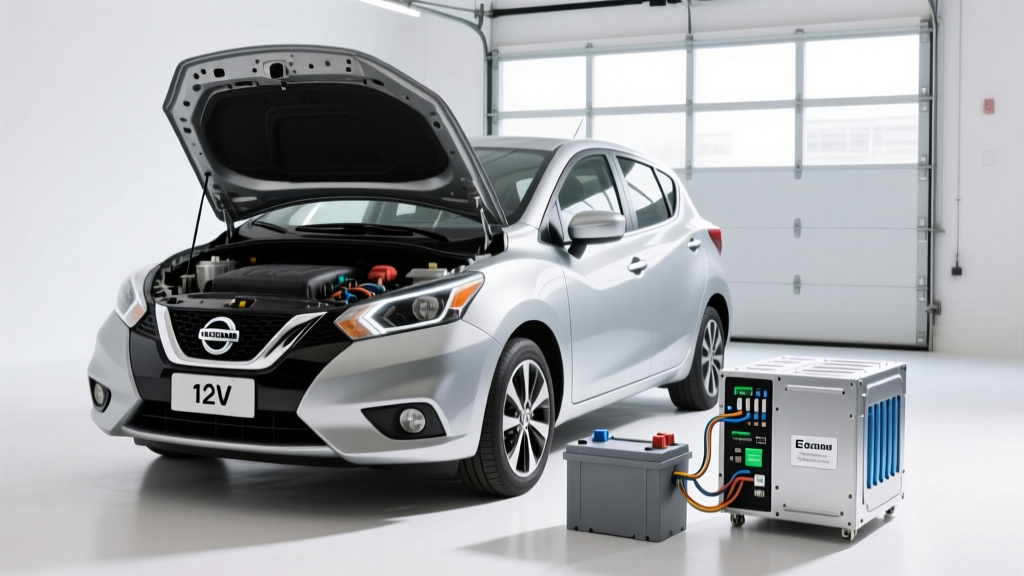
When owners search for a battery for a 2014 Nissan Versa Note, they are almost always looking for a 12-volt lead-acid starting battery, not a high-voltage traction pack. The 2014 Versa Note is a conventional, gasoline-powered subcompact hatchback equipped with a 1.6L four-cylinder engine. It has no electric drive motor, no lithium-ion traction battery, and no plug. Confusing the 12V auxiliary battery with an EV traction battery is one of the most common research missteps, so let's establish the baseline clearly before diving into the broader world of EV battery technology that shapes today's market.
If you are replacing the 12V battery in a 2014 Versa Note, you need a Group Size 26R or 35 (depending on the exact trim and region) AGM or flooded lead-acid battery. Expect to pay between $120 and $220 at retail. But if you've landed here because you're exploring how batteries work in electrified vehicles — whether you're considering an upgrade to a modern EV like the Nissan Leaf or just want to understand the tech — the rest of this guide is for you.
EV Battery Chemistry: LFP vs NMC/NCA Explained
Modern electric vehicles rely on one of two dominant lithium-ion chemistries for their high-voltage traction batteries: Lithium Iron Phosphate (LFP) or Nickel Manganese Cobalt / Nickel Cobalt Aluminum (NMC/NCA). The chemistry choice affects range, longevity, cold-weather performance, and vehicle price.
| Attribute | LFP (Lithium Iron Phosphate) | NMC / NCA |
|---|---|---|
| Energy Density | Lower (~160-180 Wh/kg cell-level) | Higher (~220-280 Wh/kg cell-level) |
| Cycle Life | 3,000-5,000+ cycles to 80% SoH | 1,000-2,000 cycles to 80% SoH |
| Cold Performance | Weaker below 32°F; slower charging | Better low-temp discharge and charge acceptance |
| Cost (per kWh) | Lower — no cobalt or nickel | Higher — commodity-sensitive materials |
| Thermal Stability | Excellent; lower thermal runaway risk | Good, but requires more active management |
| Typical Use (2026) | Standard-range trims (Tesla Model 3 RWD, base BYD, some Ford models) | Long-range/performance trims (Hyundai Ioniq 5 LR, Tesla LR, Rivian) |
| Recommended SoC Habit | Can charge to 100% regularly | Best kept 20-80% daily; 100% for trips only |
Neither chemistry is universally "better." LFP wins on cycle life and cost — ideal for daily commuters who charge at home. NMC wins on energy density and cold-weather usability — critical for long-range models and northern-climate drivers. According to IEA battery tracking data, NMC cells have steadily improved energy density year over year, while LFP has closed the gap significantly since 2022 thanks to CATL and BYD advances.
How Long Do EV Batteries Last? Real Degradation Data
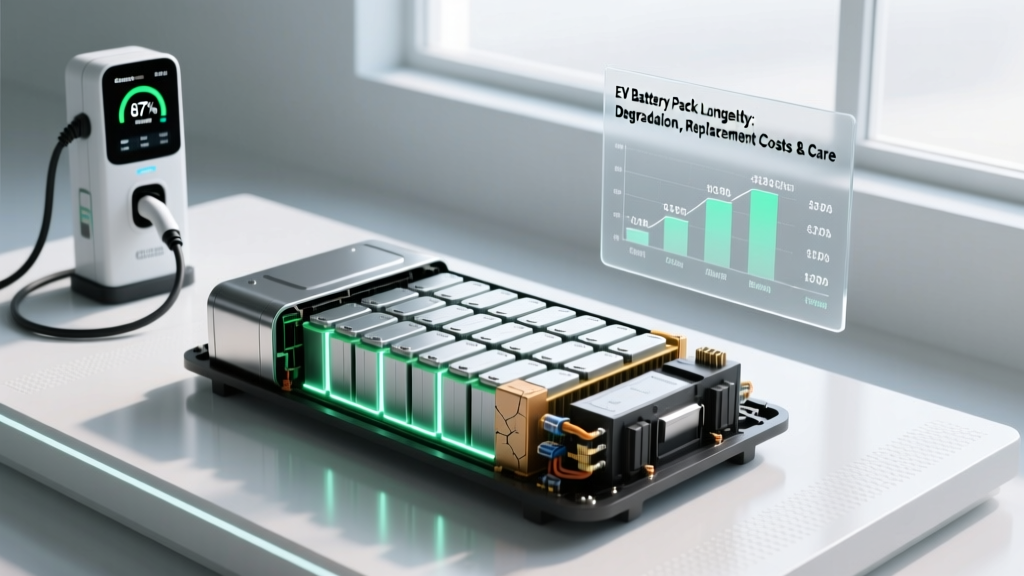
The most persistent EV myth is that batteries need frequent replacement. In reality, modern liquid-cooled traction batteries are engineered to outlast the vehicle's economic life. Degradation is gradual, not catastrophic.
Typical degradation follows a curve: a steeper initial drop of 2-5% in the first year, then a slow, linear decline of roughly 1-2% per year afterward. Real-world data from Geotab's fleet study of over 10,000 EVs shows average capacity loss of approximately 2.3% per year across all models, meaning a typical EV retains roughly 88-90% of its original capacity after five years.
Some specific data points:
- Tesla Model 3/Y (NMC): ~10-12% loss at 100,000 miles per Tesla's 2025 Impact Report fleet data.
- Nissan Leaf (earlier passive-cooled NMC): Higher degradation — up to 20-25% at 80,000 miles in hot climates, due to lack of active thermal management.
- Hyundai/Kia E-GMP (NMC): ~5-8% loss at 60,000 miles in owner-reported data, aided by robust liquid cooling.
- LFP packs (Tesla Model 3 RWD, BYD): Minimal degradation — often under 5% at 60,000 miles in fleet data.
Degradation curve summary: Expect roughly 2-5% loss in Year 1, then 1-2% annually. A 250-mile EPA-rated EV driven 12,000 miles/year would realistically deliver ~225-230 miles of range at Year 5 and ~210-215 miles at Year 10, assuming moderate climate and good charging habits.
What Does the EV Battery Warranty Actually Cover?
Federal law mandates a minimum 8-year/100,000-mile warranty on EV battery packs (10 years/150,000 miles in CARB states like California). But the details matter — specifically, the capacity-retention threshold that triggers a warranty claim.
| Manufacturer | Warranty Period | Capacity Threshold | Notes |
|---|---|---|---|
| Tesla | 8 yr / 120,000 mi (Model 3/Y LR) | 70% retention | Long Range and Performance get 120k; RWD gets 100k |
| Hyundai / Kia | 10 yr / 100,000 mi | 70% retention | Among the longest standard coverage |
| Ford | 8 yr / 100,000 mi | 70% retention | Applies to Mustang Mach-E, F-150 Lightning |
| General Motors (Ultium) | 8 yr / 100,000 mi | 70% retention | Covers Bolt EV/EUV, Blazer EV, Silverado EV |
| BMW | 8 yr / 100,000 mi | 70% retention | i4, iX, i7 covered |
| Nissan (Leaf) | 8 yr / 100,000 mi | 66.25% (9/12 bars) | Bar-based system; less granular than % readout |
The 70% threshold is industry standard. In practice, very few EVs drop below 70% within the warranty period under normal use. If your pack does breach the threshold, the manufacturer replaces or refurbishes it at no cost — though "refurbished" may mean a pack with 75-80% capacity, not a brand-new one.
EV Battery Replacement Cost: When and How Much
Most EV batteries never need replacement during the vehicle's useful life. When they do — typically beyond 150,000-200,000 miles or after significant physical damage — the cost is substantial but declining.
| Battery Size / Vehicle Class | Estimated Replacement Cost (2026) | Typical Need Timeline |
|---|---|---|
| 40-50 kWh (compact, e.g., older Leaf, Bolt) | $6,000 - $9,000 | 150,000+ mi; rarely needed |
| 60-80 kWh (mid-size, e.g., Model 3, Ioniq 5) | $10,000 - $16,000 | 180,000+ mi; rarely needed |
| 90-110 kWh (large, e.g., F-150 Lightning, Model S) | $15,000 - $25,000 | 200,000+ mi; rarely needed |
| 130+ kWh (heavy-duty, Hummer EV, Silverado EV Max) | $25,000 - $35,000+ | Not yet observed at scale |
For context, a 2014 Nissan Versa Note's entire resale value in 2026 is roughly $4,000-$7,000 — meaning a hypothetical EV battery swap for a modern mid-size EV costs more than the Versa Note is worth. This is why most high-mileage EVs with degraded batteries are traded in or retired rather than repaired. However, cell-level repair (replacing individual modules rather than the entire pack) is increasingly available from specialist shops for $3,000-$6,000, reducing the financial risk.
Factors That Accelerate (or Preserve) Battery Health
Battery longevity isn't random — it's heavily influenced by how you charge, drive, and store the vehicle.
- Minimize DC fast charging: Frequent use of 150+ kW DC chargers stresses cells. Use Level 2 (7-11 kW) for daily charging and reserve DCFC for road trips. Data from fueleconomy.gov confirms that heat from rapid charging accelerates degradation.
- Avoid extreme State of Charge: For NMC batteries, keep daily SoC between 20-80%. LFP batteries tolerate 100% better and actually benefit from periodic full charges for cell balancing.
- Precondition before fast charging: Most EVs automatically warm the battery when a Supercharger or DCFC is navigated to. If yours doesn't, drive for 15-20 minutes before plugging in at high power, especially in cold weather.
- Avoid prolonged storage at 100% or 0%: If parking for weeks, leave the car plugged in with a charge limit set to ~50-60%.
- Thermal management matters: Garage your EV in extreme heat or cold when possible. Active liquid cooling (standard on most 2020+ EVs) dramatically reduces degradation compared to passive air cooling (older Nissan Leaf, early Fiat 500e).
- Don't obsess over regen braking settings: Regen does not meaningfully affect battery longevity; the battery management system (BMS) handles charge acceptance safely.
Monitoring Battery Health: How to Check State of Health (SoH)
State of Health (SoH) is the percentage of original capacity your battery can still hold. Unlike the 12V battery in a 2014 Versa Note — where you'd use a multimeter or load tester at an auto parts store — EV SoH monitoring requires software access to the BMS.
Here's how owners check SoH in 2026:
- In-vehicle displays: Tesla, Hyundai, and BMW provide a battery health percentage or estimated range vs. original in the settings menu.
- OBD-II dongles + apps: Tools like OBDeleven (VW/Audi), LeafSpy (Nissan Leaf), or Scan My Tesla pull real SoH data from the BMS. A $30-50 ELM327-compatible dongle paired with the right app gives you cell-level voltage, degradation percentage, and cycle count.
- Dealer diagnostics: Any authorized service center can run a full battery health report, typically during warranty inspections.
- Third-party reports: Services like Recurrent Auto provide battery health certificates useful for resale. A growing number of used-EV listings include SoH data.
For buyers considering a used EV, always request or verify SoH before purchase. A 2020 Model 3 Long Range showing 92% SoH at 45,000 miles is a healthy pack; one at 82% warrants investigation.
Emerging Battery Technology: Solid-State and Silicon Anodes
Next-generation battery tech is advancing, but timelines remain longer than headlines suggest. Here's a realistic 2026 assessment:
- Solid-state batteries: Toyota has announced limited production of solid-state-equipped EVs for 2027-2028, promising ~750 km (466 mi) range and 10-minute fast charging. Samsung SDI and QuantumScape are also in pilot production. However, mass-market availability at competitive pricing is not expected before 2030. Current solid-state prototypes face manufacturing yield challenges and cost premiums of 2-3x over liquid-electrolyte cells.
- Silicon-dominant anodes: Companies like Sila Nanotechnologies and Group14 are supplying silicon-carbon anode materials to production EV batteries starting in 2025-2026, boosting energy density by 10-20% without a full chemistry overhaul. Mercedes-Benz's next-gen EQ models and select GM Ultium variants are early adopters.
- Sodium-ion batteries: CATL and BYD have begun deploying sodium-ion packs in low-cost Chinese-market EVs. Energy density is 30-40% lower than LFP, making them suitable for city cars and micro-EVs but not long-range models. US availability is not expected before 2028.
These technologies are forward-looking and not yet available in any vehicle currently on sale in the US market. For buyers shopping today, current LFP and NMC chemistries are mature, well-warrantied, and proven over billions of fleet miles.
Frequently Asked Questions
What size 12V battery does a 2014 Nissan Versa Note use?
The 2014 Versa Note typically uses a Group Size 26R or Group 35 12V lead-acid battery (check your owner's manual or the label on your current battery for exact fitment). It is a standard starting battery — not a high-voltage traction pack — and is available at any auto parts retailer for $120-$220.
How long do EV batteries last in years and miles?
Modern liquid-cooled EV batteries typically retain 85-90% of their original capacity at 100,000 miles and 75-85% at 200,000 miles. In calendar years, most EV batteries remain functional and warrantied for 8-10 years minimum, with real-world data showing usable life extending to 15-20 years in moderate climates.
How much does it cost to replace an EV battery?
Full pack replacement ranges from $6,000 for smaller 40-50 kWh packs to $25,000+ for 130+ kWh heavy-duty packs, including labor. However, most EV batteries never need replacement during the vehicle's life, and cell-level module repair can reduce costs to $3,000-$6,000 in many cases.
Which is better: LFP or NMC battery chemistry?
LFP is better for daily commuters who charge at home and prioritize longevity and lower cost — it tolerates 100% charging and offers 3,000+ cycle life. NMC is better for long-range needs, cold climates, and performance driving — it packs more energy per kilogram and charges faster in low temperatures. Neither is universally superior; the right choice depends on your driving profile.
Does DC fast charging damage my EV battery?
Occasional DC fast charging (road trips, a few times per month) has minimal impact. However, daily use of 150+ kW chargers generates sustained heat that accelerates degradation by an estimated 1-3% additional loss over 100,000 miles compared to primarily Level 2 charging. Use Level 2 for daily needs and DCFC when you genuinely need speed.