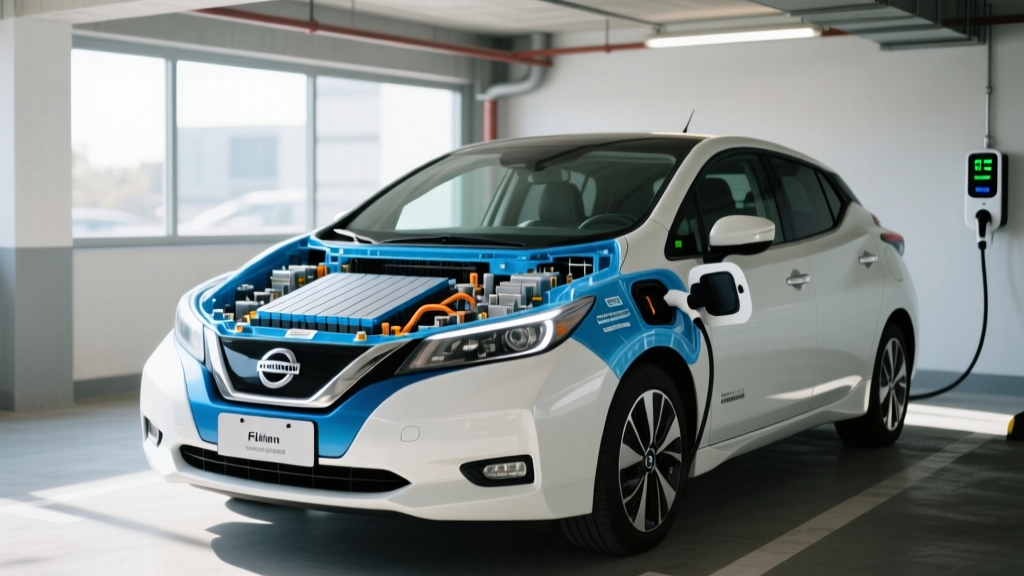
If you own a Nissan Leaf — or are considering buying one used — the high-voltage traction battery is the single most important component in the car. Unlike the 12V auxiliary battery that powers accessories, the main lithium-ion pack stores the energy that actually drives the wheels. When that pack degrades, range drops, and eventually you face a choice: live with reduced range, replace the battery, or sell the car.
This guide breaks down every practical angle of a Nissan Leaf battery upgrade: what degradation actually looks like across model years, what replacement costs in 2026, whether a larger-capacity swap is feasible, and how to monitor and extend the life of the pack you have. We'll also cover the broader EV battery landscape — LFP vs. NMC chemistry, warranty protections, and what solid-state tech means for the future.
Understanding the Nissan Leaf Battery: Chemistry and Generations
The Nissan Leaf has used several battery packs across its production run (2011–2026). All rely on laminated lithium-ion cells with NMC (nickel-manganese-cobalt) or LMO/NMC hybrid cathode chemistry — not the LFP (lithium iron phosphate) chemistry now common in newer Tesla Model 3 RWD and BYD vehicles.
Here's how the major Leaf battery generations break down:
| Generation | Capacity (kWh usable) | EPA Range (new) | Chemistry | Thermal Management |
|---|---|---|---|---|
| 2011–2012 (ZE0) | 24 kWh | 73 mi | LMO/NMC | Passive air cooling |
| 2013–2017 (AZE0) | 24 kWh / 30 kWh | 84 mi / 107 mi | LMO/NMC | Passive air cooling |
| 2018–2023 (ZE1 40) | 40 kWh | 151 mi | NMC | Passive air cooling |
| 2019–2026 (ZE1 62 / Leaf Plus) | 62 kWh | 212–226 mi | NMC | Passive air cooling |
A critical design note: the Leaf uses passive air cooling rather than the active liquid thermal management found in most modern EVs (Tesla, Hyundai Ioniq 5, Ford Mustang Mach-E). This matters enormously for battery longevity. Without active cooling, the cells are more vulnerable to heat buildup during DC fast charging and hot-climate driving — a factor that directly accelerates degradation.
How Long Do EV Batteries Last? Real-World Degradation Data
The most common question from Leaf owners and prospective buyers is straightforward: how long will the battery last before range loss becomes a problem?
The answer depends heavily on climate, charging habits, and which generation you own. Here's what real-world data shows:
Typical Nissan Leaf Battery Degradation (State of Health over time):
- 24 kWh (2011–2017): Many packs dropped to 70–80% SoH within 5–7 years / 60,000–90,000 miles, especially in hot climates (Arizona, Texas, Southern California). Early 24 kWh packs in temperate climates (Pacific Northwest, Northern Europe) fared better, often retaining 80–85% SoH at 8 years.
- 30 kWh (2016–2017): Showed faster initial degradation than the 24 kWh packs, with some owners reporting 70% SoH within 4–5 years. Nissan issued a software update to recalibrate the BMS, but the underlying cell chemistry was more susceptible to capacity loss.
- 40 kWh (2018–2023): Improved chemistry and BMS management. Typical degradation: 5–8% loss over the first 3 years, settling to roughly 85–90% SoH at 5 years / 60,000 miles for moderate-use owners.
- 62 kWh / Leaf Plus (2019–2026): Best longevity of the lineup. Owners report 3–5% loss in the first 2–3 years, with projected 85–92% SoH at 6 years for those avoiding frequent DC fast charging.
Sources: Nissan Leaf owner community data (MyNissanLeaf.com), Recurrent Auto battery health data, and individual Leaf Spy Pro readings shared across forums.
For context, modern EV batteries across the industry typically retain 85–92% of original capacity after 100,000 miles, according to data from Recurrent Auto and fueleconomy.gov. The Leaf's passive cooling puts it on the lower end of that spectrum, particularly for owners in hot climates who rely on DC fast charging.
Nissan Leaf Battery Upgrade Paths: Swap, Replace, or Upsize?
When degradation makes daily driving impractical — typically when SoH drops below 70% and real-world range falls to 60–80 miles on a 40 kWh pack — you have three options:
Option 1: Same-Capacity Replacement
Replace the degraded pack with a new or refurbished pack of the same kWh. This restores original range. Nissan dealerships offer OEM replacements; independent EV shops sometimes source refurbished packs at lower cost.
Option 2: Capacity Upsize (The "Upgrade")
Some Leaf owners have explored swapping a 24 kWh pack for a 40 kWh or even 62 kWh pack to gain range. This is not a straightforward plug-and-play procedure. It requires:
- Physical fitment compatibility (the 62 kWh pack is larger and heavier)
- BMS (Battery Management System) reprogramming or replacement
- Charging system compatibility verification
- Potential dashboard and software recalibration
A few specialist shops in the US and Europe have performed these swaps, but they are expensive ($10,000–$16,000+ including labor) and may void any remaining warranty. Nissan does not officially support cross-generation battery swaps.
Option 3: Refurbished / Used Pack
Buying a used Leaf battery from a salvaged vehicle (typically 80–90% SoH) is the most budget-friendly path, usually $3,500–$5,500 for the pack alone. Risk: you inherit someone else's degradation curve, and the pack may have 3–5 years of useful life remaining.
How Much Does a Nissan Leaf Battery Replacement Cost?
| Battery Size | OEM New (Dealer) | Refurbished / Aftermarket | Used / Salvaged | Labor (Additional) |
|---|---|---|---|---|
| 24 kWh | $6,500–$8,000 | $4,500–$6,000 | $2,500–$4,000 | $1,000–$2,000 |
| 30 kWh | $7,000–$8,500 | $5,000–$6,500 | $3,000–$4,500 | $1,000–$2,000 |
| 40 kWh | $8,000–$10,000 | $6,000–$8,000 | $4,000–$6,000 | $1,200–$2,500 |
| 62 kWh (Plus) | $9,500–$13,000 | $7,500–$10,000 | $5,500–$8,000 | $1,500–$3,000 |
Important context: Most EV batteries outlast the vehicles they're installed in. According to data from Recurrent Auto, fewer than 5% of EVs across all brands have needed a full battery replacement as of 2025. The Leaf's older generations (24/30 kWh) are the exception, with higher replacement rates driven by the passive cooling design and early chemistry limitations.
For 40 kWh and 62 kWh Leaf owners practicing moderate charging habits, a replacement is unlikely to be needed before 150,000+ miles — at which point the car's resale value may not justify the expense.
What Does the Nissan Leaf Battery Warranty Cover?
| Model Year | Capacity Loss Warranty | Defect Warranty | Threshold |
|---|---|---|---|
| 2011–2015 | 5 years / 60,000 mi | 8 years / 100,000 mi | Below 9/12 capacity bars (~75%) |
| 2016–2017 | 5 years / 60,000 mi | 8 years / 100,000 mi | Below 9/12 capacity bars (~75%) |
| 2018–2026 | 8 years / 100,000 mi | 8 years / 100,000 mi | Below 9/12 capacity bars (~70–75%) |
Key details:
- The capacity loss warranty covers degradation below the bar threshold (displayed on the dashboard as capacity bars out of 12). If your Leaf drops below 9 bars within the warranty period, Nissan will repair or replace the battery.
- The defect warranty covers manufacturing failures (cell shorts, BMS faults) regardless of capacity level.
- Warranty claims require that the vehicle has been maintained per Nissan's schedule and has not been modified (aftermarket battery swaps void coverage).
- Nissan's warranty is competitive but not class-leading — Hyundai/Kia offer 10-year/100,000-mile battery warranties, and Tesla covers 8 years/120,000 miles with a 70% retention threshold.
If your Leaf is still under warranty and showing significant degradation, file a claim before the window closes. The capacity bar display is your first indicator, but for precise measurement, use an OBD-II dongle with Leaf Spy Pro to read exact SoH percentage.
LFP vs. NMC: Which Battery Chemistry Is Better?
The Leaf has always used NMC-type chemistry. But the broader EV market has shifted, with LFP gaining ground in standard-range models. Here's how they compare:
| Factor | LFP (Lithium Iron Phosphate) | NMC (Nickel-Manganese-Cobalt) |
|---|---|---|
| Energy Density | Lower (~160 Wh/kg) — heavier pack for same range | Higher (~220–260 Wh/kg) — lighter, more compact |
| Cycle Life | 3,000–5,000+ cycles — significantly longer | 1,000–2,500 cycles |
| Cold-Weather Performance | Weaker — greater range loss below 32°F | Better — more resilient in freezing temps |
| Cost | ~20–30% cheaper per kWh (no cobalt/nickel) | Higher raw material cost |
| Thermal Stability | Excellent — very low thermal runaway risk | Good — requires active thermal management |
| Charging to 100% | Can be charged to 100% daily without significant harm | Best kept between 20–80% for longevity |
| Common In | Tesla Model 3 RWD, BYD, standard-range EVs | Most long-range EVs, Leaf, Tesla LR/Performance |
Which is better? It depends on your priorities. LFP wins on longevity, cost, and safety — ideal for daily commuters who charge at home and don't need maximum range. NMC wins on energy density and cold-weather performance — better for long-range driving and colder climates. The Leaf's NMC chemistry gives it a range-density advantage, but at the cost of shorter cycle life and greater sensitivity to heat.
Factors That Accelerate Leaf Battery Degradation
Not all Leaf batteries age equally. These habits and conditions have the biggest impact on how quickly your pack loses capacity:
Top Degradation Factors (ranked by impact):
- Frequent DC fast charging — Especially at 50+ kW without preconditioning. The Leaf's passive cooling means heat builds up rapidly during fast charging. Repeated sessions above 80°F ambient can accelerate degradation by 2–4% per year vs. Level 2-only charging.
- Hot-climate exposure — Parking outdoors in sustained 95°F+ heat, particularly at high state of charge (above 80%), stresses the cells. Leaf owners in Phoenix and Houston report measurably faster degradation than those in Seattle or Portland.
- Consistently charging to 100% — NMC chemistry degrades faster when held at full charge for extended periods. If you don't need the full range daily, set charge limits to 80% (available on 2018+ models via the timer/charge settings).
- Deep discharges (below 10%) — Regularly running the battery nearly empty stresses cells. Try to keep SoC above 15% when possible.
- High-mileage fast-charge cycles — Road-tripping with multiple DC fast charges in a single day compounds heat stress. For long trips, plan charging stops to allow the pack to cool between sessions.
How to Check and Monitor Nissan Leaf Battery Health
Nissan provides a basic capacity bar display on the dashboard (12 bars total, with each bar representing roughly 6.25% of original capacity). But this is a coarse indicator. For precise monitoring:
Leaf Spy Pro (Recommended)
This third-party app, paired with an OBD-II Bluetooth dongle (e.g., OBDLink MX+ or LELink), reads the battery's actual State of Health (SoH) percentage, cell voltage balance, temperature, and cycle count. It's the gold standard for Leaf owners and costs roughly $20 for the app + $30–$50 for the dongle.
Nissan Service Department
Dealers can run a battery health report during scheduled service. Ask specifically for a "battery health check" — it's often included free during warranty-period visits.
Dashboard Capacity Bars
Useful for a quick check, but imprecise. The bars update slowly and don't reflect cell imbalance or temperature-related range loss. A 12-bar Leaf might still have only 90% SoH; a 10-bar Leaf could be anywhere from 78–83%.
What SoH numbers mean in practice:
- 95–100%: Essentially new. Typical for the first 1–2 years.
- 85–94%: Normal, healthy degradation. Range loss is noticeable but manageable.
- 70–84%: Significant degradation. A 40 kWh pack at 75% SoH delivers roughly 113 miles of real-world range (down from ~151). Daily usability depends on your commute.
- Below 70%: Time to consider replacement or selling the vehicle. This is also the typical warranty claim threshold.
Emerging Battery Tech: What Solid-State and Silicon Anodes Mean for the Future
Nissan has been vocal about its solid-state battery ambitions, announcing prototype testing and targeting commercialization by the late 2020s. Here's a realistic assessment of where next-gen battery tech stands:
Solid-State Batteries: These replace the liquid electrolyte in current lithium-ion cells with a solid material, promising higher energy density (potentially 400+ Wh/kg), faster charging, and improved safety. Nissan, Toyota, and Samsung SDI are all developing solid-state packs, but no mass-production EV currently uses them. Realistic timeline for affordable, widely available solid-state EVs: 2029–2032. Early applications will likely appear in premium vehicles before reaching the Leaf's price segment.
Silicon Anode Batteries: Companies like Sila Nanotechnologies and Group14 are integrating silicon into anodes to boost energy density by 20–40%. These are beginning to appear in limited production (the 2024 Mercedes G-Class EV uses a silicon-dominant anode). Expect broader adoption in mainstream EVs by 2027–2029.
What this means for current Leaf owners: If your battery needs replacement in 2026–2028, you'll be replacing it with today's NMC technology. Waiting for solid-state isn't practical — the timeline is still years away, and retrofitting a future chemistry into an existing Leaf platform is extremely unlikely. Make replacement decisions based on current economics and your driving needs, not future tech promises.
Maximizing Your Leaf Battery's Lifespan: Practical Tips
Whether your Leaf is new or has 80,000 miles on it, these practices will help preserve capacity:
- Default to Level 2 charging at home (240V, 6.6 kW on the Leaf's onboard charger). Reserve DC fast charging for road trips or when you genuinely need it.
- Set charge limits to 80% for daily driving. On 2018+ models, use the charge timer feature. On older models, you can manually unplug or use a smart EVSE with scheduling.
- Park in shade or a garage during hot months. Every degree of sustained heat exposure compounds degradation over time.
- Precondition while plugged in — if your Leaf supports it, pre-heat or pre-cool the cabin while connected to your charger. This draws power from the grid rather than the battery.
- Avoid storing at extreme SoC — if you're leaving the Leaf unused for weeks, aim for ~50% charge. Don't leave it at 100% or below 10%.
- Monitor with Leaf Spy — check SoH monthly. If you notice an accelerating drop or cell imbalance (individual cell voltages varying by more than 200 mV), have the pack evaluated.
Frequently Asked Questions
Can I upgrade my 24 kWh Nissan Leaf to a 40 kWh or 62 kWh battery?
Technically, some specialist shops have performed these swaps, but Nissan does not support or warranty them. The process requires BMS reprogramming, potential physical modifications, and charging system verification. Cost typically exceeds $10,000 including labor. For most owners, the investment isn't justified relative to the car's value — trading up to a newer Leaf or a different EV is usually the more practical path.
How do I know if my Leaf battery qualifies for a warranty replacement?
Check your dashboard capacity bars. If you've dropped below 9 bars (out of 12) and your Leaf is within 8 years / 100,000 miles (2018+ models) or 5 years / 60,000 miles for the capacity warranty (2011–2017 models), contact your Nissan dealer for a battery health assessment. Use Leaf Spy Pro to document your SoH percentage as supporting evidence.
Is it worth replacing the battery in an older Nissan Leaf?
It depends on the car's overall condition and your budget. A 2013 Leaf with a $7,500 battery replacement might cost you $12,000–$14,000 total (including the car's purchase price if bought used), yielding a 73-mile-range EV. That's a lot for limited range. However, if you already own the car outright, drive short distances, and the rest of the vehicle is in good shape, a replacement can extend its life by another 8–10 years at a fraction of the cost of a new EV.
Does DC fast charging really damage the Leaf battery that much?
"Damage" is too strong — but it accelerates degradation measurably. The Leaf's passive cooling means the cells heat up during fast charging with no active system to shed that heat. Studies and owner data consistently show that Leaf owners who DC fast charge 3+ times per week see 2–4% more annual degradation than those who primarily use Level 2. Occasional fast charging on road trips is fine; daily fast charging as your primary charge method will cost you range over the long term.
What's the best alternative if I don't want to replace my Leaf battery?
Consider trading in or selling the Leaf and moving to a modern EV with active thermal management — vehicles like the Hyundai Ioniq 5, Tesla Model 3, or Chevrolet Equinox EV all use liquid-cooled packs that degrade more slowly. If budget is tight, a used 2022+ Leaf Plus (62 kWh) with verified high SoH is also a strong option, giving you 200+ miles of range with a newer, more resilient pack.
How does the Leaf's battery longevity compare to other EVs?
The Leaf's passive cooling puts it at a disadvantage versus liquid-cooled competitors. Tesla Model 3/Y packs routinely show 90%+ SoH at 100,000 miles. Hyundai/Kia EVs with active thermal management also outperform the Leaf in hot climates. That said, the 40 kWh and 62 kWh Leaf generations are significantly improved over the early 24 kWh packs — owners in temperate climates who charge mostly at home report strong longevity.