The Nissan Leaf holds a unique place in EV history. As one of the first mass-market electric vehicles, it has accumulated more real-world battery data than almost any other EV on the road. For current owners, prospective used-EV buyers, and anyone researching long-term battery durability, understanding Nissan Leaf batteries — their chemistry, degradation patterns, replacement costs, and health-monitoring quirks — is essential before spending a dollar.
This guide covers every Leaf battery generation, from the original 24 kWh pack introduced in 2011 through the current 40 kWh and 62 kWh configurations, with hard data on degradation, warranty coverage, and ownership costs.
Nissan Leaf Battery Generations: Specs at a Glance
Nissan has offered several battery pack sizes across the Leaf's production run. Each uses lithium-ion cells, but the chemistry, thermal management approach, and usable capacity differ significantly by model year and trim.
| Generation / Years | Total Capacity | Usable Capacity (approx.) | Chemistry | EPA Range (new) | Thermal Mgmt |
|---|---|---|---|---|---|
| 2011–2012 (ZE0) | 24 kWh | ~21.6 kWh | NMC (laminated) | 73 mi | Passive air |
| 2013–2015 (AZE0) | 24 kWh (improved) | ~22.5 kWh | NMC (laminated) | 84 mi | Passive air |
| 2016 (AZE0 30 kWh) | 30 kWh | ~28 kWh | NMC | 107 mi | Passive air |
| 2018–present (ZE1) 40 kWh | 40 kWh | ~38 kWh | NMC | 149 mi | Passive air |
| 2019–present (ZE1) 62 kWh (e+) | 62 kWh | ~59 kWh | NMC | 212–226 mi | Passive air |
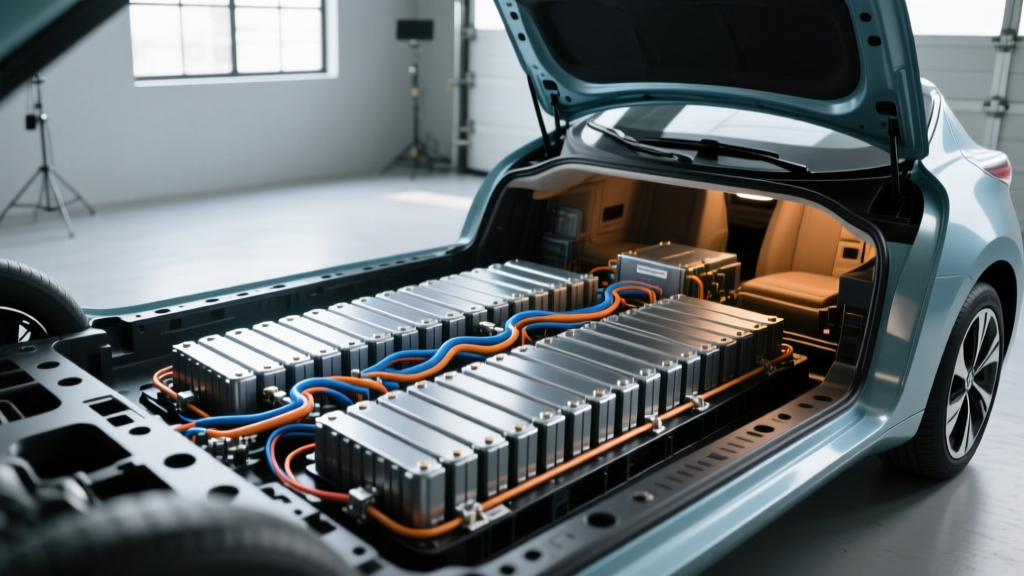
Critical note: All Leaf generations use passive air cooling rather than active liquid thermal management. This is the single most important design choice affecting Leaf battery longevity, and it's a major reason the Leaf's degradation profile differs from liquid-cooled competitors like the Tesla Model 3 or Hyundai Ioniq 5.
Battery Chemistry: NMC in the Leaf — and Why Not LFP?
Every Nissan Leaf battery uses NMC (nickel manganese cobalt) lithium-ion cells in a laminated pouch format, manufactured primarily by AESC (Automotive Energy Supply Corporation, formerly a Nissan-NEC joint venture, now owned by Envision Group). Unlike some newer EVs that have adopted LFP (lithium iron phosphate) chemistry for standard-range trims, Nissan has not offered an LFP Leaf.
| Attribute | NMC (Leaf's chemistry) | LFP (not used in Leaf) |
|---|---|---|
| Energy density | Higher (150–220 Wh/kg cell-level) | Lower (90–160 Wh/kg) |
| Cycle life | ~1,000–2,000 full cycles to 80% SoH | ~2,000–5,000+ full cycles to 80% SoH |
| Cold-weather performance | Better low-temp discharge capability | Reduced performance below 32°F; needs preconditioning |
| Cost per kWh (cell) | Higher (cobalt/nickel content) | Lower (no cobalt, abundant iron) |
| Optimal daily SoC | 20–80% recommended | Can be charged to 100% regularly without harm |
| Thermal stability | Good, but more sensitive to sustained heat | Excellent — higher thermal runaway threshold |
What this means for Leaf owners: NMC gives the Leaf its packaging efficiency — fitting 62 kWh into a compact hatchback footprint. But NMC is more sensitive to heat accumulation, and the Leaf's lack of active liquid cooling means the pack absorbs and retains heat during repeated DC fast charging or hot-climate driving. This is the primary driver of accelerated degradation in Leafs, particularly 2011–2015 models.
Nissan Leaf Battery Degradation: Real-World Data
Battery degradation is measured as a loss of State of Health (SoH) — the percentage of original capacity remaining. A new Leaf starts at 100% SoH. As cycles accumulate and calendar aging progresses, that number declines.
Here's what aggregated owner data, fleet studies, and independent testing (including Geotab's large-scale battery health study covering thousands of EVs) reveal about Leaf-specific degradation:
| Pack / Generation | ~3 Years / 45k mi | ~5 Years / 75k mi | ~8 Years / 100k mi | Notes |
|---|---|---|---|---|
| 24 kWh (2011–2012) | 85–90% SoH | 75–82% SoH | 65–75% SoH | Most affected by heat; early cells degraded fastest |
| 24 kWh (2013–2015) | 88–92% SoH | 80–86% SoH | 72–80% SoH | Improved "lizard" chemistry; better heat tolerance |
| 30 kWh (2016) | 87–91% SoH | 78–84% SoH | 70–78% SoH | Higher energy density slightly increased degradation rate |
| 40 kWh (2018+) | 90–94% SoH | 84–90% SoH | 78–85% SoH | Better cell chemistry; still air-cooled |
| 62 kWh (2019+) | 91–95% SoH | 86–92% SoH | 80–87% SoH (projected) | Larger buffer; long-term data still maturing |
Key degradation accelerators specific to the Leaf:
- Repeated DC fast charging: CHAdeMO fast charging (up to 100 kW on 62 kWh models, 50 kW on 40 kWh) generates significant heat. Without liquid cooling, consecutive fast-charge sessions — common on road trips — cause "rapidgate," where the Leaf's BMS throttles charging speed to protect the pack.
- Hot climates: Leaf owners in Arizona, Texas, and the Middle East report measurably faster degradation than those in the Pacific Northwest or northern Europe. Sustained ambient temperatures above 90°F stress NMC cells.
- High state of charge storage: Regularly parking a Leaf at 100% SoC for extended periods (days to weeks) accelerates calendar aging in NMC chemistry.
- Deep discharges: Routinely driving the Leaf below 10% SoC stresses the cells. The BMS maintains a bottom buffer, but repeated deep cycles still take a toll.
Nissan Leaf Battery Warranty: What's Actually Covered
Nissan provides a lithium-ion battery capacity warranty that is separate from the general powertrain warranty. Understanding the exact threshold and exclusions is critical — especially for used Leaf buyers evaluating whether a degraded pack is still under warranty.
| Warranty Component | Duration / Mileage | Threshold / Detail |
|---|---|---|
| Battery capacity warranty (2018+ models) | 8 years / 100,000 miles | Capacity drops below 9 bars out of 12 on the dashboard capacity gauge (roughly ~66–70% SoH) |
| Battery capacity warranty (2013–2017 models) | 5 years / 60,000 miles (early); later extended to 8/100k on some | Below 9 of 12 bars (~66–70% SoH) |
| Battery defect/materials warranty | 8 years / 100,000 miles | Covers manufacturing defects, not normal degradation |
| EV powertrain warranty | 5 years / 60,000 miles | Motor, inverter, reducer — not the battery pack itself |
The 12-bar capacity gauge explained: Nissan uses a dashboard display of 12 bars to represent battery capacity (not state of charge — that's the separate charge meter). Each bar represents roughly 8.33% of original capacity. When the Leaf drops below 9 bars (approximately 66–70% SoH), it qualifies for warranty replacement. However, Nissan typically replaces with a refurbished pack of equivalent or slightly better capacity, not a brand-new battery.
For the most current warranty terms on a specific model year, consult the Nissan warranty information page or your dealer's warranty booklet.
Nissan Leaf Battery Replacement Cost: 2026 Pricing
Out-of-warranty battery replacement is the question every used Leaf buyer asks. Costs vary significantly depending on pack size, whether you choose new or refurbished, and labor rates at your Nissan dealer or independent EV shop.
| Pack Size | New OEM Pack (parts) | Refurbished / Remanufactured | Labor (dealer) | Total Estimated Range |
|---|---|---|---|---|
| 24 kWh (2011–2015) | $5,000–$6,500 | $3,500–$5,000 | $1,000–$2,000 | $4,500–$8,500 |
| 30 kWh (2016) | $5,500–$7,000 | $4,000–$5,500 | $1,000–$2,000 | $5,000–$9,000 |
| 40 kWh (2018+) | $6,500–$8,500 | $4,500–$6,500 | $1,200–$2,200 | $5,700–$10,700 |
| 62 kWh (2019+, e+) | $8,000–$11,000 | $6,000–$8,500 | $1,500–$2,500 | $7,500–$13,500 |
When is replacement typically needed? Most Leaf batteries do not fail catastrophically. They gradually lose capacity. A 24 kWh Leaf at 70% SoH still functions — it just has roughly 50 miles of range instead of 73. Many owners continue driving degraded Leafs for years as city runabouts. Replacement becomes economically worth considering when:
- Range no longer meets your daily needs (commute, school runs, errands)
- The pack falls below warranty threshold and you want to restore utility
- An individual cell or module fails (causing imbalance and accelerated loss)
Independent shops and module-level repair: Some EV-specialist shops offer module-level replacement (swapping only degraded cells within the pack) for $2,000–$4,000 on older 24 kWh packs. This is significantly cheaper but requires a skilled technician and may not restore full original capacity. Availability varies by region.
How to Check Nissan Leaf Battery Health (SoH)
Unlike some EVs that display a battery health percentage in the infotainment system, the Leaf's SoH monitoring is less intuitive. Here are the methods available:
Method 1: The 12-Bar Dashboard Gauge
On the instrument cluster, locate the battery capacity bars (distinct from the state-of-charge meter). A healthy Leaf shows 12 bars. Each lost bar represents roughly 8% capacity loss. A Leaf showing 10 bars has approximately 83% SoH. This is the quickest check but lacks precision.
Method 2: Leaf Spy Pro (OBD-II App)
This is the gold standard for Leaf owners and used-car evaluators. Using an OBD-II Bluetooth dongle (typically an ELM327-compatible adapter, ~$15–$30) and the Leaf Spy Pro app ($20 on iOS/Android), you can read:
- State of Health (SoH) — precise percentage (e.g., 87.3%)
- Hx value — Nissan's internal health metric
- Individual cell voltages — identifies weak or imbalanced cells
- Charge cycles — total number of full equivalent cycles
- Quick charge count — how many DC fast charges the pack has endured
For any used Leaf purchase, running Leaf Spy before buying is non-negotiable. It's the difference between guessing and knowing.
Method 3: Dealer Diagnostic Report
A Nissan dealer can pull a battery health report using the CONSULT diagnostic tool. This provides SoH and detailed cell data but typically costs $100–$150 for the service visit. Request this during a pre-purchase inspection.
Maximizing Nissan Leaf Battery Life: Practical Care Guide
- Limit DC fast charging: Use CHAdeMO fast charging for road trips, not daily routine. Frequent 50–100 kW charges without liquid cooling generate cumulative heat damage. Level 2 (6.6 kW) home charging is the Leaf's ideal daily fuel source.
- Avoid 100% SoC storage: Charge to 80% for daily use. If you need a full charge for a longer trip, time it so you leave shortly after reaching 100%. NMC cells degrade faster when held at high voltage for extended periods.
- Don't routinely drain below 10–15%: The Leaf's BMS maintains a small bottom buffer, but deep discharges still stress NMC chemistry. Plug in when you hit 20%.
- Park in shade or a garage in hot climates: Ambient heat is the Leaf battery's biggest enemy. A car parked in direct sun in Phoenix with a 90% SoC is enduring the worst possible conditions for NMC longevity.
- Precondition while plugged in: Use the Leaf's timer or app-based preconditioning to warm or cool the cabin while connected to shore power. This draws from the grid rather than the traction battery.
- Monitor with Leaf Spy quarterly: Track your SoH trend line. A sudden drop may indicate a failing cell module that can be addressed before it cascades.
- Avoid repeated back-to-back fast charges: On road trips, allow the pack to cool between CHAdeMO sessions. The Leaf's passive cooling needs time — plan stops accordingly.
Looking Ahead: Solid-State Batteries and the Leaf's Future
Nissan has been one of the most vocal legacy automakers about solid-state battery development. In 2022, Nissan announced a pilot production line at its Yokohama plant, targeting a prototype solid-state cell by the mid-2020s and production intent by approximately 2028–2029.
What solid-state promises (if delivered):
- Roughly 2x the energy density of current NMC lithium-ion
- Faster charging capability without thermal degradation risk
- Improved safety (no liquid electrolyte to leak or ignite)
- Longer cycle life
Realistic timeline: As of 2026, solid-state EV batteries remain in pre-production testing. Nissan's stated goal of a production vehicle with solid-state cells by 2028–2029 is ambitious and may slip. Toyota, Samsung SDI, and QuantumScape are pursuing parallel programs with similar timelines. No solid-state EV is currently available for purchase anywhere in the world.
What this means for current Leaf owners: If your Leaf's battery needs replacement in the next 2–4 years, solid-state will not be an option. Plan around existing NMC replacement packs or refurbished units. If you're considering a new EV purchase and can wait until 2029+, solid-state may eventually appear in a next-generation Nissan EV — but pricing, availability, and retrofitting into existing Leaf platforms remain entirely speculative.
Nissan has also referenced silicon-anode research (partnering with various materials companies) that could incrementally boost energy density in conventional lithium-ion cells before solid-state arrives. These are incremental improvements, not imminent products.
Frequently Asked Questions About Nissan Leaf Batteries
How long do Nissan Leaf batteries last in years and miles?
Based on aggregated fleet and owner data, most Nissan Leaf batteries retain 70–85% of original capacity at 8–10 years or 100,000–120,000 miles, depending on generation and climate. The 24 kWh packs from 2011–2012 degraded fastest, with some falling below 70% SoH by year 6 in hot climates. The 40 kWh and 62 kWh packs in 2018+ models show meaningfully better longevity. Many Leafs remain drivable well past 150,000 miles — just with reduced range.
How much does it cost to replace a Nissan Leaf battery?
Out-of-warranty replacement ranges from approximately $4,500 (refurbished 24 kWh pack with independent labor) to $13,500 (new 62 kWh OEM pack at a dealer). Most 40 kWh replacements fall in the $6,000–$9,000 range including labor. Module-level repair at an independent EV shop can cost $2,000–$4,000 for older packs. Check whether your Leaf is still under the 8-year/100,000-mile capacity warranty before paying out of pocket.
What does the Nissan Leaf battery warranty actually cover?
The capacity warranty covers the traction battery if it drops below 9 of 12 capacity bars (approximately 66–70% State of Health) within 8 years or 100,000 miles, whichever comes first. The defect warranty covers manufacturing failures for the same period. Neither warranty covers damage from accidents, flooding, or unauthorized modifications. Nissan typically provides a refurbished replacement pack, not a new one. Always verify your specific model year's warranty terms on Nissan's warranty page.
How do I check my Nissan Leaf's battery health?
The fastest free method is counting the capacity bars on the dashboard gauge (12 = excellent, 10 or below = significant degradation). For a precise SoH percentage, cell voltage data, and charge-cycle count, use the Leaf Spy Pro app with an OBD-II adapter (~$35–$50 total investment). A Nissan dealer can also run a diagnostic report for approximately $100–$150.
Is LFP better than the NMC chemistry used in the Leaf?
It depends on the metric. LFP offers superior cycle life (2,000–5,000+ cycles vs. 1,000–2,000 for NMC), lower cost, and better thermal stability. NMC offers higher energy density (more range in the same pack volume) and better cold-weather performance. For a compact car like the Leaf where packaging space is limited, NMC's energy density advantage is significant. If Nissan ever introduces an LFP Leaf variant, it would likely trade some range for dramatically longer battery life — a compelling proposition for city-focused buyers. As of 2026, all Leafs use NMC.
Does fast charging damage the Nissan Leaf battery?
Occasional DC fast charging does not cause significant harm. However, the Leaf's passive air-cooling system means that frequent fast charging — especially in warm weather or on consecutive days — generates cumulative heat that accelerates NMC degradation. This is well-documented in the Leaf community as "rapidgate," where the car's BMS progressively throttles charge speed during repeated sessions. For daily use, Level 2 home charging at 6.6 kW is strongly preferred.
Can I upgrade my older 24 kWh Leaf to a larger battery?
Technically, some owners have retrofitted 30 kWh or 40 kWh packs into earlier Leaf models through independent EV shops. Nissan does not offer an official upgrade path. Retrofits cost $5,000–$10,000+ depending on the pack and labor, require BMS reprogramming, and may affect insurance and registration. Proceed with caution and only through a reputable EV specialist.
For official EPA range and efficiency figures on all Leaf model years, consult fueleconomy.gov. For federal tax credit eligibility on new EV purchases (the Leaf currently qualifies for up to $3,750 under §30D depending on battery sourcing and buyer income), see the IRS clean vehicle credit page.