If you're researching the Nissan Leaf — whether as a used-EV buyer or a current owner wondering about long-term viability — one question dominates: how long does the Nissan Leaf battery last? The answer depends on which generation you own, how you charge it, and what climate you drive in. The Leaf has been on the road since 2011, giving us more real-world battery longevity data than almost any other EV. Here's what the numbers actually show.
Leaf Battery Generations: What Changed and Why It Matters
The Nissan Leaf has shipped with four distinct battery pack sizes across its production run, each with different chemistry characteristics and degradation profiles:
| Generation | Pack Size (kWh) | Chemistry | EPA Range (New) | Key Degradation Trait |
|---|---|---|---|---|
| 2011–2015 (ZE0) | 24 kWh | NMC (LMO blend) | 73–84 mi | Fastest degradation; passive air cooling |
| 2016–2017 (AZE0) | 30 kWh | NMC | 107 mi | Moderate; still passively cooled |
| 2018–2025 (ZE1) | 40 kWh | NMC | 149–151 mi | Improved cell design; slower early loss |
| 2019–2025 (ZE1 Plus) | 62 kWh | NMC (higher nickel) | 212–226 mi | Best longevity of any Leaf pack |
The critical differentiator: every Leaf generation uses passive air cooling rather than the active liquid thermal management found in Tesla, Hyundai, and GM platforms. This design choice — intended to reduce cost and weight — means the battery has less protection against heat buildup during fast charging and high-temperature operation. It's the single biggest factor behind the Leaf's historically faster degradation compared to liquid-cooled competitors.
Real Degradation Data: What Leaf Owners Actually Experience
Unlike manufacturer projections, real-world degradation data comes from fleet studies, owner surveys, and third-party testing. Here's what the evidence shows across Leaf generations:
- 24 kWh (2011–2015): Average 20–30% capacity loss by year 8 / 80,000 miles. Some Arizona/California units in hot climates reported 35%+ loss. (fueleconomy.gov lists original EPA range; real-world range on degraded packs can fall to 50–60 miles.)
- 30 kWh (2016–2017): Average 15–22% loss by year 7. Nissan issued a software update to address premature degradation reporting issues on the battery capacity gauge.
- 40 kWh (2018+): Average 10–15% loss over the first 5 years / 60,000 miles based on owner fleet data from LeafSpy community reporting.
- 62 kWh Leaf Plus (2019+): Average 8–12% loss over the first 4–5 years. Larger buffer and updated cell chemistry contribute to slower degradation.
Two patterns emerge from the data. First, degradation is non-linear: most packs lose 5–8% in the first year or two (calendar aging and initial formation losses), then the curve flattens to roughly 1–2% per year under normal use. Second, the 62 kWh pack's larger usable buffer means even a 12% loss still leaves you with roughly 185 miles of range — far more practical than a degraded 24 kWh pack dropping to 55 miles.
Nissan Leaf Battery Warranty: What's Covered and What Isn't
Nissan provides a lithium-ion battery capacity warranty that's separate from the general vehicle warranty. Understanding the threshold is essential because it determines when you can actually claim a replacement:
| Warranty Element | Coverage |
|---|---|
| Battery Capacity Warranty | 8 years / 100,000 miles (whichever comes first) |
| Capacity Retention Threshold | Below 9 bars out of 12 on the capacity gauge (approximately 70% of original capacity) |
| Battery Defect Warranty | 5 years / 60,000 miles — covers manufacturing defects, not normal degradation |
| Remedy | Nissan may replace, refurbish, or recondition the pack at their discretion |
The 9-bar threshold is a point of frustration for some owners. A Leaf that drops from 12 bars to 10 bars has lost meaningful range but hasn't triggered the warranty. You're only eligible for a warranty repair when the pack falls below roughly 70% State of Health (SoH). For a 24 kWh pack, that means range has already fallen to around 50 miles before Nissan is obligated to act. For a 62 kWh Leaf Plus, 70% SoH still yields approximately 150 miles — far more livable.
Always verify current warranty terms with your local Nissan dealer, as coverage details can shift by model year and region. Nissan's official owner resources provide the latest documentation.
How Much Does a Nissan Leaf Battery Replacement Cost?
Out-of-warranty battery replacement is the scenario that generates the most anxiety among prospective Leaf buyers. Here's the current cost landscape:
| Pack Size | New OEM Replacement | Refurbished / Reconditioned | Typical Need Timeline |
|---|---|---|---|
| 24 kWh | $6,500–$8,500 (limited availability) | $3,500–$5,500 | 8–12 years (many owners retire the car instead) |
| 30 kWh | $7,000–$9,000 | $4,000–$6,000 | 10–14 years |
| 40 kWh | $8,000–$10,000 | $5,000–$7,000 | 12–16 years (projected) |
| 62 kWh (Plus) | $9,000–$12,000 | $6,000–$8,500 | 14+ years (projected; few out-of-warranty replacements yet) |
Important context: most Leaf batteries outlive the car's economic value. A 2013 Leaf with a degraded 24 kWh pack may be worth $4,000–$6,000 as a whole vehicle — making a $7,500 battery replacement financially irrational. This is why many early-gen Leaf owners sell or trade in rather than replace. For 40 kWh and 62 kWh models, the replacement cost is more justifiable because the vehicle retains higher value and the replacement restores 150–226 miles of range.
Third-party EV battery shops have emerged that can perform module-level repairs — replacing individual degraded cell modules rather than the entire pack — for $2,000–$4,000. This option is growing in availability but requires a qualified high-voltage technician.
What Kills a Leaf Battery Faster? The 5 Degradation Factors
Not all Leaf batteries age equally. These five factors have the largest measurable impact on long-term State of Health:
- Limit DC fast charging. The Leaf's passive air cooling means repeated CHAdeMO fast charges (50 kW on 40 kWh; up to 100 kW on 62 kWh) generate sustained heat with no active dissipation. Occasional fast charging is fine; daily fast charging accelerates degradation measurably. Aim for Level 2 (6.6 kW) as your daily charge method.
- Avoid parking at 100% SoC in heat. A fully charged Leaf sitting in a 95°F+ parking lot for hours experiences accelerated calendar aging. If you charge to 100%, drive soon after. For daily use, charging to 80% is ideal — though note that older Leafs (pre-2018) lack a built-in charge-limit setting, requiring an external timer or smart EVSE.
- Don't store at very low SoC. Letting the pack sit below 10% for extended periods stresses the cells. If storing the car for weeks, aim for 50–60% SoC.
- Hot climates are harder than cold ones. Heat is the primary enemy of lithium-ion longevity. Leaf owners in Phoenix, Las Vegas, and inland California historically see faster degradation than those in Portland or Minneapolis. Cold weather reduces range temporarily but doesn't cause permanent damage the way sustained heat does.
- Use the Leaf's charge timer. Setting your Leaf to finish charging just before you leave (rather than sitting at full charge overnight) reduces time spent at high SoC, which slows calendar aging.
How to Check Your Leaf's Battery Health (SoH)
Monitoring your Leaf's State of Health is straightforward, and you have several methods available:
The Dashboard Capacity Bars
Every Leaf displays a battery capacity bar gauge on the far right of the instrument cluster. A new Leaf shows 12 bars. As the pack degrades, bars disappear permanently. This is the simplest health indicator, but it's coarse — each bar represents roughly 6–8% of capacity, so you won't notice small changes. The warranty threshold is 9 bars (below ~70% SoH).
LeafSpy Pro (Third-Party OBD-II App)
The gold standard for Leaf battery monitoring. A $20 OBD-II dongle plugged into the Leaf's diagnostic port, paired with the LeafSpy app (iOS/Android), reads real-time data including:
- State of Health (SoH) percentage — precise to one decimal place
- Individual cell voltages — reveals cell imbalance issues
- Battery temperature — critical for monitoring heat during fast charging
- Charge/discharge power in kW
For used Leaf buyers, a LeafSpy reading is the single most important pre-purchase check. A 2019 Leaf Plus showing 92% SoH at 45,000 miles is a healthy pack. The same car at 83% SoH suggests heavy fast-charge use or hot-climate storage.
Nissan Dealer Diagnostic
Any Nissan dealer can run a battery health report using their CONSULT diagnostic tool. Request this during routine service or before a used purchase. The report provides SoH percentage and is the official record for warranty claims.
NMC vs LFP Chemistry: Where the Leaf Stands in 2026
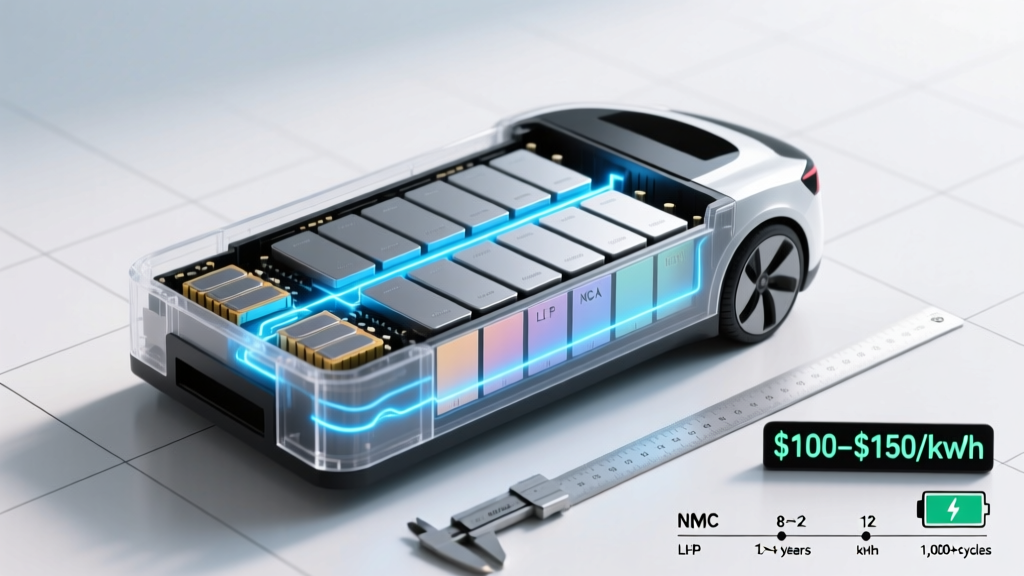
The Nissan Leaf has always used NMC (nickel-manganese-cobalt) cathode chemistry, with variations in the nickel-to-cobalt ratio across generations. This is significant because the broader EV industry is increasingly adopting LFP (lithium iron phosphate) chemistry for its longevity and cost advantages. Here's how they compare:
| Attribute | NMC (Leaf's Chemistry) | LFP (Tesla Model 3 RWD, BYD, others) |
|---|---|---|
| Energy Density | Higher — more range per kg | Lower — heavier pack for same kWh |
| Cycle Life | 1,000–2,000 cycles | 3,000–5,000+ cycles |
| Cold-Weather Performance | Better low-temp range retention | Greater range loss below freezing |
| Can Charge to 100% Daily? | Not recommended (accelerates aging) | Yes — LFP benefits from regular 100% charges |
| Cost per kWh | Higher (cobalt, nickel content) | Lower (iron, phosphate — abundant materials) |
| Thermal Stability | Good with active cooling; riskier passively cooled | Excellent — inherently more stable chemistry |
Which is better? For longevity and daily convenience, LFP wins — you can charge to 100% every night without worry, and the pack will likely outlast the car. For maximum range in a lighter package and better cold-weather driving, NMC holds an edge. The Leaf's NMC chemistry isn't a flaw, but combined with passive air cooling, it requires more careful charging habits than an LFP-equipped competitor.
Nissan has not announced a switch to LFP for the Leaf as of early 2026. The anticipated next-generation Leaf (expected late 2020s on the CMF-EV platform) may adopt new cell formats and potentially different chemistry, but specs remain unconfirmed.
What's Next: Solid-State and Future Battery Tech
Nissan has been one of the most vocal automakers about solid-state battery development, with prototype testing underway and pilot production targeted for the late 2020s. Solid-state batteries promise:
- Double the energy density of current lithium-ion
- 10-minute fast charging from 10–80%
- Dramatically reduced degradation (minimal electrolyte breakdown)
- Improved safety (no flammable liquid electrolyte)
For current Leaf owners and buyers, this means today's NMC packs are what you'll be living with for the foreseeable future. The good news: the 62 kWh Leaf Plus pack has proven durable enough that most owners will never need a replacement during typical ownership.
Frequently Asked Questions
How long do EV batteries last in years and miles?
Modern EV batteries (2019+) are engineered for 150,000–200,000 miles before reaching 70% capacity. In years, that's typically 12–18 years of average driving. The Nissan Leaf Plus (62 kWh) aligns with this expectation. Older 24 kWh Leafs from 2011–2015 had shorter practical lifespans due to smaller buffers and less advanced cell chemistry.
How much does an EV battery cost to replace?
Replacement costs range from $6,500 to $15,000+ depending on pack size and whether you use new OEM, refurbished, or module-level repair. For the Nissan Leaf specifically, expect $6,500–$12,000 for a full pack replacement depending on kWh size. Most EV batteries, however, are never replaced — they outlast the vehicle's economic value.
What does the Nissan Leaf battery warranty cover?
Nissan covers the Leaf's battery for 8 years / 100,000 miles against capacity loss below approximately 70% (9 of 12 bars on the capacity gauge). A separate 5-year / 60,000-mile warranty covers manufacturing defects. Normal degradation above the 70% threshold is not covered — it's considered expected wear.
How do I check my Nissan Leaf's battery health?
Three methods: (1) Count the capacity bars on the dashboard gauge (12 is new, 9 or below triggers warranty). (2) Use a LeafSpy Pro OBD-II adapter for precise SoH percentage, cell voltages, and temperature data — the preferred method for used-car evaluation. (3) Request a dealer diagnostic report using Nissan's CONSULT system.
Does fast charging damage the Nissan Leaf battery?
Occasional DC fast charging is fine. However, because the Leaf uses passive air cooling (no liquid thermal management), frequent CHAdeMO fast charging — especially in hot weather — generates heat the pack can't actively shed. This accelerates degradation over time. For daily charging, use a Level 2 home charger at 6.6 kW and reserve fast charging for road trips.
Is the Nissan Leaf a good used EV buy in 2026?
The 40 kWh (2018+) and 62 kWh Leaf Plus (2019+) models are strong used-EV buys if you verify SoH via LeafSpy before purchasing. They offer 149–226 miles of EPA range, qualify for the used clean vehicle credit (up to $4,000 under IRS §25E, subject to income and price caps), and have low running costs. Avoid 2011–2015 24 kWh models unless the price is very low and you accept limited range.